High Sugar Content of Modern Fruit Varieties Causing Illnesses in Zoo Animals
October 1st, 2018Via: Sydney Morning Herald:
Selective breeding has made the fruit we eat so full of sugar, Melbourne Zoo has had to wean its animals off it.
…
“The issue is the cultivated fruits have been genetically modified to be much higher in sugar content than their natural, ancestral fruits,” says Dr Michael Lynch, the zoo’s head vet.
“It’s interesting. After doing a lot with nutrition here, I tend to eat less fruit.”
Monkeys love bananas. But now, says Dr Lynch, the zoo’s primates don’t get any fruit at all.
Research Credit: DF
DEF CON Report: “Grave and Undeniable” Security Issues with Electronic Voting Systems
October 1st, 2018Via: Ars Technica:
Today, six prominent information-security experts who took part in DEF CON’s Voting Village in Las Vegas last month issued a report on vulnerabilities they had discovered in voting equipment and related computer systems. One vulnerability they discovered—in a high-speed vote-tabulating system used to count votes for entire counties in 23 states—could allow an attacker to remotely hijack the system over a network and alter the vote count, changing results for large blocks of voters. “Hacking just one of these machines could enable an attacker to flip the Electoral College and determine the outcome of a presidential election,” the authors of the report warned.
…
The report authors…documented dozens of other severe vulnerabilities found in voting systems. They found that four major areas of “grave and undeniable” concern need to be addressed urgently. One of the most critical is the lack of any sort of supply-chain security for voting machines—there is no way to test the machines to see if they are trustworthy or if their components have been modified.
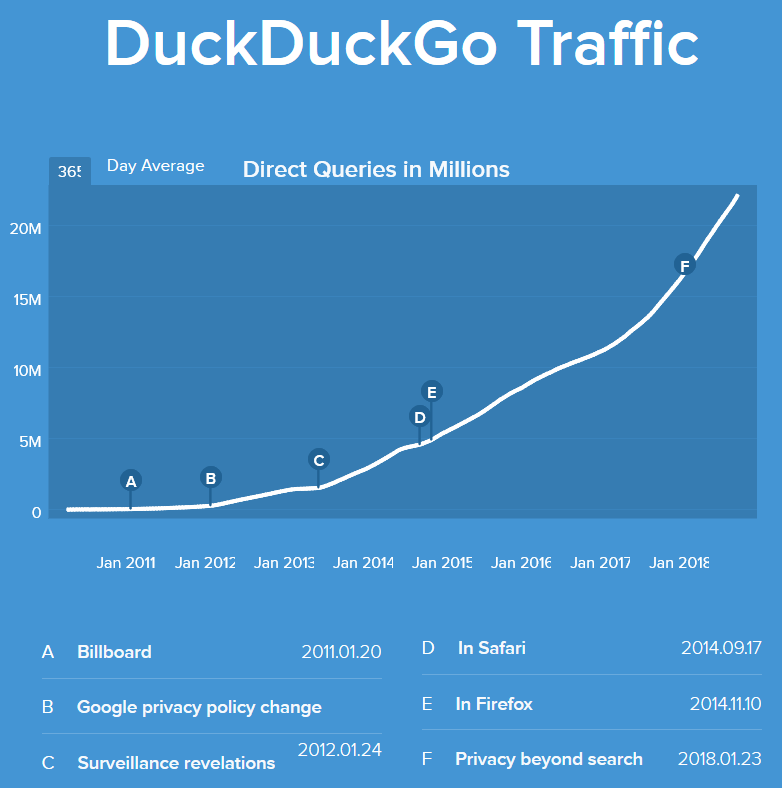
DuckDuckGo Traffic
September 29th, 2018Via: DuckDuckGo:
Tim Berners-Lee Working on Decentralized Apps and Data Storage
September 29th, 2018Via: Fast Company:
On his screen, there is a simple-looking web page with tabs across the top: Tim’s to-do list, his calendar, chats, address book. He built this app–one of the first on Solid–for his personal use. It is simple, spare. In fact, it’s so plain that, at first glance, it’s hard to see its significance. But to Berners-Lee, this is where the revolution begins. The app, using Solid’s decentralized technology, allows Berners-Lee to access all of his data seamlessly–his calendar, his music library, videos, chat, research. It’s like a mashup of Google Drive, Microsoft Outlook, Slack, Spotify, and WhatsApp.
The difference here is that, on Solid, all the information is under his control. Every bit of data he creates or adds on Solid exists within a Solid pod–which is an acronym for personal online data store. These pods are what give Solid users control over their applications and information on the web. Anyone using the platform will get a Solid identity and Solid pod. This is how people, Berners-Lee says, will take back the power of the web from corporations.
For example, one idea Berners-Lee is currently working on is a way to create a decentralized version of Alexa, Amazon’s increasingly ubiquitous digital assistant. He calls it Charlie. Unlike with Alexa, on Charlie people would own all their data. That means they could trust Charlie with, for example, health records, children’s school events, or financial records. That is the kind of machine Berners-Lee hopes will spring up all over Solid to flip the power dynamics of the web from corporation to individuals.
Bizarre, High Energy Particles Flying Out of Antarctica’s Ice
September 27th, 2018Via: LiveScience:
There’s something mysterious coming up from the frozen ground in Antarctica, and it could break physics as we know it.
Physicists don’t know what it is exactly. But they do know it’s some sort of cosmic ray — a high-energy particle that’s blasted its way through space, into the Earth, and back out again. But the particles physicists know about — the collection of particles that make up what scientists call the Standard Model (SM) of particle physics — shouldn’t be able to do that. Sure, there are low-energy neutrinos that can pierce through miles upon miles of rock unaffected. But high-energy neutrinos, as well as other high-energy particles, have “large cross-sections.” That means that they’ll almost always crash into something soon after zipping into the Earth and never make it out the other side.
And yet, since March 2016, researchers have been puzzling over two events in Antarctica where cosmic rays did burst out from the Earth, and were detected by NASA’s Antarctic Impulsive Transient Antenna (ANITA) — a balloon-borne antenna drifting over the southern continent.
ANITA is designed to hunt cosmic rays from outer space, so the high-energy neutrino community was buzzing with excitement when the instrument detected particles that seemed to be blasting up from Earth instead of zooming down from space. Because cosmic rays shouldn’t do that, scientists began to wonder whether these mysterious beams are made of particles never seen before.
SEC Sues Elon Musk, Seeks to Ban Him from Running Tesla or Any Public Company
September 27th, 2018Update: Musk to Resign as Tesla Chairman, Remain as CEO in SEC Settlement
Via: Reuters:
Tesla and Elon Musk have agreed to pay $20 million each to financial regulators and the billionaire will step down as the company’s chairman but remain as chief executive, under a settlement that caps a tumultuous two months for the car-maker.
—
Via: Mercury News:
In a blockbuster move Thursday, the U.S. Securities and Exchange Commission filed fraud charges against Tesla Chief Executive Elon Musk, and is seeking to ban the electric-car maker’s high-profile boss from running any publicly traded company.
Filed in the U.S. District Court for the Southern District of New York, the charges are related to Musk’s August announcement that he wanted to take Tesla private for $420 a share. Musk dropped the bombshell idea in an August 7 tweet in which he said he had “funding secured” to take Tesla private, but provided no financing details at that time.
“Neither celebrity status, nor reputation as a technological innovator, provide an exemption from the federal securities laws,” said Stephanie Avakian, co-director of enforcement for the SEC, during a press conference Thursday.
Jeff Bezos’s Blue Origin to Supply Engines for Boeing-Lockheed Rocket Venture
September 27th, 2018Via: Wall Street Journal:
Blue Origin LLC, the space-transportation company run by Jeff Bezos, has won a contract to provide engines for a potential rival’s next-generation rocket, according to people familiar with the matter, vaulting Mr. Bezos into the lucrative market for Pentagon satellite launches.
United Launch Alliance LLC—a joint venture between Boeing Co. and Lockheed Martin Corp. that launches U.S. military and spy satellites into orbit—is set to announce Thursday it has picked Blue Origin’s BE-4 engine for its Vulcan rocket, these people said. United Launch declined to comment.
The long-term, potentially multibillion-dollar agreement could provide a boost to Blue Origin’s eventual goal of becoming a major military launch provider itself. The company plans to use the same engines to power its own heavy-lift launcher, called New Glenn, which is currently under development.
Insiders Selling at Record Pace
September 26th, 2018Via: CBS:
Corporate insiders are dumping stock in their companies at a rate not seen in 10 years.
With September not yet over, stock sales by company executives reached $5.7 billion, according to data from TrimTabs Investment Research — the highest September in a decade. August’s $10.3 billion in insider sales also reached a 10-year record.
At the same time, stock buybacks are roaring ahead, pumping up U.S. share prices to new heights. Companies this year have announced $827 billion in spending to purchase their own shares — well above the buybacks that took place during all of 2007, which set the previous annual record.
“Insiders have been committing lots of money for stock buybacks, and they’re not doing buybacks because they think stocks are cheap. They’re doing to it to pump up the stock so they can sell it,” said David Santschi, director of liquidity research at TrimTabs.
Ex-Google Employee Warns of ‘Disturbing’ China Plans
September 26th, 2018Via: BBC:
A former Google employee has warned of the firm’s “disturbing” plans in China, in a letter to US lawmakers.
Jack Poulson, who had been a senior researcher at the company until resigning in August, wrote that he was fearful of Google’s ambitions.
His letter alleges Google’s work on a Chinese product – codenamed Dragonfly – would aid Beijing’s efforts to censor and monitor its citizens online.
…
The letter alleges Google is working on:
A prototype interface designed to allow a Chinese joint venture company to search for a given user’s search queries based on their phone number
An extensive censorship blacklist developed in accordance with Chinese government demands. Among others, it contained the English term “human rights”, the Mandarin terms for ‘student protest’ and ‘Nobel prize’, and very large numbers of phrases involving ‘Xi Jinping’ and other members of the CCP
Explicit code to ensure only Chinese government-approved air quality data would be returned in response to Chinese users’ search
Mr Poulson said the sum of these efforts amounted to a “catastrophic failure” of Google’s internal policies on privacy – as well as going against assurances made to the US trade regulator regarding data protection measures in its products.
“Dragonfly is part of a broad pattern of unaccountable decision making across the tech industry,” Mr Poulson wrote.
Mr Poulson’s letter follows a joint statement signed by hundreds of current Google employees against Dragonfly sent last month.
Kristinn Hrafnsson Replaces Julian Assange as WikiLeaks Editor-in-Chief
September 26th, 2018Via: The Daily Dot:
Icelandic investigative journalist and former WikiLeaks spokesperson Kristinn Hrafnsson is set to become the whistleblowing organization’s new editor-in-chief, replacing isolated founder Julian Assange in the role.
The announcement was made late Wednesday in a statement issued through the WikiLeaks’ official Twitter account.