Facebook Lobbies to Prevent State Limits on Facial Recognition
July 31st, 2017Via: The Center for Public Integrity:
When Chicago resident Carlo Licata joined Facebook in 2009, he did what the 390 million other users of the world’s largest social network had already done: He posted photos of himself and friends, tagging the images with names.
But what Licata, now 34, didn’t know was that every time he was tagged, Facebook stored his digitized face in its growing database.
Angered this was done without his knowledge, Licata sued Facebook in 2015 as part of a class action lawsuit filed in Illinois state court accusing the company of violating a one-of-a-kind Illinois law that prohibits collection of biometric data without permission. The suit is ongoing.
Facebook denied the charges, arguing the law doesn’t apply to them. But behind the scenes, the social network giant is working feverishly to prevent other states from enacting a law like the one in Illinois.
Since the suit was filed, Facebook has stepped up its state lobbying, according to records and interviews with lawmakers. But rather than wading into policy fights itself, Facebook has turned to lower-profile trade groups such as the Internet Association, based in Washington, D.C., and the Illinois-based trade association CompTIA to head off bills that would give users more control over how their likenesses are used or whom they can be sold to.
That effort is part of a wider agenda. Tech companies, whose business model is based on collecting data about its users and using it to sell ads, frequently oppose consumer privacy legislation. But privacy advocates say Facebook is uniquely aggressive in opposing all forms of regulation on its technology.
Your Banker Is Always In: Sweden Rolls Out the Robots
July 31st, 2017Via: Bloomberg:
Aida is the perfect employee: always courteous, always learning and, as she says, “always at work, 24/7, 365 days a year.”
Aida, of course, is not a person but a virtual customer-service representative that SEB AB, one of Sweden’s biggest banks, is rolling out. The goal is to give the actual humans more time to engage in more complex tasks.
‘Smartphone Zombies’
July 30th, 2017Via: Reuters:
A ban on pedestrians looking at mobile phones or texting while crossing the street will take effect in Hawaii’s largest city in late October, as Honolulu becomes the first major U.S. city to pass legislation aimed at reducing injuries and deaths from “distracted walking.”
The ban comes as cities around the world grapple with how to protect phone-obsessed “smartphone zombies” from injuring themselves by stepping into traffic or running into stationary objects.
World’s Richest Person Escapes Scrutiny From His Own Paper—and Its Rivals
July 29th, 2017Disclosure: Cryptogon has affiliate relationships with Amazon.
—
And if Amazon kills my Amazon U.S. affiliate account (like it did with Amazon Germany and Amazon France), Cryptogon is finished. It’s funny/sad that it has come down to this. Who knew Bezos would become a CIA contractor and a major peddler of fake news!?
Not only do I rely on Amazon Affiliate commissions for income, but I wind up spending some of it right back to Amazon when I buy homeschooling materials for my children, and other books.
Yes, I know about Amazon alternatives, but what you may not know is that even those are typically linked to Amazon directly or indirectly. In NZ for example, online retailers are, in many cases, simply forwarding stuff they’re obtaining through Amazon in the U.S. When the item says, “Ships from USA,” yeah, that means Amazon.
Hilariously, The Nile’s Amazon scraper sometimes pulls Amazon references in product titles and includes them on their site:
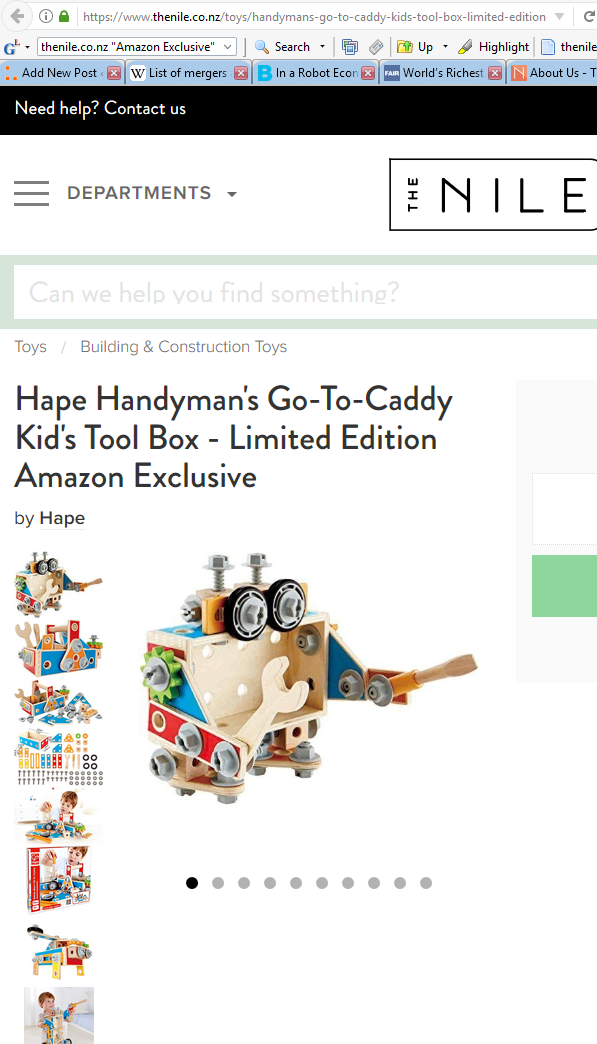
Woopsee. haha
For years, I’ve made references to company towns on here… Yep, looking in the mirror can be pretty interesting.
The Matrix has you.
Via: FAIR:
The three most prominent US newspapers haven’t run a critical investigative piece on Jeff Bezos’ company Amazon in almost two years, a FAIR survey finds.
A review of 190 articles from the New York Times, Wall Street Journal and the Bezos-owned Washington Post over the past year paints a picture of almost uniformly uncritical–ofttimes boosterish–coverage. None of the articles were investigative exposes, 6 percent leaned negative, 54 percent were straight reporting or neutral in tone, and 40 percent were positive, mostly with a fawning or even press release–like tone.
The last major investigative piece we found in any of these three publications was a 4,500-word critique of Amazon’s labor practices in the New York Times (8/16/15) almost two years ago. Considering that Amazon is the fourth-most-valuable company in the world, with a 43 percent (and growing) share of all US online commerce, it’s a striking absence of journalistic scrutiny.
The line between straight reporting and fawning coverage wasn’t always clear, given the nature of technology journalism, but, in general, a distinction was drawn when reporting on Amazon’s latest moves featured no criticism or contrary third-party input, and the article was mostly indistinguishable from a press release.
Motor Trend: The Tesla Model 3 “Is the Most Important Vehicle of the Century”
July 29th, 2017Via: Motor Trend:
The Tesla Model 3 is here, and it is the most important vehicle of the century.
Yes, the hyperbole is necessary. The original Tesla Model S was a proof of concept—it was possible to make a long-range electric vehicle. The Model X showed that you could make an electric SUV. But neither was affordable to the masses. And although the Chevrolet Bolt has shown that 238 miles of electric range is possible for less than $40,000, GM’s volume aspirations are modest.
Not so for Tesla CEO Elon Musk, who wants to blow out the walls of his Fremont, California, factory to build a half-million Tesla Model 3s every year.
Tesla gave Motor Trend an opportunity for an extended test drive with the Tesla Model 3 engineer. Following is Testing Director Kim Reynolds’ review.
How Governments, Food Companies, Big Pharma, Media and Healthcare Operators Keep Us Fat and Sick
July 27th, 2017If you thought the Military Industrial Complex was something…
Via: The Drs. Wolfson:
These numbers clearly reveal a U.S. economy totally dependent on the healthcare system. Were the need for healthcare to cease, or be reduced dramatically, the U.S. economy would be in crisis of unprecedented proportions.
So, what has the government been doing to promote sickness to stabilize/grow the economy?
Let’s examine the following…
Bollinger Unveils New Minimalist All-Electric Truck with Up to 200 Miles of Range
July 27th, 2017No pricing was revealed, which is good, since it would probably melt our faces off.
Via: Electrek:
Today, Bollinger Motors unveiled what it calls a “no nonsense back-to-basics all-electric sport utility truck (SUT).”
The minimalist-looking vehicle with sharp edges and bare interior will not be for everyone, but with a promised range of up to 200 miles and quite a few interesting features, it could check all the boxes of a lot of people looking to buy an EV that can go on and off road.
The New York-based startup brought the prototype to the Classic Car Club of Manhattan. They released the entire spec list, which we added at the end of this article, and revealed almost everything about the vehicle except for the price.
Bollinger Motors’ founder and CEO, Robert Bollinger, commented on the unveiling:
“We are so thrilled to be able to finally take the wraps off of our Bollinger B1 SUT. This is the culmination of what has been a 40-year-long boyhood dream of mine and I couldn’t be more pleased with the vehicle and the incredible team who worked so hard to create it.”
First Human Embryos Edited in U.S.
July 27th, 2017Via: MIT Technology Review:
The first known attempt at creating genetically modified human embryos in the United States has been carried out by a team of researchers in Portland, Oregon, Technology Review has learned.
The effort, led by Shoukhrat Mitalipov of Oregon Health and Science University, involved changing the DNA of a large number of one-cell embryos with the gene-editing technique CRISPR, according to people familiar with the scientific results.
Until now, American scientists have watched with a combination of awe, envy, and some alarm as scientists elsewhere were first to explore the controversial practice. To date, three previous reports of editing human embryos were all published by scientists in China.
Now Mitalipov is believed to have broken new ground both in the number of embryos experimented upon and by demonstrating that it is possible to safely and efficiently correct defective genes that cause inherited diseases.
Although none of the embryos were allowed to develop for more than a few days—and there was never any intention of implanting them into a womb—the experiments are a milestone on what may prove to be an inevitable journey toward the birth of the first genetically modified humans.
In altering the DNA code of human embryos, the objective of scientists is to show that they can eradicate or correct genes that cause inherited disease, like the blood condition beta-thalassemia. The process is termed “germline engineering” because any genetically modified child would then pass the changes on to subsequent generations via their own germ cells—the egg and sperm.
Some critics say germline experiments could open the floodgates to a brave new world of “designer babies” engineered with genetic enhancements—a prospect bitterly opposed by a range of religious organizations, civil society groups, and biotech companies.
The U.S. intelligence community last year called CRISPR a potential “weapon of mass destruction.”
Toyota Set to Sell Long-Range, Fast-Charging Electric Cars in 2022
July 25th, 2017Toyota made a strategic error in holding out hope for hydrogen fuel cell technology as the leaders in zero emission vehicles went ahead with lithium ion batteries. By opting to attempt to make solid state battery technology viable by 2022, Toyota might be trying to make up for lost time.
Via: Reuters:
Toyota Motor Corp is working on an electric car powered by a new type of battery that significantly increases driving range and reduces charging time, aiming to begin sales in 2022, the Chunichi Shimbun daily reported on Tuesday.
Toyota’s new electric car, to be built on an all-new platform, will use all-solid-state batteries, allowing it to be recharged in just a few minutes, the newspaper said, without citing sources.
By contrast, current electric vehicles (EVs), which use lithium-ion batteries, need 20-30 minutes to recharge even with fast chargers and typically have a range of just 300-400 kilometers (185-250 miles).
Toyota has decided to sell the new model in Japan as early as 2022, the paper said.
Toyota spokeswoman Kayo Doi said the company would not comment on specific product plans but added that it aimed to commercialize all-solid-state batteries by the early 2020s.
More: Toyota in “Production Engineering” for a Solid State Battery
Judge Offers to Cut Jail Time if Inmates Get Vasectomies or Long Term Birth Control Implants
July 25th, 2017Via: News Channel 5:
Inmates in White County, Tennessee have been given credit for their jail time if they voluntarily agree to have a vasectomy or birth control implant, a popular new program that is being called “unconstitutional” by the ACLU.
On May 15, 2017 General Sessions Judge Sam Benningfield signed a standing order that allows inmates to receive 30 days credit toward jail time if they undergo a birth control procedure.
Women who volunteer to participate in the program are given a free Nexplanon implant in their arm, the implant helps prevent pregnancies for up to four years. Men who volunteer to participate are given a vasectomy, free of charge, by the Tennessee Department of Health.