How Police Departments Use Civil Forfeiture to Collect Billions
March 15th, 2017Whenever you hear about tips to the police from confidential informants or “concerned citizens,” etc. keep this in mind: U.S. Communications Intelligence Secretly Shared with Law Enforcement for Use Against Americans in Criminal Investigations.
So, mass surveillance and civil forfeiture: Is there a link?
“It is the height of naivete to think that once collected this information won’t be used,” said a former Stazi former Stasi Lieutenant Colonel about the U.S. Government’s mass surveillance operations. The fact that the mechanism is in place is enough proof for me, and if you don’t want the pigs to rob you, I’d suggest that you treat your computer, mobile devices and the surveillance platforms from and Google and major CIA contractor Amazon with extreme caution.
Via: Vice:
Based on laws that originated from the War on Drugs in the 1980s, police departments around the country are able to seize a person’s cash and property without charging them with a crime.
Civil forfeiture laws were created as a tool to cripple suspected criminals and drug rings, but police departments nationwide have been using this cash and property to fund their operations or even pay policemen directly.
The problem, is that in the vast majority of assets seizures, the individual is not charged with a crime. And once their cash and property are seized, getting it back is a prohibitively lengthy and expensive process.
NSA Routinely Monitors Americans’ Communications Without Warrants
March 15th, 2017Are They building electronic dossiers on as many of us as they can? I don’t know, but it sure looks that way.
—Cryptogon, 2007: NSA, AT&T and the NarusInsight Intercept Suite
In Open Thread: Trump Wiretap Claims, I wrote:
Where is the uproar over the spook’s data center in Utah? Man, if you think that place is only used to store information gleaned from taps on foreigners, I’ve got a bridge to sell you.
Here’s how it typically works on Cryptogon.
1) I make a guess about how bad a situation actually is vs. what the public is being told. Even some Cryptogon readers think I am insane.
2) Years pass.
3) Information comes out that shows that I was essentially right.
4) Years pass.
5) Information comes out that shows that the situation was or is worse than even I thought.
We’re only at stage 3 with the mass surveillance situation.
I’ll reiterate what I think the stage 5 reality could be:
I think the reality is that a dossier on every “citizen” is being automatically maintained. The dossier contains everything from purchases to Internet activity, audio from phone calls, to full contents of emails. Income. Library records. Travel records. etc. Additionally, I think that there is another widget that links activity, that users think is anonymous, up to their main dossier.
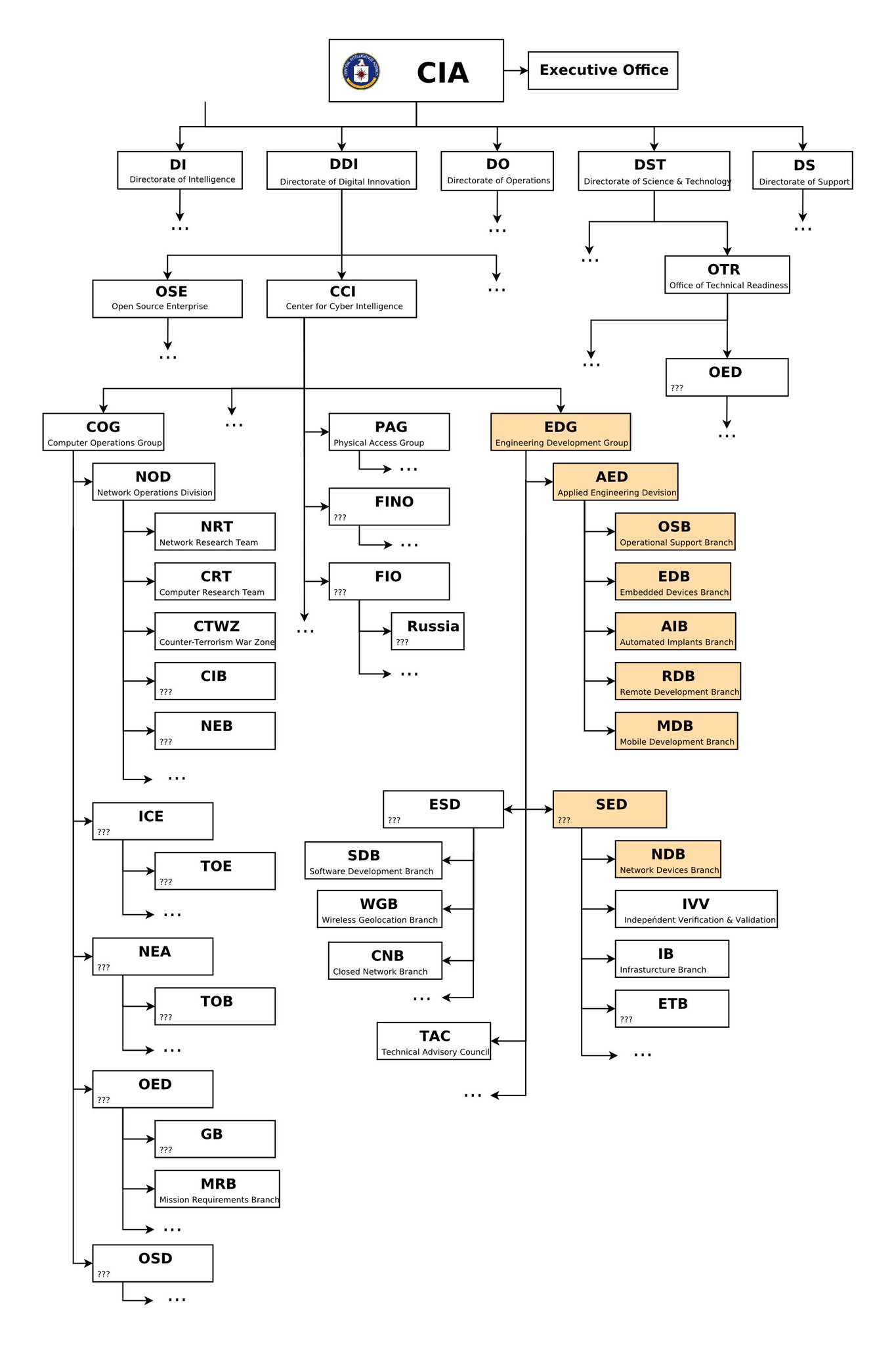
And for good measure, most people conveniently carry a GPS tracker/smartphone around with them that provides their location on the ground. I’ve maintained, for about a decade, that mass tracking of people is part of the core functionality of this thing. As I write this, searching the exact phrase, “Wireless Geolocation Branch” on Google shows nothing.
Check out the partial CIA organizational chart that WikiLeaks released a few days ago:

The Wireless Geolocation Branch… Fascinating.
Here is an extended passage from my 2007 post on, Synthetic Environments for Analysis and Simulation:
Remember Russell Tice, the NSA SIGINT officer who had knowledge of a special access NSA operation that was so disturbing that he tried to tell the U.S. Congress about it?
What was Tice talking about here:
Tice said his information is different from the Terrorist Surveillance Program that Bush acknowledged in December and from news accounts this week that the NSA has been secretly collecting phone call records of millions of Americans. “It’s an angle that you haven’t heard about yet,” he said.
An angle that we haven’t heard about. Since everyone and his dog knows about the mass surveillance, what could that angle be?
More recently, Tice said that the NSA intercepts of civilian traffic is “the tip of the iceberg” and says, again, that there is something else, something we still don’t know about. Here’s part of the interview between Tice and Reason:
REASON: What prompted you to step forward now?
Tice: Well, I’ve known this for a long time and I’ve kept my mouth shut…
REASON: You’re referring to what James Risen calls “The Program,” the NSA wiretaps that have been reported on?
Tice: No, I’m referring to what I need to tell Congress that no one knows yet, which is only tertiarily connected to what you know about now.
Ok, so the outrage that Tice was willing to ruin his life over is only “tertiarily connected” to the operation we already new about.
Tice continues:
In my case, there’s no way the programs I want to talk to Congress about should be public ever, unless maybe in 200 years they want to declassify them. You should never learn about it; no one at the Times should ever learn about these things.
The surveillance side of this is the chickenfeed. There’s something far more sinister than the simple surveillance… an angle we haven’t heard about yet.
Tice never did tell his story to Congress about this different aspect of the program.
Well, my guess is that it has something to do with providing surveillance data for this SEAS World Sim thing, and that individual Americans are being watched and potentially targeted with it. Tice’s background seems to involve a lot of traditional electronic warfare, radar and ELINT stuff. Maybe Tice’s deal involved the collection of the mobile phone GPS and/or triangulation data which would provide realtime spacial/geographic data to the SEAS system. In other words, SEAS sees you. They could bring up a map of a city and plot your path based on the information that your phone is exchanging with the mobile network.
—
I just went to see if Tice has said anything recently. I found this from 2013:
Russell Tice, a retired National Security Agency intelligence analyst and whistleblower, said: “What is going on is much larger and more systemic than anything anyone has ever suspected or imagined.”
He obviously doesn’t read Cryptogon.
Although an anonymous senior Obama administration official said that “on its face” the court order revealed by the Guardian did not authorise the government to listen in on people’s phone calls, Tice now believes the NSA has constructed such a capability.
“I figured it would probably be about 2015” before the NSA had “the computer capacity … to collect all digital communications word for word,” Tice said. “But I think I’m wrong. I think they have it right now.”
There it is.
I think that what has changed over the last several years is that the full dossier functionality, that I’ve speculated about for a decade, has expanded from a group of targeted individuals to everyone.
All of this, I have no doubt at all, is searchable by any combination of keyword, date, name, browser fingerprint, browsing fingerprint, linguistic fingerprint, IP address, geographic proximity, and probably dozens of other criteria.
The cherry on top of this disaster is that the infrastructure is being used illegally to feed information to law enforcement for use against American citizens, “It’s just like laundering money – you work it backwards to make it clean.”
Via: The Intercept:
On Sunday’s Face the Nation, Sen. Rand Paul was asked about President Trump’s accusation that President Obama ordered the NSA to wiretap his calls. The Kentucky senator expressed skepticism about the mechanics of Trump’s specific charge, saying: “I doubt that Trump was a target directly of any kind of eavesdropping.” But he then made a broader and more crucial point about how the U.S. government spies on Americans’ communications — a point that is deliberately obscured and concealed by U.S. government defenders.
Paul explained how the NSA routinely and deliberately spies on Americans’ communications — listens to their calls and reads their emails — without a judicial warrant of any kind:
The way it works is, the FISA court, through Section 702, wiretaps foreigners and then [NSA] listens to Americans. It is a backdoor search of Americans. And because they have so much data, they can tap — type Donald Trump into their vast resources of people they are tapping overseas, and they get all of his phone calls.
And so they did this to President Obama. They — 1,227 times eavesdrops on President Obama’s phone calls. Then they mask him. But here is the problem. And General Hayden said this the other day. He said even low-level employees can unmask the caller. That is probably what happened to Flynn.
They are not targeting Americans. They are targeting foreigners. But they are doing it purposefully to get to Americans.
Paul’s explanation is absolutely correct. That the NSA is empowered to spy on Americans’ communications without a warrant — in direct contravention of the core Fourth Amendment guarantee that “the right of the people to be secure in their persons, houses, papers, and effects, against unreasonable searches and seizures, shall not be violated, and no Warrants shall issue, but upon probable cause” — is the dirty little secret of the U.S. Surveillance State.
Trump to Nominate Goldman Sachs’ Donovan as Deputy Treasury Secretary
March 14th, 2017Mmm hmm.
Via: Reuters:
U.S. President Donald Trump will nominate Goldman Sachs Group (GS.N) Managing Director James Donovan as deputy secretary of the Treasury, the White House said on Tuesday.
Google’s DeepMind Makes AI Program that Learns Sequentially
March 14th, 2017Via: Guardian:
Researchers have overcome one of the major stumbling blocks in artificial intelligence with a program that can learn one task after another using skills it acquires on the way.
Developed by Google’s AI company, DeepMind, the program has taken on a range of different tasks and performed almost as well as a human. Crucially, and uniquely, the AI does not forget how it solved past problems, and uses the knowledge to tackle new ones.
The AI is not capable of the general intelligence that humans draw on when they are faced with new challenges; its use of past lessons is more limited. But the work shows a way around a problem that had to be solved if researchers are ever to build so-called artificial general intelligence (AGI) machines that match human intelligence.
“If we’re going to have computer programs that are more intelligent and more useful, then they will have to have this ability to learn sequentially,” said James Kirkpatrick at DeepMind.
The ability to remember old skills and apply them to new tasks comes naturally to humans. A regular rollerblader might find ice skating a breeze because one skill helps the other. But recreating this ability in computers has proved a huge challenge for AI researchers. AI programs are typically one trick ponies that excel at one task, and one task only.
More: Enabling Continual Learning in Neural Networks
Research Credit: Jb
Former Tesla Executive to Build €4bn Battery Factory to Take on Elon Musk
March 13th, 2017Disclosure: I sell solar power systems in New Zealand.
—
Via: Independent:
NorthVolt, the Swedish company founded by a former Tesla executive, wants to cut the cost of storing power in half with a €4bn (£3.5bn) lithium-ion battery factory.
The Stockholm-based company wants to raise €1bn by 2018, when it plans to break ground on a factory during the second half of the year, according to founder Peter Carlsson, who was Tesla’s former head of sourcing and supply chains. NorthVolt will announce a shortlist of possible Swedish manufacturing sites in about a month.
“Europe will be a very important market for energy storage,” Mr Carlsson said by phone. “There is a huge need for back-up power. There is also a sizable auto industry that has made big promises to go electric.”
Intel Buying Mobileye for $15 Billion
March 13th, 2017Via: Recode:
Cars coming off the assembly line in the next few years will have computing power to rival your cellphones, and they’ll get even more complex as automakers introduce more self-driving technology.
That’s why Intel — known for its chips, data centers and computing capabilities — just bought self-driving tech supplier Mobileye for $15 billion. Intel, which has long been a supplier to the PC industry, lost out on the mobile revolution. It sees cars as “data centers on wheels,” generating as much as four terrabytes of data a day.
Mobileye, which makes an array of cameras and laser-based sensors, already sells its technology to 27 automakers, as well as to other automotive suppliers. It has a firm foothold within the car industry. Intel, meanwhile, has an automotive division, but it doesn’t have as many direct inroads into autonomous driving.
The self-driving industry is still very new and car manufacturers as well as auto suppliers are all creating different parts of the technology. Chipmaker Nvidia, for example, competes with both Intel and Mobileye. In addition to making chips, Nvidia also has mapping technology.
While Mobileye is one of the few companies that has a comprehensive set of technology, no single company currently offers the entire stack of technologies for self-driving. Intel and Mobileye together would be able to marry the data-crunching needs with sensor tech.
Pi-hole: A Black Hole for Internet Advertisements
March 13th, 2017Via: Pi-hole:
FBI Undercover Stings Foil Terrorist Plots — That It Creates
March 12th, 2017Via: Kansas City Star:
Announcements of foiled terrorist plots make for lurid reading.
Schemes to carry out a Presidents Day jihadist attack on a train station in Kansas City. Bomb a Sept. 11 memorial event. Blow up a 1,000-pound bomb at Fort Riley. Detonate a weapon of mass destruction at a Wichita airport — the failed plans all show imagination.
But how much of it was real?
Often not much, according to a review of several recent terrorism cases investigated by the FBI in Kansas and Missouri. The most sensational plots invoking the name of the Islamic State or al-Qaida here were largely the invention of FBI agents carrying out elaborate sting operations on individuals identified through social media as being potentially dangerous.
New GOP Bill Lets Companies Force Employees to Take Genetic Tests
March 12th, 2017Via: ExtremeTech:
A new bill introduced by Virginia Foxx (R-NC) and approved by the House Ways and Means Committee would allow corporations to force employees to undergo genetic testing — and then share those results with third parties. In theory, this is already illegal, thanks to a 2008 law known as GINA. This type of behavior is also regulated by the Americans With Disabilities Act (ADA).
The new House bill, HR 1313, gets around these issues by preemptively declaring that workplace wellness programs offered in conjunction with an employer’s sponsored health care plan shall be considered to be in compliance with GINA, the ADA, and other workplace protections. Given that the relevant section of GINA (section 202(b)(2)) specifically states that it shall be unlawful for employers to gather genetic information on employees without the express permission and consent of the employee in question, the GOP just wrote a privacy-shredding exception into a bill and then quietly passed that bill through committee.
Research Credit: Jb
Thousands of Upcoming Nuclear Weapons Shipments During $1 Trillion Nuclear Arsenal Upgrade
March 12th, 2017Via: Los Angeles Times:
The unmarked 18-wheelers ply the nation’s interstates and two-lane highways, logging 3 million miles a year hauling the most lethal cargo there is: nuclear bombs.
The covert fleet, which shuttles warheads from missile silos, bomber bases and submarine docks to nuclear weapons labs across the country, is operated by the Office of Secure Transportation, a troubled agency within the U.S. Department of Energy so cloaked in secrecy that few people outside the government know it exists.
The $237-million-a-year agency operates a fleet of 42 tractor-trailers, staffed by highly armed couriers, many of them veterans of the Iraq and Afghanistan wars, responsible for making sure nuclear weapons and components pass through foggy mountain passes and urban traffic jams without incident.
The transportation office is about to become more crucial than ever as the U.S. embarks on a $1-trillion upgrade of the nuclear arsenal that will require thousands of additional warhead shipments over the next 15 years.
The increased workload will hit an agency already struggling with problems of forced overtime, high driver turnover, old trucks and poor worker morale — raising questions about its ability to keep nuclear shipments safe from attack in an era of more sophisticated terrorism.