Working Qubit in Silicon
September 21st, 2012Via: Register:
The University of New South Wales’ School of Electrical Engineering and Telecommunications has created what it says is the world’s first working qubit based on a single atom.
Detailed in a new Nature paper, A single-atom electron spin qubit in silicon, the qubit relies on the ability to impart “spin” to an electron bound to a single phosphorus atom, then read that spin.
…
The team now hopes to assemble two working qubits into a logic gate, the next logical step towards building a quantum computer. Morello said building such a device won’t require step into the unknown, but will take a year or two to accomplish.
Mainstream Medicine and Corporate Media Admit: Pot Compound Has, ‘Ability to Turn Off the Activity of a Gene Responsible for Metastasis in Breast and Other Types of Cancers’
September 21st, 2012Warning: No information that appears on Cryptogon should be considered medical advice.
But what they won’t admit is that lots of people are already effectively treating themselves with concentrated hemp oil:
Dennis Hill Talks About Curing His Stage IV Prostate Cancer with Cannabis Oil
Cured Too, A Cancer Story By David Triplett
More at phoenixtears.ca and the Rick Simpson Facebook page is VERY active.
Via: San Francisco Chronicle:
A growing body of early research shows a compound found in marijuana – one that does not produce the plant’s psychotropic high – seems to have the ability to “turn off” the activity of a gene responsible for metastasis in breast and other types of cancers.
Two scientists at San Francisco’s California Pacific Medical Center Research Institute first released data five years ago that showed how this compound – called cannabidiol – reduced the aggressiveness of human breast cancer cells in the lab.
Last year, they published a small study that showed it had a similar effect on mice. Now, the researchers are on the cusp of releasing data, also on animals, that expands upon these results, and hope to move forward as soon as possible with human clinical trials.
“The preclinical trial data is very strong, and there’s no toxicity. There’s really a lot of research to move ahead with and to get people excited,” said Sean McAllister, who along with scientist Pierre Desprez, has been studying the active molecules in marijuana – called cannabinoids – as potent inhibitors of metastatic disease for the past decade.
Multibillion-Dollar Fines Won’t Change Behavior of Criminal Pharmaceutical Companies
September 21st, 2012“The pharmaceutical industry is the most lucrative, the most cynical and the least ethical of all the industries. It is like an octopus with tentacles that has infiltrated all the decision making bodies, world health organisations, governments, parliaments, high administrations in health and hospitals and the medical profession. It has done this with the connivance, and occasionally the corruption of the medical profession. I am not just talking about medicines but the whole of medicine. It is the pharmaceutical industry that now outlines the entire medical landscape in our country.”
Via: Independent:
The global pharmaceutical industry has racked up fines of more than $11bn in the past three years for criminal wrongdoing, including withholding safety data and promoting drugs for use beyond their licensed conditions.
In all, 26 companies, including eight of the 10 top players in the global industry, have been found to be acting dishonestly. The scale of the wrongdoing, revealed for the first time, has undermined public and professional trust in the industry and is holding back clinical progress, according to two papers published in today’s New England Journal of Medicine. Leading lawyers have warned that the multibillion-dollar fines are not enough to change the industry’s behaviour.
The 26 firms are under “corporate integrity agreements”, which are imposed in the US when healthcare wrongdoing is detected, and place the companies on notice for good behaviour for up to five years.
The largest fine of $3bn, imposed on the UK-based company GlaxoSmith-Kline in July after it admitted three counts of criminal behaviour in the US courts, was the largest ever. But GSK is not alone – nine other companies have had fines imposed, ranging from $420m on Novartis to $2.3bn on Pfizer since 2009, totalling over $11bn.
Kevin Outterson, a lawyer at Boston University, says that despite the eye watering size of the fines they amount to a small proportion of the companies’ total revenues and may be regarded as a “cost of doing business”. The $3bn fine on GSK represents 10.8 per cent of its revenue while the $1.5bn fine imposed on Abbott Laboratories, for promoting a drug (Depakote) with inadequate evidence of its effectiveness, amounted to 12 per cent.
Mr Outterson said: “Companies might well view such fines as a quite small percentage of their global revenue. If so, little has been done to change the system. The government merely recoups a portion of the financial fruit of firms’ past misdeeds.”
He argues that penalties should be imposed on executives rather than the company as whole. He cites a Boston whistleblower attorney, Robert Thomas who observed that GSK had committed a $1bn crime and “no individual has been held responsible”.
Research Credit: ms
OPEC Countries Pouring Billions of Dollars Into Solar Power… To Export More Oil And Gas
September 21st, 2012Via: Wall Street Journal:
Middle Eastern members of OPEC are finally diversifying their energy base, pouring hundreds of billions of dollars into harnessing that other resource they feature in vast quantities: sunshine.
But it isn’t what you think. The Saudis, Abu Dhabi and Iran aren’t racing to burnish their green credentials by reducing their carbon footprints. They are investing in solar-power production mainly for one reason: to help them export even more oil and gas.
For More And More Companies, The Hiring Boss Is An Algorithm
September 21st, 2012Via: Wall Street Journal:
When looking for workers to staff its call centers, Xerox Corp. used to pay lots of attention to applicants who had done the job before. Then, a computer program told the printer and outsourcing company that experience doesn’t matter.
The software said that what does matter in a good call-center worker—one who won’t quit before the company recoups its $5,000 investment in training—is personality. Data show that creative types tend to stick around for the necessary six months. Inquisitive people often don’t.
“Some of the assumptions we had weren’t valid,” said Connie Harvey, Xerox’s chief operating officer of commercial services.
After a half-year trial that cut attrition by a fifth, Xerox now leaves all hiring for its 48,700 call-center jobs to software that asks applicants to choose between statements like: “I ask more questions than most people do” and “People tend to trust what I say.”
For more and more companies, the hiring boss is an algorithm.
Research Credit: rs
NYSE Pays a Paltry $5 Million Fine for Giving Private Customers a Trading Head Start
September 20th, 2012Via: IEEE:
On Friday, the U.S. Securities and Exchange Commission (SEC) announced that it had administratively fined the New York Stock Exchange (NYSE) $5 million (pdf) for allowing its private customers access to stock market information ahead of when it was available to the general public. This occurred from June 2008 to about mid-May 2010. The fine amounts to about a morning’s worth of revenue for the exchange.
Rethink Robotics
September 20th, 2012Via: IEEE:
Whereas traditional industrial robots perform one specific task with superhuman speed and precision, Baxter is neither particularly fast nor particularly precise. But it excels at just about any job that involves picking stuff up and putting it down somewhere else while simultaneously adapting to changes in its environment, like a misplaced part or a conveyor belt that suddenly changes speed.
Cryptogon Reader Signs Up for Hosting with BlueHost
September 20th, 2012Thanks to the owner of parabellumradio.com for signing up for hosting with BlueHost. Cryptogon received a $90 commission.
France: Monsanto’s GMO Corn Causes Cancer, Organ Damage in Rats
September 20th, 2012Update: Study Linking GM Maize to Rat Tumors Retracted, Author Unrepentant
Via: Nature:
Bowing to scientists’ near-universal scorn, the journal Food and Chemical Toxicology today fulfilled its threat to retract a controversial paper that claimed that a genetically modified (GM) maize causes serious disease in rats after the authors refused to withdraw it.
The paper, from a research group led by Gilles-Eric Séralini, a molecular biologist at the University of Caen, France, and published in 20121, showed “no evidence of fraud or intentional misrepresentation of the data”, said a statement from Elsevier, which publishes the journal. But the small number and type of animals used in the study means that “no definitive conclusions can be reached”. The known high incidence of tumours in the Sprague-Dawley rat ”cannot be excluded as the cause of the higher mortality and incidence observed in the treated groups”, it added.
Today’s move came as no surprise. Earlier this month, the journal’s editor-in-chief, Wallace Hayes, threatened retraction if Séralini refused to withdraw the paper, which is exactly what he announced at a press conference in Brussels this morning. Séralini and his team remained unrepentant, and allege that the retraction derives from the journal’s editorial appointment of biologist Richard Goodman, who previously worked for biotechnology giant Monsanto for seven years.
“The magazine reviewed our paper more than any other,” says co-author and medical doctor Joël Spiroux, who is also president of the Paris-based Committee for Research and Independent Information on Genetic Engineering (CRIIGEN), which collaborated in the study. The retraction is “a public-health scandal”, he says.
—
Update / Predictable: Nothing to See Here
Via: New York Times:
Two additional panels of experts in France said the rat study does not change their view of Monsnto’s engineered corn or the Roundup herbicide. See the postscript below.]
An intensively promoted and controversial French study claiming to find high tumor rates and early mortality in rats fed genetically modified corn and “safe” levels of the herbicide Roundup has been dismissed in a rare joint statement from France’s six scientific academies.
—End Update—
This image is from a French language story about the study posted at nouvelobs.com:
Rats, GMO Corn, RoundUp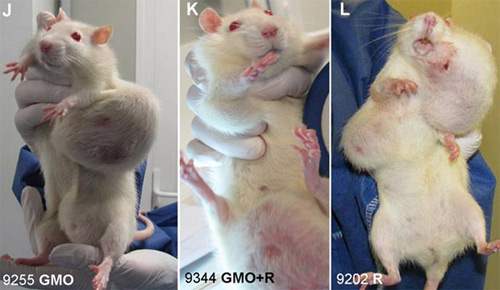
Americans are literally made of the stuff: King Corn:
Via: AFP:
France’s government on Wednesday asked a health watchdog to carry out a probe, possibly leading to EU suspension of a genetically-modified corn, after a study in rats linked the grain to cancer.
Agriculture Minister Stephane Le Foll, Ecology Minister Delphine Batho and Health and Social Affairs Minister Marisol Touraine said they had asked the National Agency for Health Safety (ANSES) to investigate the finding.
“Depending on ANSES’ opinion, the government will urge the European authorities to take all necessary measures to protect human and animal health,” they said in a joint statement.
“(The measures) could go as far as invoking emergency suspension of imports of NK603 corn to Europe pending a re-examination of this product on the basis of enhanced assessment methods.”
Earlier, French scientists led by Gilles-Eric Seralini at the University of Caen in Normandy unveiled a study that said rats fed with NK603 corn or exposed to the weedkiller used with it developed tumours.
NK603 is a corn, also called maize, made by US agribusiness giant Monsanto.
It has been engineered to make it resistant to Monsanto’s herbicide Roundup.
This enables farmers to douse fields with the weedkiller in a single go, thus offering substantial savings.
Genetically modified (GM) crops are widely grown in North America, Brazil and China but are a hot-button issue in Europe.
The study, published in the peer-reviewed journal Food and Chemical Toxicology, says it is the first to look at rats over their normal lifespan of two years.
“For the first time ever, a GM organism and a herbicide have been evaluated for their long-term impact on health, and more thoroughly than by governments or the industry,” Seralini told AFP. “The results are alarming.”
Two hundred male and female rats were split into 10 groups of 10 animals.
One was a “control” group which was given ordinary rat food that contained 33 percent non-GM corn, and plain water.
Three groups were given ordinary rat food and water with increasing doses of Roundup, reflecting various concentrations of the herbicide in the food chain.
The other six were fed rat food of which 11, 22 or 33 percent comprised NK603 corn, either treated or not with Roundup when the corn was grown.
The researchers found that NK603 and Roundup both caused similar damage to the rats’ health, whether they were consumed together or on their own.
Premature deaths and sickness were concentrated especially among females.
At the 14-month stage of experiment, no animals in the control groups showed any signs of cancer, but among females in the “treated” groups, tumours affected between 10 and 30 percent of the rodents.
“By the beginning of the 24th month, 50-80 percent of female animals had developed tumours in all treated groups, with up to three tumours per animal, whereas only 30 percent of controls were affected,” it said
Males which fell sick suffered liver damage, developed kidney and skin tumours and digestive problems.
Related:
Why are Monsanto Insiders Now Appointed to Protect Your Food Safety?
California: The Companies Trying to Stop Mandatory Labeling of Products Containing GM Ingredients
Research Credit: LDXX
DARPA’s Mentats: EEG Data Used for Threat Detection
September 20th, 2012During a recent email conversation about a related technology with a friend of mine, who, shall we say, knows more than a little about this subject, he wrote something that you might find interesting:
Interesting approach. It sounds like they’ve given up on computers processing images and instead they’re trying to create a mentat. Maybe they should try giving the guy some spice and see if his performance improves?
This is kind of interesting because in the Dune series the mentats were created because the empire couldn’t trust AI machines. The AI machines almost took over during this war called the Butlerian Jihad. After that, they said forget this we’re going to just improve human calculating ability to the point where it can compete with a computer. So, they used the drug called spice to create the mentat. At that point, they didn’t have to rely on AI computers anymore. The mentat could do the same thing and was more controllable.
I wonder if the current empire is thinking along the same lines. Eventually there will be no humans on the battlefield. The DoD has a goal to do that by 2034. Everyone will be remote controlling robots or drones. But the problem with using a normal human pilot is there will still be a 1-to-1 ratio between robots and humans. What they really need is a mentat that can guide a thousand robots simultaneously. Then it won’t be the 0.01% that rule the world, it’ll just be one power-mad PHB with his bunker full of mentats controlling semi-automated swarms of drones. What a paradise that sounds like.
—
Have a nice day!
Via: ExtremeTech:
After more than four years of research, DARPA has created a system that successfully combines soldiers, EEG brainwave scanners, 120-megapixel cameras, and multiple computers running cognitive visual processing algorithms into a cybernetic hivemind. Called the Cognitive Technology Threat Warning System (CT2WS), it will be used in a combat setting to significantly improve the US Army’s threat detection capabilities.
There are two discrete parts to the system: The 120-megapixel camera, which is tripod-mounted and looks over the battlefield (pictured below); and the computer system, where a soldier sits in front of a computer monitor with an EEG strapped to his head (pictured above). Images from the camera are fed into the computer system, which runs cognitive visual processing algorithms to detect possible threats (enemy combatants, sniper nests, IEDs). These possible threats are then shown to a soldier whose brain then works out if they’re real threats — or a false alarm (a tree branch, a shadow thrown by an overheard bird).
The soldier is linked into the computer system via an EEG (electroencephalogram) brain-computer interface that continually scans his brains for P300 responses. As we’ve discussed previously (see: Hackers backdoor the human brain), a P300 response is triggered when your brain recognizes something important. This might be a face of someone you know or the glint of a sniper scope — it doesn’t matter. P300 responses are very reliable and can even be triggered subconsciously.
In short, CT2WS taps the human brain’s unsurpassed ability to recognize objects. In testing, the 120-megapixel camera, combined with the computer vision algorithms, generated 810 false alarms per hour; with a human operator strapped into the EEG, that drops down to just five false alarms per hour. The human brain is surprisingly fast, too: According to DARPA, CT2WS display 10 images per second to the human operator — and yet that doesn’t seem to affect accuracy. The total overall accuracy of the system is 91% — but that will improve as DARPA moves beyond the prototype stage.
Related: Dune by Frank Herbert