U.S. Dollar Index: Breakout
December 14th, 2011Warning: This is not a recommendation to buy, sell or hold any financial instrument.
The dollar has clawed its way up and out of the recent range on the European chaos. Look for some resistance in the vicinity of 81.444.

U.S. Dollar Index, Weekly Interval
Update: Gold Breakdown
The spot gold weekly candle is down through the 50EMA just now. Make or break.
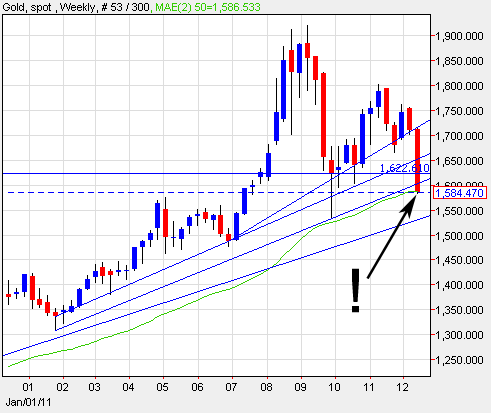
Spot Gold, Weekly Interval
Austrian Makes Formal Request for All Personal Information Facebook Keeps on Him
December 14th, 2011Via: ThreatPost:
Be careful of what you ask for. That’s a lesson that Max Schrems of Vienna, Austria, learned the hard way when he sent a formal request to Facebook citing European law and asking for a copy of every piece of personal information that the world’s largest social network had collected on him.
After a wait, the 24 year-old law student got what he was seeking: a CD with all his data stored on it – 1,222 files in all. The collection of PDF format documents was roughly the length Leo Tolstoy’s War and Peace but told a more mundane story: a record of Schrems’ years-long relationship with the world’s largest social network.
Collected together were records of when Schrems logged in and out of the social network, the times and content of sent and received messages and an accounting of every person and thing he’s ever liked, posted, poked, friended or recorded. The archive captured friend requests, former or alternative names and email addresses, employment and relationship statuses and photos, in some cases with their GPS locations included, to name a few. To Schrems’ dismay, much of the data he received from the network was information he thought he had deleted. Facebook, it seems, doesn’t think much of the Delete key and continued to hold copies of the data on its servers.
Russia Will Use Nuclear Reactors Beyond Their Engineered Life Spans
December 14th, 2011Via: The Bulletin of Atomic Scientists:
In response to the accident at the Fukushima Daiichi Nuclear Power Station, countries such as Germany and Switzerland are preparing to phase out aging nuclear power plants. The Russian State Atomic Energy Corporation (Rosatom), however, is taking a very different approach. In 2001, Rosatom began extending the operation of nuclear power plants that had surpassed their projected life spans. More recently, Sergey Kiryenko, the chief executive of Rosatom, confirmed that Rosatom intends to give all of its aging reactors a new lease on life, including water-cooled, graphite moderated RBMK reactors like the one that exploded at Chernobyl in 1986. Under Rosatom’s plan, the youngest of these reactors would continue operating until 2035.
Many of the country’s experts and non-governmental organizations maintain that this decision is economically unjustifiable and environmentally dangerous — to say nothing of illegal. The Russian nuclear industry, however, argues that lifetime extensions are justified because the original estimate of a 30-year life span was conservative; the plants have been significantly upgraded; and extensions cost significantly less than constructing new reactors.
The Neil Keenan / “Dragon Family” Trillion-Dollar Lawsuit Is Real
December 14th, 2011The full text of the lawsuit (Case 1:11-cv-08500-JFK, Filed 11/23/11, downloaded from pacer.gov) has been posted at the Divine Cosmos website:
This is a civil claim arising out of the concerted, knowing, malicious scheme and international conspiracy engaged in by the Defendants for the designed purpose of defrauding plaintiff KEENAN, the designated Agent of his Principal, the “Dragon Family,” for the express purpose of expropriating, stealing and converting certain negotiable financial instruments lawfully owned by the Dragon Family and entrusted to KEENAN in early 2009. These assets (hereinafter referred to as the “Dragon Family Financial Instruments” or the “DFFI”) had been intended for participation in select, registered and authorized Private Placement Investment Programs (or “PPPs”) for the benefit of a wide range of global humanitarian purposes. At the time of the criminal and deceitful acts of the Defendants, the approximate face value of the stolen DFFI was One Hundred Forty-Five and One Half Billion ($145,500,000,000.00) United States Dollars with an approximate accrued interest value of One Trillion ($1,000,000,000,000.00) United States Dollars.
Related:
Courthouse News Service: Bizarre Claim for $1 Trillion
Blackwater, Xe, ACADEMI
December 13th, 2011Via: AFP:
The US security firm formerly known as Blackwater, which was barred from Iraq over a deadly 2007 shooting, has renamed itself a second time.
USTC Holdings, the investor consortium that acquired ex-Blackwater firm Xe Services in December 2010, announced ACADEMI as the new name and brand for Xe Services.
The rebranding came as President Barack Obama met with Iraqi Prime Minister Nuri al-Maliki on Monday, marking America’s exit from a war launched to oust Saddam Hussein.
Advertisement: Story continues below
“We have had a year of extraordinary changes that have resulted in a new, better company,” ACADEMI president and chief executive Ted Wright said in a statement.
“I know that everyone at ACADEMI shares in this commitment to promote the highest standards of ethical conduct, compliance and integrity in all of our activities.
“We are already the best operationally. We are going to become the best at governance,” Wright said, adding “we still have much work to do.”
South Korea: Seoul Skyscraper Resembling Twin Towers Collapse
December 13th, 2011Pic at link.
Via: Bloomberg:
The design of twin skyscrapers planned for Seoul may be modified in the wake of criticism that a cloud-shaped bridge joining the buildings resembles the explosions that felled the World Trade Center towers.
MVRDV, the Dutch architecture firm that drew the plans for the towers joined at the 27th floor by a billowing cloud-shaped bridge, apologized for any affront caused by the resemblance to the fireball that sprung from the New York buildings in the Sept. 11 attacks that destroyed the twin towers.
The building designs “have been widely published in Asia and Europe without anyone noticing a resemblance,” Jan Knikker, a spokesman for the Rotterdam-based firm, said in an e-mail today. “Once the plan was published in the U.S., the controversy started.”
The design represents a cloud wrapping around the center of the skyscrapers, according to the firm’s website. The bridge connecting the towers, which are 57 and 60 stories high, would house a conference center, restaurants, swimming pools and a lounge, MVRDV said.
MIT Scientists Create Camera That Allows Photons To Be Seen Moving In Slow Motion
December 13th, 2011Via: New York Times / MIT News Office:
More than 70 years ago, the M.I.T. electrical engineer Harold (Doc) Edgerton began using strobe lights to create remarkable photographs: a bullet stopped in flight as it pierced an apple, the coronet created by the splash of a drop of milk.
Now scientists at M.I.T.’s Media Lab are using an ultrafast imaging system to capture light itself as it passes through liquids and objects, in effect snapping a picture in less than two-trillionths of a second.
…
…the researchers were able to create slow-motion movies, showing what appears to be a bullet of light that moves from one end of the bottle to the other. The pulses of laser light enter through the bottom and travel to the cap, generating a conical shock wave that bounces off the sides of the bottle as the bullet passes.
The streak tube scans and captures light in much the same way a cathode ray tube emits and paints an image on the inside of a computer monitor. Each horizontal line is exposed for just 1.71 picoseconds, or trillionths of a second, Dr. Raskar said — enough time for the laser beam to travel less than half a millimeter through the fluid inside the bottle.
To create a movie of the event, the researchers record about 500 frames in just under a nanosecond, or a billionth of a second. Because each individual movie has a very narrow field of view, they repeat the process a number of times, scanning it vertically to build a complete scene that shows the beam moving from one end of the bottle, bouncing off the cap and then scattering back through the fluid. If a bullet were tracked in the same fashion moving through the same fluid, the resulting movie would last three years.
“You can think of it as slow motion,” Andreas Velten, a postdoctoral researcher who is a member of the design team, said during a recent technical presentation. “It is so much slow motion you can see the light itself move. This is the speed of light: there’s nothing in the universe that moves faster.”
Multimillion Dollar Crowdturfing Industry Growing Exponentially
December 13th, 2011Incredibly, laughably, this piece doesn’t mention things like the U.S. Military’s desire to develop persona management software or Team Themis (HBGary Federal, Palantir and Berico):
After having spent several months studying those emails and otherwise investigating the industry depicted therein, I have revealed my summary of a classified US intelligence programme known as Romas/COIN, as well as its upcoming replacement, known as Odyssey. The programme appears to allow for the large-scale monitoring of social networks by way of such things as natural language processing, semantic analysis, latent semantic indexing and IT intrusion. At the same time, it also entails the dissemination of some unknown degree of information to a given population through a variety of means – without any hint that the actual source is US intelligence.
Via: Technology Review:
A trawl of Chinese crowdsourcing websites—where people can earn a few pennies for small jobs such as labeling images—has uncovered a multimillion-dollar industry that pays hundreds of thousands of people to distort interactions in social networks and to post spam.
The report’s authors, at the University of California, Santa Barbara, also found evidence that crowdsourcing sites in the U.S. are similarly dominated by ethically questionable jobs. They conclude that the rapid growth of this way of making money will make paid shills a serious security problem for websites and those who use them around the world. A paper describing their results is available on the Arxiv pre-print server.
Ben Zhao, an associate professor of computer science at UCSB (and a TR35 winner in 2006), started looking into the largely uncharted crowdsourcing industry in China after working closely with RenRen, a social network that is sometimes called the “Facebook of China,” to track malicious activity on the site. Zhao was intrigued to see a lot of relatively sophisticated attempts to send spam and promote brands by users that appeared to be working with specific agendas.
When he and colleagues investigated the source of that activity, the team was surprised by what it found, says Zhao: “Evil crowdsourcing on a very large scale.” Influencing public opinion with fake “grassroots” activity is known as astroturfing, leading Zhao to coin the term “crowdturfing,” since it is done via large crowdsourcing sites.
…
Filippo Menczer, director of the Center for Complex Networks and Systems Research at the University of Indiana, is working to develop systems to detect political astroturfing on Twitter. “It’s already a hard thing to do, and probably it will get more difficult,” he says, especially as crowdsourcing services become easier to use.
Menczer’s group first built a system to detect political astroturfing in the run-up to the most recent midterm elections. It first identifies threads of political discussion circulating on Twitter, using hashtags, links, names, and sentences. Software trained to recognize both legitimate and astroturfing tweets then sifts fraudulent messages from that soup of political discussion, and even tracks their success in influencing real users.
That system was able to find automated accounts by sending carefully varying messages promoting certain political sites. But Menczer has always suspected they were missing an unknown amount of more subtle astroturfing campaigns. Looking at the origin of crowdsourced astroturfing provides another perspective, he says.
“The fact that there are websites almost dedicated to making it easy to hire people to do this is further evidence that this is happening,” says Menczer, who is working to upgrade his astroturfing detection system to analyze discussion around next year’s presidential elections.
Related:
Internet Plague: Paid Shills in Comments
Fracking Industry Executives Suggest Military PSYOP Techniques to Peers for Dealing with Public
FBI Holding Carrier IQ Data for ‘Law Enforcement Purposes’
December 13th, 2011There’s a shocker.
Via: The Verge:
When we spoke to Carrier IQ at length about the company’s controversial cellular tracking service, there was one question we didn’t include in the transcript. “Would you say no if the government asked Carrier IQ for a wiretap into user databases?” we asked. At the time, we felt the question was reaching, but today it seems rather apt, because MuckRock just discovered that the FBI does have files on Carrier IQ of some sort.
…
In any case, if you’re curious how Carrier IQ responded to our question, the answer was this: “We will respect the laws of the United States and other territories in which we operate.”
Butter Shortage in Norway: Bids to Roughly $465 Per Pound
December 12th, 2011Via: AFP:
An acute butter shortage in Norway, one of the world’s richest countries, has left people worrying how to bake their Christmas goodies with store shelves emptied and prices through the roof.
The shortfall, expected to last into January, amounts to between 500 and 1,000 tonnes, said Tine, Norway’s main dairy company, while online sellers have offered 500-gramme packs for up to 350 euros ($465).
The dire shortage poses a serious challenge for Norwegians who are trying to finish their traditional Christmas baking — a task which usually requires them to make at least seven different kinds of biscuits.
The shortfall has been blamed on a rainy summer that cut into feed production and therefore dairy output, but also the ballooning popularity of a low-carbohydrate, fat-rich diet that has sent demand for butter soaring.
“Compared to 2010, demand has grown by as much as 30 percent,” Tine spokesman Lars Galtung told AFP.
Last Friday, customs officers stopped a Russian at the Norwegian-Swedish border and seized 90 kilos (198 pounds) of butter stashed in his car.




