U.S. Military Wants Drones that Detect ‘Adversarial Intent’
September 28th, 2011Oh sure.
Via: Wired:
Perhaps the idea of spy drones already makes your nervous. Maybe you’re uncomfortable with the notion of an unblinking, robotic eye in the sky that can watch your every move. If so, you may want to click away now. Because if the Army has its way, drones won’t just be able to look at what you do. They’ll be able to recognize your face — and track you, based on how you look. If the military machines assemble enough information, they might just be able to peer into your heart.
…
The Pentagon isn’t content to simply watch the enemies it knows it has, however. The Army also wants to identify potentially hostile behavior and intent, in order to uncover clandestine foes.
Charles River Analytics is using its Army cash to build a so-called “Adversary Behavior Acquisition, Collection, Understanding, and Summarization (ABACUS)” tool. The system would integrate data from informants’ tips, drone footage, and captured phone calls. Then it would apply “a human behavior modeling and simulation engine” that would spit out “intent-based threat assessments of individuals and groups.” In other words: This software could potentially find out which people are most likely to harbor ill will toward the U.S. military or its objectives. Feeling nervous yet?
“The enemy goes to great lengths to hide his activities,” explains Modus Operandi, Inc., which won an Army contract to assemble “probabilistic algorithms th[at] determine the likelihood of adversarial intent.” The company calls its system “Clear Heart.” As in, the contents of your heart are now open for the Pentagon to see. It may be the most unnerving detail in this whole unnerving story.
Euro Crisis Makes Fed Lender of Only Resort
September 28th, 2011Via: Bloomberg:
The Federal Reserve, chastised by Congress for lending money to foreign institutions such as the Central Bank of Libya, is once again the lender of last resort for banks around the world it knows little about.
Three years after the collapse of Lehman Brothers Holdings Inc., money-market borrowing rates for dollars are rising, leading the Fed and European Central Bank to make the currency available to Europe’s institutions for as many as three months. U.S. prime money-market funds cut their exposure to euro-zone bank deposits and commercial paper, or short-term IOUs, to $214 billion in August from $391 billion at the end of last year, according to JPMorgan Chase & Co. data.
The failure of regulators worldwide to address European banks’ fragile dependence on short-term funding is “putting the Fed in a really awkward position,” said Karen Shaw Petrou, managing partner at Federal Financial Analytics, a Washington regulatory research firm whose clients include the biggest U.S. banks. The swaps with Europe “are an extremely advantageous political football” for critics of the Fed, she said.
The Trader on BBC
September 28th, 2011I’m a bit baffled by the level of interest in this one. I watched this and thought, *meh*, “Maybe he has been reading Cryptogonzerohedgeautomaticeartheconomiccollapseblogetcetc” HAHA. I also wondered if he was trying to shill the thing down so he could go long… Because, for as many times as this was submitted, nobody mentioned what happened the next day:
FTSE 100 +204.68 +4.02%
DAX +282.88 +5.29%
CAC 40 +164.04 +5.74%
Anyway, here you go.
Facebook Tracks Users After They Leave Site
September 27th, 2011I use a custom filter in AdBlock+ to block all Facebook nonsense. I haven’t seen one of those ‘Like’ buttons in years. (Not on my computer, anyway.)
If you don’t know what this ‘Like’ button garbage is all about, it’s a little widget that site operators put all over the place that lets Facebook users indicate when they like something on the Internet. These bits of Facebook code are like a plague that have spread over most of the Internet.
—Germany: Facebook Data Collection Under Fire Again
Ghostery also blocks Facebook widgets.
Via: Sydney Morning Herald:
FACEBOOK is following you, even when you have logged out.
An Australian technology expert has discovered Facebook tracks the websites its users visit after they leave the social networking site. Nik Cubrilovic said his tests showed Facebook did not delete its tracking cookies when you logged out but modified them, maintaining account information and other unique tokens that could identify you.
So whenever you visited a web page containing a Facebook button or widget, your browser was still sending the details back to Facebook, said Mr Cubrilovic.
Advertisement: Story continues below
”Even if you are logged out, Facebook still knows and can track every page you visit,” he wrote in a blog post. ”The only solution is to delete every Facebook cookie in your browser, or to use a separate browser for Facebook interactions.”
Wisconsin Judge: ‘No, Plaintiffs do not have the right to produce and consume the foods of their choice”
September 27th, 2011Via: The Complete Patient:
As if to show how pissed he was at being questioned, he said his decision translates further that “no, Plaintiffs to not have a fundamental right to own and use a dairy cow or a dairy herd;
“no, Plaintiffs do not have a fundamental right to consume the milk from their own cow;”
And in a kind of exclamation point, he added this to his list of no-nos: “no, Plaintiffs do not have a fundamental right to produce and consume the foods of their choice…”
Michigan: Palisades Nuclear Power Plant Venting “Low” Level Radioactive Steam
September 27th, 2011Via: Michigan Messenger:
Entergy’s Palisades nuclear plant near South Haven is venting radioactive steam into the environment as part of an unplanned shutdown triggered by an electrical accident.
This shutdown, which began Sunday evening, came just five days after the plant restarted from a shutdown that was caused by a leak in the plant’s cooling system.
Nuclear Regulatory Commission spokeswoman Prema Chandrithal said that the current shutdown happened because an object slipped during work on a circuit breaker and caused an arc that took out power for one of two DC electrical systems that power safety valves and other devices.
According to a notice filed with the Nuclear Regulatory Commission, the plant is stable and “controlling temperature using Atmospheric Dump Valves.”
“The steam that would normally go to the generators, that steam is now going into the environment … through the steam stack,” said Chandrithal. “This would have very low levels of tritium.”
Iraq to Buy U.S. Warplanes Worth Around $3 Billion
September 27th, 2011Mmm hmm.
Via: Reuters:
Iraq has signed a contract to buy 18 Lockheed Martin F-16 warplanes to bolster its air force, an adviser to Prime Minister Nouri al-Maliki said Monday.
The value of the deal was not immediately known, but a senior U.S. military official said recently the offer on the table for the Iraqi government was valued at “roughly $3 billion.”
Iraqi and U.S. military officials have said strengthening its air force is one of Baghdad’s top priorities as U.S. troops prepare to leave by Dec. 31, more than eight years after the invasion that ousted Saddam Hussein.
“The contract was signed … and a part of the contract cost was sent to the bank account of the company,” said Maliki’s media adviser, Ali al-Moussawi.
Lockheed ‘pleased’
Lockheed said in a statement it was “pleased by the announcement that the governments of Iraq and the United States” have agreed on the sale. The company added it welcomes Iraq “as the 26th nation to operate the F-16.”
Will Robots Steal Your Job?
September 27th, 2011Via: Slate:
They might not know it yet, but some of the most educated workers in the nation are engaged in a fierce battle with machines. As computers get better at processing and understanding language and at approximating human problem-solving skills, they’re putting a number of professions in peril. Those at risk include doctors, lawyers, pharmacists, scientists, and creative professionals—even writers like myself.
5 Minute U.S. Dollar Index for Fib Heads
September 27th, 2011Warning: This is not a recommendation to buy, sell or hold any financial instrument.
I was just examining the recent gold slaughter by looking at the U.S. Dollar Index and I noticed a fantastic series of Fibonacci setups on the current five minute dollar index chart.
U.S. Dollar Index, 5 Minute Interval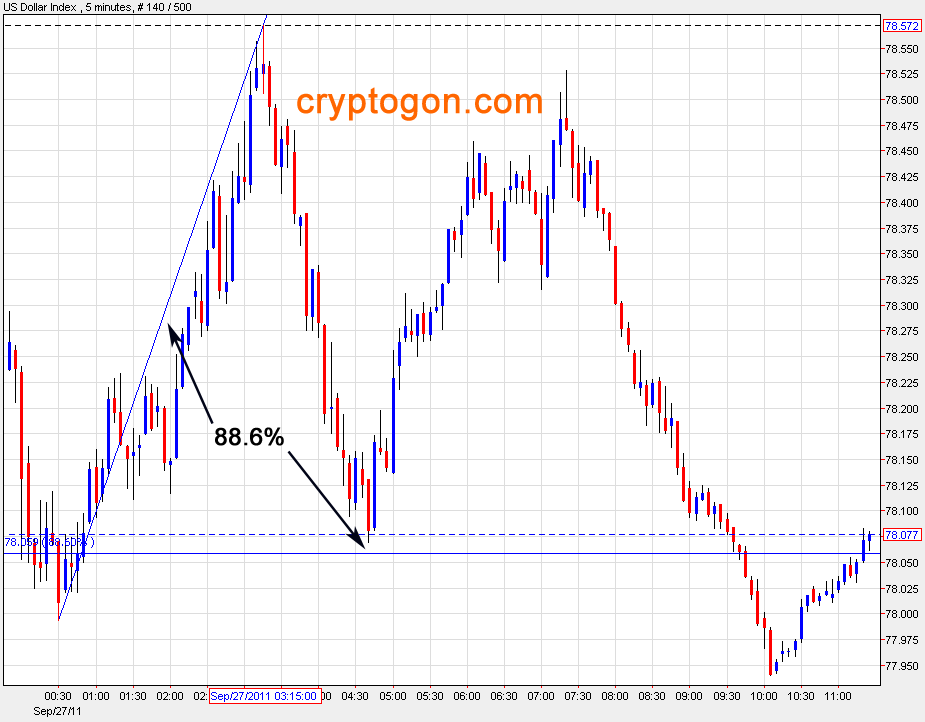
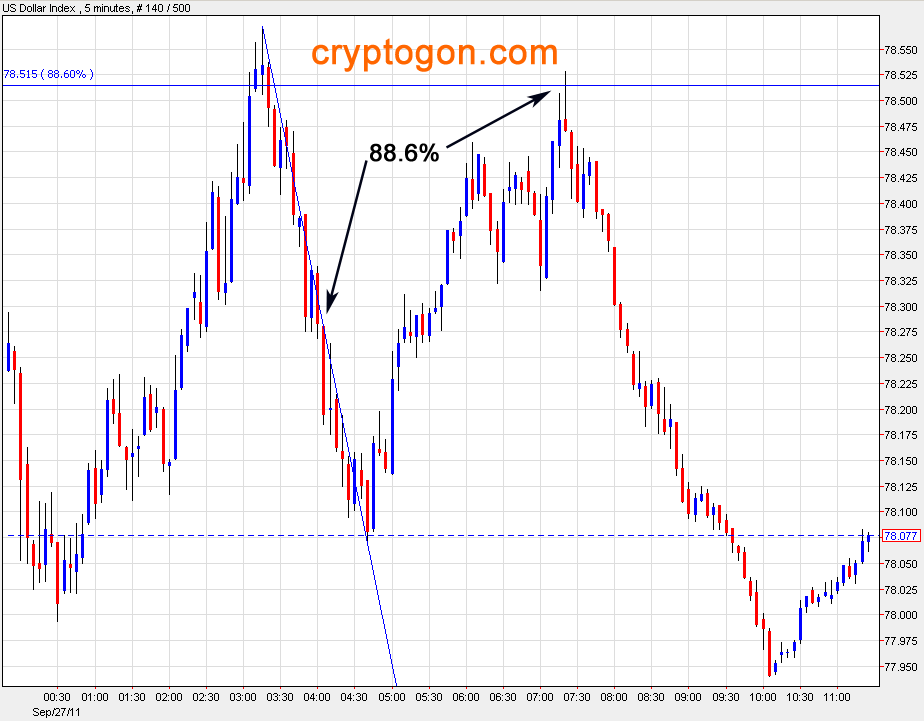
U.S. Dollar Index, 5 Minute Interval
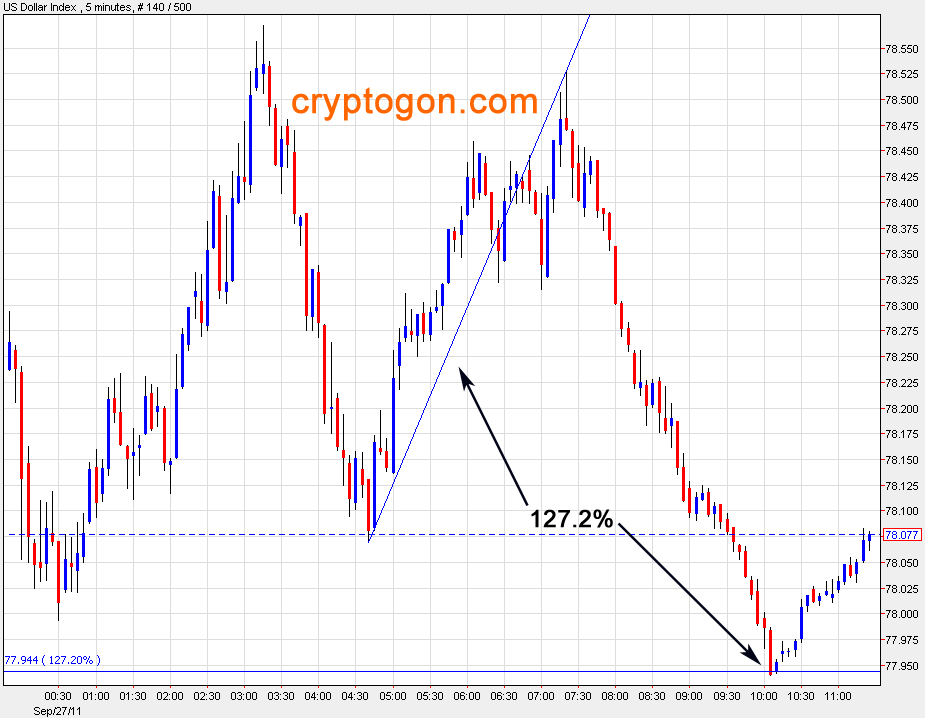
U.S. Dollar Index, 5 Minute Interval
Japan: Radioactive Zone Bigger Than That Left by Atomic Bombings of Hiroshima and Nagasaki
September 27th, 2011Via: Bloomberg:
Beyond the police roadblocks that mark the no-go zone around Japan’s wrecked Fukushima nuclear plant, six-foot tall weeds invade rice paddies and vines gone wild strangle road signs along empty streets.
Takako Harada, 80, returned to an evacuated area of Iitate village to retrieve her car. Beside her house is an empty cattle pen, the 100 cows slaughtered on government order after radiation from the March 11 atomic disaster saturated the area, forcing 160,000 people to move away and leaving some places uninhabitable for two decades or more.
“Older folks want to return, but the young worry about radiation,” said Harada, whose family ran the farm for 40 years. “I want to farm, but will we be able to sell anything?”
What’s emerging in Japan six months since the nuclear meltdown at the Tokyo Electric Power Co. plant is a radioactive zone bigger than that left by the 1945 atomic bombings at Hiroshima and Nagasaki. While nature reclaims the 20 kilometer (12 mile) no-go zone, Fukushima’s $3.2 billion-a-year farm industry is being devastated and tourists that hiked the prefecture’s mountains and surfed off its beaches have all but vanished.
The March earthquake and tsunami that caused the nuclear crisis and left almost 20,000 people dead or missing may cost 17 trillion ($223 billion), hindering the recovery of the world’s third-largest economy from two decades of stagnation.