New Jersey City Prepares to Shut Down Library System
August 6th, 2010Via: Philadelphia Enquirer:
Camden is preparing to permanently shut its library system by the end of the year, potentially leaving residents of the impoverished city among the few in the United States unable to borrow a library book free.
At an emotional but sparsely attended meeting of the library board Thursday, its president, Martin McKernan, said the city’s three libraries cannot stay open past Dec. 31 because of severe budget cuts by Mayor Dana L. Redd.
“It’s extraordinary, it’s appalling,” McKernan said.
All materials in the libraries would be donated, auctioned, stored, or destroyed. That includes 187,000 books, historical documents, artifacts, and electronic equipment. Keeping materials in the shuttered buildings is a fire hazard, officials said, and would make them vulnerable to vandalism and vermin.
“They don’t want to see our children grasp a future, but go down the toilet,” said Jean Kehner, who described herself as a Camden resident for 76 years.
Redd is facing a $28 million projected deficit stemming from reductions in state aid and a long-standing lack of taxable property. She is planning deep cuts in all departments, and she told McKernan last month that she would slash funding to the 105-year-old library system by about two-thirds.
Because not even one of the three libraries could stay open in 2011 on such limited support, all 21 employees would be laid off, McKernan said.
U.S. Government Funding Program to Train Foreign Workers So American Firms Can Outsource Jobs
August 5th, 2010The number of Americans who are receiving food stamps rose to a record 40.8 million in May as the jobless rate hovered near a 27-year high, the government reported yesterday.
Via: Information Week:
Federally-backed program aims to help outsourcers in South Asia become more fluent in areas like Java programming—and the English language.
Despite President Obama’s pledge to retain more hi-tech jobs in the U.S., a federal agency run by a hand-picked Obama appointee has launched a $36 million program to train workers, including 3,000 specialists in IT and related functions, in South Asia.
Following their training, the tech workers will be placed with outsourcing vendors in the region that provide offshore IT and business services to American companies looking to take advantage of the Asian subcontinent’s low labor costs.
Under director Rajiv Shah, the United States Agency for International Development will partner with private outsourcers in Sri Lanka to teach workers there advanced IT skills like Enterprise Java (Java EE) programming, as well as skills in business process outsourcing and call center support. USAID will also help the trainees brush up on their English language proficiency.
USAID is contributing about $10 million to the effort, while its private partners are investing roughly $26 million.
“To help fill workforce gaps in BPO and IT, USAID is teaming up with leading BPO and IT/English language training companies to establish professional IT and English skills development training centers,” the U.S. Embassy in Colombo, Sri Lanka, said in a statement posted Friday on its Web site.
“Courses in Business Process Outsourcing, Enterprise Java, and English Language Skills will be offered at no charge to over 3,000 under- and unemployed students who will then participate in on-the-job training schemes with private firms,” the embassy said.
USAID is also partnering with Sri Lankan companies in other industries, including construction and garment manufacturing, to help create 10,000 new jobs in the country, which is still recovering from a 30-year civil war that ended in 2009.
But it’s the outsourcing program that’s sure to draw the most fire from critics. While Obama acknowledged that occupations such as garment making don’t add much value to the U.S. economy, he argued relentlessly during his presidential run that lawmakers needed to do more to keep hi-tech jobs in IT, biological sciences, and green energy in the country.
He also accused the Bush administration of creating tax loopholes that made it easier for U.S. companies to place work offshore in low-cost countries.
40 Billionaires Pledge to Give Away Half of Wealth
August 5th, 2010Yep, we can’t get those flying syringes fast enough.
Via: MSNBC:
A little over a year after Bill Gates and Warren Buffett began hatching a plan over dinner to persuade America’s wealthiest people to give most of their fortunes to charity, more than three-dozen individuals and families have agreed to take part, campaign organizers announced Wednesday.
In addition to Buffett and Gates — America’s two wealthiest individuals, with a combined net worth of $90 billion, according to Forbes — 38 other billionaires have signed The Giving Pledge. They include New York Mayor Michael Bloomberg, entertainment executive Barry Diller, Oracle co-founder Larry Ellison, energy tycoon T. Boone Pickens, media mogul Ted Turner, David Rockefeller, film director George Lucas and investor Ronald Perelman.
WHEAT HALTED; RUSSIA IMPOSES EXPORT BAN
August 5th, 2010In other news, Speculators Rediscover Agricultural Commodities.
Via: Reuters:
Chicago wheat markets jumped 8 percent to near two-year highs on Thursday, twice triggering trading curbs to restore order before easing back after Russia said it would temporarily halt grain exports.
Russia’s worst drought on record has devastated crops in parts of the country and sent international grain prices soaring as markets placed bets that without shipments from one of the world’s leading exporters, global supplies would be restricted.
Wheat has risen seven of the past eight days at the Chicago Board of Trade and buying by funds and traders spilled across the grain markets. Corn and soybeans were 2 and 0.5 percent higher, respectively.
Prime Minister Vladimir Putin signed an order banning grain and flour exports from August 15 to December 31, with a spokesman saying this would apply to contracts that had been already signed.
The news confirmed an earlier report from Interfax that kicked off the buying.
Google’s CEO: Technology Good, Anonymity “Dangerous”
August 5th, 2010Via: Cnet:
For those concerned with privacy, Google CEO Eric Schmidt gave them a few more things to start worrying about.
Cisco’s Sub Second Melt Up and Identifying Crop Circles in the High Frequency Market Data
August 5th, 2010WARNING: This is not a recommendation to buy, sell or hold any financial instrument.
Last week, Cisco (CSCO) was halted because the new “circuit breaker” rule kicked in. The price had moved more than 10% in five minutes (ABC/Reuters):
Trading in Cisco Systems Inc shares was briefly halted on Thursday after triggering a circuit breaker.
According to the Nasdaq website, trading was paused due to a move of 10 percent or more in Cisco’s price in a five-minute period.
Cisco fell 1.7 percent at $23 in mid-day trading.
Thomson Reuters data showed a single trade at $26, which would have represented a more than 10 percent move. The halt started at around 10:41 a.m. EDT (14:41 GMT), and trading resumed five minutes later.
NYSE Amex, where the trade occurred, said in an e-mail that all trades will stand after it had reviewed those executed at 10:41 a.m. between $23.67 and $26.
Unless you know a bit about how Cisco behaves in the market, you might not have thought much more about this.
I used to watch Cisco all day and it just doesn’t move violently like that. CSCO is an extremely liquid stock. The daily volume (3 month average) is around 60 million shares. It meanders in a slow, nauseating grind, a penny at a time. I thought I’d bring up a minute chart to see how the action played out during this halt event.
There was just one whacked out upper candle shadow on the minute chart; it actually looked like bad data, but it wasn’t.
I went to a 30 second interval. Same weird upper candle shadow. Ten second. Same thing again. Five second. Two second.
One second, and still, just one upper shadow to $26.
“What the… This happened in under a second?!” I mumbled to myself in total disbelief. The circuit breaker is meant to kick in on moves that happen over five minutes. What all the news about this incident on Cisco fails to mention is that the circuit breaking move happened in under a second.
So, I was looking at a one second chart that contained the whole incident! Here it is:
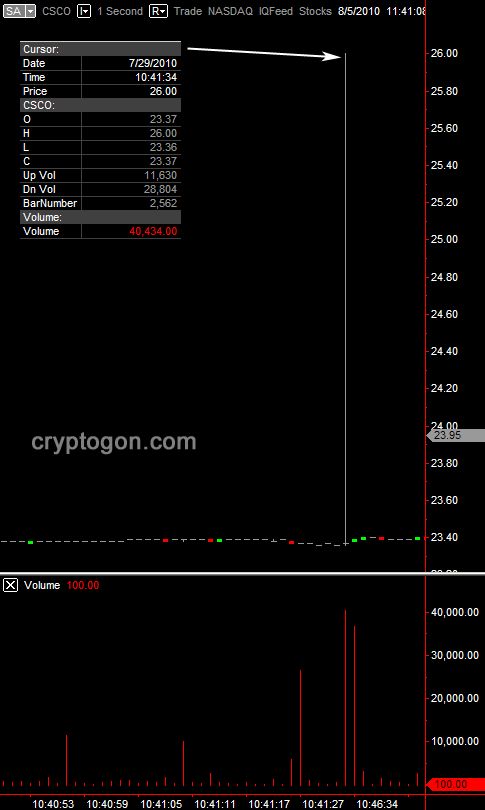
Cisco Halt Event - One Second Interval
I had to drill down further, so I brought it up in tick.
Tick data shows us every change to the best bid and ask as well as the volume. Tick data has no fixed time component. The number of ticks that occur in a second, minute or hour depends on the instrument in question and the activity at any given time.
For mere mortals, tick data is the most detailed data available, and this is what you see below (Data: IQFeed, Charts: MultiCharts):
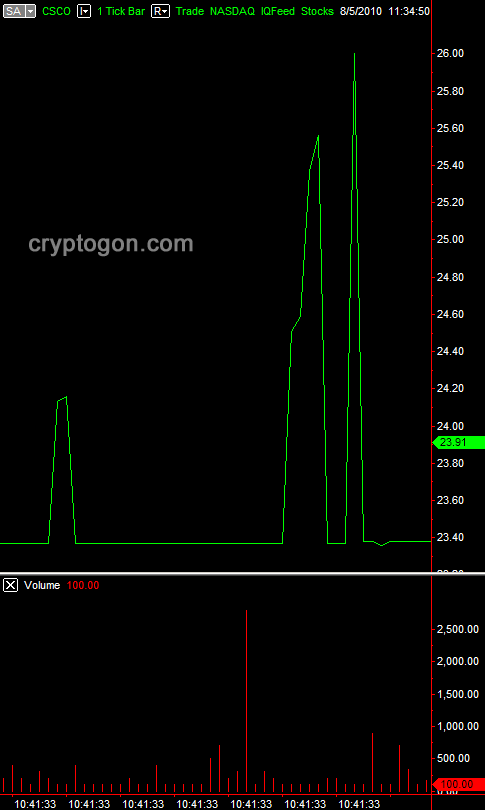
Cisco Halt Event - One Tick Interval
There’s a lot of room for the machines to iterate inside of one second, and so, for a few fractions of a second last Thursday, all Hell broke loose.
CSCO, the stock that normally grinds pennies for minutes or hours at a time, gapped violently (almost three bucks) higher as sell side liquidity disappeared. It didn’t just happen once, or twice inside that fateful second. It was the third gap higher that was far enough to trigger the kill switch.
This was no normal ramp job, with the price moving sharply higher in an orderly way. The sell side liquidity disappeared several levels deep, for some number of cycles, inside this second, and someone’s bot just kept trying to find shares higher and higher, until the exchange pulled the plug.
When, exactly, did this happen?
Well, that’s an interesting question. We’re looking inside the one second bar that ended 7/29/2010 10:41:34. I can’t be more precise than that because my tick data is only time stamped with seconds.
I don’t know who or what took out the sell side of the CSCO book, during those fractions of a second last week, but if this can happen to a stock like Cisco… You should be extremely concerned if you have more than pocket lint riding on stock market. This isn’t a functional market, where buyers and sellers are efficiently determining prices by their activities. This is machines juggling chainsaws.
The only reason I noticed was because a wheel came off the cart. Keep in mind, however, that this kind of thing is happening in all electronic markets, every trading day.
Now, let’s turn to the The Atlantic piece, “Market Data Firm Spots the Tracks of Bizarre Robot Traders,” which I’ve referenced below. A firm called Nanex, LLC. provides a set of tools that are used for developing trading systems that are capable of operating in timeframes measured in nanoseconds. Nanex started finding wild patterns of activity in these tiny slices of time. It’s a fascinating article, mainly because nobody has any good explanations as to what the Hell is really going on here. (Don’t miss Nanex’s Crop Circle of the Day – Quote Stuffing and Strange Sequences page.)
What’s even more fascinating is that millions of people are trusting their financial futures to this hyped up game of pong that has been left to run in autonomous mode.
Via: The Atlantic:
Mysterious and possibly nefarious trading algorithms are operating every minute of every day in the nation’s stock exchanges.
What they do doesn’t show up in Google Finance, let alone in the pages of the Wall Street Journal. No one really knows how they operate or why. But over the past few weeks, Nanex, a data services firm has dragged some of the odder algorithm specimens into the light.
The trading bots visualized in the stock charts in this story aren’t doing anything that could be construed to help the market. Unknown entities for unknown reasons are sending thousands of orders a second through the electronic stock exchanges with no intent to actually trade. Often, the buy or sell prices that they are offering are so far from the market price that there’s no way they’d ever be part of a trade. The bots sketch out odd patterns with their orders, leaving patterns in the data that are largely invisible to market participants.
In fact, it’s hard to figure out exactly what they’re up to or gauge their impact. Are they doing something illicit? If so, what? Or do the patterns emerge spontaneously, a kind of mechanical accident? If so, why? No matter what the answers to these questions turn out to be, we’re witnessing a market phenomenon that is not easily explained. And it’s really bizarre.
It’s thanks to Nanex, the data services firm, that we know what their handiwork looks like at all. In the aftermath of the May 6 “flash crash,” which saw the Dow plunge nearly 1,000 points in just a few minutes, the company spent weeks digging into their market recordings, replaying the day’s trades and trying to understand what happened. Most stock charts show, at best, detail down to the one-minute scale, but Nanex’s data shows much finer slices of time. The company’s software engineer Jeffrey Donovan stared and stared at the data. He began to think that he could see odd patterns emerge from the numbers. He had a hunch that if he plotted the action around a stock sequentially at the millisecond range, he’d find something. When he tried it, he was blown away by the pattern. He called it “The Knife.”
…
“When I pulled up that first chart, we saw ‘the knife,’ we said, that’s certainly algorithmic and that is weird. We continued to refine our software, honing the algorithms we use to find this stuff,” Donovan told me. Now that he knows where and how to look, he could spend all day for weeks just picking out these patterns in the market data. The examples that he posts online are just the ones that look the most interesting, but at any given moment, some kind of bot is making moves like this in the stock exchange.
“We probably get 10 stocks in any 10 minutes where we see something like this,” Donovan said. “It’s happening all the time.”
These odd bots don’t really make sense within the normal parameters of the high-frequency trading business. High-frequency traders do employ algorithms to look for patterns in the market and exploit them, but their goal is making winning trades, not simply sending quotes into the financial ether.
…
But the algorithms we see at work here are different. They don’t serve any function in the market. University of Pennsylvania finance professor, Michael Kearns, a specialist in algorithmic trading, called the patterns “curious,” and noted that it wasn’t immediately apparent what such order placement strategies might do.
Donovan thinks that the odd algorithms are just a way of introducing noise into the works. Other firms have to deal with that noise, but the originating entity can easily filter it out because they know what they did. Perhaps that gives them an advantage of some milliseconds. In the highly competitive and fast HFT world, where even one’s physical proximity to a stock exchange matters, market players could be looking for any advantage.
“They are moving the high-frequency services as close to the exchanges as possible because even the speed of light matters,” in such a competitive market, said Stanford finance professor Peter Hansen.
The Death of Paper Money
August 5th, 2010Dying of Money: Lessons of the Great German and American Inflations by Jens O. Parsson: Amazon, HTML, PDF.
Via: Telegraph:
As they prepare for holiday reading in Tuscany, City bankers are buying up rare copies of an obscure book on the mechanics of Weimar inflation published in 1974.
Ebay is offering a well-thumbed volume of “Dying of Money: Lessons of the Great German and American Inflations” at a starting bid of $699 (shipping free.. thanks a lot).
The crucial passage comes in Chapter 17 entitled “Velocity”. Each big inflation — whether the early 1920s in Germany, or the Korean and Vietnam wars in the US — starts with a passive expansion of the quantity money. This sits inert for a surprisingly long time. Asset prices may go up, but latent price inflation is disguised. The effect is much like lighter fuel on a camp fire before the match is struck.
People’s willingness to hold money can change suddenly for a “psychological and spontaneous reason” , causing a spike in the velocity of money. It can occur at lightning speed, over a few weeks. The shift invariably catches economists by surprise. They wait too long to drain the excess money.
“Velocity took an almost right-angle turn upward in the summer of 1922,” said Mr O Parsson. Reichsbank officials were baffled. They could not fathom why the German people had started to behave differently almost two years after the bank had already boosted the money supply. He contends that public patience snapped abruptly once people lost trust and began to “smell a government rat”.
Cryptogon Reader On Giving Up His American Citizenship: The U.S. Government Is “The Largest Criminal Organization In The World”
August 5th, 2010Mike Gogulski’s site is: nostate.com.
Organic Co-Op Rawesome Foods: Security Camera Footage of Police (Guns Drawn) Raid
August 5th, 2010As the state stupidly tries to crush suppliers of delicious, nutritious and safe food, people become radicalized. For our purposes, radicalized means increasingly seeking out and paying cash or bartering for outlaw meat, raw milk, free range eggs, heirloom vegetables, etc.
…
The person who feels empowered by supplying and/or consuming delicious, nutritious and safe food and then witnesses the state’s fascist response, thinks, “If the state is my enemy when it comes to something as basic as food, in what other ways does the state threaten my security?”
That’s it. Lesson learned. The floodgates are open.
As usual, keep hammering the food issue. The more the state responds with guns drawn, the more powerful we become. This kind of maniac fascism just increases awareness and demand.
Via: Los Angeles Times:
With no warning one weekday morning, investigators entered an organic grocery with a search warrant and ordered the hemp-clad workers to put down their buckets of mashed coconut cream and to step away from the nuts.
Then, guns drawn, four officers fanned out across Rawesome Foods in Venice. Skirting past the arugula and peering under crates of zucchini, they found the raid’s target inside a walk-in refrigerator: unmarked jugs of raw milk.
“I still can’t believe they took our yogurt,” said Rawesome volunteer Sea J. Jones, a few days after the raid. “There’s a medical marijuana shop a couple miles away, and they’re raiding us because we’re selling raw dairy products?”
Cartons of raw goat and cow milk and blocks of unpasteurized goat cheese were among the groceries seized in the June 30 raid by federal, state and local authorities — the latest salvo in the heated food fight over what people can put in their mouths.
$200 Biometric Lock Vs. Paperclip
August 4th, 2010Via: Wired:
The lock that would seem to have thwarted them the most was actually one of the easiest to crack. The Biolock Model 333 is a sleek £126 ($200) lock that combines a mechanical cylinder and fingerprint reader.
The Biolock fingerprint reader illuminates a blue LED when a fingerprint is authenticated. If the reader fails, a key can be inserted in a key port hidden behind a flip door in the handle.
“It’s a very neatly designed container,” says Tobias. “But the problem with this lock design is so elementary, frankly it defies belief.”
The lock can be programmed with one or more “master” fingerprints, which can be used to authorise other users. To open the lock, a user touches the fingerprint pad, and a blue LED light illuminates to indicate the person is authorised, allowing the door handle to turn. The lock can also be unlocked with a remote-control.
If the fingerprint reader fails, a mechanical key can be used instead. The key entry is concealed beneath a flip door on the lever handle. And therein lies the security problem, Tobias says.
A paperclip inserted in the Biolock’s key chamber (hidden behind a flip door) is used to push an internal pin and unlock the door, making the fingerprint reader superfluous.
The mechanical lock, which uses a bypass cylinder, can be easily thwarted with a paperclip inserted in the keyway to depress a pin that engages the latch. In two seconds, the researchers were able to open the lock.
“This is an absolute perfect example of insecurity engineering,” Tobias says.




