Bilderberg Group Now Has a Website
June 13th, 2010Via: Guardian:
An extraordinary thing happened last weekend. The world’s most secretive strategy group, Bilderberg, poked its nose out of the shadows and launched its own website: bilderbergmeetings.org. For an organisation that prefers to cordon the press a mile from its meetings, whose press relations policy to date has been to arrest, harass and search journalists, this was an astonishing turnaround.
…
No longer able to deny its existence, Bilderberg has shifted gear: the story they’re putting out now is that “nothing goes on”, “just some old chaps having a chinwag” – old, insignificant chaps like José Zapatero (the Spanish PM), Peter Voser (CEO of Royal Dutch Shell), Paul Volcker (chairman of Obama’s economic advisory board), Richard Holbrooke (Obama’s special envoy to Afghanistan and Pakistan), Josef Ackermann (CEO of Deutsche Bank). Have a look online at our Bilderberg 2010 “Power Gallery” for more “golfing buddies”.
Cryptogon Readers Send Contributions
June 13th, 2010Thank you.
Pookie $75
TR $15
metalsdb.com $20
droplettr.com $20
Obama More Aggressive Than Bush In Targeting Whistleblowers
June 13th, 2010Via: New York Times:
In 17 months in office, President Obama has already outdone every previous president in pursuing leak prosecutions. His administration has taken actions that might have provoked sharp political criticism for his predecessor, George W. Bush, who was often in public fights with the press.
The Oil Spills You’ve Never Heard Of
June 13th, 2010Via: The Star:
Deepwater Horizon. Exxon Valdez. How many other oil spills can you name?
Perhaps some Canadian accidents stick in the mind. There was the 41.8 million gallons that leaked from the American tanker Odyssey off Nova Scotia in 1988, and the 42,000 gallons that gushed from the Petro Canada-owned Terra Nova platform in 2004. That’s about it, though, right?
Based on the massive reaction to the current Gulf of Mexico spill, it might seem like big oil accidents are rare. Actually, our attention spans are short. Oil from Exxon Valdez still lingers in Alaska’s Prince William Sound, 21 years after the tanker spilled 11 million gallons. Now that Deepwater Horizon is partially capped — after releasing roughly one million gallons a day for weeks — it might fade from notice too.
But lots of oil spills happen with scant notice, particularly in the Third World. Cleanup efforts in such cases frequently have been minimal.
“There’s a double standard,” said Richard Steiner, an environmental scientist and frequent critic of the oil industry. “Double Standard” is the title a report he wrote last fall about the neglect that he says has led to one of the world’s worst cases of oil pollution, the fouling of the Niger Delta. The repeated spills and lack of adequate cleanup there have led Amnesty International to single out the Niger Delta as a human rights disaster.
“There’s what we do in the U.S. (the Deepwater Horizon reaction) versus what we’re willing to import from overseas,” says Steiner.
Nigeria may be the worst of humanity’s oil sins, but the number of spills that make only brief headlines then disappear is extensive. Amounts are always in question — there’s no international reporting protocol, so companies, governments and environmentalists proffer wildly different numbers.
The word “spill” connotes an accident, but it happens so often it hardly seems like a mistake. Until we stop guzzling oil, maybe we should start calling them “pours.”
Research Credit: JH
$1 Billion Cocaine Bust in Gambia
June 12th, 2010So, we have Blackwater/Xe increasing “aviation support” activities in two of the hottest narcotics trafficking hubs in the world. Coincidences, of course.
—Blackwater Worldwide Changes Its Name to Xe; Same Mercenaries, but Now with More “Aviation Support”
Via: AFP:
Gambian and British police seized more than two tonnes of cocaine worth about one billion dollars in a small fishing village — a record haul for West Africa, officials said Wednesday.
The operation highlighted the growing popularity of West Africa for South American drug cartels.
Fifteen people — South Americans, Europeans and Africans — working under cover of a fishing company on a tiny island were arrested following raids at Bonto on the tiny island near the Gambian capital Banjul, police said.
The 2.1 tonnes of cocaine was found in an underground bunker concealed behind a false wall in a warehouse used by the fishing company.
A senior police official, speaking on condition of anonymity, told AFP that four Nigerians, three Ghanaians, two Venezuelans, and three Dutch nationals were arrested on May 12 after residents of Bonto tipped off police.
The 12 suspects appeared in court on three charges of drug trafficking on Wednesday. They pleaded not guilty and were remanded in police custody, an AFP correspondent reported.
Two Gambians and a Nigerian were arrested late Tuesday and a senior police official told AFP more arrests were expected.
“The suspects included the Dutch owner and Venezuelan employees of a Gambia-based fishing company,” Britain’s Serious Organised Crime Agency (SOCA) said.
They “had a number of premises including exclusive use of a small island where they made use of a dilapidated hotel and set up communications and transportation systems.”
Gambia, a sliver of land bordered on three sides by Senegal and the fourth by the Atlantic Ocean, sought the help of British police to examine suspected drugs warehouses.
The underground bunker was found on Friday. Authorities also found 250,000 dollars in cash and a number of loaded firearms.
The cocaine was in “bricks” in 85 sacks, while another 60 empty sacks indicated “the bunker had been used as a distribution centre”.
The cocaine is worth more than 150 million dollars (125 million euros) but “the street value would be many times higher depending on how much the criminals diluted the cocaine with cutting agents,” said SOCA.
A British official speaking to AFP in London said that the street value was as much as one billion dollars.
SOCA said the seizure was a “record for West Africa”, which has become a key transit point for Latin American cartels seeking that take advantage of weak governance and corruption which plague many of the region’s states.
“It has long been feared that cocaine traffickers might seek to exploit the Gambia and other countries in the region as warehousing locations for drugs en route from South America to Europe,” said SOCA deputy director Neil Giles.
“It is highly likely a large proportion of these drugs would have found their way on to the streets of Europe and the UK. Taking this cocaine, and the profits it would have generated, out of the hands of criminals is a major blow to their operations.”
In March, Gambian President Yayha Jammeh said there would be “zero tolerance” for drug-trafficking after 11 senior officials were arrested.
A former police chief and drug chief are alongside senior military and drug enforcement officials on trial for drug trafficking and corruption.
Russell Benson, US Drug Enforcement Agency regional director for Europe and Africa, warned last week that West Africa faced a “very complicated threat” from drug cartels and urged countries to boost legislation, law enforcement and judicial capabilities.
BP NOW BURNING THE OIL ON THE SURFACE
June 12th, 2010The article below states that BP, “Plans to burn hundreds of thousands of gallons of oil.”
They have already started burning the oil.
The latest Big Picture includes this image from the U.S. Coast Guard:
A controlled burn of oil from the Deepwater Horizon/BP oil spill sends towers of fire hundreds of feet into the air over the Gulf of Mexico June 9. (U.S. Coast Guard Photo by Petty Officer First Class John Masson)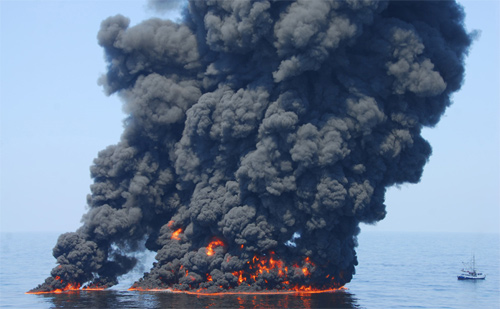
I found this photo on a KATU.com gallery. This woman has the right idea:
Sonja Daniel, who has a house on the Fort Morgan Peninsula, wears a mask Sunday, June 6, 2010 as she sunbathes on the beach of the Bon Secour National Wildlife Refuge in Baldwin County, Ala. (AP Photo/Mobile Press Register, Kate Mercer) 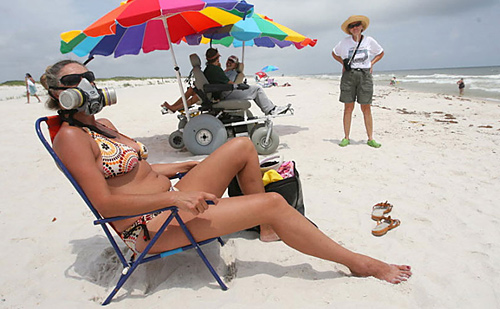
Whether or not that mask will protect her from benzene and dioxins—and other toxic substances that result from burning crude oil—is a different matter. She gets a 10 for style points, though.
Via: Arizona Daily Star:
Plans to burn hundreds of thousands of gallons of oil from BP’s blown-out well are raising new questions about the health and safety of the thousands of workers on nearby rigs and vessels.
BP and the federal government are in new territory once again in dealing with the nation’s worst environmental disaster: There’s never been such a huge flaring of oil in the Gulf of Mexico, or possibly anywhere.
The incineration of such huge amounts of oil combined with the black clouds of smoke already wafting over the Gulf waters from controlled burns of surface oil create pollution hazards for the estimated 2,000 people working in the area.
Dozens of rigs and ships are clustered in the area around the spill site.
The Discoverer Enterprise, the main recovery ship, is recovering as much as 15,000 barrels of oil a day through a pipe from the wellhead. A second vessel, the Q4000, is being prepared to pull up more oil and burn it. Experts say it could be burning 10,000 barrels, or 420,000 gallons, a day.
Dr. Phil Harber, a UCLA professor, said the burning oil could expose workers to toxins that might cause severe respiratory irritation, asthma attacks and inflamed airways depending on how the burns are handled. Burning oil is a fairly common method of relieving pressure in refinery operations, he said.
“But the magnitude is a concern,” said Harber, who is also the chief of UCLA’s division of occupational and environmental medicine.
The other worry, he said, is if the wind carries off the thick clouds, “There are hundreds of ships in the area, and those workers could have significant exposures and perhaps less protection because the exposures would be unanticipated,” he said.
Harmful byproducts of burning the light crude flowing into the Gulf include fine particles; toxic gases such as sulfur dioxide, nitrogen oxides and carbon monoxide; polycyclic aromatic hydrocarbons, which result from the incomplete burning of carbon-containing materials such as oil; and volatile organic compounds such as benzene, toluene, ethylbenzene and xylene.
…
Diane Bailey, a senior scientist with the Natural Resources Defense Council, questioned why the Coast Guard decided to allow the oil to be burned.
“It seems like a no-brainer that you wouldn’t want to do this,” she said. “Maybe there’s just such a logistical challenge in getting it onshore and getting it processed that they decided this is the cheapest, easiest thing to do. But the possible acute health problems should be of a greater concern.”
Daniel Ellsberg: WikiLeaks Founder’s Life Is In Danger
June 12th, 2010All states use their embassies and consulates to run intelligence operations. The U.S. Government is likely concerned that some of these activities, that are happening under official cover, could be compromised. Public exposure would represent a gigantic pain in the ass for the U.S. because of the Kabuki theater act that’s mandated to follow such revelations.
So, is Julian Assange’s life actually in danger? Very possibly, if the government believes that WikiLeaks will publish information related to active military or covert operations.
Now, would assassinating Assange accomplish anything, in terms of preventing WikiLeaks from publishing the information in question?
Almost certainly, no.
Assange isn’t a fool. The information would have been distributed through his network in a manner that would ensure that it would survive, even if he didn’t. Assange has been on the scene for a very long time and he doubtlessly has a long list people that he works with. The very real problem for the U.S. Government is that Assange himself doesn’t know who some of his associates are. (See: No Secrets: Julian Assange’s mission for total transparency.) In other words, torturing him wouldn’t work either. Some of his associates may be intelligence personnel that states have infiltrated into the WikiLeaks organization. But in other cases… Who knows?
Via: Fire Dog Lake:
Daniel Ellsberg, the former US military analyst who released the pentagon papers in 1971, appeared on MSNBC today with Dylan Ratigan. He said he fears for the safety of Julian Assange, founder of Wikileaks, who is reportedly on the verge of leaking secret State Department cables. The Daily Beast reports that Assange is currently being sought by the Pentagon, and Ellsberg advises him not to reveal his whereabouts.
“We have after all for the first time, that I ever perhaps in any democratic country, we have a president who has announced that he feels he has the right to use special operations operatives against anyone abroad, that he thinks is associated with terrorism,” says Ellsberg. “Now as I look at Assange’s case, they’re worried that he will reveal current threats. I would have to say puts his well-being, his physical life, in some danger now. And I say that with anguish. I think it’s astonishing that an American president should have put out that policy and he’s not getting these resistance from it, from Congress, the press, the courts or anything. It’s an amazing development that I think Assange would do well to keep his whereabouts unknown.”
FAA Imposes Flight Restrictions Over Oil Spill Area
June 12th, 2010In other words, no media related aircraft below 3000 feet.
Via: FAA:
All aircraft operations are prohibited except those flights authorized by ATC, routine flights supporting offshore oil operations; federal, state, local and military flight operations supporting oil spill recovery and reconstitution efforts; and air medical and law enforcement operations.
CNN on Media Blackout on Oil Spill
June 12th, 2010Very poor audio quality.
Via: CNN / YouTube:
Judge Limits DHS Laptop Border Searches
June 11th, 2010Via: Cnet:
A federal judge has ruled that border agents cannot seize a traveler’s laptop, keep it locked up for months, and examine it for contraband files without a warrant half a year later.
U.S. District Judge Jeffrey White in the Northern District of California rejected the Obama administration’s argument that no warrant was necessary to look through the electronic files of an American citizen who was returning home from a trip to South Korea.
“The court concludes that June search required a warrant,” White ruled on June 2, referring to a search of Andrew Hanson’s computer that took place a year ago. Hanson arrived San Francisco International Airport in January 2009.
The Justice Department invoked a novel argument–which White dubbed “unpersuasive”–claiming that while Hanson was able to enter the country, his laptop remained in a kind of legal limbo where the Bill of Rights did not apply. (The Fourth Amendment generally requires a warrant for searches.)
“Until merchandise has cleared customs, it may not enter the United States,” assistant U.S. attorney Owen Martikan argued. “The laptop never cleared customs and was maintained in government custody until it was searched…”
This is not exactly a new dispute: two years ago, the U.S. Department of Homeland Security’s Customs and Border Protection announced that it reserves the right to seize for an indefinite period of time any laptops that are taken across the border.
Last year, the department reiterated that claim, saying laptops and electronic gadgetry can still be seized and held indefinitely. There’s no requirement that they be returned to their owners after even six months or a year has passed, though supervisory approval is required if they’re held for more than 15 days. The complete contents of a hard drive or memory card can be perused at length for evidence of lawbreaking of any kind, even if it’s underpaying taxes or not paying parking tickets.