Open Thread: Various BP Oil Spill Theories
May 25th, 2010Want to discuss BP oil spill theories that are percolating though the rumor sphere? Go for it here.
I’ve seen all of the ones that you guys have submitted (and then some!), but I can’t find any sources that I feel are worth mentioning here.
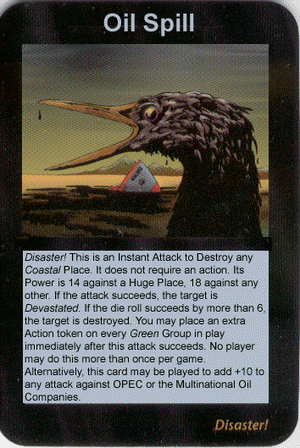
Oil Spill Card from Illuminati Role Playing Game
This is not to say that I think we’re getting the full picture from the corporate media on this cataclysm. As per routine, it’s probably not that bad, it’s worse. But, from long experience, I avoid posting stuff from sites that generate in excess of 95% noise and rat poison, consider Sucha Fool to be an authoritative source of information and have roll playing/social engineering games running as factual threads (complete with teams of trolls egging on the peanut gallery).
However, there is that other 5% of information that might represent legitimate signal… Think you have a grip on that 5%, well, shine on you wild diamond. This is the place.
If you want to mention something about the sea floor, the alleged looped video, space based beam weapons, etc. go for it.
Goldman Sachs Linked to Toxic Oil Dispersal Chemical Used by BP in Gulf of Mexico
May 24th, 2010Many tentacles.
Via: Picasso Dreams:
2003
…
The Blackstone Group, Apollo Management L. P. and Goldman Sachs Capital Partners buy Ondeo Nalco.
A Billionaire Goes All-In on Gold
May 24th, 2010Via: Wall Street Journal:
Gold is setting records again, boosting the holdings of central banks, Armageddon worrywarts, and ordinary people who own gold bars, coins and jewelry.
But few individuals stand to benefit as much as low-profile billionaire Thomas Kaplan. A New York-born commodities magnate who earned a doctorate in British colonial history at Oxford, Mr. Kaplan oversees an empire devoted largely to gold.
Many fund managers and high-rollers have allocated small percentages of their portfolios to gold as a hedge against inflation. But Mr. Kaplan is the bull of bullion. He has gone further than perhaps any other major investor, betting the majority of his wealth on gold and other precious metals. And it reflects his deeply held conviction that global economic instability could bring rising demand for gold.
Through his firm, Tigris Financial Group, and affiliates, Mr. Kaplan has loaded up on bullion and bought up properties in 17 countries on five continents, where geologists are exploring for more. Tigris subsidiaries have taken stakes in mining companies, including tiny firms that have yet to produce an ounce.
Though he won’t disclose how much physical gold he owns, Mr. Kaplan, who is 47 years old, controls up to 30% of the shares in some so-called junior miners. Together, his holdings amount to a nearly $2 billion bet on gold, more than the Brazilian central bank’s bullion is currently worth.
Flashback 2002: Australian Scientist Urged Government to Use Biological Weapons Against “Overpopulated” Countries
May 24th, 2010Via: The Age:
World-famous microbiologist Sir Macfarlane Burnet, the Nobel prize winner revered as Australia’s greatest medical research scientist, secretly urged the government to develop biological weapons for use against Indonesia and other “overpopulated” countries of South-East Asia.
The revelation is contained in top-secret files declassified by the National Archives of Australia, despite resistance from the Department of Foreign Affairs and Trade.
Sir Macfarlane recommended in a secret report in 1947 that biological and chemical weapons should be developed to target food crops and spread infectious diseases.
His key advisory role on biological warfare was uncovered by Canberra historian Philip Dorling in the National Archives in 1998.
The department initially blocked release of the material on the basis it would damage Australia’s international relations. Dr Dorling sought a review and the material was finally released to him late last year.
The files include a comprehensive memo Sir Macfarlane wrote for the Defence Department in 1947 in which he said Australia should develop biological weapons that would work in tropical Asia without spreading to Australia’s more temperate population centres.
“Specifically to the Australian situation, the most effective counter-offensive to threatened invasion by overpopulated Asiatic countries would be directed towards the destruction by biological or chemical means of tropical food crops and the dissemination of infectious disease capable of spreading in tropical but not under Australian conditions,” Sir Macfarlane said.
The Victorian-born immunologist, who headed the Walter and Eliza Hall Institute of Medical Research, won the Nobel prize for medicine in 1960. He died in 1985 but his theories on immunity and “clonal selection” provided the basis for modern biotechnology and genetic engineering.
On December 24, 1946, the secretary of the Department of Defence, F.G. Shedden, wrote to Macfarlane Burnet saying Australia could not ignore the fact that many countries were conducting intense research on biological warfare and inviting him to a meeting of top military officers to discuss the question.
The minutes of a meeting in January, 1947, reveal that Sir Macfarlane argued that Australia’s temperate climate could give it a significant military advantage.
“The main contribution of local research so far as Australia is concerned might be to study intensively the possibilities of biological warfare in the tropics against troops and civil populations at a relatively low level of hygiene and with correspondingly high resistance to the common infectious diseases,” he told the meeting.
In September, 1947, Sir Macfarlane was invited to join a chemical and biological warfare subcommittee of the New Weapons and Equipment Development Committee.
He prepared a secret report titled Note on War from a Biological Angle suggesting that biological warfare could be a powerful weapon to help defend a thinly populated Australia.
Sir Macfarlane also urged the government to encourage universities to research those branches of biological science that had a special bearing on biological warfare.
A clinically scientific approach is evident in a note he wrote in June, 1948.
He said a successful attack with a microbiological agent on a large population would have such a devastating impact that its use was extremely unlikely while both sides were capable of retaliation.
“The main strategic use of biological warfare may well be to administer the coup de grace to a virtually defeated enemy and compel surrender in the same way that the atomic bomb served in 1945.
“Its use has the tremendous advantage of not destroying the enemy’s industrial potential which can then be taken over intact.
“Overt biological warfare might be used to enforce surrender by psychological rather than direct destructive measures.”
The minutes of a meeting at Melbourne’s Victoria Barracks in 1948 noted that Sir Macfarlane “was of the opinion that if Australia undertakes work in this field it should be on the tropical offensive side rather than the defensive. There was very little known about biological attack on tropical crops.”
After visiting the UK in 1950 and examining the British chemical and biological warfare research effort, Sir Macfarlane told the committee that the initiation of epidemics among enemy populations had usually been discarded as a means of waging war because it was likely to rebound on the user.
“In a country of low sanitation the introduction of an exotic intestinal pathogen, e.g. by water contamination, might initiate widespread dissemination,” he said.
“Introduction of yellow fever into a country with appropriate mosquito vectors might build up into a disabling epidemic before control measures were established.”
The subcommittee recommended that “the possibilities of an attack on the food supplies of S-E Asia and Indonesia using B.W. agents should be considered by a small study group”.
It 1951 it recommended that “a panel reporting to the chemical and biological warfare subcommittee should be authorised to report on the offensive potentiality of biological agents likely to be effective against the local food supplies of South-East Asia and Indonesia”.
Dr Dorling said that while Sir Macfarlane was a great Australian he was also a product of times when many Australians held deep fears about more populous Asian countries.
He said the Menzies government was more interested in trying to acquire nuclear weapons. “Fortunately this also proved impracticable and Australia never acquired a weapon of mass destruction.”
The secretary of the Federation of Australian Scientific and Technological Societies, Peter French, said he had not yet seen the files but the whole notion of biological warfare was something that Australian scientists would not be comfortable with today. “Viewed through today’s eyes it is clearly an abhorrent suggestion,” Dr French said.
Live Video Link of Damaged BP Oil Riser
May 24th, 2010Israel Responsible for Faking Aussie Passports, Diplomat Expelled
May 24th, 2010Via: Sydney Morning Herald:
Australia’s relations with Israel have hit a new low, with the Rudd Government expelling an Israeli diplomat over the fake passports affair.
The Minister for Foreign Affairs, Stephen Smith, told Parliament today that inquiries by Australian intelligence agencies into the use of fake Australian passports in Dubai had concluded the fakes were the work of a state intelligence agency.
Mr Smith said this led to the conclusion there was no doubt Israel was responsible.
“No government can tolerate the abuse of its passports, especially by a foreign government,” he said. “This represents a clear affront to the security of our passport system.”
The scandal over the use of fake passports erupted internationally after the January murder of a Hamas operative.
Mahmoud al-Mabhouh, one of Hamas’s top arms dealers, was found dead in his hotel room on January 20.
Dubai police identified 27 people involved in the assassination, 12 of whom travelled on forged British passports.
Four of the suspects travelled on Australian passports in the names of four dual Australian-Israeli citizens.
Mr Smith said that intelligence sharing with Mossad would also be cut as the fake passports affair drags relations between the two countries to a new low.
Ted Molczan on Recently Launched Unmanned Spacecraft
May 23rd, 2010Readers of Blank Spots on the Map by Trevor Paglen will definitely remember Ted Molczan.
Via: New York Times:
The secretive flight, civilian specialists said in recent weeks, probably centers at least partly on testing powerful sensors for a new generation of spy satellites.
Now, the amateur sky watchers have succeeded in tracking the stealthy object for the first time and uncovering clues that could back up the surveillance theory. Ted Molczan, a team member in Toronto, said the military spacecraft was passing over the same region on the ground once every four days, a pattern he called “a common feature of U.S. imaging reconnaissance satellites.”
In six sightings, the team has found that the craft orbits as far north as 40 degrees latitude, just below New York City. In theory, on a clear night, an observer in the suburbs might see the X-37B as a bright star moving across the southern sky.
“This looks very, very good,” Mr. Molczan said of the identification. “We got it.”
In moving from as far as 40 degrees north latitude to 40 degrees south latitude, the military spacecraft passes over many global trouble spots, including Iraq, Iran, Afghanistan, Pakistan and North Korea.
Mr. Molczan said team members in Canada and South Africa made independent observations of the X-37B on Thursday and, as it turned out, caught an earlier glimpse of the orbiting spaceship late last month from the United States. Weeks of sky surveys paid off when the team members Kevin Fetter and Greg Roberts managed to observe the craft from Brockville, Ontario, and Cape Town.
Mr. Molczan said the X-37B was orbiting about 255 miles up — standard for a space shuttle — and circling the planet once every 90 minutes or so.
U.S. Drops Criminal Probe of AIG Executives
May 23rd, 2010Via: Reuters:
The U.S. Justice Department has dropped a probe of American International Group Inc executives involving the credit default swaps that sent the insurer to the brink of bankruptcy and forced a huge taxpayer bailout, lawyers for the executives said on Saturday.
The investigation had centered on AIG Financial Products, which nearly brought down the giant insurer after writing tens of billions of dollars on insurance-like contracts on complex securities backed by mortgages that turned out to be toxic.
The U.S. government stepped in with a $182 billion bailout to avert a bankruptcy filing by AIG.
The criminal probe had focused on whether Joseph Cassano, who ran the financial products unit, and Andrew Forster, his deputy, knowingly misled investors about the company’s accounting losses on its credit default swaps portfolio.
“Although a 2-year, intense investigation is tough for anyone, the results are wholly appropriate in light of our client’s factual innocence,” F. Joseph Warin and Jim Walden, Cassano’s lawyers, said in a statement.
Forster’s lawyers also confirmed the probe had been dropped.
“We were very pleased but not surprised to hear from the DOJ late yesterday that they were dropping the criminal investigation of our client,” David Brodsky, one of Forster’s lawyers, said in a statement. “In the end, the facts were stronger than the emotions surrounding AIG’s problems.”
The Department of Justice declined to comment.
AIG said in a statement it welcomed the decision’.
Obama Wins the Right to Detain People with No Habeas Review
May 23rd, 2010Via: Salon:
Today, a three-judge panel of the D.C. Circuit Court of Appeals adopted the Bush/Obama position, holding that even detainees abducted outside of Afghanistan and then shipped to Bagram have no right to contest the legitimacy of their detention in a U.S. federal court, because Boumediene does not apply to prisons located within war zones (such as Afghanistan).
Obama Channels Bush Senior with New International Order Speech
May 23rd, 2010Via: The Australian:
BARACK Obama wants to shape a new “international order” in which the US co-operates with other nations and seeks long-term support by promoting its democratic values.
The US President’s weekend speech to cadets at the West Point military academy was practically a trial run for the national security policy he will announce this week.
Addressing graduates at the same venue he announced a 30,000 US troop increase for the Afghan war six months ago, Mr Obama said: “Yes, we are clear-eyed about the shortfalls of our international system.
“But America has not succeeded by stepping out of the currents of co-operation — we have succeeded by steering those currents in the direction of liberty and justice, so nations thrive by meeting their responsibilities and face consequences when they don’t.”
His comments indicate he has not been dissuaded from his theme of engagement with other nations, including the Muslim world, despite threats to national security from two attempted terror attacks on US territory.
Mr Obama’s doctrine on national security is a marked contrast to the 2002 policy announced by George W. Bush, who endorsed the idea of “pre-emptive war” and a “distinctively American internationalism”. Consistent with his speeches last year to the UN in New York and to Islamic countries in Cairo, the US President is set to officially dump all hint of unilateralism in favour of building partnerships.
” We have to shape an international order that can meet the challenges of our generation,” Mr Obama said. “We will be steadfast in strengthening those old alliances that have served us so well, including those who will serve by our side in Afghanistan and around the globe.”




