Cultivated Play: Farmville
April 19th, 2010Related: The Future Where Soda Cans Have Screens
Via: Future of the Book:
Farmville is a free, browser-based video game that is played through one’s Facebook account. Users harvest crops, decorate their farms, and interact with one another, in what is ostensibly a game about farming. While this may sound like a relatively banal game, over seventy-three million people play Farmville.[7] Twenty-six million people play Farmville every day. More people play Farmville than World of Warcraft, and Farmville users outnumber those who own a Nintendo Wii.[8] This popularity is not surprising per se; even in the current recession, video game revenues reached nearly twenty billion dollars in America last year.[9] The video games industry is a vibrant one, and there is certainly room in it for more good games.
Farmville is not a good game. While Caillois tells us that games offer a break from responsibility and routine, Farmville is defined by responsibility and routine. Users advance through the game by harvesting crops at scheduled intervals; if you plant a field of pumpkins at noon, for example, you must return to harvest at eight o’clock that evening or risk losing the crop. Each pumpkin costs thirty coins and occupies one square of your farm, so if you own a fourteen by fourteen farm a field of pumpkins costs nearly six thousand coins to plant. Planting requires the user to click on each square three times: once to harvest the previous crop, once to re-plow the square of land, and once to plant the new seeds. This means that a fourteen by fourteen plot of land—which is relatively small for Farmville—takes almost six hundred mouse-clicks to farm, and obligates you to return in a few hours to do it again. This doesn’t sound like much fun, Mr. Caillois. Why would anyone do this?
One might speculate that people play Farmville precisely because they invest physical effort and in-game profit into each harvest. This seems plausible enough: people work over time to develop something, and take pride in the fruits of their labor. Farmville allows users to spend their in-game profits on decorations, animals, buildings, and even bigger plots of land. So users are rewarded for their work. Of course, people can sidestep the harvesting process entirely by spending real money to purchase in-game items. This is the major source of revenue for Zynga, the company that produces Farmville. Zynga is currently on pace to make over three hundred million dollars in revenue this year, largely off of in-game micro-transactions.[10] Clearly, even people who play Farmville want to avoid playing Farmville.
If people don’t play Farmville because of the play itself, perhaps they play because of the rewards. Users can customize their farms with ponds, fences, statues, houses, and even Christmas trees, and compare their farms with those of their friends. It’s important to note that Farmville is a public game, shared with friends across the largest social networking site in America. It makes sense that some people would enjoy the aesthetics of Farmville, of designing and arranging their farms. No doubt some users want to show off their handiwork, and impress and compete with their virtual neighbors. Nevertheless, it is difficult to imagine seventy-three million people playing a game that isn’t fun to play, just to keep up with the Joneses. After all, we have real life for that sort of thing.
Even Zynga’s designers seem well aware that their game is repetitive and shallow. As you advance through Farmville, you begin earning rewards that allow you to play Farmville less. Harvesting machines let you click four squares at once, and barns and coops let you manage groups of animals simultaneously, saving you hundreds of tedious mouse-clicks. In other words, the more you play Farmville the less you have to play Farmville. For such a popular game, this seems suspicious. Meanwhile, Zynga is constantly adding new items and giveaways to Farmville, often at the suggestion of their users. Hardly a week goes by that a new color of cat isn’t available for purchase. What fun.
Goldman Lawyers Advised Lehman
April 19th, 2010Via: Telegraph:
The US law firm supporting Goldman Sachs against fraud allegations was Lehman Brothers’ legal adviser as it crashed into bankruptcy two years ago.
Rodgin Cohen, the senior chairman at Sullivan & Cromwell, was the man who made the fateful call on Sunday September 14, 2008 to Dick Fuld, the boss of Lehman, to tell him the final attempt to save the investment bank had failed.
Mr Cohen, 65, has become one of the most recognisable legal faces on Wall Street since the financial crisis, advising clients such as Bear Stearns and AIG. Recalling the talks to bail out the US banking system in 2008, Hank Paulson, the former US Treasury Secretary, said last year: “Every time I looked up, it seemed like Rodge was in the room.”
100 Years of U.S. Medical Fascism
April 19th, 2010Via: Ludwig Von Mises Institute:
As far as other conservative Republicans go, former Arkansas governor Mike Huckabee has repeatedly stated that he sees “some good things” in Obamacare, especially the expanded use of Medicaid.
Voters naïve enough to think they will get a complete repeal from the Republican Party appear to be in for a major disappointment. “Obamacare,” with its continuance of socialized costs for private gains in American medicine, was the treatment that the conservative Republican doctor had in mind for some time. The problem is that the Democrats were the first to implement it.
Research Credit: JF
Crime Prediction Software Is Here and It’s a Very Bad Idea
April 18th, 2010Via: Gizmodo:
There are no naked pre-cogs inside glowing jacuzzis yet, but the Florida State Department of Juvenile Justice will use analysis software to predict crime by young delinquents, putting potential offenders under specific prevention and education programs. Goodbye, human rights!
They will use this software on juvenile delinquents, using a series of variables to determine the potential for these people to commit another crime. Depending on this probability, they will put them under specific re-education programs. Deepak Advani—vice president of predictive analytics at IBM—says the system gives “reliable projections” so governments can take “action in real time” to “prevent criminal activities?”
Really? “Reliable projections”? “Action in real time”? “Preventing criminal activities”? I don’t know about how reliable your system is, IBM, but have you ever heard of the 5th, the 6th, and the 14th Amendments to the United States Constitution? What about article 11 of the Universal Declaration of Human Rights? No? Let’s make this easy then: Didn’t you watch that scientology nutcase in Minority Report?
Sure. Some will argue that these juvenile delinquents were already convicted for other crimes, so hey, there’s no harm. This software will help prevent further crimes. It will make all of us safer? But would it? Where’s the guarantee of that? Why does the state have to assume that criminal behavior is a given? And why should the government decide who goes to an specific prevention program or who doesn’t based on what a computer says? The fact is that, even if the software was 99.99% accurate, there will be always an innocent person who will be fucked. And that is exactly why we have something called due process and the presumption of innocence. That’s why those things are not only in the United States Constitution, but in the Universal Declaration of Human Rights too.
Other people will say that government officials already makes these decisions based on reports and their own judgement. True. It seems that a computer program may be fairer than a human, right? Maybe. But at the end the interpretation of the data is always in the hands of humans (and the program itself is written by humans).
But what really worries me is that this is a first big step towards something larger and darker. Actually, it’s the second: IBM says that the Ministry of Justice in the United Kingdom—which has an impeccable record on not pre-judging its citizens—already uses this system to prevent criminal activities. Actually, it may be the third big step, because there’s already software in place to blacklist people as potential terrorist, although most probably not as sophisticated as this.
IBM clearly wants this to go big. They have spent a whooping $12 billion beefing up its analytics division. Again, here’s the full quote from Deepak Advani:
Predictive analytics gives government organizations worldwide a highly-sophisticated and intelligent source to create safer communities by identifying, predicting, responding to and preventing criminal activities. It gives the criminal justice system the ability to draw upon the wealth of data available to detect patterns, make reliable projections and then take the appropriate action in real time to combat crime and protect citizens.
If that sounds scary to you, that’s because it is. First it’s the convicted-but-potentially-recidivistic criminals. Then it’s the potential terrorists. Then it’s everyone of us, in a big database, getting flagged because some combination of factors—travel patterns, credit card activity, relationships, messaging, social activity and everything else—indicate that we may be thinking about doing something against the law.
The Game That Goes On and On: a Swiss Bank, a President, and the Permanent Government
April 18th, 2010Flashback: Backbone of Complex Networks of Corporations: The Flow of Control
Via: Smirking Chimp:
Last August, the presidential press corps followed Barack Obama and his family to Martha’s Vineyard for their brief vacation. The coverage focused on summery fare–a visit to an ice cream parlor, the books the president had brought along. Nearly everyone mentioned his few rounds of golf, including his swing, and the enthusiasm of onlookers. What caught my eye, though, was the makeup of his foursome. The president was joined by an old friend from Chicago; a young aide; and Robert Wolf, Chairman and CEO, UBS Group Americas. In a decidedly incurious piece, a New York Times reporter made light of Wolf’s presence:
“The president has told friends that to truly relax he prefers golfing with young aides…But he departed from that pattern Monday when he invited a top campaign contributor, Robert Wolf, president of UBS Investment Bank, to join him for 18 holes. Call it donor maintenance.”
Wolf, however, is hardly–as the Times suggested– just another donor. For one thing, he is a leading figure in an industry that almost brought down the entire financial system–and then was the recipient of astonishing government largesse. UBS, along with other banks, benefited directly from the backdoor bailout of the insurance giant AIG.
But UBS stands alone in one rather formidable respect–it was the defendant in the largest offshore tax evasion case in U.S. history, accused of helping wealthy Americans hide their income in secret offshore accounts. To settle a massive investigation, UBS forked over $780 million to the US treasury. This settlement came shortly before Wolf rounded out Obama’s golfing party. Given this rather problematical situation, why then would the President choose UBS’s Wolf of all people for this honor?
Wolf declined a request for an interview about his relationship with the President, so it was not possible to pose that question to him. This hardly matters, though, for the story goes far beyond Wolf and UBS. It involves Republicans as well as Democrats, the Bush Administration as well as Obama’s. More importantly, behind the trivialized golf outing on Martha’s Vineyard, lie the interests that increasingly set the course for every administration. And that now game the system so well that the rest of us–wherever we live in the world–are kept fighting for the scraps.
When most people criticize those aspects of government that seem most impervious to the democratic process, they cite the permanency and perceived self-interest of the mandarins of the Washington bureaucracy. But when it comes to real power, an ability to come out ahead no matter which party is in power, it’s hard to top certain financial institutions.
UBS is very much a part of that permanent government.
Research Credit: dagobaz
“Plastic Soup” Found in Atlantic Ocean
April 18th, 2010Via: CBS / AP:
Researchers are warning of a new blight on the ocean: a swirl of confetti-like plastic debris stretching over thousands of square miles in a remote expanse of the Atlantic Ocean.
The floating garbage – hard to spot from the surface and spun together by a vortex of currents – was documented by two groups of scientists who trawled the sea between scenic Bermuda and Portugal’s mid-Atlantic Azores islands.
The studies describe a soup of micro-particles similar to the so-called Great Pacific Garbage Patch, a phenomenon discovered a decade ago between Hawaii and California that researchers say is likely to exist in other places around the globe.
“We found the great Atlantic garbage patch,” said Anna Cummins, who collected plastic samples on a sailing voyage in February.
The debris is harmful for fish, sea mammals – and at the top of the food chain, potentially humans – even though much of the plastic has broken into such tiny pieces they are nearly invisible.
Since there is no realistic way of cleaning the oceans, advocates say the key is to keep more plastic out by raising awareness and, wherever possible, challenging a throwaway culture that uses non-biodegradable materials for disposable products.
“Our job now is to let people know that plastic ocean pollution is a global problem – it unfortunately is not confined to a single patch,” Cummins said.
Research Credit: ltcolonelnemo
Tattooing Patients With UV Ink Could Protect Pacemakers From Hackers
April 18th, 2010Oh sure.
Via: Popular Science:
More and more implantable devices, like pacemakers or defibrillators, are turning to wireless signals as a means to communicate with external devices, but in doing so they open themselves to security breaches. Several solutions are in the works that tackle this problem by upping device defenses, but by piling on security measures, yet another risk emerges: that at a critical time an authorized physician might not be able to access the device.
So Microsoft Research proposes putting a new technological spin on an old, time-tested security protocol: protect every device with a password, then tattoo the password right onto the patient in invisible UV ink.
Feds Indict Ex-Blackwater President
April 17th, 2010Via: AP:
The former president of Blackwater Worldwide was charged Friday with using straw purchases to stockpile automatic weapons at the security firm and filing false documents to cover up gifts given to the King of Jordan.
The federal indictment charges Gary Jackson, 52, who left the company last year in a management shakeup, along with four other former workers. The charges against Jackson include a conspiracy to violate firearms laws, false statements and possession of an unregistered firearm.
Also indicted were former general counsel Andrew Howell, 44; former executive vice president Bill Mathews, 44; former procurement vice president Ana Bundy, 45; and, 65-year-old Ronald Slezak, a former weapons manager.
The charges open a new front of the government’s oversight of the sullied security company. Several of the company’s contractors have previously been charged with federal crimes for their actions in war zones, but the company’s executives have so far weathered a range of investigations.
The company has been trying to rehabilitate its image since a 2007 shooting in Baghdad left 17 people dead, outraged the Iraqi government and led to a federal charges against several Blackwater guards — accusations later thrown out of court after a judge found prosecutors mishandled evidence. Around the time that Jackson left the company, Blackwater changed its name to Xe Services.
The latest case stems from a raid conducted by federal agents at the company’s headquarters in Moyock in 2008 that seized 22 weapons, including 17 AK-47s.
Blackwater signed agreements in 2005 in which the company financed the purchase of 34 automatic weapons for the Camden County sheriff’s office. Sheriff Tony Perry became the official owner of the weapons, but Blackwater was allowed to keep most of the guns at its armory.
The indictment accuses Blackwater officials of enticing the local sheriff’s office to pose as the purchaser of the weapons, something prosecutors called essentially a straw purchase. The office provided blank letterhead to the company, which then used the stationery to prepare letters ordering weapons.
Prosecutors said company officials, hoping to land a lucrative overseas contract, presented the king of Jordan with several firearms as gifts then realized that they were unable to account for where the weapons went. To cover it up, they falsified four federal documents “to give the appearance that the weapons had been purchased by them as individuals,” according to the indictment.
Federal law prohibits licensed firearms dealers such as Blackwater to have more than two of the same style of weapon. Law enforcement agencies can have fully automatic weapons.
Kenneth Bell, an attorney for Jackson, said the former executive was a true American hero. Jackson spent two decades in the military as a Navy Seal.
“These charges are false,” Bell said. “He will defend himself, as he defended this country, in what he calls the greatest justice system in the world.”
Venice Was a Quiet Mena
April 16th, 2010Via: Mad Cow Productions:
“Venice was a kind of quiet Mena (Arkansas),” stated a former drug pilot for The Company. “Jackson Stephens built this huge headquarters next to the airport. And he was in charge. But I do remember seeing Porter Goss around the airport a lot.”
The airport where three of the four terrorist pilots in the 9/11 attack learned to fly was a hub of operations in the 1970’s and early ‘80’s for “The Company,” an international drug smuggling organization headquartered in Lexington, Kentucky and Mena, Arkansas.
Led by a mysterious Cuban exile, who used the alias “Frank Guzman,” The Company’s contingent at the Venice Airport numbered as many as a dozen pilots and associates. The Company began receiving national attention in the early 1980’s.
“The Company,” whose name is a commonly-used euphemism for the CIA, was profiled in Sally Denton’s best-selling book “The Blue-Grass Conspiracy,” which raised pointed questions about the involvement of the CIA with the group.
The 60-year secret history of covert CIA and military operations at the Venice Municipal Airport now coming to light goes well beyond anything previously known to have taken place there.
Goldman Sachs Charged with Fraud Related to Subprime Securities
April 16th, 2010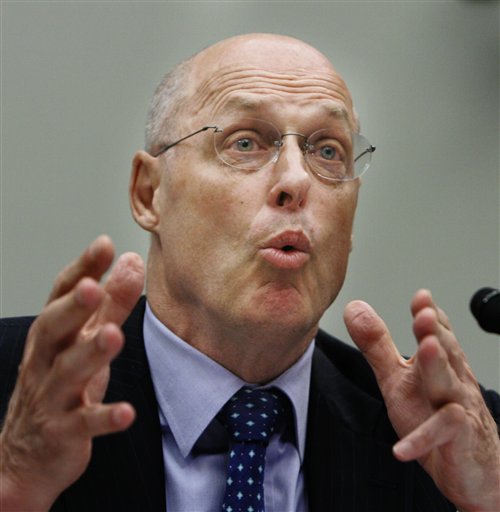
When will Hank be arrested?
Via: AP:
The government has accused Goldman Sachs & Co. of defrauding investors by failing to disclose conflicts of interest in mortgage investments it sold as the housing market was faltering.
The Securities and Exchange Commission said in a civil complaint Friday that Goldman failed to disclose that one of its clients helped create — and then bet against — subprime mortgage securities that Goldman sold to investors.
Investors in the mortgage securities lost more than $1 billion, the SEC said. The agency is seeking to recoup profits reaped on the deal.
Goldman Sachs denied the allegations. In a statement, it called the SEC’s charges “completely unfounded in law and fact” and said it will contest them.
The charges come as lawmakers seek to crack down on Wall Street practices that helped cause the financial crisis. Among proposals Congress is weighing are tougher rules for complex investments like those involved in the alleged Goldman fraud.
The Goldman client implicated in the fraud is one of the world’s largest hedge funds, Paulson & Co., which paid Goldman roughly $15 million for structuring the deals in 2007.
Goldman Sachs shares fell more than 13 percent after the SEC announcement, which also caused shares of other financial companies to sink. The Dow Jones industrial average fell more than 140 points in midday trading.
The civil lawsuit filed by the SEC in federal court in Manhattan was the government’s most significant legal action related to the mortgage meltdown that ignited the financial crisis and helped plunge the country into recession. The SEC’s enforcement chief said the agency is investigating a broad range of practices related to the crisis.
The agency also charged a Goldman vice president, Fabrice Tourre, 31, who it said was principally responsible for devising the deal and marketing the securities.
The SEC is seeking unspecified fines and restitution from Goldman Sachs and Tourre.
Asked why the SEC did not also pursue a case against Paulson, Enforcement Director Robert Khuzami said: “It was Goldman that made the representations to investors. Paulson did not.”
Goldman told investors that a third party, ACA Management LLC, had selected the underlying mortgages in the investment. But, the SEC alleges, Goldman misled investors by failing to disclose that Paulson & Co. also played a role in selecting the mortgages and stood to profit from their decline in value.
“Goldman wrongly permitted a client that was betting against the mortgage market to heavily influence which mortgage securities to include in an investment portfolio, while telling other investors that the securities were selected by an independent, objective third party,” Khuzami said in a statement.
The SEC charges come after Goldman Sachs denied last week it bet against clients by selling them mortgage-backed securities while reducing its own exposure to them.
In an annual letter to shareholders, Goldman said it began reducing its exposure to the U.S. mortgage market in late 2006. It said it did so by selling mortgage investments or buying credit default swaps. The swaps are a form of insurance that pays out if the value of the underlying asset declines.
Those hedges, also known as short positions, served Goldman well. As the housing market began cratering and losses piled up for other big banks, Goldman suffered less damage. That led to criticism that the bank benefited at the expense of clients who bought mortgage-backed securities that became toxic. Goldman denied that.
“Our short positions were not a ‘bet against our clients,'” Goldman said in the letter. “Rather, they served to offset our long positions. Our goal was, and is, to be in a position to make markets for our clients while managing our risk within prescribed limits.”
In the letter, Goldman also rejected claims that it profited from the mortgage market meltdown.




