Britain: Gun Find Soldier Walks Free from Court
December 26th, 2009Via: This is Surrey:
Paul Clarke, 27, was given a 12-month suspended sentence for possession of a firearm at Reading Crown Court today.
Clarke took the stand and sensationally claimed he had been having a sexual relationship with a female Surrey Police detective – and another police officer had grown jealous.
Research Credit: Fishy911
North Magnetic Pole Moving East Due to Core Flux
December 26th, 2009Via: National Geographic:
Earth’s north magnetic pole is racing toward Russia at almost 40 miles (64 kilometers) a year due to magnetic changes in the planet’s core, new research says.
The core is too deep for scientists to directly detect its magnetic field. But researchers can infer the field’s movements by tracking how Earth’s magnetic field has been changing at the surface and in space.
Now, newly analyzed data suggest that there’s a region of rapidly changing magnetism on the core’s surface, possibly being created by a mysterious “plume” of magnetism arising from deeper in the core.
And it’s this region that could be pulling the magnetic pole away from its long-time location in northern Canada, said Arnaud Chulliat, a geophysicist at the Institut de Physique du Globe de Paris in France.
Finding North
Magnetic north, which is the place where compass needles actually point, is near but not exactly in the same place as the geographic North Pole. Right now, magnetic north is close to Canada’s Ellesmere Island.
Navigators have used magnetic north for centuries to orient themselves when they’re far from recognizable landmarks.
Although global positioning systems have largely replaced such traditional techniques, many people still find compasses useful for getting around underwater and underground where GPS satellites can’t communicate.
The magnetic north pole had moved little from the time scientists first located it in 1831. Then in 1904, the pole began shifting northeastward at a steady pace of about 9 miles (15 kilometers) a year.
In 1989 it sped up again, and in 2007 scientists confirmed that the pole is now galloping toward Siberia at 34 to 37 miles (55 to 60 kilometers) a year.
Dred Scott Redux: Obama and the Supremes Stand Up for Slavery
December 26th, 2009Via: Chris Floyd:
While we were all out doing our Christmas shopping, the highest court in the land quietly put the kibosh on a few more of the remaining shards of human liberty.
It happened earlier this week, in a discreet ruling that attracted almost no notice and took little time. In fact, our most august defenders of the Constitution did not have to exert themselves in the slightest to eviscerate not merely 220 years of Constitutional jurisprudence but also centuries of agonizing effort to lift civilization a few inches out of the blood-soaked mire that is our common human legacy. They just had to write a single sentence.
Here’s how the bad deal went down. After hearing passionate arguments from the Obama Administration, the Supreme Court acquiesced to the president’s fervent request and, in a one-line ruling, let stand a lower court decision that declared torture an ordinary, expected consequence of military detention, while introducing a shocking new precedent for all future courts to follow: anyone who is arbitrarily declared a “suspected enemy combatant” by the president or his designated minions is no longer a “person.” They will simply cease to exist as a legal entity. They will have no inherent rights, no human rights, no legal standing whatsoever — save whatever modicum of process the government arbitrarily deigns to grant them from time to time, with its ever-shifting tribunals and show trials.
This extraordinary ruling occasioned none of those deep-delving “process stories” that glut the pages of the New York Times, where the minutiae of policy-making or political gaming is examined in highly-spun, microscopic detail doled out by self-interested insiders. Obviously, giving government the power to render whole classes of people “unpersons” was not an interesting subject for our media arbiters. It was news that wasn’t fit to print. Likewise, the ruling provoked no thundering editorials in the Washington Post, no savvy analysis from the high commentariat — and needless to say, no outrage whatsoever from all our fierce defenders of individual liberty on the Right.
But William Fisher noticed, and gave this report at Antiwar.com:
In the wake of the U.S. Supreme Court’s refusal Monday to review a lower court’s dismissal of a case brought by four British former Guantanamo prisoners against former defense secretary Donald Rumsfeld, the detainees’ lawyers charged Tuesday that the country’s highest court evidently believes that “torture and religious humiliation are permissible tools for a government to use.”
…Channeling their predecessors in the George W. Bush administration, Obama Justice Department lawyers argued in this case that there is no constitutional right not to be tortured or otherwise abused in a U.S. prison abroad.
The Obama administration had asked the court not to hear the case. By agreeing, the court let stand an earlier opinion by the D.C. Circuit Court, which found that the Religious Freedom Restoration Act – a statute that applies by its terms to all “persons” – did not apply to detainees at Guantanamo, effectively ruling that the detainees are not persons at all for purposes of U.S. law.
The lower court also dismissed the detainees’ claims under the Alien Tort Statute and the Geneva Conventions, finding defendants immune on the basis that “torture is a foreseeable consequence of the military’s detention of suspected enemy combatants.”
The Constitution is clear: no person can be held without due process; no person can be subjected to cruel and unusual punishment. And the U.S. law on torture of any kind is crystal clear: it is forbidden, categorically, even in time of “national emergency.” And the instigation of torture is, under U.S. law, a capital crime. No person can be tortured, at any time, for any reason, and there are no immunities whatsoever for torture offered anywhere in the law.
And yet this is what Barack Obama — who, we are told incessantly, is a super-brilliant Constitutional lawyer — has been arguing in case after case since becoming president: Torturers are immune from prosecution; those who ordered torture are immune from prosecution. They can’t even been sued for, in the specific case under review, subjecting uncharged, indefinitely detained captives to “beatings, sleep deprivation, forced nakedness, extreme hot and cold temperatures, death threats, interrogations at gunpoint, and threatened with unmuzzled dogs.”
Again, let’s be absolutely clear: Barack Obama has taken the freely chosen, public, formal stand — in court — that there is nothing wrong with any of these activities. Nothing to answer for, nothing meriting punishment or even civil penalties. What’s more, in championing the lower court ruling, Barack Obama is now on record as believing — insisting — that torture is an ordinary, “foreseeable consequence” of military detention of all those who are arbitrarily declared “suspected enemy combatants.”
And still further: Barack Obama has now declared, openly, of his own free will, that he does not consider these captives to be “persons.” They are, literally, sub-humans. And what makes them sub-humans? The fact that someone in the U.S. government has declared them to be “suspected enemy combatants.” (And note: even the mere suspicion of being an “enemy combatant” can strip you of your personhood.)
This is what President Barack Obama believes — believes so strongly that he has put the full weight of the government behind a relentless series of court actions to preserve, protect and defend these arbitrary powers.
China Jails Literature Professor Who Demanded Open Elections and the Rule of Law
December 26th, 2009Via: New York Times:
The harsh sentence handed down on Friday to Liu Xiaobo, one of China’s most prominent campaigners for democracy and human rights, prompted strong rebukes in the United States and Europe, but it also raised fresh questions over whether the West has much leverage over a government that is increasingly self-assured on the world stage.
By sentencing Mr. Liu to 11 years in prison for subversion, the Chinese government sent a chilling message to advocates of political reform and free speech. Mr. Liu, 53, a former literature professor who helped draft a manifesto last December that demanded open elections and the rule of law, was convicted after a closed two-hour trial on Wednesday in which his lawyers were allowed less than 20 minutes to state his case.
But many experts on Chinese politics said that Mr. Liu’s conviction on vague charges of “incitement to subvert state power” through his writing was also an unmistakable signal to the West that China would not yield to international pressure when it came to human rights. During his visit to China last month, President Obama raised Mr. Liu’s case with President Hu Jintao. Leaders of the European Union have been pressing for his release.
But a spokesman for China’s Foreign Ministry described such pressure on Tuesday as “gross interference in China’s judicial internal affairs.” The next day, more than two dozen American and European diplomats who sought to observe the trial were barred from the courthouse.
“If China’s Communist Party wanted to advertise to the world that they will do anything to protect their power and use the judiciary to accomplish that, then the persecution of Liu Xiaobo was a perfect vehicle,” Jerome A. Cohen, an expert on China’s legal system and a senior fellow at the Council on Foreign Relations, said Friday.
The State Department issued a statement on Friday calling on China to release Mr. Liu, saying that the “persecution of individuals for the peaceful expression of political views is inconsistent with internationally recognized norms of human rights.”
Chancellor Angela Merkel of Germany said she was “dismayed” by the sentence. The United Nations said Mr. Liu’s conviction had thrown “an ominous shadow” over China’s commitments to human rights.
Such pointed criticisms are unlikely to have much impact, many China analysts said. Mr. Hu assumed full power in 2003 after a period of modest legal reforms. But under his leadership, the government has presided over a tightening of Internet restrictions, the repression of rights lawyers and the persecution of intellectuals who called for greater transparency and an end to single-party rule. Those who thought that the leadership might loosen its controls for the Beijing Olympics last year were disheartened by the crackdown that took place to prevent people from organizing demonstrations.
Edward Friedman, an expert on Chinese politics at the University of Wisconsin in Madison, said many people in the West had been clinging to the misguided notion that China’s economic development would quickly lead to political liberalization. “It’s clear that what matters most to the Chinese Communist Party is the survival of the regime and their monopoly on power,” he said.
Federal War Spending Exceeds State Government Outlays
December 26th, 2009Via: Public Record:
The U.S. spends more for war annually than all state governments combined spend for the health, education, welfare, and safety of 308 million Americans.
Joseph Henchman, director of state projects for the Tax Foundation of Washington, D.C. says the states collected a total of $781 billion in taxes in 2008.
For a rough comparison, according to Wikipedia data, the total budget for defense in fiscal year 2010 will be at least $880 billion and could possibly top $1 trillion. That’s more than all the state governments collect.
Henchman says all American local governments combined (cities, counties, etc.) collect about $500 billion in taxes. Add that to total state tax take and you get over $1.3 trillion. This means Uncle Sam’s Pentagon is sopping up nearly as much money as all state, county, city, and other governmental units spend to run the country.
If the Pentagon figure of $1 trillion is somewhat less than all other taxing authorities, keep in mind the FBI, the various intelligence agencies, the VA, the National Institutes of Health (biological warfare) are also spending on war-related activities.
A question that describes the above and answers itself is: In what area can the Federal government operate where states and cities cannot tread? The answer is: foreign affairs—raising armies, fighting wars, conducting diplomacy, etc. And so Uncle Sam keeps enlarging this area. His emphasis is not on diplomacy, either.
For every buck spent by the State Department, which gets some $50 billion a year, the Pentagon spends $20. As for the Peace Corps, its budget is a paltry $375 million—hardly enough to keep the Pentagon elephant in peanuts.
Nobel Prize economist Joseph Stiglitz and finance authority Linda Bilmes write in their “The Three Trillion Dollar War”(W.W. Norton), “defense spending has been growing as a percentage of discretionary funding (money that is not required to be spent on entitlements like Social Security), from 48 percent in 2000 to 51 percent today. That means that our defense needs are gobbling up a larger share of taxpayers’ money than ever before.”
And they add, “The Pentagon’s budget has increased by more than $600 billion, cumulatively, since we invaded Iraq.” With its 1,000 bases in the U.S. and another 800 bases globally, the U.S. truly has become a “Warfare State.” Today, military-related products account for about one-fourth of total U.S. GDP. This includes 10,000 nuclear weapons. Indeed, the U.S. has lavished $5.5 trillion just on nukes over the past 70 years.
No other nation has anything remotely like this menacing global presence. The Pentagon strengthens its grip by running joint “training” exercises with the military of 110 other nations, including outright dictatorships that suppress internal unrest.
The U.S. spends more on weaponry than the next dozen nations combined and is by far the No. 1 world arms peddler. “The government employs some 6,500 people just to coordinate and administer its arms sales program in conjunction with senior officials at American embassies around the world, who spend most of their ‘diplomatic’ careers working as arms salesmen,” writes Chalmers Johnson in “Blowback: The Costs and Consequences of American Empire(Henry Holt).”
Johnson goes on to say the U.S. military establishment today is “close to being beyond civilian control” and that despite its ability to “deliver death and destruction to any target on earth and expect little in the way of retaliation” it demands more and newer equipment “while the Pentagon now more or less sets its own agenda” and “monopolizes the formulation and conduct of American foreign policy.”
How long will it be before this tyrannical, anti-democratic, colossus that is sucking up as much money for war as all states, counties and cities spend on peace—and which straddles the globe, boosts dictators, and beats the war drums—turns on its own people?
Fannie, Freddie: Unlimited Fail
December 25th, 2009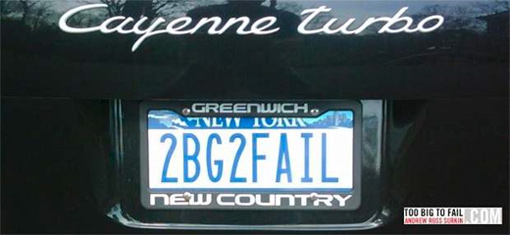
Change
Via: Reuters:
The Obama administration pledged on Thursday to back beleaguered mortgage finance giants Fannie Mae and Freddie Mac no matter how big their losses may be in the next three years.
It also jettisoned a demand that the two companies cut the size of their mortgage-related investment portfolios next year, allowing them to provide even more support in the near term for a housing market recovering from its worst slump in decades.
The Treasury Department said it made the changes to assure financial markets it stood firmly behind both companies and to buy more time for the two government-sponsored enterprises to whittle down their mortgage-related holdings.
The two agencies each had a Treasury credit line of $200 billion. Combined, they have so far tapped about $111 billion.
The Treasury’s announcement came just hours after the companies said their chief executives would be paid up to $6 million on an annualized basis for 2009.
Market Moves and the Lunatic Fringe
December 24th, 2009Via: The Australian:
IMPLODING equities, exploding credit default swaps, soaring gold and slumping oil — if, at any time over the past 18 months, it seemed that markets were in the grip of lunacy, it may be because investors are, technically, lunatics.
The market mayhem since the global financial meltdown began in 2008 has provided fertile soil for proponents of a branch of investment theory which holds that market cycles move in phase with the Moon.
Now, backed with decades of data and behaviour that can no longer be explained by purely rational analysis, the lunar theory has slipped into the mainstream.
In a piece of research that involved 14 of its senior analysts from across five leading financial centres scrutinising data from 32 leading indices over several decades, Macquarie Securities has arrived at a startling discovery: the two days on either side of the new lunar month represent most of the positive returns on equity markets for the next four weeks.
“Using data since 1988 for a wide variety of indices,” the report concluded, “it is quite clear that a strong surge in returns can be seen leading into the turn of the (lunar) month.”
The analysts are quick to dismiss the idea that the theory applies only to markets in Asia — a part of the world where belief in the lunar theory, especially in Hong Kong and Japan, is better established.
“The effect is not just an Asian effect, it happens globally,” the Macquarie report said.
Research Credit : SW
Cryptogon Readers Send Contributions
December 23rd, 2009Thank you.
AF CA$5
MW $20
RM $25
AS €100!
Eileen $45
Trading Shares in Milliseconds
December 23rd, 2009I like the part about how NASDAQ is looking at requiring all brokers to use a specified length of network cable on the links to the exchange’s servers. HA.
The article assumes the reader will get it, but just in case you don’t, the point is that the length of the cable affects the latency. A shorter cable will have shorter latency. A longer cable will have longer latency. As absurd as it sounds, the speed of light is a factor to consider for these strategies. (More information on latency issues as they relate to trading.)
Via: Technology Review:
Today’s stock market has become a world of automated transactions executed at lightning speed. This high-frequency trading could make the financial system more efficient, but it could also turn small mistakes into catastrophes.
If Manoj Narang is about to bring down the markets, he’s certainly relaxed about it. Narang, who wears a goatee and wire-frame glasses, is casually dressed in a brown shirt and dark gray sweatshirt. Sitting on a swivel chair with one leg tucked under the other, he seems positively composed, especially for a man who has just bought and sold 15 million shares with a total value of $600 million. For Narang, however, such volume represents just the start of a normal day. Though it’s about noon on a Friday morning, he has barely begun.
Narang is the head of Tradeworx, a hedge fund and financial-technology firm that makes purely automated trades; all decisions are reached and acted on at near light speed by computers running preprogrammed algorithms. “Actually, we run two businesses,” he says. “The first trades in and out of shares in about a second and holds them for an average of two or three days. That’s the medium-speed fund. The high-speed fund could make thousands of trades a second and holds them for a matter of minutes.”
By the end of the day, his computers will have bought and sold about 60 million to 80 million shares, with the heaviest activity in the last hour of trading, from three to four in the afternoon. Tradeworx and similar firms around the country will race to close billions of bets that hinge on things like tiny differences between the prices of shares in an exchange-traded fund holding the S&P 500 and the individual shares that make up the same index. The profits go to the company with the fastest hardware and the best algorithms–advantages that enable it to spot and exploit subtle market patterns ahead of everyone else. At the end of a typical day, the Tradeworx high-speed business holds no shares at all. Come Monday, Narang will look to trade millions more shares. It seems like a lot, and it is, but Narang estimates that he’s probably only somewhere in the middle of the top 50 traders by volume.
Just five years ago, automated trades made up about 30 percent of the market, and few of those moved as quickly as today’s trades do. Since then, however, automated trading has become much more widespread, and much quicker. Narang acknowledges starting his ultrafast group as a defensive maneuver when he began to notice faster traders eroding the performance of his medium-speed strategy. Now the medium-speed fund is adopting the techniques he developed in the ultrafast fund.
TheTabb Group, a consultancy based in Westborough, MA, estimates that high-frequency automated trading now accounts for 61 percent of the more than 10 billion shares traded daily across the numerous exchanges that make up the U.S. market. Tabb estimates profits from high-frequency trading in the first nine months of last year at $8 billion or more. With the rise of automation, the bulk of U.S. stock trading has moved from the once-crowded floor of Manhattan’s New York Stock Exchange (NYSE) to silent server farms run by exchanges and broker-dealers across the country: the proportion of all trades that the NYSE handles has shrunk from 80 percent in 2005 to 40 percent today. Trading is now essentially a virtual art, and its practitioners put such a premium on speed that NASDAQ has considered issuing equal 100-foot lengths of cable to the brokers who send orders to its exchange servers.
Swindler Duped CIA Over Al-Qaeda Decoding Scam
December 23rd, 2009Related “research”: U.S. Government Funding Research Into “Malintent” Detector?
Via: AFP:
A con artist convinced the CIA and other US agencies in 2003 that he could decode secret messages sent by Al-Qaeda through Al-Jazeera broadcasts, Playboy magazine reported.
Duped by claims that “bar codes” on Al-Jazeera television contained targeting information for Al-Qaeda attacks, former president George W. Bush’s administration raised the terror alert and cancelled several transatlantic flights in December 2003, the report said, citing former CIA officials.
The swindler at the center of the scam was Dennis Montgomery, head of a small software company in Reno, Nevada. He persuaded the Central Intelligence Agency and the Department of Homeland Security that his technology could decipher messages with flight numbers and longitudes and latitudes meant for Al-Qaeda operatives.
With assistance from French intelligence, CIA officials eventually concluded there were no secret messages in Al-Jazeera television broadcasts, said the report, published in the magazine’s latest edition.
“A branch of the French intelligence services helped convince the Americans that the bar codes were fake,” it said.
CIA and French officials asked another technology company to find or re-create codes from Al-Jazeera transmissions and “found definitively that what Montgomery claimed was there was not,” it said.
But even after the CIA stopped cooperating with Montgomery, he succeeded in convincing other government agencies that he had valuable code-breaking technology.
In January 2009, he signed a three-million-dollar research contract with the US Air Force, according to Playboy.
“We were testing some of the software. We were just looking at it to see if there was anything there,” Joseph Liberatore, an Air Force program manager, told the magazine.
Montgomery has faced a number of lawsuits and last year was charged with bouncing nine checks worth a total of one million dollars in Las Vegas.