Telecom XT Blues: Resolved with Directional, High Gain Antenna
December 20th, 2009Update: Tennatron Directional Antenna Works Great
As anticipated, the antenna did the trick.
I bought and installed Tennatron’s antenna for mobile networks in New Zealand. With the antenna installed, my XT connection hit 2.6 megabits/sec down and 1.5 megabits up. (That’s *bleeping* fantastic; considering our deep wopwops location.) More importantly, the connection is stable. I haven’t tested it extensively, but constant ping returns successful 99% of the time. I haven’t had any timeouts so far.
If you’re struggling with Telecom XT mobile broadband in a difficult coverage area, I’d highly recommend this antenna from Tennatron. It’s working out very well for me.
Some notes for anyone who is using this antenna:
The reception bars on the modem’s connection manager software aren’t very helpful. To make sure that your antenna is pointed in the best direction, sweep it around in a full circle and check your latency and speed as you go. Since the antenna is so directional, orientation is critical. Depending on where I pointed it, the download speed ranged from 500 kilobits per second to 2.6 megabits per second.
—End Update—
Update: Screen Door
Check this out:
ScreenDoorFi
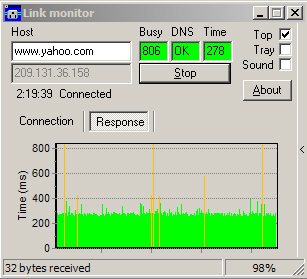
This is in a dead zone area outside the house, or so I thought. Right near a metal screen door-type thing, it picked up one bar. I’ve been using the connection for a few hours and it has been pretty stable.
Move the modem more than a few inches from the screen door and the link goes dead again.
—End Update—
I don’t know what has happened, but over about the last two days, my Telecom XT mobile broadband connection has become pretty much unusable. The connection manager program shows that I have three out of five bars reception, like it usually does, but the link is extremely unstable and is going dead 30%-40% of the time.
Telecom assures me that nothing has changed on their side, and that this has nothing to do with the issue that took out the entire network south of Taupo a few days ago. I went all the way through their tech support hoops. They’re baffled. I’m baffled. It’s a fascinating coincidence, though.
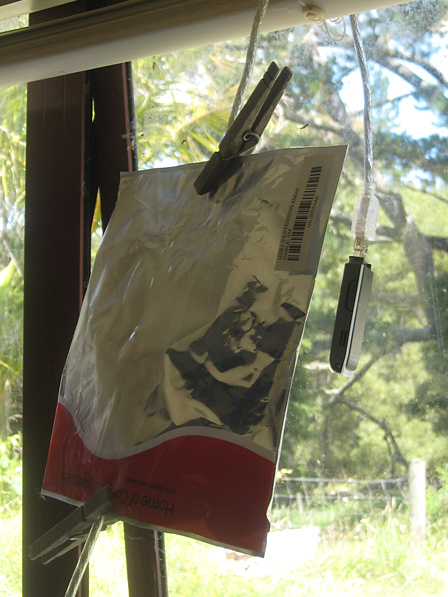
This was never a great area for reception to begin with. So, I’m hoping that this is somehow a reception/reflection issue. But now, no amount of wokfi is enough to make this thing work right. An anti static bag with clothes pegs has yielded the best result so far. Without that clipped behind the modem, no dice, nothing, zilch. Totally dead.
BagFi
I convinced Telecom to send me out a new mobile broadband modem (MF668+) at the discounted contract price; this one has an external antenna connection. When I signed up, there were no options for modems with external antenna connections. I’m going to buy a high gain antenna that’s designed for these situations. It should work fine once I install the antenna.
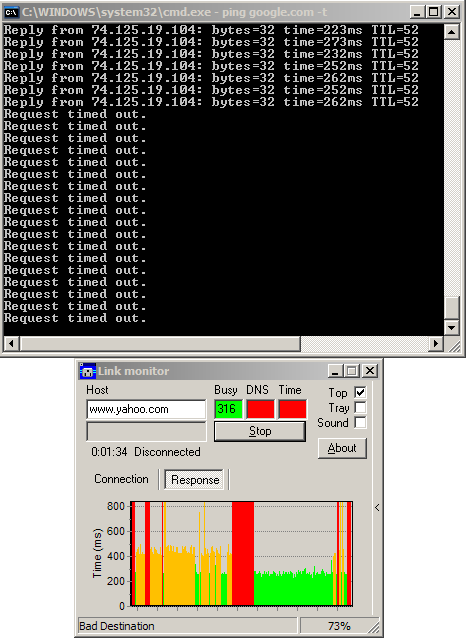
All of this is a roundabout way of telling you that I’m having a really hard time using the Internet right now. I run Link Monitor to let me know when the connection is working. Green is normal. Yellow means latency is above normal. Red is a dead connection, like right now.
Telecom XT Blues
So, I’ll wait a few minutes and try to post this… *sigh*
With any luck, the new gear should be here this week… But the annual Northern Hemisphere Winter Solstice Pagan Ritual (Christmas), could delay my infrastructure upgrades until the following week.
“Double the holdings? It is definitely impossible.”
December 19th, 2009Via: Shanghai Daily:
IT is getting harder for governments to buy United States Treasuries because the US’s shrinking current-account gap is reducing supply of dollars overseas, a Chinese central bank official said yesterday.
The comments by Zhu Min, deputy governor of the People’s Bank of China, referred to the overall situation globally, not specifically to China, the biggest foreign holder of US government bonds.
Chinese officials generally are very careful about commenting on the dollar and Treasuries, given that so much of its US$2.3 trillion reserves are tied to their value, and markets always watch any such comments closely for signs of any shift in how it manages its assets.
China’s State Administration of Foreign Exchange reaffirmed this month that the dollar stands secure as the anchor of the currency reserves it manages, even as the country seeks to diversify its investments.
In a discussion on the global role of the dollar, Zhu told an academic audience that it was inevitable that the dollar would continue to fall in value because Washington continued to issue more Treasuries to finance its deficit spending.
He then addressed where demand for that debt would come from.
“The United States cannot force foreign governments to increase their holdings of Treasuries,” Zhu said, according to an audio recording of his remarks. “Double the holdings? It is definitely impossible.”
“The US current account deficit is falling as residents’ savings increase, so its trade turnover is falling, which means the US is supplying fewer dollars to the rest of the world,” he added. “The world does not have so much money to buy more US Treasuries.”
China continues to see its foreign exchange reserves grow, albeit at a slower pace than in past years, due to a large trade surplus and inflows of foreign investment. They stood at US$2.3 trillion at the end of September.
FDIC Friday
December 19th, 2009Via: CNN:
Banks in six U.S. states were closed Friday, bringing the total number of failed banks this year to 140, at a cost of over $1 billion to the Federal Deposit Insurance Corporation.
Among the institutions seized by regulators was a so-called “bankers’ bank” in Illinois called Independent Bankers’ Bank (IBB), which had about 450 client banks in four U.S. states.
France: Former President Chirac Indicted for Embezzlement
December 18th, 2009Via: France24:
A drawn-out case involving claims that former French president Jacques Chirac set up fictitious jobs while he served as mayor of Paris is heading to court after a judge ordered Chirac’s indictment on embezzlement charges.
U.S. Army Lightning-Gun ‘Approaching Weaponisation’
December 18th, 2009Via: Register:
The Pentagon continues to pour funding into Arizona-based laser plasma lightning blaster-gun firm Applied Energetics, formerly known as Ionatron. The US Army says that the firm’s lightning guns are “approaching the level of maturity needed to begin weaponization”.
The military assessment came as the US Army Research, Development and Engineering Command (ARDEC) inked a new $3.1m deal with Applied last week.
“Now that the technology is approaching the level of maturity needed to begin weaponization we will be more closely coordinated with Applied Energetics through this contract to fulfil Army mission needs,” said Ben Lagasca, chief of “Advanced Energy Armaments” at ARDEC.
The technology in question is a fairly old idea: that of using a laser beam to create a plasma “tunnel” or “channel” through the atmosphere which would be more conductive than ordinary air. This would allow a powerful electric spark discharge – an artificial lightning bolt – to be directed onto a target with some precision.
Arizona firm Ionatron began work on this plan in 2002. Originally the company thought that it would soon develop lightning blasters so portable and powerful that they would supersede conventional small arms. Any desired electric intensity from lethal force down to circuitry-disabling-but-harmless-to-people could be selected on one’s battery-powered electric blaster pistol. There would also be a wireless-Taser stun option in between.
Initially, however, the firm attempted to deploy its zappers as a bomb-disposal tool on robotic vehicles for use in Iraq. This ended in ignominious failure during 2006, and Ionatron stock fell off a cliff. The firm renamed itself, but nonetheless faced huge shareholder anger and earlier this month was forced to cough up $6.5m to settle a class-action lawsuit.
Still, normally the firm’s continued military research contracts would offer some confidence that at least some kind of electric bomb-zapper is in fact on the horizon – if not a proper sci-fi raygun.
But colossal amounts of cash have been targeted by the US forces at finding a technical fix for the insurgent bombs which have been such a deadly scourge overseas. That money has to be spent – perhaps regardless of how promising any given project may genuinely appear to be.
Not Just Drones: Militants Can Snoop on Most U.S. Warplanes
December 18th, 2009Via: Wired:
Tapping into drones’ video feeds was just the start. The U.S. military’s primary system for bringing overhead surveillance down to soldiers and Marines on the ground is also vulnerable to electronic interception, multiple military sources tell Danger Room. That means militants have the ability to see through the eyes of all kinds of combat aircraft — from traditional fighters and bombers to unmanned spy planes. The problem is in the process of being addressed. But for now, an enormous security breach is even larger than previously thought.
The military initially developed the Remotely Operated Video Enhanced Receiver, or ROVER, in 2002. The idea was let troops on the ground download footage from Predator drones and AC-130 gunships as it was being taken. Since then, nearly every airplane in the American fleet — from F-16 and F/A-18 fighters to A-10 attack planes to Harrier jump jets to B-1B bombers has been outfitted with equipment that lets them transmit to ROVERs. Thousands of ROVER terminals have been distributed to troops in Afghanistan and Iraq.
But those early units were “fielded so fast that it was done with an unencrypted signal. It could be both intercepted (e.g. hacked into) and jammed,” e-mails an Air Force officer with knowledge of the program. In a presentation last month before a conference of the Army Aviation Association of America, a military official noted that the current ROVER terminal “receives only unencrypted L, C, S, Ku [satellite] bands.”
So the same security breach that allowed insurgent to use satellite dishes and $26 software to intercept drone feeds can be used the tap into the video transmissions of any plane.
People Fed Pizza as Reward for Receiving Swine Flu Vaccination
December 18th, 2009Via: WXYZ:
The Detroit Health Department is fighting swine flu with pepperoni. When kids return to school after the holiday break, each class has the opportunity to get a free pizza party – if they sign up for the shots.
…
The Detroit Health Department has already been working especially hard to get the vaccine into the community.
For instance, today parents attending the Christmas program at the Foreign Language Immersion School on Outer Drive had the chance to get shots for themselves and their children before or after the program.
Mom, Kimberley Wallace said, “This is the easiest for me. This way I don’t have to take them to the doctor’s office, take them out of school or anything so it works out real well.”
But apparently not well enough. So Dr. Davis and his team came up with an innovative idea. They teamed up with Happy’s Pizza. And each class in the city that has a permission slip return rate of 80-percent or more will get a pizza party for the entire class.
AIG, Fannie Mae, Freddie Mac and GMAC: “Long-Term Wards of the State”
December 18th, 2009Via: New York Times:
Even as the biggest banks repay their government debt in what is being heralded as a successful rescue program, four troubled giants of the financial world remain on government life support.
These companies, the American International Group, Fannie Mae, Freddie Mac and GMAC, are not only unable to repay the government, they are in need of continuing infusions that make them look increasingly like long-term wards of the state.
And the total risk they pose to the taxpayer far exceeds that of the big banks. Fannie and Freddie, in the final days of the year, are even said to be negotiating with the Treasury about greatly expanding the money available to them.
Though the four are not in all the same businesses, they were caught in one of the same traps: They sold mortgage guarantees — in some cases to each other. Now when homeowners default, as they are doing in record numbers, these companies are covering the losses. Essentially, taxpayer money to these companies is being used partly to protect banks and other investors who own the mortgages.
Initial Jobless Claims in U.S. Unexpectedly Increase
December 17th, 2009Via: Bloomberg:
More Americans than anticipated filed first-time claims for unemployment benefits last week, a reminder that the labor market will take time to strengthen and may weigh on the economic recovery.
Initial jobless claims rose by 7,000 to 480,000 in the week ended Dec. 12, from a revised 473,000 the prior week, Labor Department figures showed today in Washington. The number of people receiving unemployment insurance was little changed in the prior week, while those getting extended payments increased.
Federal Reserve policy makers yesterday said weakness in the labor market is restraining consumer spending, which accounts for about 70 percent of the world’s largest economy. Concerns over the lack of jobs prompted the central bank yesterday to reiterate a pledge to keep the benchmark interest rate low for an “extended period.”
“The level of new claims remains elevated,” said Steven Wood, president of Insight Economics LLC in Danville, California. “The labor market is improving, but remains soft.”
Stock-index futures were down after the report as Citigroup Inc. sold stock for a price so low the U.S. government delayed plans to shrink its one-third stake. The contract on the Standard & Poor’s 500 Index fell 0.9 percent to 1,096.2 at 8:49 a.m. in New York. Treasury securities rose.
Exceeds Forecast
Jobless claims were projected to drop to 465,000 from 474,000 initially reported for the prior week, according to the median forecast of 43 economists in a Bloomberg News survey. Estimates ranged from 450,000 to 475,000.
The report showed the four-week moving average of initial claims, a less volatile measure, fell to 467,500 last week, the lowest level since September 2008, from 472,750.
Continuing claims increased by 5,000 in the week ended Dec. 5 to 5.19 million. The continuing claims figure does not include the number of Americans receiving extended benefits under federal programs.
Today’s report showed the number of people who’ve use up their traditional benefits and are now collecting extended payments jumped by about 144,000 to 4.73 million in the week ended Nov. 28. Seventeen of the 50 states and territories where workers are eligible to receive the government’s latest 13-week extension have begun to report that data, a Labor Department spokesman said.
AT&T Workers Sue for $1 Billion in Overtime Pay
December 17th, 2009Mark Klein’s, Wiring Up The Big Brother Machine…And Fighting It, not only lays out the most detailed account (in the public domain) of how the NSA conducts mass communications intercepts, it also covers the grim corporate culture at AT&T. If you want to constantly think that you’re about to get laid off, AT&T is the place to work.
Via: Reuters:
AT&T Inc workers are suing the telephone operator for an estimated $1 billion in overtime payments in two class action lawsuits that say it is wrongly depriving about 5,000 employees of overtime pay.
The lawsuits say that a company-wide policy exempting first-level managers from overtime pay was a violation of federal labor laws and California state laws, according to Sanford Wittels & Heisler, the law firm filing the case.
AT&T, which employs about 290,000 people and is expected to generate $123 billion in revenue this year, declined to comment on the cases directly but said that it complies with all federal and state wage laws.