Australia: Was a Covert Operative Planted in a Group of Five Melbourne Men Charged with Terrorism Offences?
August 26th, 2009Via: The Age:
THE Australian Federal Police has come under pressure to reveal whether a covert operative was planted in a group of five Melbourne men charged with terrorism offences.
The charges relate to an alleged plot to attack the Holsworthy Army Base in NSW.
It was revealed yesterday that one of the men, Saney Aweys, had been recorded on telephone intercepts expressing his hatred for Australia and people who were not followers of Islam. Lawyers for the men described the prosecution case as weak.
Under questioning from Aweys’ lawyer, Rob Stary, on the second day of a bail application at Melbourne Magistrates Court, federal agent David Kinton said no civilian witnesses had made statements ”at this stage”.
But when Mr Stary asked if a covert operative had been planted, Mr Kinton hesitated, before replying: ”Can I seek legal advice?”
After an adjournment, Gerard Maguire, for Chief Commissioner Simon Overland, said his instructions could only be disclosed in a closed court.
Mr Stary dropped the questioning, but said he would not relinquish the point. It is likely to be brought up again later.
State of Florida Sold Personal Information from Registration and Driver License Records to Mass Marketers
August 26th, 2009Via: Miami Herald:
Gov. Charlie Crist and the Florida Cabinet have agreed to pay the federal government $1.5 million to settle a complaint that the state violated motorists’ privacy.
The panel accepted the deal Tuesday, but it also will need the Legislature’s approval.
Florida violated federal law by selling personal information from registration and driver license records to mass marketers from June 1, 2000 through Sept. 30, 2004.
State law then had let motorists opt out of the program. Federal law, though, required just the opposite – that information be withheld unless motorists asked for it to be released.
The state previously settled a lawsuit for $10.4 million by agreeing to give motorists $1 off 2009-10 registration fees.
George Carlin – Conspiracy Theorists
August 26th, 2009Geithner: Auditing the Fed Is a “Line That We Don’t Want to Cross”
August 26th, 2009Via: Corbett Report:
In an interview released today by Digg and the Wall Street Journal, Treasury Secretary Timothy Geithner was pressured about the growing popular movement to Audit the Fed spearheaded by Texas Congressman Ron Paul. A visibly uncomfortable Geithner attempts to dismiss the question by stating “I’m sure people understand that you want to keep politics out of monetary policy.” When Geithner is again pressed on the issue, he makes the stunning assertion that conducting an audit of the Federal Reserve—something never before done in its 96 year history—is a “line that we don’t want to cross,” proclaiming that such a move would be “problematic for the country.”
Multitasking Muddles Brains, Even When the Computer Is Off
August 26th, 2009Via: Wired:
Some people suspect that a multitasking lifestyle has changed how they think, leaving them easily distracted and unable to concentrate even when separated from computers and phones. Their uneasiness may be justified.
In several benchmark tests of focus, college students who routinely juggle many flows of information, bouncing from e-mail to web text to video to chat to phone calls, fared significantly worse than their low-multitasking peers.
Geithner Asks Congress for Higher U.S. Debt Limit
August 26th, 2009Via: Reuters:
U.S. Treasury Secretary Timothy Geithner formally requested that Congress raise the $12.1 trillion statutory debt limit on Friday, saying that it could be breached as early as mid-October.
“It is critically important that Congress act before the limit is reached so that citizens and investors here and around the world can remain confident that the United States will always meet its obligations,” Geithner said in a letter to Senate Majority Leader Harry Reid that was obtained by Reuters.
A Treasury spokeswoman declined to comment on the letter.
Treasury officials earlier this week said that the debt limit, last raised in February when the $787 billion economic stimulus legislation was passed, would be hit sometime in the October-December quarter. Geithner’s letter said the breach could be two weeks into that period, just as the 2010 fiscal year is getting underway.
The latest request comes as the Treasury is ramping up borrowing to unprecedented levels to fund stimulus and financial bailout programs and cope with a deep recession that has devastated tax revenues.
It is expected to issue net new debt of as much as $2 trillion in the 2009 fiscal year ended Sept. 30 and up to $1.6 trillion in the 2010 fiscal year, according to bond dealer forecasts.
As Budget Deficit Grows, So Do Doubts on Dollar
August 26th, 2009Via: Wall Street Journal:
The U.S. economy may be showing signs of recovering from the financial crisis, but the jury is still out on the future of the U.S. dollar.
While many analysts expect the dollar to strengthen in coming months as the crisis fades and the U.S. economy turns toward growth, a growing chorus of investors is expressing concern about the longer-term outlook for the greenback.
In a new twist to an old refrain among economists, who have long worried about the effects of growing U.S. debt, they say that the huge liabilities the U.S. is taking on to dig its way out of crisis could ultimately undermine faith in the dollar.
“There has been a lot of disappointment with the way the U.S. credit crisis was handled,” says Claire Dissaux, managing director of global economics and strategy for Millennium Global Investments Ltd., a London investment firm specializing in currencies. “The dollar’s loss of influence is a steady and long-term trend.”
On Tuesday, the Obama administration added fuel to concerns about the dollar, saying the U.S. will run a cumulative budget deficit of $9 trillion over the next 10 years, $2 trillion more than it had previously projected.
“That’s going to be negative for the dollar,” says Adam Boyton, a currency analyst at Deutsche Bank AG in New York. President Barack Obama also reappointed Federal Reserve Chairman Ben Bernanke, whose efforts to rescue the economy have won praise, but have also entailed pumping large amounts of freshly created dollars into the financial system.
Investors and economists have long harbored concerns about the dollar’s decline, especially in the beginning of this decade as the federal government and consumers ran up their debtloads to finance everything from foreign wars to flat-screen TVs. Last fall’s financial crash suggested that such fears may be overblown: As markets plunged in the wake of the collapse of Lehman Brothers Holdings Inc., investors scrambled to stash their cash in U.S. Treasury bills, perceiving them to be the safest investments. That boosted the value of the U.S. dollar against many of its major counterparts.
Now, though, major investors like Berkshire Hathaway Inc. Chairman Warren Buffett and bond investment firm Pimco fear the government’s fiscal and monetary stimulus programs could end up fueling inflation in coming years and hammering the dollar. Higher inflation eats up the returns of bond investments that provide a fixed interest income, making them less attractive to investors. Less demand for U.S. bonds could mean a weaker dollar.
Mr. Buffett, for example, worries that U.S. policy makers will fail to move decisively to curtail the nation’s ballooning net debt, expected by some to rise to more than 75% of annual economic output by 2013. Instead, policy makers might tolerate higher inflation, which makes existing debts more manageable but would hurt the U.S.’s creditors, including China and Japan. In this scenario, investors would demand much higher interest when lending to the U.S. government, raising its borrowing costs and making further budget deficits harder to finance at a time when an aging population will sharply boost the costs of social security and government-sponsored health care.
CIA Threatened to Kill Detainee Families
August 25th, 2009Until the early 1980s, the U.S. military ran an intelligence training program in Latin America and elsewhere using manuals that taught foreign officers to offer bounties for captured or killed insurgents, spy on nonviolent political opponents, kidnap rebels’ family members and blackmail unwanted informants, according to recently declassified Army and Defense Department documents.
The manuals, known as Project X, were written by U.S. Army experts starting in 1965 for use by the U.S.-funded Joint Foreign Intelligence Assistance Program. Portrayed by the Army as instructional materials to help friendly governments fight Cuban- and Soviet-inspired rebels in Latin America, the manuals were “in fact a guide for the conduct of clandestine operations” against domestic political adversaries including peaceful ones, according to a panel of Army experts that later reviewed some of the material.
—Army’s Project X Had Wider Audience (1997)
Via: CBC News:
A newly declassified CIA report says interrogators threatened to kill family members of a man accused of planning the Sept. 11, 2001 attacks.
The report, written in 2004 and released Monday by the U.S. Justice Department, said CIA officers told Khalid Sheikh Mohammed that if any other attacks happened in the United States, “we’re going to kill your children.”
The report also said Abd al-Nashiri, the alleged mastermind of the 2000 USS Cole warship bombing, was hooded and handcuffed and threatened with an unloaded gun and a power drill.
The unidentified interrogator also threatened Nashiri’s mother and family, implying that they would be sexually abused in front of him, according to the report.
Mohammed and al-Nashiri are currently being held by the U.S. at the Guantanamo Bay detention centre in Cuba.
In another case, CIA officers staged a mock execution — firing a gun in a room adjacent to an interrogation — in an apparent effort to convince a detainee that someone nearby had been killed, the report said.
Goldman Sachs “Trading Huddles”
August 25th, 2009I had always assumed the entire business of the markets to be a massive criminal enterprise that allowed public participation simply because it made a few people extremely wealthy.
—Insider Crimes, Funny Money and Options Rackets
Via: Wall Street Journal:
Securities regulators are examining weekly meetings at Goldman Sachs Group Inc. in which research analysts give tips to traders and then to big clients, as the Wall Street giant considers disclosing these so-called trading huddles to all its clients.
The Wall Street Journal reported Monday that analysts at Goldman sometimes shared with traders and key clients short-term trading tips that sometimes differed from the firm’s long-term research.
Examiners at the Financial Industry Regulatory Authority, the industry self-regulatory body known as Finra, and the Securities and Exchange Commission intend to ask Goldman for more information on these weekly get-togethers, people familiar with the matter said.
Internal documents show that at times, these short-term trading tips differed from Goldman’s long-term research. Critics complain that Goldman’s distribution of the trading ideas to Goldman traders and major clients hurts other Goldman customers who aren’t given the opportunity to trade on the information, and may be relying on the firm’s longer-term research to make investment decisions.
The huddles, and what is discussed during or after them, currently aren’t disclosed in Goldman’s long-term research. On Monday the firm internally discussed adding information about the service on its client Web site. Some firms, such as Morgan Stanley, also give stock ideas to clients, but disclose the service in their longer-term research and on its Web site.
The huddles highlight the new demands on research analysts as trading desks have become central drivers of profit in recent years. In a 2003 case, U.S. regulators accused firms of issuing overly optimistic research in order to win lucrative investment banking business. In a settlement of that case, Wall Street agreed to strict limitations on the dealings between bankers and stock analysts.
“I think it is unrealistic to expect firms to treat all clients equally,” said Robert Glauber, former head of the National Association of Securities Dealers, the precursor agency to Finra, and a lecturer at Harvard’s John F. Kennedy School of Government. “The speed, depth and detail of the advice given may be different, but there has to be limits. And the basic stock recommendation must be the same and any differences should be disclosed.”
Goldman hasn’t been accused of violating any securities laws in its distribution of the trading tips. While it is considering adding a disclosure to its client Web site, it says there is no issue with the huddles. “We believe the disclosure we have now is entirely appropriate. Analysts are not allowed to express differing views without publishing that view,” a Goldman spokesman said.
In the Monday Journal article, a Goldman spokesman said ideas that arise from the huddles are simply “market color” and “always consistent with the fundamental analysis” in published research reports.
July Earnings and Cryptogon Readers Send Contributions in August
August 25th, 2009I don’t know about other parents out there, but for me, having an almost two-year-old son has shaken loose a couple of cotter pins and caused a few gears to throw some teeth around here. There is a constant hum of activity that is accentuated by crashing sounds and gleeful shrieks and laughter. Updating Cryptogon these days is somewhat like trying to read, write and concentrate in the middle of a machine shop.
I told Becky that I was having trouble concentrating and that something was probably wrong with me. She said that it’s called “baby brain” and that most parents experience it. *chuckle*
My use of the computer, or “booper,” is a source of near otherworldly fascination for Owen (although, given the choice, he’d much rather run around outside in the mud and pouring rain like a wild man). He doesn’t understand what his dad is doing in front of the computer for such long periods of time, or, more importantly, why he isn’t allowed to help. For a while, we tried closing the door to the room where I work, but he heard me typing on the keyboard and knew what was happening. “Daddy booper. Daddy booper.” Also, there are boopers at many of the places we go. Post office. ATM. Grandparents’ house. Auntie’s house. Grocery store. Library. Other people’s homes often have TV screens in addition to computers. Everybody except mum and dad have little screens (mobile phones) in their pockets or purses that occasionally light up and make weird noises. These are immensely fascinating. Seriously, he lets out a satisfied groan when he gets a hold of one and pushes the buttons.
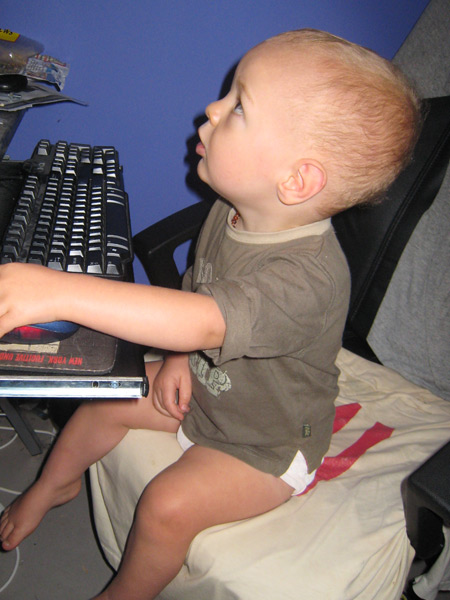
I left Owen standing on the floor near my chair and I took two steps away to open a window. When I turned back around...

Owen mooing at the cows.

Owen likes steering wheels. Since his plastic trike has handle bars, he flipped it sideways and uses one of the rear wheels as a steering wheel. Slackjack Bunny often rides along. Owen provides the engine noise.
I was flat out shitting myself to think that we would be able to keep screens away from him. Even if I had a different occupation—that didn’t require the use of screens—he would still see all the other screens everywhere else… And there we would be again.
Anyway, we’ve decided to split the difference and allow him to have some time with the computer (we use Phun together, type gibberish into OpenOffice and look at pictures of creatures). The end of computer time can result in tears and back arching. After all, why the hell does daddy get to keep using the screen?!
Some of you have noticed that Farmlet hasn’t been updated in weeks. Becky is with Owen much of the time, and after he goes to sleep around 8pm, she pretty much just wants sit down and drink pot after pot of various herbal teas. But she doesn’t just sit down and drink tea because she has all kinds of stuff that she can only do when Owen is asleep; like maintaining her fermentation cultures, studying her Playcentre lessons (she’s doing the adult education program to help make sure that our Playcentre continues to receive funding), sewing, running the food buying co-op etc.
All of this is a roundabout way of explaining why I’m doing the July earnings total near the end of August, and why I have yet to acknowledge August contributions.
So, in July, total earnings came to $1276.84. Affiliate payments from Amazon and Bluehost made up about 60% of the total. That’s another great month. Thank you to all Cryptogon contributors and affiliate patrons for keeping us on the air in July.
Now, let’s look at August. The following Cryptogon readers have sent contributions:
Pookie $75
Eileen $40
JS $25
AW £100
SM $20
JM CA$15
MW $20
JR $25
PA $100
There’s one more here.
IL dropped a cool one thousand dollars on us. Yes, US$1000.
Once in a while, a member of the heavy lifting crew will take out the monthly goal in one shot. IL did it in August. Ironically, he doesn’t read Cryptogon much anymore (he gets it—enough already), but he wanted to make sure that both Cryptogon and Farmlet keep going.
Thank you all very much.




