The Fourth Kind
August 19th, 2009I noticed some chatter in a couple of nonsense polluted backwaters about a psychologist and some related cases in the upcoming alien abduction film, The Fourth Kind. At first, I wasn’t going to post anything about this, but to head off people from emailing me about it, I decided to go ahead:
I spent about five minutes looking into this, including watching the trailer, and there is no Dr. Abigail Tyler. This is a Blair Witch-style “documentary” based on the massive body of alien abduction literature.
Also, I found the firm that Universal is apparently using to game Google (see my Goldman Sachs code torrent antics) to track people who are looking for information about the film.
Here is the Google results page for “Abigail Tyler” abduction at the moment:
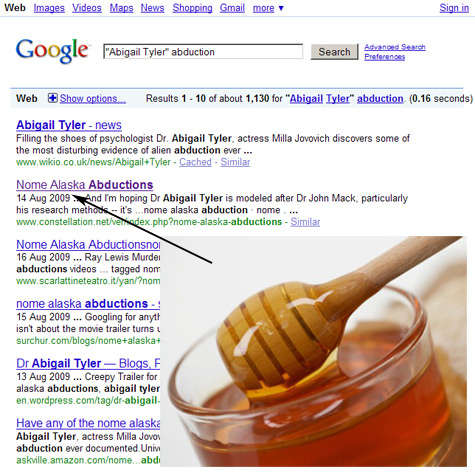
That constellation.net thing is some kind of honeypot that’s capturing data from Google (and possibly other) searches. When you click the link from Google, constellation.net captures your information and then simply forwards you back to the Google homepage.
Apparently, constellation.net is not allowing the URL to be visited without the right referral headers being transmitted. I have better things to do today than than fiddle with this, but the constellation.net home page has a link to linxworks.com, the site for a company called Linxworks Solutions. I’m sure that you can do the rest of the math from there, if you’re interested.
To the propeller heads out there who can’t help yourselves: Try pretending to be Googlebot and see if it will let you in. Are they blocking it by IP as well as referrer? In other words, even if you look like Googlebot, do you actually have to come from a Google IP?
District 9
August 19th, 2009Several people have been suggesting that I should see District 9.
The closest movie theater is about a two hour drive from where I live, and I don’t know if District 9 is showing there. (Our local, uh, movie theater, The Swamp Palace, closed down.)
I’ll add the film to my Fatso queue and I’ll be able to watch it someday when it’s released on DVD. (Fatso is a New Zealand version of Netflix.)
If you want to discuss the film, go for it in comments.
Lawyer: FBI Trained Hal Turner As An “Agent Provocateur”
August 19th, 2009Via: Hartford Courant:
Internet blogger Harold “Hal” Turner’s attorney said today that Turner’s background as an FBI informant will be a key part of his defense to charges that he incited violence against two state legislators and a state ethics official.
Superior Court Judge David P. Gold on Tuesday authorized Michael A. Orozco, a New Jersey attorney, to represent Turner. Turner did not appear again in court Tuesday because he remains in federal custody without bail in Chicago, where he is accused of threatening three federal judges.
In asking Gold to allow Orozco to represent Turner, Turner’s Connecticut lawyer, Matthew R. Potter, said Orozco has a long-term legal relationship with Turner, plans to bring a complicated First Amendment defense and is familiar with Turner’s background as an FBI informant.
That role as an informant for the FBI is a key part of the defense, Orozco said outside court.
Orozco said Turner was trained by the FBI as “an agent provocateur.”
“Mr. Turner was trained by the FBI,” Orozco said. “He was told where the line was — what he could say.”
In his comments on his blog that brought the state and federal charges, Turner did not cross that line, Orozco said.
Orozco said Turner worked for the FBI from roughly 2002 to 2007.
“His job was basically to publish information which would cause other parties to act in a manner that would cause their arrest,” Orozco said.
What To Do If Force Vaccinated
August 18th, 2009Click through to the source for lots of links.
Via: Clare Swinney:
This report provides practical information on how to protect yourself if you are unlucky enough to be forced to take an A/H1N1 vaccine.
Dr Russell L. Blaylock, a highly-respected neurosurgeon, who has authored three books on nutrition and wellness, including Health And Nutrition Secrets That Can Save Your Life, recently spoke with Dr Bill Deagle, MD of The Nutrimedical Report about some proven natural, readily accessible solutions that may help deal with the toxic effects of A/H1N1 vaccines. The excellent hour-long interview can be downloaded from HERE at 0731091 and a transcript of the interview is posted at Dr Deagle’s site at this link here.
Dr Blaylock’s List of suggestions on How to Reduce the Toxic Effects of the A/H1N1 Vaccine, is as follows:
1. Number one on the list says Dr Blaylock, is to bring a cold pack with you and place it on the site of the injection as soon as you can, as this will block the immune reaction. Once you get home, continue using a cold pack throughout the day. If you continue to have immune reactions the following day, have cold showers and continue with the cold press.
2. Take fish oil. Eicosapentaenoic acid (EPA), one of the omega 3 fatty acids found in fish oil supplements, is a potent immune suppressant. If you take high dose EPA you will be more susceptible to infections, because it is a powerful immune suppressant. However, in the case of an immune adjuvant reaction, you want to reduce it. Studies show that if you take EPA oil one hour before injecting a very powerful adjuvant called lipopolysaccharide (LPS), it would completely block the ability of the LPS to cause brain inflammation. Take a moderate dose everyday and more if needed to tame a cytokine storm.
3. Flavonoids are third on the list, namely curcumin, quercetin, ferulic acid and ellagic acid, particularly in a mixture. The curcumin and quercetin in particular have been found to block the ability of the adjuvants to trigger a long-term immune reaction. If you take it an hour before the vaccination, it should help dampen the immune reactions says Dr Blaylock.
4. Vitamin E, the natural form that is high in gamma-E will help dampen the immune reactions and reduces several of the inflammatory cytokines.
5. An important ingredient on the list is Vitamin C at a dose of 1000 mg, taken four times a day between meals. It is a very potent anti-inflammatory and should be taken in a buffered form, not as absorbic acid, says Dr Blaylock.
6. Also use astaxanthin as it’s an anti-inflammatory. According to Dr Blaylock, fatal reactions to vaccines in aboriginal and African children occurred in those who were deficient in carotinoids, like astaxanthin. It is a good protection against the toxic effects of the vaccine.
7. Likewise, it was found that children who were deficient in zinc had a high mortality rate. Zinc is very protective against vaccine toxicity. (Do not use zinc mixed with copper however, as copper is a major trigger of free-radical generation according to Dr Blaylock).
8. Ensure you avoid all immune-stimulating supplements, such as mushroom extracts, whey protein and beta-glucan.
9. Take a multivitamin-mineral daily – one that does not contain iron. This multivitamin-mineral is to make sure your body has plenty of B vitamins and selenium. Selenium, said Dr Blaylock, is very important for fighting viral infections and it reduces the inflammatory response to vaccines.
10. Magnesium citrate/malate 500 mg of elemental magnesium two capsules, three times a day. (This was not mentioned during the show, but was posted at Dr Deagle’s website, ClayandIron.com).
11. What is very important is vitamin D3, which is the only ‘vitamin’ the body can manufacture from sunlight (UVB). It is a neural hormone, not really a vitamin says Dr Blaylock and helps if you are over-reacting immunologically by cooling down the reaction. Similarly, if you are under-reacting, it helps to boost your immune response. In addition it also protects against microorganism invasion.
Black people and those in colder climates are particularly deficient, so they will almost certainly require supplementation.
Dr Blaylock recommends that following vaccination it will help to keep the immune reaction under control if:
i) All children get 5,000 units a day for two weeks after the vaccine and then 2,000 a units a day thereafter;
ii) Adults get 20,000 units a day after the vaccine for two weeks, then 10,000 units a day thereafter;
iii) And with that adults should take 500-1000 mg of calcium a day and children under the age of 12 years should take 250 mg a day, as vitamin D works more efficiently in the presence of calcium.
12. Ensure you avoid all mercury-containing seafood or any other sources of mercury, as the heavy metal is a very powerful inducer of autoimmunity, is known to make people more susceptible to viral infections and will be in H1N1 vaccines.
13. Avoid the oils that significantly suppress immunity and increase inflammation – such as corn, safflower, sunflower, soybean, canola and peanut oils.
14. Drink very concentrated white tea at least four times a day. It helps to prevent abnormal immune reactions.
15. Pop parsley and celery in a blender and drink 8 ounces of this mixture twice a day. Dr Blaylock says the parsley is very high in a flavonoid called apigenin and that celery is high in luteolin. Both are very potent in inhibiting autoimmune diseases, particularly the apigenin, so go and plant some parsley in your garden now.
Related:
Watch Out for Flying Syringes, GMO Food Vaccines, and Forced Vaccinations
Vaccines, Depression and Neurodegeneration After Age 50: Another Reason to Avoid the Recommended Vaccines
Britain: Only 1/3 of Nurses Willing to Have Swine Flu Vaccine
August 18th, 2009Via: Telegraph:
Only a third of nurses have said they are willing to have the vaccine against swine flu amid fears it has not been tested enough, a survey has found.
Frontline health and social care workers will be among the first to be vaccinated in October along with people with serious underlying health problems and pregnant women.
However a survey by Nursing Times has found many frontline nurses have reservations.
Only one in three said they are prepared to have the H1N1 vaccine with a third undecided and the rest saying no.
Almost 1,500 nurses were polled, of whom 91 per cent said they were frontline.
It comes after news that parents are also concerned about the vaccine, with worries predominantly about the safety of its contents, side effects, and the amount of testing that will be done.
Of the nurses who said they would not get vaccinated, 60 per cent said concern about the safety of the vaccine was the main reason.
A further 31 per cent said they did not consider the risks to their health from swine flu to be great enough, while nine per cent thought they would not be able to take time out of work to get immunised.
“I would not be willing to put myself at risk of, as yet, unknown long-term effects to facilitate a short-term solution,” said one respondent.
A further respondent said: “I have yet to be convinced there is a genuine health risk (from swine flu) and it’s not just government propaganda.”
Federal Reserve Running Low on Ammo
August 18th, 2009Via: Reuters:
On Monday the Fed announced it had purchased another $7 billion worth of Treasuries under its quantitative easing program. Readers will recall that in last week’s FOMC statement, the Fed said it was extending the Treasury purchase program by a month, to the end of October, while maintaining its total purchase commitment of $300 billion.
After today’s $7 billion purchase, the Fed has just $40 billion left. Spread out over the next 10 weeks, that doesn’t give it very much ammo. To date, purchases have averaged over $12 billion per week. That is set to fall to $4 billion.
Cash-for-Clunkers Boost Japanese Car Sales
August 18th, 2009Via: Financial Times:
The US’s cash-for-clunkers scheme, designed to bolster Detroit’s embattled carmakers, is turning out to be an even bigger boon for their Japanese rivals.
According to data published by the National Highway Traffic Safety Administration on Monday, Americans are using the scrappage incentives to buy more vehicles from Toyota than any of the three Detroit carmakers.
Toyota has an 18.9 per cent share of vehicles bought so far, putting it ahead of General Motors with 17.6 per cent and Ford with 15.4 per cent. Chrysler is in fifth place, after Honda.
95% of Dollar Bills in Washington DC Bear Traces of Cocaine
August 17th, 2009Via: BBC:
The largest study of banknotes has found that 95% of dollar bills in Washington DC bear traces of the illegal drug cocaine.
The figure for the US capital is up 20% over two years.
Researchers at the University of Massachusetts in Dartmouth tested notes from more than 30 cities worldwide.
They say the rise observed in the US may be due to increased drug use caused by higher stress levels linked to the global economic downturn.
Bank notes can pick up traces of cocaine directly from users snorting it through rolled up bills or when cash is stacked together.
Stress factor?
Besides Washington, other big US cities such as Baltimore, Boston and Detroit had the highest average cocaine levels on their dollar bills.
Dr Yuegang Zuo, who led the research, said: “To my surprise, we’re finding more and more cocaine in banknotes.
“I’m not sure why we’ve seen this apparent increase, but it could be related to the economic downturn, with stressed people turning to cocaine.”
Other countries where notes were tested were Canada, Brazil, China and Japan.
China had the lowest rates, with only 12% of its bills contaminated.
In the US the cleanest bills were collected from Salt Lake City, home of the religious group, the Mormons.
Taliban Funding Comes Primarily from the U.S.
August 17th, 2009Via: Global Post:
It is the open secret no one wants to talk about, the unwelcome truth that most prefer to hide. In Afghanistan, one of the richest sources of Taliban funding is the foreign assistance coming into the country.
Virtually every major project includes a healthy cut for the insurgents. Call it protection money, call it extortion, or, as the Taliban themselves prefer to term it, “spoils of war,” the fact remains that international donors, primarily the United States, are to a large extent financing their own enemy.
“Everyone knows this is going on,” said one U.S. Embassy official, speaking privately.
It is almost impossible to determine how much the insurgents are spending, making it difficult to pinpoint the sources of the funds.
Mullah Abdul Salaam Zaeef, former Taliban minister to Pakistan, was perhaps more than a bit disingenuous when he told GlobalPost that the militants were operating mostly on air.
“The Taliban does not have many expenses,” he said, smiling slightly. “They are barefoot and hungry, with no roof over their heads and a stone for their pillow.” As for weapons, he just shrugged. “Afghanistan is full of guns,” he said. “We have enough guns for years.”
The reality is quite different, of course. The militants recruit local fighters by paying for their services. They move about in their traditional 4x4s, they have to feed their troops, pay for transportation and medical treatment for the wounded, and, of course, they have to buy rockets, grenades and their beloved Kalashnikovs.
Up until quite recently, most experts thought that drug money accounted for the bulk of Taliban funding. But even here opinion was divided on actual amounts. Some reports gauged the total annual income at about $100 million, while others placed the figure as high as $300 million — still a small fraction of the $4 billion poppy industry.
Now administration officials have launched a search for Taliban sponsors. Richard Holbrooke, U.S. special envoy for Afghanistan and Pakistan, told a press conference in Islamabad last month that drugs accounted for less of a share of Taliban coffers than was previously thought.
“In the past there was a kind of feeling that the money all came from drugs in Afghanistan,” said Holbrooke, according to media reports. “That is simply not true.”
The new feeling is that less than half of the Taliban’s war chest comes from poppy, with a variety of sources, including private contributions from Persian Gulf states, accounting for much of the rest. Holbrooke told reporters that he would add a member of the Treasury Department to his staff to pursue the question of Taliban funding.
But perhaps U.S. officials need look no further than their own backyard.
Anecdotal evidence is mounting that the Taliban are taking a hefty portion of assistance money coming into Afghanistan from the outside.
This goes beyond mere protection money or extortion of “taxes” at the local level — very high-level negotiations take place between the Taliban and major contractors, according to sources close to the process.
A shadowy office in Kabul houses the Taliban contracts officer, who examines proposals and negotiates with organizational hierarchies for a percentage. He will not speak to, or even meet with, a journalist, but sources who have spoken with him and who have seen documents say that the process is quite professional.
The manager of an Afghan firm with lucrative construction contracts with the U.S. government builds in a minimum of 20 percent for the Taliban in his cost estimates. The manager, who will not speak openly, has told friends privately that he makes in the neighborhood of $1 million per month. Out of this, $200,000 is siphoned off for the insurgents.
If negotiations fall through, the project will come to harm — road workers may be attacked or killed, bridges may be blown up, engineers may be assassinated.
The degree of cooperation and coordination between the Taliban and aid workers is surprising, and would most likely make funders extremely uncomfortable.
One Afghan contractor, speaking privately, told friends of one project he was overseeing in the volatile south. The province cannot be mentioned, nor the particular project.
“I was building a bridge,” he said, one evening over drinks. “The local Taliban commander called and said ‘don’t build a bridge there, we’ll have to blow it up.’ I asked him to let me finish the bridge, collect the money — then they could blow it up whenever they wanted. We agreed, and I completed my project.”
In the south, no contract can be implemented without the Taliban taking a cut, sometimes at various steps along the way.
One contractor in the southern province of Helmand was negotiating with a local supplier for a large shipment of pipes. The pipes had to be brought in from Pakistan, so the supplier tacked on about 30 percent extra for the Taliban, to ensure that the pipes reached Lashkar Gah safely.
Once the pipes were given over to the contractor, he had to negotiate with the Taliban again to get the pipes out to the project site. This was added to the transportation costs.
“We assume that our people are paying off the Taliban,” said the foreign contractor in charge of the project.
In Farah province, local officials report that the Taliban are taking up to 40 percent of the money coming in for the National Solidarity Program, one of the country’s most successful community reconstruction projects, which has dispensed hundreds of millions of dollars throughout the country over the past six years.
Many Afghans see little wrong in the militants getting their fair share of foreign assistance.
“This is international money,” said one young Kabul resident. “They are not taking it from the people, they are taking it from their enemy.”
But in areas under Taliban control, the insurgents are extorting funds from the people as well.
In war-ravaged Helmand, where much of the province has been under Taliban control for the past two years, residents grumble about the tariffs.
“It’s a disaster,” said a 50-year-old resident of Marja district. “We have to give them two kilos of poppy paste per jerib during the harvest; then we have to give them ushr (an Islamic tax, amounting to one-tenth of the harvest) from our wheat. Then they insisted on zakat (an Islamic tithe). Now they have come up with something else: 12,000 Pakistani rupee (approximately $150) per household. And they won’t take even one rupee less.”
It all adds up, of course. But all things are relative: if the Taliban are able to raise and spend say $1 billion per year — the outside limit of what anyone has been able to predict — that accounts for what the United States is now spending on 10 days of the war to defeat them.
And Now… “Finland Denies Missing Ship Carries Nuclear Material”
August 17th, 2009Suitable for framing.
Via: AFP:
Finland denies missing ship carries nuclear material
By Orlando Rodrigues (AFP)
PRAIA — Finnish authorities dismissed talk Sunday that the Arctic Sea was bearing a cargo of nuclear material, as Russia and NATO joined forces in an international hunt for the missing vessel.
Jukka Laaksonen, head of the Finnish Radiation and Nuclear Safety Authority, said firefighters conducted radiation tests on the ship — last reported off Cape Verde — at a port in Finland before it began a voyage full of intrigue.
But he dismissed as “stupid rumours” reports in British and Finnish newspapers that the ship could be carrying a “secret” nuclear cargo that could explain why it was attacked on the Baltic Sea before vanishing.
“Some fireman for some reason thought that there might be some radioactivity involved in this shipment and that was a very stupid idea. There was no basis for that,” Laaksonen told AFP.
Finnish police said Saturday that the ship’s Helsinki-based operator, Solchart Management, had received a ransom demand for the Arctic Sea, raising fresh hopes for its 15-strong Russian crew.
The Financial Times Deutschland newspaper, without citing a source, reported on its website that the demand was for 1.5 million dollars (1.05 million euros).
“This is the first positive sign that there are intentions to bring back the crew,” Russian maritime expert Mikhail Voitenko told AFP.
Yulia Latynina, an anti-Kremlin political commentator and a radio host in Moscow, took a similar view.
“It appears they are looking for a way out of the situation and it appears to mean that the crew will return safe and sound, thank God — and that’s the most important.”
Russian warships, backed by NATO, are scouring the Atlantic for the ship, which left Finland on July 23 on its way to Algeria with a cargo of sawn timber estimated to be worth 1.16 million euros.
The Maltese-flagged vessel was last seen off the coast of Cape Verde, officials in the west African archipelago and in France revealed Friday.
Lieutenant Colonel Antonio Monteiro, Cape Verde coastguard captain, confirmed Sunday that on Wednesday or Thursday the vessel was reported off the islands.
He said the ship had reportedly been “following a direction of 188 degrees” in international waters.
But since that sighting about 400 nautical miles (740 kilometres) off the island chain, the ship had slipped off the radar, he went on.
The lieutenant stressed it was not the Cape Verde coastguard who spotted the vessel, however, and it was only reported to the force.
As such, he could not be 100 percent certain of the sighting.
“We have not had any direct contact with the ship,” he said.
Russia has not confirmed the sighting.
In the Maltese capital Valletta, the Malta Maritime Authority told AFP on Sunday that the island nation was teaming up with Sweden and Finland to launch a criminal investigation into the disappearance.
Russia’s envoy to NATO said Saturday that the transatlantic alliance was working closely with Moscow in the hunt.
“All information that is full and most likely objective, is instantly sent to Russian navy headquarters” from NATO headquarters in Brussels, Dmitry Rogozin told the RIA Novosti news agency.
Experts are debating whether pirates, a mafia quarrel or a commercial dispute are behind the disappearance.
On the night the Arctic Sea left port in Finland last month, masked men boarded the ship between the Swedish islands of Oland and Gotland in the Baltic Sea, Swedish police reported several days after the incident.
Claiming to be anti-drugs police, they tied up the crew and conducted a thorough search of the vessel before reportedly leaving several hours later. The last definite trace of the ship was in the early hours of July 30, when its tracking system put if off the coast of northwestern France.
On Friday, European Commission spokesman Martin Selmayr said the ship appeared to have been attacked a second time, this time off the coast of Portugal.




