Bush Regime Creature Now Shilling for Financial Firms
June 29th, 2009With the Obama regime crawling with Wall Street Shills, this should make for a successful partnership in crime.
Via: Mother Jones:
The strategic communications specialist advising a financial industry effort to enhance Wall Street’s image has plenty of experience in spinning the American public: In the Bush White House, he was one of the aides in charge of the administration’s fact-bending campaign to sell the Iraq War.
Bloomberg reported on Thursday that Jim Wilkinson, a one-time senior aide to former Treasury Secretary Henry Paulson, is part of a campaign, spearheaded by the Securities Industry and Financial Markets Association (SIFMA), to quell the upsurge of “populist” anger directed at the financial sector. But the story leaves out an important part of his résumé: He’s a GOP PR operative with a history of disseminating misleading information and once served as the deputy communications director in the Bush White House.
…
Wilkinson is now fighting a new information war, on behalf of embattled finance firms yearning for the days when million-dollar bonuses and luxury retreats were none of the public’s business. The pair are part of a Brunswick team that’s devising SIFMA’s PR campaign, which earns the company a retainer of $70,000 a month. The strategy, according to documents obtained by Bloomberg, calls for a “city-by-city, grass roots” effort targeting such international hubs as New York, London, Washington, and Brussels. The goal: to convince the public that Wall Street is open to reform, and is part of the solution, not the problem. But what does it say about Wall Street’s commitment to change that it turned to a man notorious for misleading PR campaigns to sell the US public on its transformation?
Research Credit: ottilie
Military Coup in Honduras
June 29th, 2009Via: AFP:
Honduran troops ousted President Manuel Zelaya Sunday and flew him out of the country, ending a bitter power struggle with the military as parliament swiftly voted in a new leader.
Zelaya insisted as he arrived in regional neighbour Costa Rica that he remained the president of his Central American nation, but just hours later the Congress voted in the parliamentary speaker as the country’s new leader.
The first such major upheaval in several decades in the impoverished country was triggered by a tense political standoff between Zelaya and the country’s military and legal institutions over his bid to secure a second term.
“I will never give up since I was elected the president by the people,” Zelaya said from San Jose, accusing Honduran troops of kidnapping him and denouncing what he called a “political conspiracy.”
But Congress said it voted unanimously to remove him from office for his “apparent misconduct” and for “repeated violations of the constitution and the law and disregard of orders and judgments of the institutions.”
In his place they appointed speaker Roberto Micheletti as the new leader to serve out the rest of the term, which ends in January. New general elections are planned for November 29.
Zelaya, elected to a non-renewal four-year term in 2005, had planned a vote Sunday asking Hondurans to sanction a future referendum to allow him to run for reelection in the November polls.
The planned referendum had been ruled illegal by the country’s top court and was opposed by the military, but the president said he planned to press ahead with it anyway and ballot boxes had already been distributed.
The Supreme Court said Sunday that it had ordered the president’s ouster in order to protect law and order in the nation of some seven million people.
“Today’s events originate from a court order by a competent judge,” the country’s highest court said in a statement read by spokesman Danilo Izaguirre.
The drama unfolded just about dawn on Sunday when some 200 troops swooped on Zelaya’s home. He was bundled away in his pyjamas and flown out of the country.
A leading government official, Armando Sarmiento, told AFP that at least eight cabinet members were also detained including Foreign Minister Patricia Rodas.
As planes and helicopters overflew the capital, several hundred Zelaya supporters ignored warnings to stay home and flooded onto the streets of Tegucigalpa shouting out, “We want Mel,” the president’s nickname.
But the demonstration was halted in front of the presidential palace when the way was barred by a cordon of troops and armored vehicles.
“Within a few years, the Franken-insects could be airborne.”
June 28th, 2009Guess who? I know. It’s not a tough question.
Yes, Bill Gates is at it again.
I have to wonder, though: Have they backed off from talking about the flying syringes, genetically engineered mosquitoes that deliver vaccines when they bite people? Maybe that idea was just too f*&^%$# nuts for maintaining the right appearances.
Via: Newsweek:
Aedes Aegypti is a tricky enemy with a dangerous weakness for travel. Unlike other mosquitoes, it can survive the cold and thrives on city life. The increase of international trade and the accelerating pace of urbanization have broadened its horizon with grim consequences. The disease it carries, dengue fever—debilitating and sometimes lethal—is spreading fast. More than 100 million people in 100 countries are afflicted every year. Fatality rates can top 20 percent. There is no vaccine, no cure and no solution—none, at least, that conventional medicine can offer.
A new strategy involves a subtle reconfiguring of the bug’s DNA. Scientists working in labs near Oxford have devised a genetic modification that sterilizes the male Aedes, transforming the critter into his own worst enemy. He can still mate—but he can’t breed. Any offspring dies before becoming fully developed. The idea is to release a huge, all-conquering swarm of the doctored insects into the wild, let them find partners among the native females and wait for the mosquito population to decline. Preliminary trials, looking at both safety and effectiveness, have already taken place in Malaysia. Within a few years, the Franken-insects could be airborne.
The idea of GM mosquitoes was first floated 20 years ago. But it’s only recently gained the support of mainstream health officials. The Bill and Melinda Gates Foundation has invested $38 million into the research. In May, experts from around the world gathered in Geneva for a meeting sponsored by the World Health Organization to discuss progress and develop global guidelines for testing. Some environmental groups are alarmed at the development, and a confrontation looks certain. This is one they may lose. Unlike GM crops, whose benefits have more often gone to farmers, GM insects address a global health problem that causes great human suffering and death.
Dengue fever may be only the start. Researchers are tweaking the genome of the Anopheles gambiae mosquito, the species that carries the malaria parasite, which kills at least a million people each year. Scientists hope to produce, say, a mutant bug with a superboosted immune system capable of killing off the parasite or loaded with an extra gene to block its development.
…
To an eco-aware generation, already fearful of genetically modified food, any tinkering with the world’s delicately balanced ecosystems is unacceptable. “The inherent arrogance of believing that you can control the outcome is outrageous,” says Gillian Madill, a genetic-technologies campaigner at Friends of the Earth in Washington.
The Union of Soviet Indian Republics Is Rolling Out a National ID Card
June 28th, 2009Tens of millions of people who who can’t read or write (see: literacy in India) will need an identity card to get their government food handouts.
Yes, it has come to this.
Via: New York Times:
Policy makers see a national ID card as critical to improving the delivery of social services, subsidies and other government programs while also strengthening national security. The Indian government and outside observers have shown that the majority of aid earmarked for the poor does not reach them, and it is hard for the government to detect embezzlement and misuse of funds.
If administered properly, experts say a universal ID card could help ensure that most of the billions India and other organizations spend on aid reaches the people for whom it was intended. Today, Indians use a variety of documents to prove their identities, like state-issued driver’s licenses, ration cards used for food purchases at government-run stores and a tax identification card that is akin to the American Social Security card.
More Obama Lies: Signing Statement on $106B War Bill
June 28th, 2009Via: The Hill:
President Obama signed the $106 billion war-spending bill into law Friday, but not without taking a page from his predecessor and ignoring a few elements in the legislation.
Obama included a five-paragraph signing statement with the bill, including a final paragraph that outlined his objections to at least four areas of the bill.
President George W. Bush was heavily criticized for his use of signing statements, declaring he’d ignore some elements of legislation by invoking presidential prerogative.
The Obama administration announced in the statement it would disregard provisions of the legislation that, among other things, would compel the Obama administration to pressure the World Bank to strengthen labor and environmental standards and require the Treasury department to report to Congress on the activities of the World Bank and International Monetary Fund (IMF).
“Provisions of this bill…would interfere with my constitutional authority to conduct foreign relations by directing the Executive to take certain positions in negotiations or discussions with international organizations and foreign governments, or by requiring consultation with the Congress prior to such negotiations or discussions,” Obama said in a statement.
“I will not treat these provisions as limiting my ability to engage in foreign diplomacy or negotiations,” he added.
The sections in question would compel the administration to direct its World Bank representatives to pressure that institution to use metrics that “fairly represent the value of internationally recognized workers’ rights. Organized labor groups had pushed for a revision of those standards.
Sine Wave Google Searches
June 28th, 2009UPDATE: Vitamin D?
I told Becky about the “ringing ears” chart, and when the waves peaked.
She said, “Maybe it’s related to Vitamin D.” Indeed, the searches peak around the nadir of Vitamin D availability in the Northern Hemisphere.
—End Update—
I’m developing some tools on another website—partially to help me keep track of information in a more effective manner—and I started messing around with Google Trends.
I was punching in various queries, just to have a fiddle around.
Then the phone rang. Becky answered it.
I typed in ringing phone. Then ringing bell. Then ringing ears. I have no idea what I was looking for, but look at this chart for ringing ears:
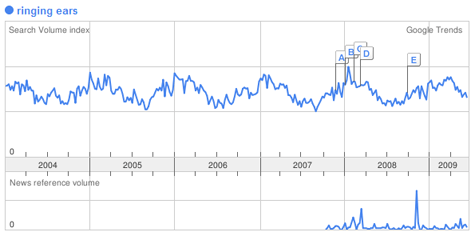
Is that weird?
Most of these charts look like a noise floor, with occasional news driven spikes. I looked at tinnitus, the clinical term for “ringing in the ears” and when I combined the chart from that with the one above, there’s a general correlation, as one would expect. (CSV datasets from all of these queries may be downloaded if you want to perform actual correlation calculations instead of just eyeballing it with the boneheaded charts Google is using.)
Next, I tried one with obvious seasonal correlates: gardening. That chart looks exactly as one would expect. Hay fever works the same way.
Are there seasonal correlates to tinnitus? I didn’t think so, but I’m definitely no expert. It seems to spike around the end of the year. Maybe it’s from listing to that Christmas music in China Mart.
What other queries describe sine waves, but without apparent seasonal or other correlates?
U.S. Confirms U-Turn in Afghan Counter-Narcotics Policy
June 28th, 2009My previous guess was that the USUK drug cartel was going to try to drive prices back up and then unload the tons of stuff that have been stockpiling. According to the information below, that doesn’t seem to be the case.
Perhaps the new goal is to get as many acres as possible going with opium production and take an economies of scale approach. Recall the British covert operation that was centered around training Taliban fighters in irrigation and farming techniques *cough* *cough* *wink* *wink*.
Maybe that program is coming out of the shadows.
Via: Financial Times:
The US counter-narcotics strategy in Afghanistan is to undergo a U-turn with money previously spent on controversial opium poppy eradication shifting to agricultural development, Richard Holbrooke, US special envoy to Afghanistan and Pakistan, told an international conference on Saturday.
Franco Frattini, Italy’s foreign minister who chaired the conference in the port city of Trieste, quoted Mr Holbrooke as saying the US would spend “several hundred million dollars” in promoting production of legal crops and cut back funding for eradication.
Research Credit: dano5050
IRAN: BRITISH EMBASSY STAFF ARRESTED
June 28th, 2009Via: CNN:
Local staff members at the British Embassy in Tehran have been arrested, the Foreign Office in London told CNN Sunday, confirming earlier reports from Iran’s government-backed Press TV.
Press TV said eight staffers had been seized for their role in the unrest following the disputed presidential elections on June 12. The Foreign Office did not confirm the number of people held.
Earlier Sunday the Foreign Office said it had recently “received a number of, sometimes confused, reports that British nationals or others with British connections had been detained. We continue to raise them with the Iranian authorities.”
A spokesman further added: “People with a connection to the UK have been arrested all week.”
Last week, Tehran expelled two British diplomats. London responded by kicking out two Iranian envoys.
Iran then recalled its ambassador to Britain, saying it would reconsider its diplomatic ties with the United Kingdom.
Withdrawing an ambassador is a very serious gesture in diplomatic circles.
The Iranian government has long accused other countries, especially Britain, of “meddling” in its affairs, but has offered no proof any outside forces have been involved in the unrest after the disputed June 12 presidential election.
On Wednesday, Iranian authorities said they had arrested several foreign nationals, some with British passports, for allegedly helping foment the disturbances.
At the time, the Foreign Office said it was looking into the claims. It said it was aware that one of the arrested nationals was Washington Times reporter Iason Athanasiadis, who also goes by Jason Fowden.
Athanasiadis holds British and Greek passports.
Meanwhile, the Iranian government will allow a demonstration at Tehran’s Ghoba mosque Sunday, CNN has confirmed.
The gathering is officially meant to honor Mohammad Beheshti, a hero of the 1979 Islamic Revolution who was killed in a bombing on this date in 1981.
Work Begins on World’s Deepest Underground Lab
June 28th, 2009Via: AP:
Far below the Black Hills of South Dakota, crews are building the world’s deepest underground science lab at a depth equivalent to more than six Empire State buildings — a place uniquely suited to scientists’ quest for mysterious particles known as dark matter.
Scientists, politicians and other officials gathered Monday for a groundbreaking of sorts at a lab 4,850 foot below the surface of an old gold mine that was once the site of Nobel Prize-winning physics research.
The site is ideal for experiments because its location is largely shielded from cosmic rays that could interfere with efforts to prove the existence of dark matter, which is thought to make up nearly a quarter of the mass of the universe.
The deepest reaches of the mine plunge to 8,000 feet below the surface. Some early geology and hydrology experiments are already under way at 4,850 feet. Researchers also hope to build two deeper labs that are still awaiting funding from Congress.
“The fact that we’re going to be in the Davis Cavern just tickles us pink,” said Tom Shutt of Case Western Reserve University in Cleveland, referring to a portion of the mine named after scientist Ray Davis Jr., who used it in the 1960s to demonstrate the existence of particles called solar neutrinos.
Davis and a colleague named John Bahcall won a share of the 2002 Nobel Prize for physics for their work.
The old Homestake Gold Mine in a community called Lead (pronounced LEED) was shut down in 2001 after 125 years. Pumps that kept the mine dry were turned off years ago, so workers have been drying it out to prepare for the new research.
Before the labs are built, crews must also stabilize the tunnels and install new infrastructure. The lab at 4,850 feet is not much to look at yet. A rusty orange film covers the walls, floors, ceilings and debris left behind by miners.
The first dark matter experiment will be the Large Underground Xenon detector experiment — or LUX — a project to detect weakly interacting particles that could give scientists greater insight into the Big Bang explosion believed to have formed the universe.
Shutt, along with Brown University’s Rick Gaitskell and nearly a dozen collaborators will work at the site to search for dark matter, which does not emit detectable light or radiation. But scientists say its presence can be inferred from gravitational effects on visible matter.
Scientists believe most of the dark matter in the universe contains no atoms and does not interact with ordinary matter through electromagnetic forces. They are trying to discover exactly what it is, how much exists and what effect it may have on the future of the universe.
Physicists have said that without dark matter, galaxies might never have formed. By learning more about dark matter, they hope to understand better whether the universe is expanding or contracting.
The research team will try to catch the ghostly particles in a 300-kilogram tank of liquid xenon, a cold substance that is three times heavier than water. If they tried to detect dark matter above ground, the highly sensitive detector would be bombarded by cosmic radiation.
Scientists hope to start construction on the two deepest labs by 2012 and open them by 2016. The projects are expected to cost $550 million.
Man Deposits $200 with Pot, Cocaine at Bank
June 28th, 2009A little Florida reading for the weekend.
Via: AP:
Authorities said a man using the drive-through at a Tallahassee bank deposited $200 and a small bag containing marijuana and cocaine. Police said an employee at the Wachovia Bank called police Wednesday after the unusual deposit. An officer arrested a 38-year-old man and found the remnants of three marijuana cigarettes inside his vehicle.
The man was charged with drug possession and later released on $3,000 bail.
It’s not clear why the man included the drugs with his deposit.




