U.S. Credit Rating a “Solid Triple-A”: Moody’s
June 23rd, 2009“As you all know, first prize is a Cadillac Eldorado. Anybody want to see second prize? Second prize is a set of steak knives. Third prize is you’re fired.”
Via: Reuters:
Moody’s Investors Service said on Tuesday that the U.S. government’s triple-A credit rating was safe but added that it could be at risk if Washington were unable to bring its public debt back to a downward trajectory.
Financial markets have repeatedly been spooked this year by concern that triple-A rated governments such as the United States and Britain could face credit ratings downgrades as they borrow heavily to spend their way out of recession.
“The U.S. government triple-A is safe,” Pierre Cailleteau, team managing director of Moody’s Sovereign Risk Group, said at a media briefing on sovereign credit ratings held in Tokyo.
Moody’s has a stable outlook on the U.S. rating, which indicates a change is not expected over the next 18 months.
Replying to a question about the sovereign rating of the United States, Cailleteau said the U.S. rating “remains a solid triple-A.”
But he added that there were possible risks that could lead to a downgrade.
“That will happen for two reasons. Either our assumptions in terms of debt reversibility prove to be wrong. That is, in fact the U.S. government is unable to bring public debt back to a downward trajectory,” he said.
The other reason would be if the United States’ ability to raise a large amount of debt at a low cost were to be put at risk, Cailleteau said.
“It could be put at risk if the U.S. dollar was severely challenged as the main international reserve currency,” he said.
But the possibility of the dollar being replaced as the main international reserve currency in the near future was a “pretty remote risk,” he added.
Debate has flared in the past few months about the dollar’s status as the world’s reserve currency at a time when the United States’ debt issuance is ballooning to pay for financial and economic rescue programs.
The bulk of the world’s foreign exchange reserves are held in dollars, and Russia, the holder of the world’s third-largest reserves after China and Japan, has repeatedly called for less global reliance on the dollar.
Moody’s Investors Service said in May that it was comfortable with the triple-A sovereign rating on the United States, but it was not guaranteed forever.
It also warned in May that if the United States failed to reduce current debt levels once economic growth returned, the triple-A rating could come under pressure.
Canada’s Swine Flu Vaccination Plan
June 23rd, 2009Via: Windsor Star:
Five-to-40-year-olds and Canada’s aboriginal communities should be the first to get vaccinated against human swine flu, experts say as Canadian officials decide who gets priority for the flu shots.
Under Canada’s official pandemic plan, the entire population would ultimately be immunized against the H1N1 swine flu.
But the vaccine will become available in batches, meaning the entire population can’t be vaccinated at once. It might take four or five months to get all the vaccine we’re going to get, during which time a second wave of swine flu may well be underway.
The Public Health Agency of Canada is working on a priority list, deciding where the first batches should go, and who should get the injections first. All provinces and territories would be expected to follow the national prioritization scheme.
White House to Abandon Spy-Satellite Program
June 23rd, 2009Via: Wall Street Journal:
The Obama administration plans to kill a controversial Bush administration spy satellite program at the Department of Homeland Security, according to officials familiar with the decision.
The program came under fire from its inception two years ago. Democratic lawmakers said it would lead to domestic spying.
The program would have provided federal, state and local officials with extensive access to spy-satellite imagery — but no eavesdropping capabilities— to assist with emergency response and other domestic-security needs, such as identifying where ports or border areas are vulnerable to terrorism.
It would have expanded an Interior Department satellite program, which will continue to be used to assist in natural disasters and for other limited security purposes such as photographing sporting events. The Wall Street Journal first revealed the plans to establish the program, known as the National Applications Office, in 2007.
“It’s being shut down,” said a homeland security official.
The Bush administration had taken preliminary steps to launch the office, such as acquiring office space and beginning to hire staff.
The plans to shutter the office signal Homeland Security Secretary Janet Napolitano’s decision to refocus the department’s intelligence on ensuring that state and local officials get the threat information they need, the official said. She also wants to make the department the central point in the government for receiving and analyzing terrorism tips from around the country, the official added.
Lawmakers alerted Ms. Napolitano of their concerns about the program-that the program would violate the Fourth amendment right to be protected from unreasonable searches-before her confirmation hearing.
Once she assumed her post, Ms. Napolitano ordered a review of the program and concluded the program wasn’t worth pursuing, the homeland official said. Department spokeswoman Amy Kudwa declined to speak about the results of the review but said they would be announced shortly.
The lawmakers were most concerned about plans to provide satellite imagery to state and local law enforcement, so department officials asked state and local officials how useful that information would be to them. The answer: not very useful.
“In our view, the NAO is not an issue of urgency,” Los Angeles Police Chief William Bratton, wrote to Ms. Napolitano on June 21.
Writing on behalf of the Major Cities Chiefs Association, Chief Bratton said that were the program to go forward, the police chiefs would be concerned about privacy protections and whether using military satellites for domestic purposes would violate the Posse Comitatus law, which bars the use of the military for law enforcement in the U.S.
Rep. Jane Harman (D., Calif.), who oversees the House Homeland Security subcommittee on intelligence, said she was alarmed when she recently saw that the Obama administration requested money for the program in a classified 2010 budget proposal. She introduced two bills that would terminate the program.
“It’s a good decision,” Ms. Harman said in an interview. “This will remove a distraction and let the intelligence function at [the department] truly serve the community that needs it, which is local law enforcement.”
Supporters of the program lamented what they said was the loss of an important new terrorism-fighting tool for natural disasters and terrorist attacks, as well as border security.
“After numerous congressional briefings on the importance of the NAO and its solid legal footing, politics beat out good government,” said Andrew Levy, who was deputy general counsel at the department in the Bush administration.
Possible Gold Bounce Setting Up
June 23rd, 2009WARNING: This is not a recommendation to buy, sell or hold any financial instrument.
Gold is right around a its pennant support line. I also drew a “last change” pennant support line on the chart, in case it decides to pay attention to that one.
If gold breaks down and out of this pennant… Well, as the gold bugs know, nobody said it was going to be easy. As usual, I won’t sell even one gram.
Also, gold longs should know that if a breakout higher occurs, the move could run into trouble because the all time low on the dollar is still likely to be in place, with $1032 looming overhead on gold.
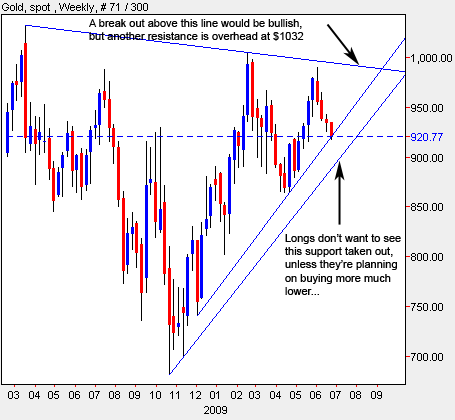
Gold has to clear $1032 and the Them will do anything and everything to prevent that from happening. The more time that passes with $1032 in tact, the more investors will start to worry that the “top” is in… Blah blah this isn’t worth worrying about just now, but if that pennant breaches to the downside and you’re in too heavy with a shorter term outlook, you could feel some pain.
Very near term, however, a bounce is likely.
South Carolina Governor’s Whereabouts Unknown, Even to Wife
June 23rd, 2009Update: Hiking
—End Update—
I’ll put this in Economy until I have reason to add it to other categories.
Via: AP:
Where is South Carolina’s governor? The lieutenant governor doesn’t know, and neither does a state senator who’s a close confidante. Even Gov. Mark Sanford’s wife is in the dark.
And while his staff said they knew where he was, a spokesman said he wasn’t aware that any of them had spoken with the governor since Thursday. Sanford’s wife said she hasn’t heard from him in several days, including Father’s Day.
“He was writing something and wanted some space to get away from the kids,” Jenny Sanford told The Associated Press while vacationing with the couple’s four sons at their Sullivans Island beach house. She said she didn’t know where he was, but wasn’t concerned.
Sanford, who’s also chairman of the Republican Governors Association, earned a reputation as the nation’s most vocal anti-bailout governor by refusing $700 million in federal stimulus money for schools until he lost a court battle earlier this month.
His spokesman Joel Sawyer said the governor was taking a break after losing the fight.
“Gov. Sanford is taking some time away from the office this week to recharge after the stimulus battle and the legislative session and to work on a couple of projects that have fallen by the wayside,” Sawyer said.
Sawyer told The Associated Press that he hadn’t spoken with Sanford since Thursday and wasn’t aware that any other member of the governor’s staff had, either. The governor told his staff where he was going last week and planned to check in.
“If an emergency arose and we were unable to immediately reach him, we would obviously consult with other state officials before making any decisions,” including Bauer, Sawyer said.
Sawyer wouldn’t say where the Sanford was, but said it was an area with limited communication.
A post-session wind-down isn’t uncommon and he goes “out of pocket for a few days at a time to clear his head,” Sawyer said. “Obviously, that’s going to be somewhat out of the question this time given the attention this particular absence has gotten.”
Asked how he knew the governor was OK, Sawyer referred a reporter to his prepared statements. “Again, this is not unusual. We are not at all concerned,” Sawyer said. He expected Sanford would return later this week.
Law enforcement officials who handle his security declined to comment and Sawyer wouldn’t say whether Sanford had a security detail with him. Sanford is known for taking walks and runs without security, but flight logs show he seldom leaves the state without it.
Swiss Offer Millionaires a Haven Away from the Poor
June 22nd, 2009Via: Guardian:
The plans of a Swiss canton to attract the super-rich by offering them the chance to buy property in exclusive, previously out of bounds locations has sparked a political row and accusations that the country is encouraging apartheid of the rich and poor.
The canton of Obwalden is planning to launch “special living zones” for millionaires in an attempt to boost its tax take by luring the wealthiest residents. Like other cantons in the tax haven, Obwalden finds itself short of revenue because it has been competing with other jurisdictions to see who can offer the lowest rate of tax.
The result has been a drastic shortfall in tax revenues as people set up PO box companies to take advantage of the low rates, while contributing nothing to the local economies because they live elsewhere.
Obwalden’s answer is to lift construction bans on land reserved for agricultural use, offering the rich the chance to secure property on protected land, with the promise of spectacular views of lake and alpine landscapes.
Details of Obwalden’s plan, published in the Swiss press, suggest selling villas on an exclusive basis to those who pay high taxes or who create work in the area – “a sunny location, with low noise emissions, good amenities … as well as an unrestricted view that cannot be built on”.
The homes would be constructed on land not usually accessible to ordinary citizens, leading to accusations that the policy discriminates against less wealthy inhabitants while rewarding the rich.
China: Hundreds of Riot Police Battle the People of Shishou
June 22nd, 2009The text below is an AP piece, but you should really click through to see the images and videos. This is just a sample.
Via: AP / East South West North:
Hundreds of baton-wielding police on Sunday dispersed protesters and cordoned off a city hotel in central China after a young man’s mysterious death sparked unrest, a local official and a witness said.
More than 200 people were injured in the clashes between police and residents outside the hotel in Hubei province’s Shishou city, according to a Hong Kong-based rights group, the Information Center for Human Rights and Democracy.
Hundreds had been angered by the death of 24-year old Tu Yuangao, who was found dead Wednesday evening in front of the Yonglong hotel. Tu’s relatives believe he was killed by the hotel boss, who is related to the mayor, the rights group said.
Discontent with local officials and police in China often leads to mass protests, which can gather size and force with remarkable speed. Mild frustration can turn into fury within minutes.
A local resident surnamed Chen said protesters started gathering outside the hotel Friday and by late Saturday had clashed five or six times with police, smashing six police vans and fire trucks. Chen said thousands of armed police forces with shields and batons were deployed in the area. The crowd started dispersing early Sunday, but security was tight, he said. “The area around the hotel is still cordoned off by hundreds of police with batons,” Chen said in a telephone interview Sunday.
A man who answered the phone at the Shishou government said the crowd dispersed after local authorities persuaded them to leave and that there had been no conflicts since Saturday afternoon. The man, who refused to give his name, said authorities were investigating the death of Tu, whose body was moved from the hotel to a funeral parlor Sunday. Chinese media reported that police ruled out murder, saying they found a suicide note.
Amateur video clips of the protest posted online showed hundreds of riot police marching down a street to reinforce a human barricade formed by officers who held their shields above their heads, supported by police vans and fire trucks. In one clip, hundreds of protesters were seen surging toward police, picking up objects from the ground and hurling them at the officers, who retreated. The video appeared to be posted by a U.S.-based user on YouTube, which is blocked in China. It could not be independently verified.
More Green Shoots: States Turning to Last Resorts in Budget Crisis
June 22nd, 2009Via: New York Times:
In Hawaii, state employees are bracing for furloughs of three days a month over the next two years, the equivalent of a 14 percent pay cut. In Idaho, lawmakers reduced aid to public schools for the first time in recent memory, forcing pay cuts for teachers.
And in California, where a $24 billion deficit for the coming fiscal year is the nation’s worst, Gov. Arnold Schwarzenegger has proposed releasing thousands of prisoners early and closing more than 200 state parks.
Meanwhile, Maine is adding taxes on candy and ski tickets, Wisconsin on oil companies, and Kentucky on alcohol and cellphone ring tones.
With state revenues in a free fall and the economy choked by the worst recession in 60 years, governors and legislatures are approving program cuts, layoffs and, to a smaller degree, tax increases that were previously unthinkable.
All but four states must have new budgets in place less than two weeks from now — by July 1, the start of their fiscal year. But most are already predicting shortfalls as tax collections shrink, unemployment rises and the stock market remains in turmoil.
“These are some of the worst numbers we have ever seen,” said Scott D. Pattison, executive director of the National Association of State Budget Officers, adding that the federal stimulus money that began flowing this spring was the only thing preventing widespread paralysis, particularly in the areas of education and health care. “If we didn’t have those funds, I think we’d have an incredible number of states just really unsure of how they were going to get a new budget out.”
The states where the fiscal year does not end June 30 are Alabama, Michigan, New York and Texas.
Even with the stimulus funds, political leaders in at least 19 states are still struggling to negotiate budgets, which has incited more than the usual drama and spite. Governors and legislators of the same party are finding themselves at bitter odds: in Arizona, Gov. Jan Brewer, a Republican, sued the Republican-controlled Legislature earlier this month after it refused to send her its budget plan in hopes that she would run out of time to veto it.
In Illinois, the Democratic-led legislature is fighting a plan by Gov. Patrick J. Quinn, also a Democrat, to balance the new budget by raising income taxes. And in Massachusetts, Gov. Deval Patrick, a Democrat, has threatened to veto a 25 percent increase in the state sales tax that Democratic legislative leaders say is crucial to help close a $1.5 billion deficit in the new fiscal year.
“Legislators have never dealt with a recession as precipitous and rapid as this one,” said Susan K. Urahn, managing director of the Pew Center on the States. “They’re faced with some of the toughest decisions legislators ever have to make, for both political and economic reasons, so it’s not surprising that the environment has become very tense.”
In all, states will face a $121 billion budget gap in the coming fiscal year, according to a recent report by the National Conference of State Legislatures, compared with $102.4 billion for this fiscal year.
Australia: Anti-Fluoride Extremists ‘Threaten to Kill MP’
June 22nd, 2009Via: The Age:
Anti-fluoride extremists have threatened to kill a Victorian government minister and blow up a regional water authority.
As anger over fluoridating Geelong’s water supply mounted today, Labor minister Lisa Neville has been targeted along with water and health officials.
A death threat was left with a bottle of water on the verandah of Ms Neville’s house on Saturday night, a government spokeswoman said.
Anti-fluoride activists have also threatened to blow up Barwon Water’s treatment plants as the authority begins on Monday adding fluoride to the water supply in Geelong, 70 kilometres southwest of Melbourne.
The Department of Human Services (DHS) received a threatening letter in the mail last week.
All three threats are being investigated by police.
A government spokeswoman said Ms Neville, who is the member for Bellarine, returned home on Saturday night to find the bottle of water and a note on her front verandah.
It read: “We’re going to kill you, bitch”.
More to come.
Kiwis Moving Closer to Cashless Society
June 22nd, 2009Japan was the future cashless country in yesterday’s news cycle. Today it’s New Zealand.
Well, New Zealand will probably use a Pan Asian digital currency, at some point, along with Japan and several other states…either that or Kongbucks.
Via: New Zealand Herald:
Cash is no longer king in New Zealand, according to the Retirement Commission’s report.
The report found electronic funds transfer (Eftpos) had displaced cash as the most common method used to pay for things such as groceries, power bills and mortgage. The number using Eftpos in the latest survey (83 per cent) is the same as in 2005, but the number using cash dropped from 84 per cent to 77 per cent. There have also been declines in all other methods of payment except internet banking, where users have increased from 34 per cent of adults in 2005 to 47 per cent.
Those most likely to use internet banking are households earning over $100,000 (70 per cent), people aged 35 to 44 (63 per cent), people in paid employment or with tertiary education (both 57 per cent), Asians (54 per cent), males (51 per cent) and Europeans and urban residents (both 49 per cent). The least likely internet bankers are provincial residents (37 per cent), Maori (34 per cent) and those aged 65 and over (12 per cent).




