“Black Swan” Author to Start Hedge Fund Betting on Hyperinflation
June 1st, 2009Via: Bloomberg:
Universa Investments LP, which has links to “Black Swan” author and New York University professor Nassim Nicholas Taleb, is starting a hedge fund to bet that efforts by governments and central banks to end the global recession will lead to hyperinflation, the Wall Street Journal reported, citing Taleb. The fund will invest in commodities and options on oil and gold stocks, the Journal said.
Dollar Under Pressure Again in Asia; Oil and Gold Up; Geithner Tells China Its Dollar Assets Are Safe, Room Erupts in Laughter
June 1st, 2009WARNING: This is not a recommendation to buy, sell or hold any financial instruments.
Disclosure: I own gold. I am a BullionVault client and affiliate.
Gold longs with a short term outlook: Lock stops in here on the strength or take profit now. Resistance is just over head and the dollar is right around support. The Geithner theatrics are likely staged to coincide with a short squeeze on the dollar, which would be a simple matter to pull off with the USDX at a support level.
Personally, I’m not selling one gram of my gold, but I’d like to buy more if a short squeeze on the dollar materializes.
Long term gold longs and dollar bears, let out a big yawn for now.
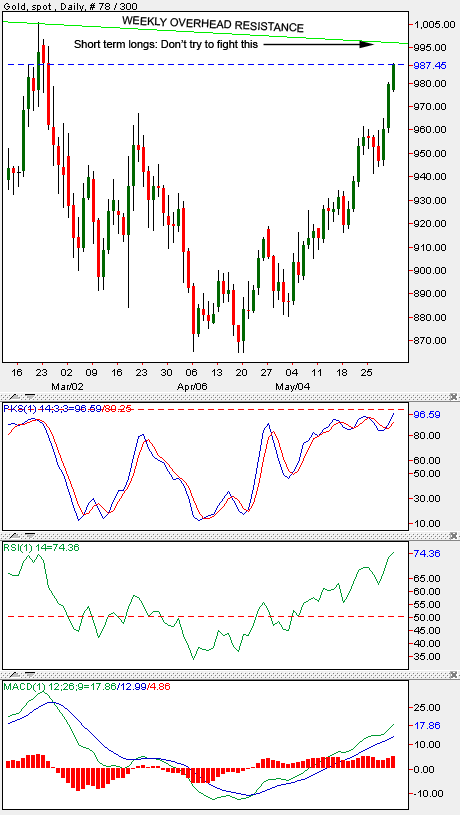
Spot gold, daily interval
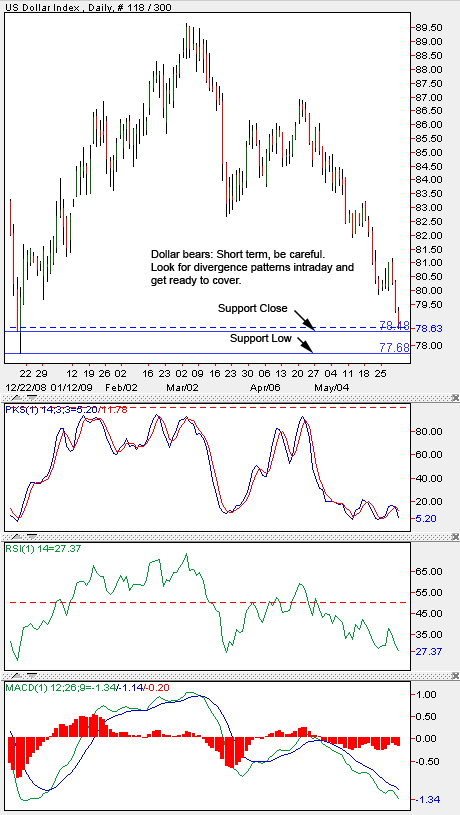
U.S. Dollar Index, daily interval
Via: Reuters:
U.S. Treasury Secretary Timothy Geithner on Monday reassured the Chinese government that its huge holdings of dollar assets are safe and reaffirmed his faith in a strong U.S. currency.
A major goal of Geithner’s maiden visit to China as Treasury chief is to allay concerns that Washington’s bulging budget deficit and ultra-loose monetary policy will fan inflation, undermining both the dollar and U.S. bonds.
China is the biggest foreign owner of U.S. Treasury bonds. U.S. data shows that it held $768 billion in Treasuries as of March, but some analysts believe China’s total U.S. dollar-denominated investments could be twice as high.
“Chinese assets are very safe,” Geithner said in response to a question after a speech at Peking University, where he studied Chinese as a student in the 1980s.
His answer drew loud laughter from his student audience, reflecting scepticism in China about the wisdom of a developing country accumulating a vast stockpile of foreign reserves instead of spending the money to raise living standards at home.
The Beijing-based Global Times greeted Geithner by publishing a survey of Chinese economists who called big holdings of U.S. debt “risky.”
Geithner renewed pledges that the Obama administration would cut its huge fiscal deficits and promised “very disciplined” future spending, possibly including reintroduction of pay-as-you-go budget rules instead of nonstop borrowing.
“We have the deepest and most liquid markets for risk-free assets in the world. We’re committed to bring our fiscal deficits down over time to a sustainable level.
“We believe in a strong dollar … and we’re going to make sure that we repair and reform the financial system so that we sustain confidence,” he said.
Geithner also offered strong backing for a bigger Chinese role in international policymaking.
“China is already too important to the global economy not to have a full seat at the international table,” he said.
GM to Seek Bankruptcy
June 1st, 2009UPDATE: GM Files for Bankruptcy Protection
Via: Washington Post:
General Motors filed for bankruptcy protection this morning, marking the end of financial independence for the 100-year-old industrial leviathan that once conflated its interests with the country’s and — counting jobs at the company and its suppliers — employed well over 1 million people.
—End Update—
Via: New York Times:
President Obama will push General Motors into bankruptcy protection on Monday, making a risky bet that by temporarily nationalizing the onetime icon of American capitalism, he can save at least a diminished automaker that is competitive.
The bankruptcy, to be filed in New York, is a moment of reckoning for an industry that was once at the heart of the American economy. It culminates a remarkable four months of confrontation between Washington and Detroit that is expected to result in a drastic downsizing of the company.
It also places the government in uncharted territory as a business owner, as it takes a 60 percent ownership stake in the company during its restructuring.
Reflecting the government’s extraordinary intervention in industry, aides say, Mr. Obama plans to tell the nation on Monday that he believes G.M. can be brought back from the brink of insolvency, even if the company looks almost nothing like the titan of old.
Meanwhile, a federal judge late Sunday night cleared a path for Chrysler to get out of bankruptcy by approving a sale of most of that carmaker’s assets to a new entity to be run by Fiat of Italy.
Administration officials briefed reporters on the G.M. plans Sunday night, as President Obama began to inform members of Congress. But the White House insisted that the aides who talked to reporters could not be named.
In his remarks on Monday, Mr. Obama will spell out a strategy in which a shrunken G.M. can make money even if new car sales remain at a sluggish 10 million a year in the United States and even if G.M., once the giant of the industry, drops below its current 20 percent market share in this country.
But to get there, American taxpayers will invest an additional $30 billion in the company, atop $20 billion already spent just to keep it solvent as the company bled cash as quickly as Washington could inject it. Whether that investment will ever be recovered is still an open question.
The company will also have to shed 21,000 union workers and close 12 to 20 factories, steps that most analysts thought could never be pushed through by a Democratic president allied with organized labor.
Forty percent of the company’s 6,000 dealers will close, the workers’ union will be forced to finance half of its $20 billion health care fund with stock of uncertain value in the restructured G.M., and bondholders, including many retirees, will be forced to take stock worth 10 cents for every dollar they lent the company.
The company’s last steps toward bankruptcy took place over the weekend as a majority of G.M. bondholders agreed not to challenge the filing in court and to exchange their debt for stock.
Cryptogon Reader Sends Contribution
May 31st, 2009Thanks to FT for sending €10.
The Ultimate Lock Picker Hacks Pentagon, Beats Corporate Security for Fun and Profit
May 31st, 2009Via: Wired:
Between stabs at his salad, Tobias hands me his latest idea of fun: nearly 300 pages of self-published hacker-porn detailing his attack on the allegedly uncrackable Medeco high-security lock. “Trust me, this will cause a goddamned riot!” he says, dabbing at tears of joy with a paper napkin. “Oh yeah, this is way, way bigger than the liquid explosives thing!” And he’s right, it is bigger—and with way, way bigger consequences.
And Now… Flu Vaccines in Corn
May 31st, 2009Via: Meat and Poultry:
Iowa State University researchers are putting flu vaccines into the genetic makeup of corn, which may someday allow pigs and humans to get a flu vaccination simply by eating corn or corn products.
“We’re trying to figure out which genes from the swine influenza virus to incorporate into corn so those genes, when expressed, would produce protein,” said Hank Harris, professor in animal science and one of the researchers on the project. “When the pig consumes that corn, it would serve as a vaccine.”
This collaborative effort project involves Mr. Harris and Brad Bosworth, an affiliate associate professor of animal science working with pigs, and Kan Wang, a professor in agronomy, who is developing the vaccine traits in the corn.
According to the researchers, the corn vaccine would also work in humans when they eat corn or even corn flakes, corn chips, tortillas or anything that contains corn, Mr. Harris said. The research is funded by a grant from Iowa State University’s Plant Sciences Institute, and is their Biopharmaceuticals and Bioindustrials Research Initiative.
If the research goes well, the corn vaccine may be possible in five to seven years. In the meantime, the team is trying to expedite the process. “While we’re waiting for Wang to produce the corn, we are starting initial experiments in mice to show that the vaccine might induce an immune response,” Mr. Bosworth said.
Mr. Harris said the team still needs more answers. “The big question is whether or not these genes will work when given orally through corn,” he added. “That is the thing we’ve still got to determine.”
Stability and safety are several advantages to the corn vaccine. Once the corn with the vaccine is grown, it can be stored for long-term without losing its potency, researchers claim. If a swine flu virus breaks out, the corn could be shipped to the location to try to vaccinate animals and humans in the area quickly. Because corn grain is used as food and feed, there is no need for extensive vaccine purification, which can be an expensive process.
The Black World Has Black Fiber; Cut It and Black SUVs Show Up Within Minutes
May 31st, 2009You have to read to the end of the article to find out that the incident happened in 2000.
Via: Washington Post:
This part happens all the time: A construction crew putting up an office building in the heart of Tysons Corner a few years ago hit a fiber optic cable no one knew was there.
This part doesn’t: Within moments, three black sport-utility vehicles drove up, a half-dozen men in suits jumped out and one said, “You just hit our line.”
Whose line, you may ask? The guys in suits didn’t say, recalled Aaron Georgelas, whose company, the Georgelas Group, was developing the Greensboro Corporate Center on Spring Hill Road. But Georgelas assumed that he was dealing with the federal government and that the cable in question was “black” wire — a secure communications line used for some of the nation’s most secretive intelligence-gathering operations.
“The construction manager was shocked,” Georgelas recalled. “He had never seen a line get cut and people show up within seconds. Usually you’ve got to figure out whose line it is. To garner that kind of response that quickly was amazing.”
Black wire is one of the looming perils of the massive construction that has come to Tysons, where miles and miles of secure lines are thought to serve such nearby agencies as the Office of the Director of National Intelligence, the National Counterterrorism Center and, a few miles away in McLean, the Central Intelligence Agency. After decades spent cutting through red tape to begin work on a Metrorail extension and the widening of the Capital Beltway, crews are now stirring up tons of dirt where the black lines are located.
“Yeah, we heard about the black SUVs,” said Paul Goguen, the engineer in charge of relocating electric, gas, water, sewer, cable, telephone and other communications lines to make way for Metro through Tysons. “We were warned that if they were hit, the company responsible would show up before you even had a chance to make a phone call.”
So far, so good, Goguen added. But the peril remains for a project that will spend $150 million moving more than 75 miles of conduit along the three-mile stretch of routes 123 and 7 that run through Tysons.
…
Georgelas, the developer whose company was overseeing the work in 2000 when the Chevrolet Suburbans drove up to the Greensboro Corporate Center, said he figured that the government was involved when an AT&T crew arrived the same day to fix the line, rather than waiting days. His opinion didn’t change when AT&T tried to bill his company for the work but immediately backed down when his company balked.
“These lines are not cheap to move,” Georgelas said. “They said, ‘You owe us $300,000.’ We said, ‘Are you nuts?’ ”
The charges just disappeared.
Government Motors: Majority of GM Bondholders Back Debt-for-Equity Deal
May 31st, 2009Via: Wall Street Journal:
General Motors Corp. moved a step closer to what it hopes will be a smooth bankruptcy process after a majority of investors holding $27 billion in the company’s bonds agreed to forgive the debt for equity in the new company, people familiar with the situation said.
A battle with the group was one of the biggest hurdles biggest hurdles GM faced in orchestrating a quick exit from Chapter 11.
The Obama administration plans to usher GM into bankruptcy court Monday as part of its ambitious effort to remake the American car industry at the tail end of its decades-long decline. President Barack Obama is expected to announce the government’s plans for GM in a speech that will try to convey the message that the government can rebuild GM and Chrysler and salvage some of the taxpayers’ investments.
The auto maker, living on U.S. government loans, faces a Monday deadline imposed by the Obama administration. GM announced Friday that Chief Executive Fritz Henderson would give a press conference on Monday in New York outlining proceedings that would likely take place.
Initially, the company said getting bondholders to agree to a debt swap was its best chance for avoiding Chapter 11. But the latest plan is designed to expedite a bankruptcy filling more than to avoid it. As part of the agreement, bondholders pledged not to oppose GM’s reorganization in court.
Under the plan, the Treasury would provide GM with $30 billion in loans to keep running through a bankruptcy, in addition to $20 billion already given to the company. GM won’t have to repay the loans; instead, the government will turn them into a controlling stake in the company. The UAW would end up with at least a 17.5% stake in the new company after agreeing to concessions that will save GM about $10 billion in obligations to retiree health care as well as billions more on labor costs. In exchange, GM agreed to use a soon-to-be-determined idled plant to build a small car in the U.S.
A Human Language Gene Changes the Sound of Mouse Squeaks
May 31st, 2009Via: New York Times:
People have a deep desire to communicate with animals, as is evident from the way they converse with their dogs, enjoy myths about talking animals or devote lifetimes to teaching chimpanzees how to speak. A delicate, if tiny, step has now been taken toward the real thing: the creation of a mouse with a human gene for language.
The gene, FOXP2, was identified in 1998 as the cause of a subtle speech defect in a large London family, half of whose members have difficulties with articulation and grammar. All those affected inherited a disrupted version of the gene from one parent. FOXP2 quickly attracted the attention of evolutionary biologists because other animals also possess the gene, and the human version differs significantly in its DNA sequence from those of mice and chimpanzees, just as might be expected for a gene sculpted by natural selection to play an important role in language.
Researchers at the Max Planck Institute for Evolutionary Anthropology in Leipzig, Germany, have now genetically engineered a strain of mice whose FOXP2 gene has been swapped out for the human version. Svante Paabo, in whose laboratory the mouse was engineered, promised several years ago that when the project was completed, “We will speak to the mouse.” He did not promise that the mouse would say anything in reply, doubtless because a great many genes must have undergone evolutionary change to endow people with the faculty of language, and the new mouse was gaining only one of them. So it is perhaps surprising that possession of the human version of FOXP2 does in fact change the sounds that mice use to communicate with other mice, as well as other aspects of brain function.
Loan Modifications: Redefault Rates May Reach 75%
May 31st, 2009Via: Wall Street Journal:
A central tenet of Washington economic policy for the past three years has been that the key to ending the recession is stopping mortgage foreclosures, whatever the cost. Well, another new study shows that mortgage-servicing companies are having a terrible time of it, not least because the mortgages are continuing to sour at a rate nearly as fast as they can be modified.
Yesterday’s Journal reports that Fitch Ratings looked at mortgages bundled into securities between 2005 and 2007 and managed by some 30 mortgage companies. Fitch found that a conservative projection was that between 65% and 75% of modified subprime loans will fall delinquent by 60 days or more within 12 months of having been modified to keep the borrowers in their homes. This is an even worse result than previous reports by federal regulators. Even loans whose principal was reduced by as much as 20% were still redefaulting in a range of 30% to 40% after 12 months.




