Red Bull: The Cocaine Energy Drink
May 25th, 2009Via: The Local:
Authorities in the German states of Hesse and North-Rhine Westphalia have ordered retailers to stop selling Red Bull Cola after they found traces of cocaine in the fizzy drink.
The consumer ministries in the two states confirmed on Friday they had ordered retailers to pull the drink off their shelves after a food safety institute in North-Rhine Westphalia found cocaine in samples of the beverage.
“The institute examined Red Bull Cola in an elaborate chemical process and found traces of cocaine,” Bernhard Kühnle, head of the food safety department at the federal ministry for consumer protection said.
Authorities said the cocaine levels do not pose a health threat but are not permitted in foodstuffs.
The Frankfurter Neuen Presse reported that the investigation was prompted by the use of a de-cocainized extract of coca leaf in the drink. That means the drink cannot be classified as a foodstuff but as a narcotic and needs a special license, authorities said.
The newspaper reported that German retail group Rewe had already issued orders to remove the fizzy drink from its shops. Wilhelm Deitermann, spokesman for the North-Rhine Westphalia consumer ministry said he expected other German states to follow suit and ban the drink.
But Red Bull Cola has protested the action. “De-cocainized extract of coca leaf is used worldwide in foods as a natural flavouring,” the paper quoted the company saying. The company added that Red Bull Cola as well as other food that contains coca leaf extract is considered safe in the EU as well as in the US.
The more popular Red Bull, dubbed the “clubbers’ drink,” is often mixed with vodka. It contains caffeine, vitamins, and sugar which, the company claims, kick-starts the body’s metabolism and keeps people alert.
Netherlands to Close Prisons Due to Lack of Criminals
May 25th, 2009Via: NRC Handelsblad:
The Dutch justice ministry has announced it will close eight prisons and cut 1,200 jobs in the prison system. A decline in crime has left many cells empty.
During the 1990s the Netherlands faced a shortage of prison cells, but a decline in crime has since led to overcapacity in the prison system. The country now has capacity for 14,000 prisoners but only 12,000 detainees.
Deputy justice minister Nebahat Albayrak announced on Tuesday that eight prisons will be closed, resulting in the loss of 1,200 jobs. Natural redundancy and other measures should prevent any forced lay-offs, the minister said.
The overcapacity is a result of the declining crime rate, which the ministry’s research department expects to continue for some time.
Belgian prisoners
Some reprieve might come from a deal with Belgium, which is facing overpopulation in its prisons. The two countries are working out an agreement to house Belgian prisoners in Dutch prisons. Some five-hundred Belgian prisoners could be transferred to the Tilburg prison by 2010.
The Netherlands would get 30 million euros in the deal, and it will allow the closing of the prisons in Rotterdam and Veenhuizen to be postponed until 2012.
Gold and the Dollar: Countertrend Elliot Wave Cycles Completed
May 24th, 2009WARNING: This is not a recommendation to buy, sell or hold any financial instrument.
DISCLOSURE: I own gold. I am a BullionVault client and affiliate.
Summary: My best guess is that, on balance, gold is headed higher and will break above the high of $1032 set back on 17 March 2008. I’ve written on balance because there is going to be a lot of noise and volatility along the way as market participants struggle with the reality of the situation on the dollar. With regard to a timeline on the breakout occurring: Less than six months is my best guess. Short term (days to a couple of weeks): expect selling; lock and load to buy dips above around $875.
Technical Analysis: To my squinty eye, gold is carving out a giant pennant. A bullish pennant alone isn’t really enough to go on, so I looked at the dollar for insights and noticed (with my other squinty eye) a completed bullish Elliot Wave cycle; the classic 5-3 pattern.
As gold and the dollar move roughly opposite to each other, I looked back at gold and—squinting hard enough—I counted five bearish waves on the weekly interval. I know. That’s arguably not a bearish Elliot Wave wave sequence on gold, but since the bullish pattern is so clear on the dollar, I really tried to see it.

Spot gold, weekly interval
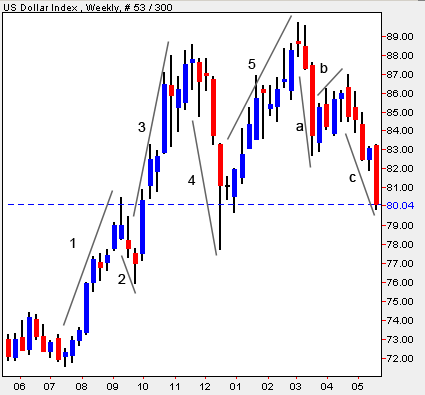
U.S. Dollar Index, weekly interval
Another bearish indicator on the U.S. Dollar Index is the formation of a Dark Cloud Cover/Hangman on the March 2009 candle. (Not illustrated here.)
I think we’re setting up the next phase (fractal) of the multi-year, uptrend on gold. Note the fairly obvious impulse wave beginning at the end of 2008. While the dollar would have a long way to fall to break below the previous all time low, I’m not convinced that the low would need to be taken out for gold to break higher. At this point, it’s much easier for gold to break out higher than it is for the dollar to break down and out of the range. That said, know that the dollar will eventually encounter hard support around 71-72.
It’s easy to turn Elliot Wave theory (or any other form of technical analysis) into a fully nuts study on apophenia, so I like to keep this stuff pretty simple. In summary: The argument for being long gold is a bullish Elliot Wave sequence occurring inside a quasi bullish pennant, meanwhile, on the dollar, we note a completed bullish Elliot Wave sequence. The monthly Dark Cloud Cover/Hangman candle adds more support for this view. Whether or not that “a” wave on the dollar index is a correction wave or, in fact, a new bearish impulse wave “1” is a matter that Elliot Wave practitioners might want to debate.
Saudi Arabian Oil Minister Naimi Says Oil to Reach $75 a Barrel
May 24th, 2009WARNING: This is not a recommendation to buy, sell or hold any financial instrument.
Disclosure: I’m long oil.
Remember this chart from May 2?

West Texas Intermediate Crude Oil, weekly interval
The relationship between oil prices and the U.S. Dollar Index:

U.S. Dollar Index vs. West Texas Intermediate Crude Oil, daily interval
Via: Bloomberg:
Saudi Arabian oil minister Ali al- Naimi said the price of oil will climb to $75 a barrel when demand picks up.
“We’ll get there eventually,” al-Naimi told reporters in Rome today where he will attend meetings with energy ministers from the Group of Eight industrialized nations. “The trick is keeping it between $70 and $80. It will be achieved as demand rises and the fundamentals are better than they are now.”
“A Plan that Would Require Americans to Get Not One, Not Two, But Three Flu Shots” – “Trust the Scientists” – “Massive Public Education Campaign”
May 24th, 2009Uncle Sam’s Human Lab Rats
May 23rd, 2009Via: Mother Jones:
They say government scientists messed with their minds. Now, veterans of secret psychedelic tests want answers.
Their stories are a staple of conspiracy culture: broken men, suffering hallucinations and near-total amnesia, who say they are victims of secret government mind-control experiments. Think Liev Schreiber in The Manchurian Candidate or Mel Gibson in Conspiracy Theory. Journalists are a favorite target for the paranoid delusions of this population. So is Gordon Erspamer—and the San Francisco lawyer’s latest case isn’t helping him to fend off the tinfoil-hat crowd. He has filed suit against the CIA and the US Army on behalf of the Vietnam Veterans of America and six former American soldiers who claim they are the real thing: survivors of classified government tests conducted at the Army’s Edgewood Arsenal in Maryland between 1950 and 1975. “I get a lot of calls,” he says. “There are a lot of crazy people out there who think that somebody from Mars is controlling their behavior via radio waves.” But when it comes to Edgewood, “I’m finding that more and more of those stories are true!”
That government scientists conducted human experiments at Edgewood is not in question. “The program involved testing of nerve agents, nerve agent antidotes, psychochemicals, and irritants,” according to a 1994 General Accounting Office (now the Government Accountability Office) report (PDF). At least 7,800 US servicemen served “as laboratory rats or guinea pigs” at Edgewood, alleges Erspamer’s complaint, filed in January in a federal district court in California. The Department of Veterans Affairs has reported that military scientists tested hundreds of chemical and biological substances on them, including VX, tabun, soman, sarin, cyanide, LSD, PCP, and World War I-era blister agents like phosgene and mustard. The full scope of the tests, however, may never be known. As a CIA official explained to the GAO, referring to the agency’s infamous MKULTRA mind-control experiments, “The names of those involved in the tests are not available because names were not recorded or the records were subsequently destroyed.” Besides, said the official, some of the tests involving LSD and other psychochemical drugs “were administered to an undetermined number of people without their knowledge.”
Erspamer’s plaintiffs claim that, although they volunteered for the Edgewood program, they were never adequately informed of the potential risks and continue to suffer debilitating health effects as a result of the experiments. They hope to force the CIA and the Army to admit wrongdoing, inform them of the specific substances they were exposed to, and provide access to subsidized health care to treat their Edgewood-related ailments. Despite what they describe as decades of suffering resulting from their Edgewood experiences, the former soldiers are not seeking monetary damages; a 1950 Supreme Court decision, the Feres case, precludes military personnel from suing the federal government for personal injuries sustained in the line of duty. The CIA’s decision to use military personnel as test subjects followed the court’s decision and is an issue Erspamer plans to raise at trial. “Suddenly, they stopped using civilian subjects and said, ‘Oh, we can get these military guys for free,'” he says. “The government could do whatever it wanted to them without liability. We want to bring that to the attention of the public, because I don’t think most people understand that.” (Asked about Erspamer’s suit, CIA spokeswoman Marie Harf would say only that the agency’s human testing program has “been thoroughly investigated, and the CIA fully cooperated with each of the investigations.”)
Erspamer’s involvement in the case is deeply personal. His father was a government scientist during Operation Crossroads, a series of nuclear tests conducted at Bikini Atoll in the Pacific in the summer of 1946; he was present aboard a research vessel for the “Baker” test, during which a 21-kiloton thermonuclear bomb was detonated 90 feet below water. The blast resulted in massive radioactive contamination. Erspamer’s father and the rest of the ship’s crew, he says, all died in middle age from radiogenic diseases. Erspamer makes his living in the field of energy litigation, but has twice before argued class action suits for veterans—one for soldiers who, like his father, were exposed to radiation during nuclear tests (a case he ultimately lost in a 1992 appellate decision) and more recently one on behalf of Iraq and Afghanistan veterans denied treatment for post-traumatic stress disorder. The case is on appeal in California’s 9th Circuit. “Nobody out there is doing these types of cases,” he says. “It’s really sad because the veterans are left holding the bag, and it’s not a very pretty bag.”
One of those vets is Frank Rochelle. Unlike those of other test veterans, portions of his heavily redacted medical records have survived, providing a rare, if incomplete, account of his experiences. In 1968, while posted at Virginia’s Fort Lee as a 20-year-old Army draftee, he saw a notice calling for volunteers for the Edgewood program. Among the promised incentives were relief from guard duty, the freedom to wear civilian clothes, three-day weekends, and, upon completion, a medal of commendation—all for participation in experiments that, according to the notice, would help the military test a new generation of equipment, clothing, and gas masks. Upon his arrival at the testing facility in Maryland, he says he was asked to sign a series of documents, including a release form and a secrecy agreement. The tests would be risk free, he says he was told, and any drugs given would not exceed normal dosage. Over the next two months, however, he was subjected to three rounds of experiments that, Rochelle says, left him permanently damaged. His medical records indicate that he was exposed to nonlethal incapacitating agents like DHMP and glycolate, both of which act as sedatives that produce hallucinations. In the latter case, Rochelle says he was taken into a gas chamber and strapped to a chair by two men in white lab coats, who affixed a mask to his face and told him to breathe normally. He quickly lost consciousness. According to Erspamer’s complaint, “Over the next two to three days, Frank was hallucinating and high: he thought he was three feet tall, saw animals on the walls, thought he was being pursued by a 6-foot-tall white rabbit, heard people calling his name, thought that all his freckles were bugs under his skin, and used a razor to try to cut these bugs out. No one from the clinical staff intervened on his behalf…”
Medical records indicate that Rochelle went through a third round of testing, but he has no memory of it. For years he’s been having nightmares about the Edgewood tests and now suffers from anxiety, memory loss, sleep apnea, tinnitus, and loss of vision, all of which he claims are direct results of the experiments. Still, he didn’t inform his doctor of the tests until 2006, believing that he was still bound by the oath of secrecy he swore in 1968. (The government finally released human test subjects to speak to their physicians about the tests in June 2006, under the condition that they not “discuss anything that relates to operational information that might reveal chemical or biological warfare vulnerabilities or capabilities.”)
Rochelle’s story is similar to those of Erspamer’s other plaintiffs, all of whom claim to be suffering debilitating health effects stemming from the experiments. Of course, substantiating these claims is a challenge, given that most of the medical records were destroyed upon completion of the program. Rochelle’s records remain intact, but for “others we have less information,” says Erspamer. “We spent a great deal of time on that topic, and we are confident that the plaintiffs are who they say they are, were where they said they were, and got what they said they got,” in terms of exposure to experimental chemicals. “Who bears the burden on that issue when the defendants destroyed the evidence?” Erspamer asks. “They’ve put all that stuff through the shredder.”
Compensation for injuries sustained during human testing of chemical and biological agents is not unprecedented. Last year, more than 350 servicemen who served as test subjects at Porton Down, a secret military research facility where the British government conducted its own series of mind-control experiments, were granted nearly $6 million in compensation in an out-of-court settlement with the UK’s Ministry of Defence. Likewise, in 2004, the Canadian government began offering $18,000 payments to eligible veterans of experiments at its testing facilities. Nevertheless, says Erspamer, “No American soldiers have ever been compensated.” The CIA and the Army “just hope they’re all gonna die off, and they will unless somebody does something.”
Deadly NY Terror Cell Are Semi-Retarded Potheads
May 23rd, 2009Via: Infowars:
Exactly as we predicted in our headline story yesterday, two of the ringleaders in the “deadly” New York terror plot salaciously hyped by the media and government officials have turned out to be semi-retarded potheads.
“The men will likely turn out to be semi-retarded dropouts,” we stated in our article yesterday, basing our forecast on the fact that in every other major terror sting in the west given so much prominence by officials and the corporate media, the poor suckers rounded up by the feds always turn out to be low IQ petty criminals down on their luck, provocateured and armed by federal agents.
We already knew that the men were provided with an inert rocket launcher and fake C4 explosives by an FBI informant, and now as more details emerge, our original summation of the case is proving accurate.
According to an Associated Press report, the four men charged with planning to blow up synagogues and military planes, “Were amateurs every step of the way. They had trouble finding guns and bought cameras at Wal-Mart to photograph their targets. One was a convicted purse snatcher, another smoked marijuana the day the plot was to be carried out.”
The report continues,”Relatives said the defendants were down-on-their-luck men who worked at places like Wal-Mart, a landscaping company and a warehouse when they weren’t behind bars. Payen’s lawyer said he was “intellectually challenged” and on medication for schizophrenia. Marilyn Reader said he has “a very low borderline” IQ.”
Of course, it was only after an FBI informant radicalized these bums and provided them with weapons that they became any kind of threat, providing the feds the opportunity to swoop in, declare a victory in the war on terror and use the case as a poster child for Americans to accept police state measures and believe the hype surrounding “domestic terrorists” in the wake of controversy surrounding the MIAC report.
As the AP article concedes, “Some have criticized informants’ roles in such cases, saying they egged on and ensnared suspects who weren’t dangerous.”
L.A. Police Union Wants San Diego Newspaper Writers Fired
May 23rd, 2009Via: Los Angeles Times:
The union representing Los Angeles police officers is pressuring the owner of San Diego’s main newspaper to change the paper’s editorial stance on labor issues or to fire its editorial writers.
The feud is rooted in the recent purchase of the San Diego Union-Tribune by Platinum Equity, a private Beverly Hills firm.
Platinum relies on a $30-million investment from the pension fund of Los Angeles police officers and fire fighters, along with large sums from other public-employee pension systems around the state, to help fund its acquisitions of companies. As League President Paul M. Weber views it, that makes the League part owner in the flagging Tribune and League officials are none to happy with the paper’s consistent position that San Diego lawmakers should cut back on salaries and benefits for public employees in order to help close gaping budget deficits.
“Since the very public employees they continually criticize are now their owners, we strongly believe that those who currently run the editorial pages should be replaced,” Weber wrote in a March 26 letter to Platinum CEO Tom Gores.
Weber, in an interview, emphasized that the League is not demanding changes in the paper’s news coverage of the issue or in its staff of reporters. “It’s just these people on the opinion side. There is not even an attempt to be even-handed. They’re one step away from saying, ‘these public employees are parasites,’ ” Weber said.
And Now… ABC Resurrects V
May 23rd, 2009Schwarzenegger Plans to Completely Eliminate Welfare for Families in California
May 23rd, 2009Via: Los Angeles Times:
Gov. Arnold Schwarzenegger is proposing to completely eliminate the state’s welfare program for families, medical insurance for low-income children and Cal Grants cash assistance to college and university students.
The proposals to sharply scale back the assistance that California provides to its neediest residents came in testimony by the administration this afternoon at a joint legislative budget committee hearing. It followed comments by the governor earlier today that he would be withdrawing a proposal to help balance the budget with billions of dollars of borrowing and replacing it with program reductions.
The proposals would completely reshape the state’s social service network, transforming California from one of the country’s most generous states to one of the most tightfisted. The proposals are intended to help close a budget deficit estimated at $21.3 billion.




