Mexico Is in Free Fall
February 26th, 2009Via: Guardian:
Shortly before the US elections last November, then vice-presidential candidate Joe Biden was widely criticised for predicting that an Obama administration would almost certainly be tested by what he called a “generated” international crisis, in much the way that the Soviet Union “tested” John F Kennedy shortly after he assumed office. Biden did not point to a specific region of the world, but mentioned the Middle East, the Indian subcontinent and Russia as the likeliest sources of trouble for the new president.
Impolitic or not, Biden’s anxieties seem to have informed several of the administration’s early foreign policy decisions. These include his own extension of an olive branch to Russia at the recent Munich security conference, and Barack Obama’s appointment of Richard Holbrooke as special envoy for Pakistan and Afghanistan – and of George Mitchell to a similar post for Israel-Palestine.
But, as pressing as the Middle East, south Asia, and Russia (as well as Iran and North Korea) are, another crisis far closer to home could create as much peril as a nuclear-armed Iran, an aggressively resurgent Russia, or even an Islamist-dominated Pakistan.
That crisis is located in Mexico, which is in free fall, its state institutions under threat as they have not been since at least the Cristero uprising of the late 1920s and possibly since the Mexican revolution of 1910. While the Obama administration is obviously aware of what is happening south of the Rio Grande, the threat simply does not command the attention that its gravity requires.
The crisis consists in nothing less than an effort by the major drug cartels to tame and suborn the Mexican state, and not just in the strip along the US border, though the epicentre of the crisis is there. Obviously, the cartels’ leaders do not have designs on Mexico’s presidential palace. But, through a policy of terror extending from Oaxaca in the south, through Acapulco on the Pacific coast, and up to the great border cities of Tijuana and Juarez (Mexico’s sixth and seventh most populous cities, respectively), they have made it abundantly clear that they are trying to achieve impunity.
The only recent parallel in Latin America was a similar effort 15 years ago by the Colombian drug cartels. That disguised coup failed – barely – and there is no guarantee that the result will be similar this time around in Mexico.
Journalists with long experience of war zones report being more worried about their safety in Mexico border than when they were in Bosnia, Afghanistan, or Iraq, though much of the violence is internecine. Of the thousands who have been killed, often after being horribly tortured, many, if not most, have been members of the drug cartels and their families.
But it is the campaign of targeted assassination against any Mexican official who seems to pose a serious threat to the cartels’ operations that makes the crisis so dire. First, in May 2007, the cartels killed Jose Nemesio Lugo Felix, the general co-ordinator of information at the national centre for planning and analysis to combat organised crime. Soon after, a hitman murdered Edgar Milan Gomez, Mexico’s highest ranking federal police official.
In November, 2008, a plane carrying Juan Camilo Mourino, Mexico’s national security adviser, crashed under mysterious circumstances. And very recently, the retired General Mauro Enrique Tello Quinones, one of the most decorated officers in the Mexican army, was abducted, tortured, and killed less than a week after assuming a new position as anti-drug chief in the resort city of Cancún.
U.S. Military Might Be Sent to U.S.-Mexico Border as Drug Cartel Chaos Spirals
February 26th, 2009Via: Los Angeles Times:
The Justice Department announced Wednesday that authorities had arrested more than 730 people across the country in a 21-month investigation targeting Mexico’s Sinaloa drug cartel and its infiltration into U.S. cities.
The arrests, including 50 on Wednesday in California, Minnesota, Maryland and the nation’s capital, come amid growing concern in Washington that Mexican crime organizations are out of control and threaten the stability of parts of Mexico and the safety of U.S. citizens.
The Homeland Security Department has developed a plan to send more agents and other resources, and possibly military support, to the U.S.-Mexico border if the drug violence continues to spill over and overwhelm the agents stationed there, a department official confirmed.
The Pentagon is looking into a larger role in bolstering counter-narcotics efforts. Adm. Dennis C. Blair, the director of national intelligence, told Congress on Wednesday that the corruptive influence and increasing violence of the cartels had undermined the Mexican government’s ability to govern parts of its country.
A recent State Department travel advisory warned U.S. citizens about the perils of travel in Mexico, likening the shootouts between authorities and the cartels to “small-unit combat.” The U.S. National Drug Intelligence Center believes that Mexican cartels maintain drug distribution networks or supply drugs to distributors in as many as 195 U.S. cities.
And on Wednesday, Rep. Lamar Smith (R-Texas), the ranking member of the House Judiciary Committee, said the recent surge in drug-related violence on the Southwest border “has turned some American communities and neighborhoods into the Wild West.”
“A battle is building on the border, and U.S. citizens are getting caught in the crossfire,” Smith said, calling on House Democrats to hold a hearing on drug-related violence on the border. “Congress must address the violence before more lives are lost.”
CIA Signals Continuity With Bush Era
February 26th, 2009Change.
Via: Wall Street Journal:
The Central Intelligence Agency’s new director outlined spy policies Wednesday, including an aggressive campaign in Pakistan, that underscored considerable continuity with the Bush administration.
CIA Director Leon Panetta, in his first meeting with reporters, said the agency will continue to carry out drone attacks on militants in Pakistan. He also said that while CIA interrogations will have new limits, President Barack Obama can still use his wartime powers to authorize harsher techniques if necessary.
Among changes under way at the CIA, the agency is now assembling a daily Economic Intelligence Brief to monitor the global economic slowdown’s impact on stability. Argentina, Ecuador and Venezuela are facing “serious problems” that threaten their economic stability, Mr. Panetta said.
…
The Obama administration has also shown a reluctance to overturn Bush administration views on certain terrorism-related legal matters. Earlier this month, it backed Bush-era positions that a case against a contractor alleged to have helped with CIA renditions shouldn’t go forward because it will reveal “state secrets,” and that detainees in Afghanistan don’t have the right to challenge their detention in a U.S. court. Coming cases that will provide additional signals include a lawsuit to force the release of Justice Department memos on anti-terrorism policies.
Baxter International “Unintentionally” Sent Flu Samples to Companies that Contained H5N1 Avian Flu
February 26th, 2009That’s the headline, but the reality of what happened might indicate a far more serious situation.
In U.S. Researchers Trying to Create Pandemic Avian Flu, pay very close attention to the part about the ferrets:
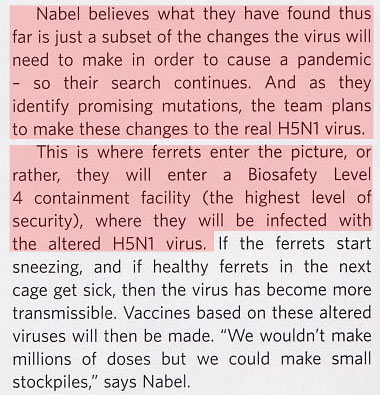
Now, flash forward to today.
What happened to the ferrets that received Baxter’s H5N1 virus material?
The animals died “promptly” according to the story below.
The sixty-four-thousand-dollar question is: Did any ferrets in neighboring cages—that didn’t receive the Baxter H5N1 virus—also get sick and die? The answer to that question is conveniently missing from every story that I have found about this incident.
If the answer is ‘yes’ it means that Baxter didn’t supply standard H5N1 virus, but rather a weaponized/pandemic version that is the same as or similar to the one that the National Institute of Allergy and Infectious Diseases was developing.
Via: The Canadian Press:
Officials are trying to get to the bottom of how vaccine manufacturer Baxter International Inc. made “experimental virus material” based on a human flu strain but contaminated with the H5N1 avian flu virus and then distributed it to an Austrian company.
That company, Avir Green Hills Biotechnology, then disseminated the supposed H3N2 virus product to subcontractors in the Czech Republic, Slovenia and Germany. Authorities in the four European countries are looking into the incident, and their efforts are being closely watched by the World Health Organization and the European Centre for Disease Control.
Though it appears none of the 36 or 37 people who were exposed to the contaminated product became infected, the incident is being described as “a serious error” on the part of Baxter, which is on the brink of securing a European licence for an H5N1 vaccine. That vaccine is made at a different facility, in the Czech Republic.
“For this particular incident … the horse did not get out (of the barn),” Dr. Angus Nicoll of the ECDC said from Stockholm.
“But that doesn’t mean that we and WHO and the European Commission and the others aren’t taking it as seriously as you would any laboratory accident with dangerous pathogens – which you have here.”
Accidental release of a mixture of live H5N1 and H3N2 viruses – if that indeed happened – could have resulted in dire consequences. Nicoll said officials still aren’t 100 per cent sure the mixture contained live H5N1 viruses. But given that ferrets exposed to the mixture died, it likely did.
H5N1 doesn’t easily infect people, but H3N2 viruses do. They are one of two types of influenza A viruses that infect people each flu season.
If someone exposed to the mixture had been co-infected with H5N1 and H3N2, the person could have served as an incubator for a hybrid virus able to transmit easily to and among people. That mixing process, called reassortment, is one of two ways pandemic viruses are created.
Research published last summer by scientists at the U.S. Centers for Disease Control found that in the laboratory, H5N1 and H3N2 viruses mated readily. While less virulent than H5N1, a number of the offspring viruses appeared to retain at least a portion of the killing power of their dangerous parent.
Baxter International, which is based in Deerfield, Ill., said the contamination was the result of an error in its research facility in Orth-Donau, Austria.
The facility had been contracted by Avir Green Hills to make what Baxter refers to as “experimental virus material” based on human H3N2 viruses.
Christopher Bona, Baxter’s director of global bioscience communications, said the liquid virus product was not a vaccine and was developed for testing purposes only. He deferred questions about the purpose of the testing to Avir Green Hills, but said the batch was to be used in animals and was never intended for use in humans.
Avir Green Hills said in an email that it took possession of the material in late December. It later sent the product to the sub-contractors. The email said the material was stored and handled throughout under high biosafety conditions.
Alarm bells rang in early February when researchers at the Czech sub-contractor inoculated ferrets with the material and the animals promptly died. Baxter learned about the problem on Feb. 6, Bona said from Deerfield.
Ferrets are susceptible to human flu strains, but they don’t die from those infections. Preliminary investigation found the material was contaminated with H5N1 flu virus, which is lethal to ferrets.
Nicoll said the fact the ferrets died supports the working assumption that there were live H5N1 viruses in the material Baxter produced.
Bona said Baxter has identified how the contamination happened and has taken steps to ensure it doesn’t happen again. He said Austrian authorities audited Baxter’s Orth-Donau research operations after the problem came to light and are satisfied with the steps taken.
Baxter is the only flu vaccine manufacturer to work with wild type flu viruses, felt to be more dangerous than the altered and attenuated (weakened) viruses other manufacturers use.
The company uses what is known as BSL3 level precautions in all its vaccine research facilities, Bona said. (Researchers at the U.S. CDC use BSL3-plus biocontainment when working with H5N1 viruses, a spokesperson for the agency said.)
People familiar with biosecurity rules are dismayed by evidence that human H3N2 and avian H5N1 viruses have somehow co-mingled in the Baxter research facility. That should not be allowed to happen, a number of experts insisted.
The company isn’t shedding much light on how it did.
“It was a combination of just the process itself, (and) technical and human error in this procedure,” Bona said. When asked to elaborate, he said to do so would give away proprietary information about Baxter’s production process.
Bona said when Baxter realized its error, it helped the various companies destroy the contaminated material and clean up their facilities. And staff who had been exposed to the contaminated product were assessed and monitored by infectious diseases doctors. They were also offered the antiviral drug oseltamivir (Tamiflu).
Baxter’s error is reminiscent of a 2005 incident where a U.S. manufacturer of kits used by laboratories to test their detection capabilities included vials of H2N2 virus in several thousand proficiency kits. H2N2, the virus that caused the 1957 pandemic, has not circulated since 1968 and is thought to be a prime candidate to cause the next pandemic.
That mistake, discovered by Canada’s National Microbiology Laboratory, set authorities around the world scrambling to retrieve and destroy the vials of virus, which had been sent to labs in 18 countries.
More: Baxter: Product Contained Live Bird Flu Virus
The company that released contaminated flu virus material from a plant in Austria confirmed Friday that the experimental product contained live H5N1 avian flu viruses.
And an official of the World Health Organization’s European operation said the body is closely monitoring the investigation into the events that took place at Baxter International’s research facility in Orth-Donau, Austria.
“At this juncture we are confident in saying that public health and occupational risk is minimal at present,” medical officer Roberta Andraghetti said from Copenhagen, Denmark.
“But what remains unanswered are the circumstances surrounding the incident in the Baxter facility in Orth-Donau.”
The contaminated product, a mix of H3N2 seasonal flu viruses and unlabelled H5N1 viruses, was supplied to an Austrian research company. The Austrian firm, Avir Green Hills Biotechnology, then sent portions of it to sub-contractors in the Czech Republic, Slovenia and Germany.
The contamination incident, which is being investigated by the four European countries, came to light when the subcontractor in the Czech Republic inoculated ferrets with the product and they died. Ferrets shouldn’t die from exposure to human H3N2 flu viruses.
Public health authorities concerned about what has been described as a “serious error” on Baxter’s part have assumed the death of the ferrets meant the H5N1 virus in the product was live. But the company, Baxter International Inc., has been parsimonious about the amount of information it has released about the event.
On Friday, the company’s director of global bioscience communications confirmed what scientists have suspected.
“It was live,” Christopher Bona said in an email.
The contaminated product, which Baxter calls “experimental virus material,” was made at the Orth-Donau research facility. Baxter makes its flu vaccine — including a human H5N1 vaccine for which a licence is expected shortly — at a facility in the Czech Republic.
People familiar with biosecurity rules are dismayed by evidence that human H3N2 and avian H5N1 viruses somehow co-mingled in the Orth-Donau facility. That is a dangerous practice that should not be allowed to happen, a number of experts insisted.
Accidental release of a mixture of live H5N1 and H3N2 viruses could have resulted in dire consequences.
While H5N1 doesn’t easily infect people, H3N2 viruses do. If someone exposed to a mixture of the two had been simultaneously infected with both strains, he or she could have served as an incubator for a hybrid virus able to transmit easily to and among people.
That mixing process, called reassortment, is one of two ways pandemic viruses are created.
There is no suggestion that happened because of this accident, however.
“We have no evidence of any reassortment, that any reassortment may have occurred,” said Andraghetti.
“And we have no evidence of any increased transmissibility of the viruses that were involved in the experiment with the ferrets in the Czech Republic.”
Baxter hasn’t shed much light — at least not publicly — on how the accident happened. Earlier this week Bona called the mistake the result of a combination of “just the process itself, (and) technical and human error in this procedure.”
He said he couldn’t reveal more information because it would give away proprietary information about Baxter’s production process.
Andraghetti said Friday the four investigating governments are co-operating closely with the WHO and the European Centre for Disease Control in Stockholm, Sweden.
“We are in very close contact with Austrian authorities to understand what the circumstances of the incident in their laboratory were,” she said.
“And the reason for us wishing to know what has happened is to prevent similar events in the future and to share lessons that can be learned from this event with others to prevent similar events. … This is very important.”
JAPAN: EXPORTS DOWN 45.7 PERCENT FROM A YEAR EARLIER
February 25th, 2009Via: Bloomberg:
Japan’s exports plunged 45.7 percent in January from a year earlier, resulting in a record trade deficit, as recessions in the U.S. and Europe smothered demand for the country’s cars and electronics.
The shortfall widened to 952.6 billion yen ($9.9 billion), the biggest since 1980, the earliest year for which there is comparable data, the Finance Ministry said today in Tokyo. The drop in shipments abroad eclipsed a record 35 percent decline set the previous month.
Exports to the U.S. tumbled an unprecedented 52.9 percent from a year earlier, and shipments to Asia and Europe also posted the largest-ever declines as the global recession deepened. The collapse is likely to force Japanese companies to keep firing workers and closing factories, worsening an economy that shrank the most in 34 years last quarter.
The Anti-Bono: Dambisa Moyo and “Dead Aid”
February 25th, 2009Via: New York Times:
Q: As a native of Zambia with advanced degrees in public policy and economics from Harvard and Oxford, you are about to publish an attack on Western aid to Africa and its recent glamorization by celebrities. “Dead Aid,” as your book is called, is particularly hard on rock stars. Have you met Bono?
I have, yes, at the World Economic Forum in Davos, Switzerland, last year. It was at a party to raise money for Africans, and there were no Africans in the room, except for me.
What do you think of him?
I’ll make a general comment about this whole dependence on “celebrities.” I object to this situation as it is right now where they have inadvertently or manipulatively become the spokespeople for the African continent.
You argue in your book that Western aid to Africa has not only perpetuated poverty but also worsened it, and you are perhaps the first African to request in book form that all development aid be halted within five years.
Think about it this way — China has 1.3 billion people, only 300 million of whom live like us, if you will, with Western living standards. There are a billion Chinese who are living in substandard conditions. Do you know anybody who feels sorry for China? Nobody.
Maybe that’s because they have so much money that we here in the U.S. are begging the Chinese for loans.
Forty years ago, China was poorer than many African countries. Yes, they have money today, but where did that money come from? They built that, they worked very hard to create a situation where they are not dependent on aid.
What do you think has held back Africans?
I believe it’s largely aid. You get the corruption — historically, leaders have stolen the money without penalty — and you get the dependency, which kills entrepreneurship. You also disenfranchise African citizens, because the government is beholden to foreign donors and not accountable to its people.
If people want to help out, what do you think they should do with their money if not make donations?
Microfinance. Give people jobs.
Research Credit: DrFrost501
Man Charged with Sending Terrorist Material by Email
February 25th, 2009Terrorist documents.
Via: Daily Mail:
A man has been charged with sending terrorist material by email.
Mohammed Gul, 20, is accused of two counts of transmitting a terrorist publication in January this year.
He is also charged with owning a document containing information likely to be useful to a person committing or preparing an act of terrorism.
Mr Gul, who lives in Elm Park Avenue, Hornchurch, east London was charged with the offences late on Monday evening.
He was arrested by anti-terror police officers on February 10 at an address in Hornchurch, a Metropolitan Police spokesman said.
The force would not reveal details of the document allegedly found in Mr Gul’s possession.
He is due to appear before Westminster Magistrates Court today.
Research Credit: ltcolonelnemo
U.S. Department of Energy Cannot Account for Nuclear Materials at 15 Locations
February 25th, 2009Remember the one about the thousands of missing tritium based Exit signs?
Via: Government Executive:
A number of institutions with licenses to hold nuclear material reported to the Energy Department in 2004 that the amount of material they held was less than agency records indicated. But rather than investigating the discrepancies, Energy officials wrote off significant quantities of nuclear material from the department’s inventory records.
That’s just one of the findings of a report released on Monday by Energy Department Inspector General Gregory Friedman that concluded “the department cannot properly account for and effectively manage its nuclear materials maintained by domestic licensees and may be unable to detect lost or stolen material.”
Auditors found that Energy could not accurately account for the quantities and locations of nuclear material at 15 out of 40, or 37 percent, of facilities reviewed. The materials written off included 20,580 grams of enriched uranium, 45 grams of plutonium, 5,001 kilograms of normal uranium and 189,139 kilograms of depleted uranium.
“Considering the potential health risks associated with these materials and the potential for misuse should they fall into the wrong hands, the quantities written off were significant,” the report stated. “Even in small quantities normally held by individual domestic licensees, special nuclear materials such as enriched uranium and plutonium, if not properly handled, potentially pose serious health hazards.”
Auditors also found that waste processing facilities could not locate or explain the whereabouts of significant quantities of uranium and other nuclear material that Energy Department records showed they held. In another case, Energy officials had no record of the fact that one academic institution had loaned a 32-gram plutonium-beryllium source to another institution.
The audit was a follow-up to a 2001 probe that found similar record-keeping problems. “Key commitments made by the department were not completed nearly eight years after our earlier audit,” Friedman reported.
More than 100 academic and commercial institutions and government agencies lease nuclear materials that are owned by Energy. The department, along with the Nuclear Regulatory Commission, is supposed to track these materials through the centralized accounting system known as the Nuclear Materials Management and Safeguards System, or NMMSS.
“Due to the inconsistencies documented in our report, it would be extremely difficult, if not impossible, for the department to accurately identify the type and quantity of its nuclear materials affected if an incident occurred at one of the sites whose NMMSS inventory we could not verify,” the IG stated in Monday’s report.
In a written response to the report, Glenn Podonsky, the chief health, safety and security officer at Energy, largely concurred with the IG’s findings and recommendations for improving inventory records.
Research Credit: KA
Stanford Had Links to a Fund Run by Bidens
February 25th, 2009HAHA Do you get it yet?
Via: Reuters:
A fund of hedge funds run by two members of U.S. Vice President Joe Biden’s family was marketed exclusively by firms controlled by Texas financier Allen Stanford, charged by regulators with an $8 billion (5.5 billion pound) fraud, the Wall Street Journal said.
The $50 million fund was jointly branded between the Bidens’ Paradigm Global Advisors and a Stanford Financial Group entity, and was known as the Paradigm Stanford Capital Management Core Alternative Fund, the paper said.
Stanford-related companies marketed the fund to investors and also invested about $2.7 million of their own money in the fund, the paper said, citing a lawyer for Paradigm.
Paradigm Global Advisors is owned through a holding company by the vice president’s son, Hunter, and Joe Biden’s brother, James, according to the paper.
Paradigm’s attorney, Marc LoPresti, who represents Hunter Biden and James Biden, as well as Paradigm, told the paper he did not know which Stanford entity invested the roughly $2.7 million.
He told the paper the Bidens never met or communicated with Stanford.
Joe Biden’s office and the U.S. Securities and Exchange Commission (SEC) could not be immediately reached for comment by Reuters.
The paper cited LoPresti as saying the fund offered to turn over the $2.7 million investment it received from Stanford’s firm in 2007 to a court-appointed receiver in the SEC’s civil fraud case involving Stanford.
Stanford was charged by the SEC last week with fraudulently selling $8 billion in certificates of deposit with improbably high interest rates from his Stanford International Bank Ltd (SIB), headquartered in Antigua.
Research Credit: WiredPirate
Putin and Emerging Barter Arrangements
February 25th, 2009Direct barter relationships for energy, raw materials. Cut out the middleman (banks).
The USUKEU confetti paper industrial complex will do anything and everything to stop this.
Via: Kitco:
Putin openly called the current unipolar world obsolete, referring indirectly to the US-UK dominance. This is as close as one could come to hearing that the current system is one step from the scrap heap. Unfortunately, chaos reigns as leadership is absent, insolvency rains down as economic troubles all over, and no leaders seem capable of pulling back the reins. Putin urged a new system of global regulators, an obvious slap at the unspeakably corrupt Securities & Exchange Commission (for stocks) and the unspeakably corrupt Commodity Futures Trading Commission (for commodities). Each is a lapdog steeped in conflict of interest, paid to look the other way to criminal activity, with no urge to prosecute their friends. The SEC and CFTC have been team players for the four major US-based crime syndicates in order for them to conduct their business. They are parasites to the system, while the syndicates spread cancers. Putin all but said to eliminate the Intl Monetary Fund and World Bank. Putin wants to see shared technology across borders. This is a slap against the US, which refuses to export advanced computer technology and telecommunications technology.
Putin made a comment about possible energy shortages and obstructed growth prospects, but urged constructive inter-dependence. This could be regarded as a threat, and should be taken as a claim for leadership. Putin reminded the group of his recommendation in 2006 for cooperation among energy suppliers, consumers, and transit countries. These suggestions fell on deaf ears over two years ago, but now after the Ukraine incidents, their time has clearly come. Putin wants a new international legal framework for energy security, with clear-cut legal statutes. Some of what Putin mentions comes as a reaction to US financial sources that are exerting extreme force on energy prices with political motive. Putin openly called for a balanced price determination system free from the vagaries of financial derivative instruments.
One might detect a theme in much of what Putin urges for new systems. Putin pursues a new energy framework to possibly serve as the foundation for a new financial structural foundation. This is a natural progression, based upon a solvent foundation, that would play into Russian strength. See the February reports for details. However, hard assets and natural resources must supplant the corrupt networks that control price systems in the current broken apparatuses. Putin is attempting to fill a dangerous vacuum. The Western leaders are caught in a vise, caught in a policy pattern toward more of the same ineffective elixirs. Putin also delivered stern warnings about NATO, whose broken treaties cause great stress. The nettlesome trend toward NATO inclusion for former Soviet Republics has also caused great stress. Expect extremely loud backfires on this front, as Ukraine will probably be used as a display case for Russian power. They will destroy the Ukrainian political structure, punish them for permitting themselves to be used as US puppets, and probably carve the nation into territories. Other Eastern European nations had better take notice.
BARTER SYSTEMS INITIATED
New important barter systems are soon to spring up. Just this week, China entering the on-ramp to the barter system highway by lending Russia $25 billion in return for a guaranteed 20 years of energy supply. It is not so much a loan, as an initial stake in a new trade system. My sources indicate that two bilateral barter accords are in progress, soon to be made public. The Russians have another bilateral barter plan with Germany, soon to be hatched. These plans will catch the Untied States off guard, and isolate the US. The pricing for commodity resources will circumvent the US-UK corrupted systems. In the process, the US will find itself outside looking in. Commodity supply routes will be redirected from Russia to China, from Canada to China, from Australia to China, and from Venezuela (as well as the Andes region) to China.
CHINESE LEADER WEN FIRMS BARTERS
Chinese Premier Wen Jiabao was more clever in his acute criticism of the United States. He made scathing comments at Davos about the ‘inappropriate macroeconomic policies’ and the ‘unsustainable model of development characterized by prolonged low savings and high consumption’ of some unnamed countries. Wen attacked ‘blind pursuit of profit’ by financial institutions and their ‘lack of self-discipline’ by them. After speaking at the World Economic Forum, where he echoed the criticism laid out by Putin, he went on an important trip across Europe. Wen traveled to four major European capitals, whose significance is enormous. He met with Swiss leaders in Bern, with German leaders in Berlin, with Spanish leaders in Madrid, and with European Union leaders in Belgium. One should interpret this not as an endorsement of the status quo, as reported by the US press media, but rather as an announcement of the new structure to conform to the Putin Blueprint for a Post-US World. The entrenched and defensive US-based and UK-based press media have no interest in mentioning a new framework. Loss of the current framework represents an invitation to the Third World. China has no interest in furthering the status quo. Wen served notice to European leaders.
Research Credit: Listless and Inattentive




