As Other Staples Soar, Potatoes Break New Ground
April 16th, 2008There’s one sentence in the article below that I’d like to highlight:
One factor helping the potato remain affordable is the fact that unlike wheat, it is not a global commodity, so it has not attracted speculative professional investment.
If you don’t understand why that sentence is so important, please see, CBOT Resembles Carnival Act as Billion Dollar Black Box Operators Move In.
Anyone concerned with food security should be growing their own potatoes. We grow our own and and they’re delicious.
Beware, though, because the Satanic FrankenpHood Cult is hard at work trying to wreck things for profit, or worse. BASF—split off from IG Farben, a company that was involved with the Third Reich’s human extermination industries—is developing GE potatoes.
Have a nice day.
Via: Reuters:
As wheat and rice prices surge, the humble potato — long derided as a boring tuber prone to making you fat — is being rediscovered as a nutritious crop that could cheaply feed an increasingly hungry world.
Potatoes, which are native to Peru, can be grown at almost any elevation or climate: from the barren, frigid slopes of the Andes Mountains to the tropical flatlands of Asia. They require very little water, mature in as little as 50 days, and can yield between two and four times more food per hectare than wheat or rice.
“The shocks to the food supply are very real and that means we could potentially be moving into a reality where there is not enough food to feed the world,” said Pamela Anderson, director of the International Potato Center in Lima (CIP), a non-profit scientific group researching the potato family to promote food security.
Like others, she says the potato is part of the solution.
The potato has potential as an antidote to hunger caused by higher food prices, a population that is growing by one billion people each decade, climbing costs for fertilizer and diesel, and more cropland being sown for biofuel production.
To focus attention on this, the United Nations named 2008 the International Year of the Potato, calling the vegetable a “hidden treasure”.
Governments are also turning to the tuber. Peru’s leaders, frustrated by a doubling of wheat prices in the past year, have started a program encouraging bakers to use potato flour to make bread. Potato bread is being given to school children, prisoners and the military, in the hope the trend will catch on.
Supporters say it tastes just as good as wheat bread, but not enough mills are set up to make potato flour.
“We have to change people’s eating habits,” said Ismael Benavides, Peru’s agriculture minister. “People got addicted to wheat when it was cheap.”
Even though the potato emerged in Peru 8,000 years ago near Lake Titicaca, Peruvians eat fewer potatoes than people in Europe: Belarus leads the world in potato consumption, with each inhabitant of the eastern European state devouring an average of 376 pounds (171 kg) a year.
India has told food experts it wants to double potato production in the next five to 10 years. China, a huge rice consumer that historically has suffered devastating famines, has become the world’s top potato grower. In Sub-Saharan Africa, the potato is expanding more than any other crop right now.
Some consumers are switching to potatoes. In the Baltic country of Latvia, sharp price rises caused bread sales to drop by 10-15 percent in January and February, as consumers bought 20 percent more potatoes, food producers have said.
The developing world is where most new potato crops are being planted, and as consumption rises poor farmers have a chance to earn more money.
“The countries themselves are looking at the potato as a good option for both food security and also income generation,” Anderson said.
AFFORDABLE RAINBOW OF COLORS
The potato is already the world’s third most-important food crop after wheat and rice. Corn, which is widely planted, is mainly used for animal feed.
Though most Americans associate potatoes with the bland Idaho variety, they actually come in some 5,000 types. Peru is sending thousands of seeds this year to the Doomsday Vault near the Arctic Circle, contributing to a gene bank for food crops that was set up in case of a global disaster.
With colors ranging from alabaster-white to bright yellow and deep purple and countless shapes, textures, and sizes, potatoes offer inventive chefs a chance to create new, eye-catching plates.
“They taste great,” said Juan Carlos Mescco, 17, a potato farmer in Peru’s Andes who says he frequently eats them sliced, boiled, or mashed from breakfast through dinner.
Potatoes are a great source of complex carbohydrates, which release their energy slowly, and — so long as they are not smothered with butter — have only five percent of the fat content of wheat.
They also have one-fourth of the calories of bread and, when boiled, have more protein than corn and nearly twice the calcium, according to the Potato Center. They contain vitamin C, iron, potassium and zinc.
SPECULATORS AREN’T TEMPTED
One factor helping the potato remain affordable is the fact that unlike wheat, it is not a global commodity, so has not attracted speculative professional investment.
Each year, farmers around the globe produce about 600 million metric tonnes of wheat, and about 17 percent of that flows into foreign trade.
Wheat production is almost double that of potato output. Analysts estimate less than 5 percent of potatoes are traded internationally, and prices are mainly driven by local tastes, instead of international demand.
Raw potatoes are heavy and can rot in transit, so global trade in them has been slow to take off. They are also susceptible to infection with pathogens, hampering export to avoid spreading plant diseases.
The downside to that is that prices in some countries aren’t attractive enough to persuade farmers to grow them. People in Peruvian markets say the government needs to help lift demand.
“Prices are low. It doesn’t pay to work with potatoes,” said Juana Villavicencio, who spent 15 years planting potatoes and now sells them for pennies a kilo in a market in Cusco, in Peru’s southern Andes.
But science is moving fast. Genetically modified potatoes that resist “late blight” are being developed by German chemicals group BASF. The disease led to famine in Ireland during the 19th century and still causes about 20 percent of potato harvest losses in the world, the company says.
Scientists say farmers who use clean, virus-free seeds can boost yields by 30 percent and be cleared for export.
That would generate more income for farmers and encourage more production as companies could sell specialty potatoes abroad, instead of just as frozen french fries or potato chips.
EUR/USD BREAKOUT; NEW RECORD HIGH
April 16th, 2008WARNING: This is not a recommendation to buy, sell or hold any financial instrument.
You might recall the one about that messy symmetrical triangle on the USDX.
EUR/USD just touched 1.5967.
Foreclosures Jump 57% in Last 12 Months
April 15th, 2008My guess is that homeowners with these loan products will wind up in very dire situations within six months of the reset. That puts the crescendo of the economic crisis in September 2008.
Via: Reuters:
Home foreclosure filings surged 57 percent in the 12 month-period ended in March and bank repossessions soared 129 percent from a year ago, as homeowners struggled to make mortgage payments, real estate data firm RealtyTrac said on Tuesday.
For the month of March, foreclosure filings, default notices, auction sale notices and bank repossessions rose 5 percent, led by Nevada, California and Florida, RealtyTrac said.
The rise in March to filings on a total of 234,685 properties followed a 4 percent decline in February, RealtyTrac reported.
RealtyTrac said the peak has yet to be reached.
“What we’re really looking at is ongoing fallout from people overextending themselves to buy homes they couldn’t afford and using highly toxic loan products to get into the houses in the first place,” Rick Sharga, vice president of marketing at RealtyTrac, based in Irvine, California, said in an interview.
“We’re going to see quite possibly a record amount of foreclosure activity in the third or fourth quarter,” reflecting sharp payment increases on adjustable-rate subprime mortgages in May and June, Sharga said.
“Subprime Was Just the Beginning”
April 15th, 2008Mmm hmm.
Via: Slate:
California is to mortgage lending what Chicago is to pork bellies. For years, that meant it was a place with soaring house values; today, the foreclosure rate across the state is twice the national average and going up fast. Riverside County, outside Los Angeles, may be the foreclosure capital of the country, with a rate close to six times the national average. And housing prices are in freefall.
California should be the poster child for a mortgage-loan bailout. In few other places have so many taken on such onerous debts with so little equity. Unfortunately, the crisis in California is going to get much worse, and there is no bailout that will solve it. Why? Because if the first stage of the foreclosure crisis was about people who could not afford their mortgages, the next stage will be about people who have every reason not even to try to pay their mortgages.
Over the next several months, we’re going to be subjected to a chorus of hand-wringing about the moral turpitude of people who walk away from their mortgages and pronouncements like last month’s warning from Treasury Secretary Henry Paulson that people should honor their mortgage obligations. The problem with finger-wagging on what you “should” or “ought” to do is that, when it comes to money, you’re usually given the lecture only when it’s in your interest to do the opposite. Certainly, that’s the case for all the California homeowners who in the next year or two are going to find themselves with the choice of whether, faced with a huge new wave of interest resets and a historic decline in the value of their homes, they will simply walk away.
Oil: New High Above $113
April 15th, 2008Oil prices flat since 2001… if priced in gold. HA
Via: AP:
Oil prices rose to new heights Tuesday, surging to almost $114 a barrel after the U.S. dollar fell and worries mounted about the global oil supply.
A report from the International Energy Agency said Russian oil production dropped this year for the first time in a decade. Crude oil shipments along one U.S. pipeline were said to be moving below capacity. And Italy’s ENI reported a 5,000 barrel per day reduction in production at one of its facilities in Nigeria.
UK: House Prices Fall at Fastest Rate Since 1978
April 15th, 2008Via: Guardian:
House prices are falling at their fastest rate since records began 30 years ago as the mortgage lending freeze continues to undermine the housing market, the Royal Institution of Chartered Surveyors says today.
In a big blow to the government, which claims Britain is well-placed to withstand the global economic downturn, the RICS paints a bleak picture, in which the number of estate agents saying house prices rose, rather than fell, has dropped to the lowest point since the survey began in 1978.
The latest monthly snapshot of the housing market shows that 78.5% more surveyors reported a fall than a rise in house prices. The gulf has widened since February and easily eclipses the previous low of 64.5% in June 1990, when the economy was heading into recession.
The survey comes amid growing government frustration with banks and mortgage lenders. Gordon Brown has summoned the heads of Britain’s top banks for breakfast meetings today, and while ministers still believe the housing situation is not as severe as the 1990s slump, they are concerned that some lenders are exploiting the global financial crisis.
Caroline Flint, the housing minister, will join forces with the chancellor, Alistair Darling, next week to step up pressure on Britain’s mortgage lenders to offer existing and new borrowers a fair deal. They will tell the Council of Mortage Lenders that buyers must be “treated fairly” and that people are not stretched beyond their means. The lenders will be told to ensure that “principles of responsible lending for customers are upheld and applied”.
Wachovia Resorts to Emergency Fundraising
April 15th, 2008Via: Guardian:
America’s fourth-largest bank, Wachovia, is raising $7bn (£3.52bn) through emergency fundraising as the subprime mortgage crisis in the US continues to reverberate through the banking sector.
Wachovia is raising the funds through public offerings of common and convertible preference stock after incurring a surprise $350m loss in the first quarter of 2008 compared with $2.3bn in profit a year earlier.
The news came today as two of the biggest names in Wall Street – Citigroup and Merrill Lynch – were poised to report huge write-downs because of the continuing credit crisis. Analysts are bracing themselves for total write-downs of $17bn when the two banks report their quarterly results later this week.
At North Carolina-based Wachovia, the loss was caused by a rise in provisions against loans which had turned sour, particularly mortgages hit in the housing downturn. These option adjustable rate mortgages begin with a low interest rate, which is then replaced by a heftier charge.
Wachovia’s chief executive, Ken Thompson, blamed the “precipitous decline in housing market conditions and unprecedented changes in consumer behaviour” for the figures.
Messy Symmetrical Triangle on U.S. Dollar Index Daily Interval
April 15th, 2008WARNING: This is not a recommendation to buy, sell or hold any financial instrument.
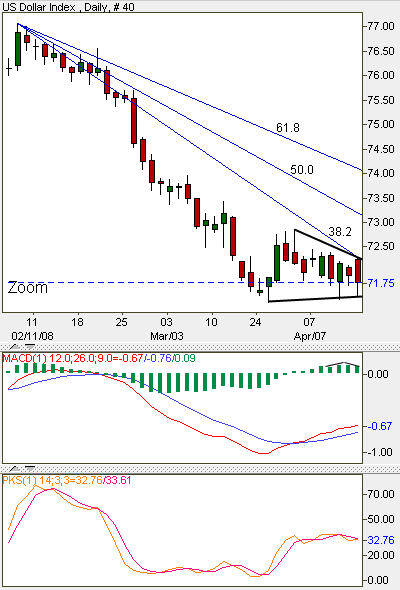
April U.S. Dollar Index, daily interval
The next leg down could be setting up. 71.34 is the all time low and the strategic support.
Any rally below 73 is, most likely, fake. At 73 it’s still constrained by the 50 fib fan overhead.
Fasten your seatbelt.
Retailing Chains Caught in a Wave of Bankruptcies
April 15th, 2008Via: New York Times:
The consumer spending slump and tightening credit markets are unleashing a widening wave of bankruptcies in American retailing, prompting thousands of store closings that are expected to remake suburban malls and downtown shopping districts across the country.
Since last fall, eight mostly midsize chains — as diverse as the furniture store Levitz and the electronics seller Sharper Image — have filed for bankruptcy protection as they staggered under mounting debt and declining sales.
But the troubles are quickly spreading to bigger national companies, like Linens ‘n Things, the bedding and furniture retailer with 500 stores in 47 states. It may file for bankruptcy as early as this week, according to people briefed on the matter.
Even retailers that can avoid bankruptcy are shutting down stores to preserve cash through what could be a long economic downturn. Over the next year, Foot Locker said it would close 140 stores, Ann Taylor will start to shutter 117 and the jeweler Zales will close 100.
The surging cost of necessities has led to a national belt-tightening among consumers. Figures released on Monday showed that spending on food and gasoline is crowding out other purchases, leaving people with less to spend on furniture, clothing and electronics. Consequently, chains specializing in those goods are proving vulnerable.
Retailing is a business with big ups and downs during the year, and retailers rely heavily on borrowed money to finance their purchases of merchandise and even to meet payrolls during slow periods. Yet the nation’s banks, struggling with the growing mortgage crisis, have started to balk at extending new loans, effectively cutting up the retail industry’s collective credit cards.
“You have the makings of a wave of significant bankruptcies,” said Al Koch, who helped bring Kmart out of bankruptcy in 2003 as the company’s interim chief financial officer and works at a corporate turnaround firm called AlixPartners.
“For years, no deal was too ugly to finance,” he said. “But now, nobody will throw money at these companies.”
IRS Audits of Big Companies Fall to All-Time Low
April 14th, 2008Via: TaxProfBlog:
The FY 2007 audit rate for the nation’s largest corporations has plunged to its lowest level in the last 20 years, less than half what it was in FY 1988 … The historic collapse in audits for the corporations with $250 million or more in assets was especially notable during the last two years when the rate dropped from 43% in FY 2005, to 34% in FY 2006 and then to an all-time low of 26% in FY 2007.
But along with the declining number of audits for the largest corporations, the IRS data point to a second significant finding: the thoroughness of these essential audits has been dropping. One example of this broad problem can be seen by the fact that the typical amount of time auditors spend on each of the large corporate audits is down by 20% over the last five years.