U.S. Troops Who Criticised Iraq War Strategy Killed in Baghdad
September 13th, 2007Is the Pat Tillman syndrome spreading?
Nothing can or will ever come of it, because, as we know, “Charging a man with murder in this place was like handing out speeding tickets in the Indy 500.”
Via: Guardian:
Two US soldiers who helped write a critique from the front saying America had “failed on every promise” in the war have been killed in Iraq, it was reported yesterday.
Staff Sergeant Yance Gray, 26, and Sergeant Omar Mora, 28, were among a group of seven soldiers serving in Iraq who wrote a piece excoriating America’s conduct of the war. The piece was published in the New York Times last month.
The men were killed in Baghdad when the cargo truck in which they were riding rolled over, the Associated Press and local news outlets reported yesterday. The Pentagon had yet to confirm their deaths early yesterday.
The criticism caused a flurry of public debate because of the candour with which the men, all serving in the 82nd Airborne, described the situation in Iraq.
There was also speculation they could face severe penalties for being so openly critical of the war. Another US soldier, Private Scott Beauchamp, who wrote a shocking account in New Republic magazine about a soldier treating a piece of a child’s skull as a souvenir, had his mobile phone and laptop confiscated.
Research Credit: Idleworm
Cryptogon Reader Signs Up for Hosting with Blue Host
September 13th, 2007Thanks to the owner of johnfabrizio.com for choosing to host with Blue Host. Cryptogon receives $65!
Who Needs Hackers?
September 13th, 2007Via: New York Times:
NOTHING was moving. International travelers flying into Los Angeles International Airport — more than 17,000 of them — were stuck on planes for hours one day in mid-August after computers for the United States Customs and Border Protection agency went down and stayed down for nine hours.
Hackers? Nope. Though it was the kind of chaos that malevolent computer intruders always seem to be creating in the movies, the problem was traced to a malfunctioning network card on a desktop computer. The flawed card slowed the network and set off a domino effect as failures rippled through the customs network at the airport, officials said.
Everybody knows hackers are the biggest threat to computer networks, except that it ain’t necessarily so.
Yes, hackers are still out there, and not just teenagers: malicious insiders, political activists, mobsters and even government agents all routinely test public and private computer networks and occasionally disrupt services. But experts say that some of the most serious, even potentially devastating, problems with networks arise from sources with no malevolent component.
U.S. Stock Market Index Values vs. Collapsing Dollar
September 13th, 2007IMPORTANT NOTE: If you think, “I’ll just buy Canadian dollars then,” you’re totally missing the point of this. The point is not to suggest one gamble over another, but to let you know the reality behind the high index numbers.
Via: University of Michigan:
Lupia, who also is a research professor at the Institute for Social Research, says the value of a Dow Jones point has declined significantly in recent years, thus news reports of “record highs do not mean what they used to.” As a result, some people might be surprised to learn how little their IRAs and 401(k)s are worth when they retire.
The researchers tested their theories in an experiment that allowed a person to purchase stock or to convert the money into Canadian currency then place it under his or her bed for a year.
In one demonstration that included dividends and other benefits of holding stocks, Lupia and colleagues showed that an investor who bought all of the stocks included in the Dow Jones on Jan. 2, 2001, and sold them on the record-high closing date of 2006 (Dec. 27), gained $3,377.34 — or $2,870.74 after taxes.
If, however, the same investor simply converted the money to Canadian dollars on Jan. 2, 2001, and changed them back for U.S. dollars on Dec. 27, 2006, his or her post-tax gain would have been substantially greater ($3,074.64) than it would have been from participating in a “record-breaking” stock market.
When the researchers repeated this comparison for nearly 800,000 combinations of “cash in” and “cash out” dates between 2001-06, they found that after accounting for taxes, investors would have been better off exchanging their money for Canadian dollars than buying the components of the Dow Jones 97 percent of the time.
The reason for this surprising result is that the value of a point on the Dow Jones Industrial Index is tied to the value of a U.S. dollar, Lupia says. In recent years, due to a series of economic factors and political decisions, the value of the U.S. dollar has fallen substantially against other benchmarks, such as an ounce of gold, a barrel of oil, the Euro, and the Canadian dollar. The meaning of a Dow Jones point increase and record highs in the stock market are severely diluted, he says.
Oil $80
September 12th, 2007Think of $60 as the gateway to $40 on the downside and $80 as the gateway to $100 on the upside.
There’s a bit of a perfect storm coming together here with very tight inventories and the collapsing dollar.
Via: Yahoo:
Oil futures prices rose sharply Wednesday, briefly climbing above a record $80 a barrel after the government reported a surprisingly large drop in crude inventories and declines in gasoline supplies and refinery activity.
The report from the Energy Department’s Energy Information Administration suggested oil supplies are tightening as demand remains strong. That’s why oil prices are rising despite OPEC’s decision on Tuesday to boost crude production by 500,000 barrels per day this fall, analysts said.
Despite Wednesday’s jump, oil is still well below inflation-adjusted highs hit in early 1980. Depending on the adjustment, a $38 barrel of oil in 1980 would be worth $96 to $101 or more today.
The Coming Financial Crash: “Where Everyone in the House is Crazy Only the Sane Seem Like Fools”
September 12th, 2007Via: European Tribune:
The unease, verging on panic, about sub-prime mortgages has given us a glimpse of what is ahead. But, let us be very clear, it has been only a glimpse. Sub-prime securitised mortgages are only a relatively tiny part of the huge credit and debt structure involved in what we may group under the generic name of derivatives. They include credit derivatives, hedge funds, private-equity deals, mutual funds, pension funds and the whole gamut of financial instruments that have flooded not only United States markets but markets around the world, especially in the last five to ten years.
MEXICO GAS LINE EXPLOSIONS FORCE MAJOR FACTORIES TO CLOSE DOWN
September 12th, 2007I can’t think of a time in history when the individual insurgent has had such an incredible asymmetric advantage over his opponent. Hierarchical dominator systems—now enjoying primacy on a global scale—exist atop a delicate grid of undefended energy and information infrastructures. With just a bit of intelligent planning, today’s insurgent can turn a small improvised explosive into a weapon of mass profit destruction. Killing soldiers and cops is a waste of time and energy. Killing profits does far more damage to the enemy than killing any number of troops.
Different societies and opponents, however, lend themselves to different forms of asymmetric warfare.
In America (and wealthier parts of the “West” in general), people don’t have to blow up a natural gas pipeline and shut down a factory or cut enough fiber to crash the NYSE and the NASDAQ market systems for a few minutes, hours or days. Voluntary simplicity, or, living well on very little money, kicks evil people in the nuts and gouges out their eyes. (Pacifists may think of this as sending the enemy Joy and Happiness if they desire.) Doing this in the U.S. has a force multiplier effect because the U.S. is the largest source of the funds that keep the global ponzi scheme running. When people in wealthy countries opt out, the action causes major economic damage to the machine.
Look at me and Rebecca. In the “normal” world, in our “normal” careers, we would have an annual combined income of roughly US$100,000. What horror would the U.S. government commit with the portion of the taxes it would demand from us? We now live well on a tiny fraction of what we would make in our “normal” careers. We have no debt. We own our small farm and our vehicles outright. We convert what’s left over at the end of the month into cash savings and gold. We also give money to people who are doing good work.
Whether you decide to leave the U.S. (like we did), or not, doesn’t matter. Living well on very little, encouraging others to do the same and actually funding people who are doing good work (allocating resources to values) are the main tactics of the frugal insurgent.
There’s a big difference between choosing to live well on a low income, on your terms, and being broke on someone else’s. My friend TR summed it up this way: “It’s easier to out through the bottom than the top.”
It’s true.
It’s a matter of hacking The Matrix in an efficient and innovative manner to reduce your monthly expenses to a fraction of previous levels. The extraction/domination system in the U.S. has few effective defenses against people who opt out—to the extent possible—by making smart use of available resources. The system assumes that you’ll stay hooked forever on a lifestyle built around profligate waste and going deep into debt to buy crap that you don’t really want, or need. Indeed, most people are content to go through life this way.
Living simply on very little money kills the system slowly. This is actually a good thing. Why don’t I advocate all out war against the many Achilles heels in the infrastructure of the American Corporate State? It’s simple really: nuclear weapons.
Threaten the system too fast and too effectively and the release of nuclear weapons becomes increasingly likely. The U.S. is not going to simply fade away without a fight. The greatest trick of all for U.S. Military commanders will be to prevent the release of nuclear weapons as U.S. power declines.
After so many decades of genocide and theft, the U.S. has made many, very real enemies. Those enemies might use sudden infrastructure collapse as an opportunity to deliver a kill shot to the U.S. The chances of cooler heads prevailing in the U.S. will be lower with massive infrastructure attacks threatening the country. Such attacks could easily be perceived as the opening phases of a Strategic Information Warfare campaign by a foreign military.
Therefore, while it’s easy to theorize strategic infrastructure attacks against U.S. targets, the law of unintended consequences, especially with regard to nuclear weapons, should cause any would be insurgents to consider very carefully, not just the severity, but the pace at which their attacks are to unfold.
In other words, stop buying toothpaste and grow your own tomatoes! Start somewhere, and use the sense of power and accomplishment to find other ways to resist, teach others and direct resources to help people who are doing good work. In a society like the U.S., defunding fascists via voluntary simplicity is the most effective form of resistance that I am aware of.
In a society like Mexico, though…
Via: AP:
More than 60 per cent of Mexico’s steel production was halted and two major auto plants, including Volkswagen’s only manufacturing facility in North America, shut down Tuesday after explosions claimed by a leftist group cut natural gas supplies.
Petroleos Mexicanos said the attacks on its oil and natural gas pipelines would cause hundreds of millions of dollars in production losses for the state-owned oil company and affect 10 states. Private-sector groups told Mexican news media that the attacks and subsequent precautionary shutdowns would cost businesses close to US$90 million.
Mexico’s steel industry chamber Canacero said Tuesday that more than 60 per cent of the country’s steel production has been halted, and that it could take up to seven days to resume.
In a statement, Canacero said losses would “significantly” exceed the $36 million the industry suffered from similar attacks on pipelines in July.
The six explosions affected a dozen natural gas pipelines and one oil pipeline in the Gulf coast state of Veracruz, sending flames and black smoke shooting into the air but causing no direct injuries. The blasts occurred at valve stations where different pipelines intersect.
Industry and national-security experts say the small leftist group claiming responsibility has proved it is a force to be reckoned with.
Treasury Gain May Falter; Foreign Holders Flee Dollar
September 11th, 2007WARNING: This is not a recommendation to buy sell or hold any financial instrument.
There is going to be great pain here as older, wealthier people wake up to the fact that their “fixed income” class investments are wild ass, risk of ruin gambles.
We’ve been through it over and over again:
Shelter, water, food, security.
Gold, guns, booze, tools.
Compost, livestock, heirloom seeds.
Still, I get about three What-should-I-do-with-my-money? emails per day.
I just walked over to my kitchen/dining room area and took this picture:
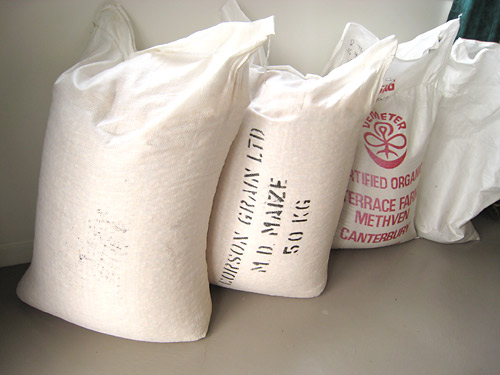
50KG sacks of maize (left), 25KG sacks of hard wheat berries (right)
What you’re looking at there is hundreds of pounds of maize and wheat. Becky and I don’t worry about the credit rating of the grains, or whether or not they’re properly capitalized. Those grains don’t have any possible exposure to the subprime mortgage apocalypse or the yen carry trade. Market liquidity isn’t an issue for those sacks of grain. Neither is event risk. We didn’t need to read a prospectus before buying them.
Sounds silly, right, to talk about all of those things with regard to some sacks of grain?
Why? Because those grains have obvious, intrinsic value. Regardless of what anyone else thinks about them, Becky and I are going to eat them.
Your paper investments have no obvious, intrinsic value.
That’s why there are a lot of lawyers and arcane words and phrases associated with them. Above board swindling is made possible by lawyers and arcane words and phrases. These things allow the people behind the swindle to avoid jail if you lose your money. The only reason that you consider stocks and bonds to be worthy places to put your money is because you have been sold a bill of goods that is likely to leave you broke and starving once appearances can no longer be maintained.
Even though many of you understand that your paper investments are part of a collapsing ponzi scheme, the dire nature of the situation still isn’t hitting home.
For me, recognition of collapse was followed by three phases:
1) Denial
2) Depression
3) Paralysis
If you’re a regular reader of Cryptogon, you’re probably past the denial phase. I’ve communicated with many of you who are in the depression and paralysis phases.
You guys already know my story. Maybe some of you who have moved into the “Taking Action” phase would be willing to share how you moved through the bog of denial-depression-paralysis.
What are you doing to prepare? But more importantly, how did you actually start to prepare, to take the action that you’re taking? What was the final straw?
People in the paralysis phase would rather stare at the wall than talk to friends and family about fiat money and debt and, energy and, uh, sacks of wheat. So how did you action takers approach friends and family who are still in the traffic-work-fastfood-tv mode? Maybe you’re like me and had to leave friends and family behind.
Obviously, I don’t share this information with anyone, but through my communications you guys in private, I know that several of you are in extraordinarily similar positions.
You’re not alone.
Via: Bloomberg:
Treasury investors basking in the biggest rally in four years have reason to fear for their profits: The largest owners of U.S. government debt are heading for the exit.
Two-year Treasuries returned 1.09 percent in August, the best monthly performance since 2003, according to indexes compiled by Merrill Lynch & Co. At the same time, holdings of U.S. bonds by governments and central banks at the Federal Reserve fell 3.8 percent, the steepest decline since 1992.
The dollar’s slump to a 15-year low against six of its most actively traded peers is turning the gains into losses for international bondholders, prompting China, Japan and Taiwan to sell. Overseas investors own more than half of the $4.4 trillion in marketable U.S. government debt outstanding, up from a third in 2001, according to data compiled by the Treasury Department.
Research Credit: JW
Banks Face 10-Day Debt Timebomb
September 11th, 2007This might be related to the massive Eurostoxx 50 put options bet that is in play now.
Related: Telegraph:
Britain’s biggest banks could be forced to cough up as much as £70bn over the next 10 days, as the credit crisis that has seized the global financial system sparks a fresh wave of chaos.
Almost 20 per cent of the short-term money market loans issued by European banks are due to mature between September 11 and September 19. Senior bankers fear that they will have to refinance almost all of these debts with funds from their own coffers, putting a further strain on bank balance sheets.
Tens of billions of pounds of these commercial paper loans have already built up in the financial system, because fear-ridden investors no longer want to buy them. Roughly £23bn of these loans expire on September 17 alone.
Fears of this impending call on bank credit lines are the true reason that lending between banks has ground to a halt, according to senior money market sources.
Banks have been stockpiling cash in preparation for this “double rollover” week, which sees quarterly loans expire alongside shorter term debts – exacerbating a problem that lies at the heart of the credit crisis.
“Banks are hoarding cash,” said David Brickman, the head of European credit strategy at Lehman Brothers. “We think the reason for that is the commercial paper markets. There was $100bn of commercial paper issued by European institutions that was scheduled to roll over in August, much of which struggled to do so.
“Those markets are just not functioning normally, so some debt has already come on to bank balance sheets and more will have to follow. We estimate that between September 11 and 19 $139bn [£68.5bn] of European commercial paper [will come] up for renewal, including monthly and quarterly maturities. That’s why banks are hoarding cash.”
Mexico: Insurgents Attack Six Oil and Gas Pipelines
September 11th, 2007Undefended critical infrastructure…
Via: Reuters:
Explosions rocked Mexico on Monday as attacks on six pipelines disrupted oil and gas supplies and forced thousands from their homes, just weeks after leftist rebels set off a string of pipeline bombs.
Huge billowing flames lit the night sky after the blasts in the early hours of the morning. More than 20,000 people were rushed from their homes to emergency shelters as gas and oil spewed from the ruptured pipes.
President Felipe Calderon, on a visit to India, condemned the sabotage and vowed to catch the perpetrators, saying: “In today’s democratic Mexico there is no place for these criminal acts.”
State energy monopoly Pemex said there were no injuries from the blasts, most of which were in Veracruz on the Gulf of Mexico, but Chief Executive Jesus Reyes Heroles said they would cost the company “hundreds of millions of dollars.”
An undetonated explosive charge was found at another oil installation in Veracruz state, Pemex said.
In July, a shadowy leftist guerrilla group claimed responsibility for a wave of bomb attacks on energy pipelines which cut natural gas supplies to thousands of businesses.
Some local media reported on Monday that the same leftist group left a message with the unexploded device — but local government and police officials denied any note was left. “It’s just a rumor,” one official said.
The pipeline damage would cut off around 25 percent of the country’s natural gas supply for 24 to 36 hours, Reyes Heroles told Mexican radio. He said the fact gas can’t be easily stored made the situation more serious than for gasoline, where ample inventory meant supplies would be less affected.
“The most important point is natural gas,” he said, adding that it could take four or five days to completely restore supply.