Cryptogon Readers Contribute $25 and $20
March 25th, 2007Hereticfig sent $25 and JJ sent $20. Thanks to both of you!
BASF and Monsanto in Terrifying Alliance
March 25th, 2007BASF, a descendant of the Third Reich’s extermination industries, is teaming up with Monsanto to put pHood on your belly, biofuel in your SUV.
Have a nice day.
Via: STLtoday:
Monsanto Co. and BASF AG, a German competitor, on Wednesday promised to work together to deliver higher-yielding crops to meet increasing global demand.
The companies announced a $1.5 billion research and development collaboration that, over a decade or more, could deliver hundreds of varieties of genetically modified corn, soybeans, cotton and canola.
…
A unit of BASF uses computers and robotics to measure more than 1,000 important chemicals that plants produce. It can track changes in the chemicals to see how a plant functions differently with the addition or subtraction of a particular gene. And it can do so quickly on many plant samples, said Peter Oakley, a member of BASF’s Board of Executive Directors responsible for Agriculture, Health and Nutrition.
The company has compiled more than 1.5 million of these profiles for more than 35,000 genes. The resulting “genetic library” is a searchable database for researchers, he said.
The next important piece of the puzzle is a BASF Plant Science unit that rapidly measures about 20 performance characteristics in plant samples grown with promising genetic modifications. BASF can test 100,000 plants a year using this automated technology and those results, too, wind up in the database.
As a result, researchers can quickly find and characterize useful traits and prioritize their development, Oakley said.
With this technology, Monsanto “has just connected a firehose to our pipeline,” Grant said. He promised product development “more, better, faster.”
…
Europe’s concern over global warming and demand for renewable fuels from plant sources could outweigh apprehension about biotech crops, said Christine Bruhn, director of the Center for Consumer Research at the University of California-Davis. “If the benefits are appealing, the people in surveys say they would consider biotech crops,” she said.
If the world is to produce enough crops to feed people and livestock, while providing corn for ethanol and soybeans for biodiesel, farmers will need high-yielding biotech crops, the companies said.
“This collaboration brings something to the table that European farmers need just as much as American farmers, and that’s yield increases,” Oakley said. “It will become very, very difficult long term for European farmers to remain competitive without access to these technologies. … It’s a door opener in Europe.”
Fraley called yield “the Holy Grail of agricultural research — in part, because it has historically been one of the most complex characteristics to dissect scientifically. Today, we have the tools to tackle that opportunity,” Fraley said.
The benefits could extend around the world, Grant said.
“Whether you’re in Schleswig-Holstein or Bangalore, the real dilemma in the next decade is going to be how do you grow more with less,” he said. “I think it’s going to be the challenge for the planet.”
Research Credit: ML
Department of Homeland Security Checks Out BullionVault Post
March 25th, 2007The U.S. Department of Homeland Security user (host: unwgsgs5.cbp.dhs.gov, ip: 63.167.255.204) looked at this recent Cryptogon post about BullionVault.
Foreclosures Force Suburbs to Fight Blight
March 25th, 2007Via: New York Times:
In a sign of the spreading economic fallout of mortgage foreclosures, several suburbs of Cleveland, one of the nation’s hardest-hit cities, are spending millions of dollars to maintain vacant houses as they try to contain blight and real-estate panic.
In suburbs like this one, officials are installing alarms, fixing broken windows and mowing lawns at the vacant houses in hopes of preventing a snowball effect, in which surrounding property values suffer and worried neighbors move away. The officials are also working with financially troubled homeowners to renegotiate debts or, when eviction is unavoidable, to find apartments.
“It’s a tragedy and it’s just beginning,†Mayor Judith H. Rawson of Shaker Heights, a mostly affluent suburb, said of the evictions and vacancies, a problem fueled by a rapid increase in high-interest, subprime loans.
“All those shaky loans are out there, and the foreclosures are coming,†Ms. Rawson said. “Managing the damage to our communities will take years.â€
Research Credit: Life After the Oil Crash
Florida: City to Seize Homes Over Parking Tickets
March 25th, 2007Via: The Newspaper:
The city council in Brooksville, Florida voted this week to advance a proposal granting city officials the authority to place liens and foreclose on the homes of motorists accused of failing to pay a single $5 parking ticket. Non-homeowners face having their vehicles seized if accused of not paying three parking offenses.
U.S. Mortgage Crisis Forces Former Homeowners to Live in Their Cars
March 25th, 2007Via: Scotsman:
THEY are victims of the United States’ growing mortgage crisis – low-paid workers whose homes have been repossessed amid rising interest rates, a stagnant property market and a lax lending regime.
But in Los Angeles, where having a car is as essential as owning a home, many are sleeping in their vehicles to ensure a roof over their head.
Campaigners for the homeless expect more to hole up in their cars as they lose homes due to the problems that have dogged “subprime mortgages” – those granted to low-earners with little capital of their own.
The trend comes despite the fact that sleeping in a car is illegal in the Los Angeles area.
“The subprime meltdown is the kind of situation that pushes people into cars. It’s a very common story,” said Ruth Hollman, of Self-Help And Recovery Exchange, a group that helps homeless people.
Advocates hope Los Angeles will adopt programmes in place in cities such as Eugene, Oregon, and Santa Barbara, California, that enable people to live in cars while receiving services they need to get back on track.
“It’s an old saying in social services that most people are one to six paychecks away from being homeless. But if you can’t make your mortgage, it’s more like a month or two,” said William Wise, of the relief agency St Vincent de Paul of Eugene, which works to find overnight parking spots for homeless people.
Without such spots, people forced to sleep in their cars fear being towed and ticketed by police, as well as being attacked by thugs and facing public scorn.
A Kirkland Cafe with No Prices
March 24th, 2007This is so interesting to me. It’s an issue that hits very close to home… The article calls this an experimental business model. It’s more of a test of the consciousness index of a community, if you ask me.
Can the tragedy of the commons be avoided? Cryptogon and Farmlet readers are demonstrating that it can by keeping these resources free and open to all. Just look at that support column at the right.
Out here in the country, farmers and gardeners sometimes leave their goods for sale out near the road, totally unattended. When Becky and I happen across one of these stands, we usually stop and buy something. We love it! But the goods have prices listed. Would the country produce stand work without any prices listed??? Most of the time, people are charging less than what I would pay if no price was listed.
How will the Terra Bite Lounge fare?
Via: Seattle Times:
With its blood-red walls and black leather sofas, Kirkland’s Terra Bite Lounge looks like any other coffee shop — until you get to the menu. There are no prices listed. Terra Bite doesn’t have them.
You read that right: No prices. Customers pay what and when they like, or not at all — it makes no difference to the cafe employees, who are instructed not to peek when people put money in the metal lock box.
Related: Gift Economy
Research Credit: EP
Are GM Crops Killing Bees?
March 24th, 2007Via: Der Spiegel:
A mysterious decimation of bee populations has German beekeepers worried, while a similar phenomenon in the United States is gradually assuming catastrophic proportions. The consequences for agriculture and the economy could be enormous.
Walter Haefeker is a man who is used to painting grim scenarios. He sits on the board of directors of the German Beekeepers Association (DBIB) and is vice president of the European Professional Beekeepers Association. And because griping is part of a lobbyist’s trade, it is practically his professional duty to warn that “the very existence of beekeeping is at stake.”
The problem, says Haefeker, has a number of causes, one being the varroa mite, introduced from Asia, and another is the widespread practice in agriculture of spraying wildflowers with herbicides and practicing monoculture. Another possible cause, according to Haefeker, is the controversial and growing use of genetic engineering in agriculture.
As far back as 2005, Haefeker ended an article he contributed to the journal Der Kritischer Agrarbericht (Critical Agricultural Report) with an Albert Einstein quote: “If the bee disappeared off the surface of the globe then man would only have four years of life left. No more bees, no more pollination, no more plants, no more animals, no more man.”
Mysterious events in recent months have suddenly made Einstein’s apocalyptic vision seem all the more topical. For unknown reasons, bee populations throughout Germany are disappearing — something that is so far only harming beekeepers. But the situation is different in the United States, where bees are dying in such dramatic numbers that the economic consequences could soon be dire. No one knows what is causing the bees to perish, but some experts believe that the large-scale use of genetically modified plants in the US could be a factor.
My National Security Letter Gag Order
March 24th, 2007ABSOLUTELY CHILLING!
Via: Washington Post:
Three years ago, I received a national security letter (NSL) in my capacity as the president of a small Internet access and consulting business. The letter ordered me to provide sensitive information about one of my clients. There was no indication that a judge had reviewed or approved the letter, and it turned out that none had. The letter came with a gag provision that prohibited me from telling anyone, including my client, that the FBI was seeking this information. Based on the context of the demand — a context that the FBI still won’t let me discuss publicly — I suspected that the FBI was abusing its power and that the letter sought information to which the FBI was not entitled.
Rather than turn over the information, I contacted lawyers at the American Civil Liberties Union, and in April 2004 I filed a lawsuit challenging the constitutionality of the NSL power. I never released the information the FBI sought, and last November the FBI decided that it no longer needs the information anyway. But the FBI still hasn’t abandoned the gag order that prevents me from disclosing my experience and concerns with the law or the national security letter that was served on my company. In fact, the government will return to court in the next few weeks to defend the gag orders that are imposed on recipients of these letters.
Living under the gag order has been stressful and surreal. Under the threat of criminal prosecution, I must hide all aspects of my involvement in the case — including the mere fact that I received an NSL — from my colleagues, my family and my friends. When I meet with my attorneys I cannot tell my girlfriend where I am going or where I have been. I hide any papers related to the case in a place where she will not look. When clients and friends ask me whether I am the one challenging the constitutionality of the NSL statute, I have no choice but to look them in the eye and lie.
I resent being conscripted as a secret informer for the government and being made to mislead those who are close to me, especially because I have doubts about the legitimacy of the underlying investigation.
The Sign on Ron Paul’s Desk
March 24th, 2007I used to have this bumper sticker on the back of my clip board when I worked at FedEx (one of homeland security’s best friends) in the 1990s. I was told to remove it by management. I wonder if it would be ok now? Perhaps not.
Via: The Libertarian:
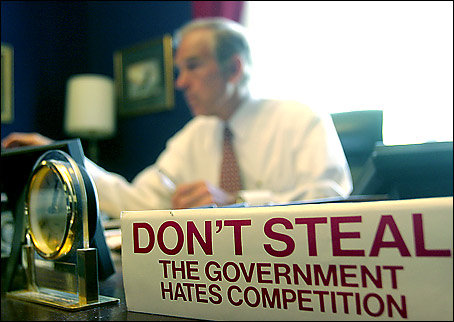
Ron Paul, 2008 Presidential Candidate