Quantum Computing for the Very Curious
June 18th, 2020Via: Quantum Country:
This essay explains how quantum computers work. It’s not a survey essay, or a popularization based on hand-wavy analogies. We’re going to dig down deep so you understand the details of quantum computing. Along the way, we’ll also learn the basic principles of quantum mechanics, since those are required to understand quantum computation.
Learning this material is challenging.
In 2010 a Researcher Predicted Mayhem in U.S. in 2020, Now Says Civil War Possible
June 18th, 2020Via: Time:
Not everyone took Peter Turchin seriously a decade ago when he said widespread civil unrest would sweep through the U.S. in 2020.
“They had no reason to believe I wasn’t crazy,” says Turchin, a 63-year-old researcher who teaches cultural evolution at the University of Connecticut.
In 2010, after analyzing historical cycles of instability, Turchin made a prediction that was published at the time in the journal Nature: America will suffer a period of major social upheaval beginning around 2020.
…
After spending the last 20 years studying crises in America and the structural defects that helped cause them, Turchin says many signs showed the U.S. was spiraling toward upheaval in this decade.
The nation, he says, has experienced stretches of turmoil about every 50 years between 1870, during heightened tensions of the Reconstruction Era, and 1970, in the aftermath of Martin Luther King Jr.’s assassination when women and many minority groups were fighting for equality amid protests against the ongoing Vietnam War.
Turchin looked at data analyzing peaceful and violent anti-government demonstrations that involved at least 100 people between 1780 and 2010. Using a computer model, he also factored in economic patterns—including declining wages, wealth inequality, exploding national debt and other social pressures that affect national stability—from the same time period. The model showed social and economic turmoil in the U.S. would come to a boiling point in the years around 2020, Turchin wrote in his 2010 paper.
Worse conditions could still be coming.
Burundi: President Pierre Nkurunziza Dies of ‘Cardiac Arrest’ After Kicking World Health Organization Out of Country
June 18th, 2020Via: BBC:
Burundi’s President Pierre Nkurunziza, aged 55, has died after suffering a cardiac arrest, the government says.
He was admitted to hospital on Saturday after feeling unwell, his condition improved but on Monday he had a cardiac arrest and efforts to revive him were unsuccessful, officials say.
…
Since last week, Mr Nkurunziza’s wife, Denise Nkurunziza, has been receiving medical treatment in Kenya.
She was rumoured to have tested positive for coronavirus – a disease Mr Nkurunziza had appeared to downplay, holding an election in the midst of the outbreak, and even expelling World Health Organization representatives from the country.
More: Burundi Expels WHO Coronavirus Team as Election Approaches
COVID-19 Coin Shortage?
June 18th, 2020Via: CNBC:
Federal Reserve Chairman Jerome Powell told Congress on Wednesday that the circulation of physical coinage has ground to a halt amid the coronavirus outbreak but that the central bank is working to fix the flow.
…
The spread of Covid-19 across the U.S. over the first half of the year has led to a rise in contactless payments as more Americans shelter in place and shop online using PayPal or credit cards. But unprecedented, state-imposed business closures also resulted in a deceleration in the rate at which physical cash and coinage exchange hands.
Companies that generate a significant portion of their revenues in physical cash, including restaurants and convenience stores, would normally deposit their earnings at local banks. That regular activity, in conjunction with regular inflows of new money from U.S. mints, helps resupply the nation’s banks with coinage to then reallocate back into local circulation.
So when states like New York this spring ordered restaurants and other in-person commerce closed, the normal cycle of U.S. money slowed and failed to refresh banks per usual.
Is The ‘Second Wave’ Another Coronavirus Hoax?
June 17th, 2020Via: Ron Paul:
Just a week or so ago the mainstream media and thousands representing the “medical community” told us we must throw out the “stay-at-home” orders and go to the streets to protest the death of George Floyd at the hands of the police. The Covid-19 virus will not bother people who are protesting this injustice, they said. The virus only attacks people leaving their homes to protest the stay-at-home orders.
Now, after thousands of businesses – many of them black-owned – have been reduced to rubble and innocent people in the inner cities no longer have anywhere to shop for the basic necessities of life, the mainstream media has backed off of its non-stop coverage of the protests. Suddenly last week they all simultaneously embraced a new fear story to terrify the masses: a “second wave” of coronavirus was among us. It was targeting those states that dared to “open up” their economies and begin a return to relatively normal lives.
Texas, Florida, and California were singled out to scare the rest of the country into thinking that if you dare leave your homes you will catch coronavirus and die. There was a “spike” in coronavirus “cases” they claimed. Funny, just a month or so ago they were demanding that we massively increase testing, which would produce just that “spike” in coronavirus cases they are now using to scare authorities into reinstating the incredibly destructive stay-at-home orders.
There Are Now 33 Covid-19 Cases…
June 17th, 2020[???]
Via: The Dollar Vigilante:
Backup on LBRY: COVID19 Is The Biggest Psyop In Human History
Trillions in Stimulus Go Unchecked With Watchdogs Kept Toothless
June 17th, 2020Via: Bloomberg:
The U.S. has spent more than half of $3 trillion in economic rescue funds passed by Congress — with little of the oversight intended to ensure the money goes to the right places.
Trump Team Prepares $1 Trillion Infrastructure Plan to Spur Economy
June 16th, 2020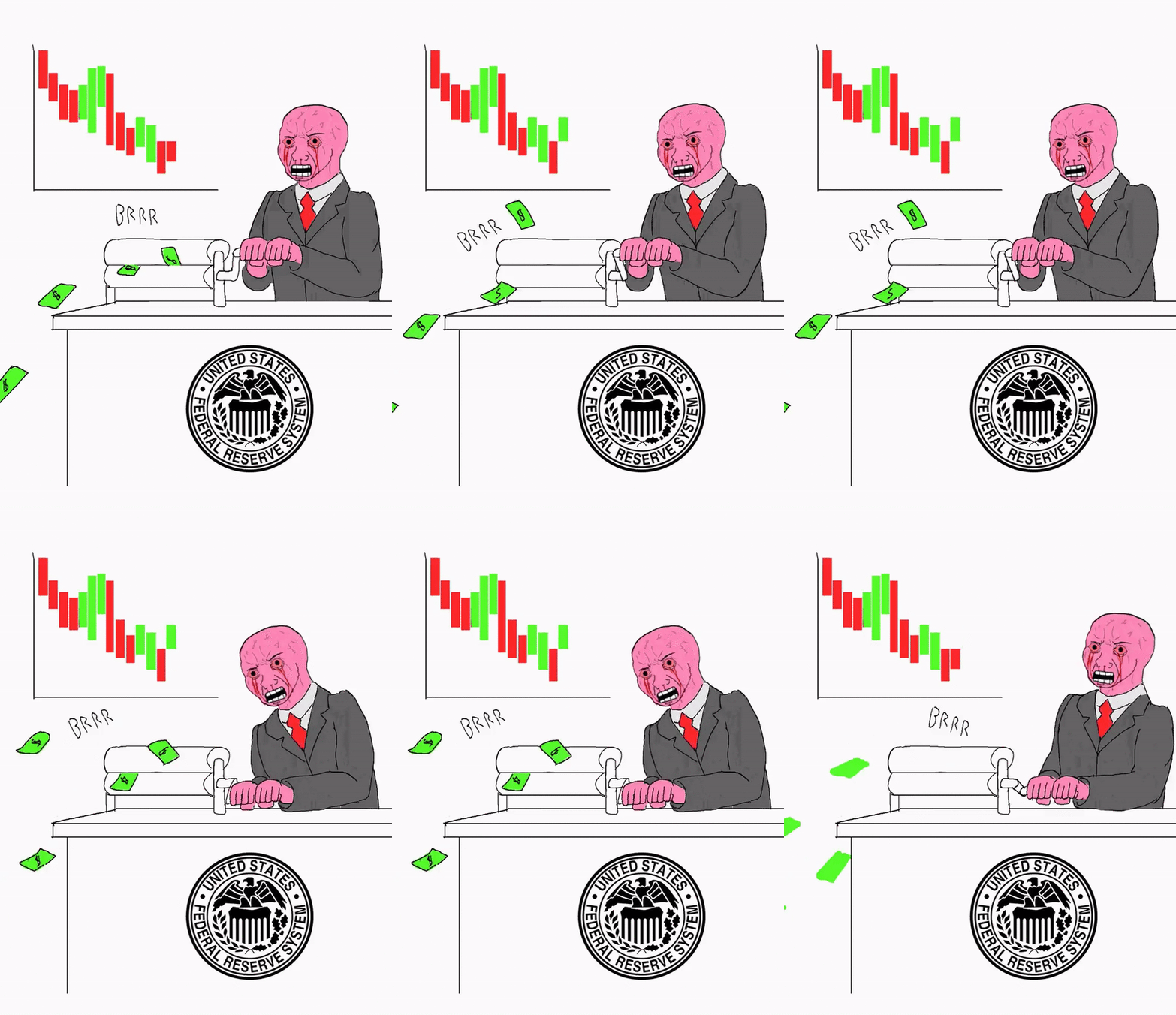
Via: Reuters:
The Trump administration is preparing an up to $1 trillion infrastructure package focused on transportation projects as part of its push to spur the world’s largest economy back to life, a source familiar with the situation said on Tuesday.
The Department of Transportation’s preliminary version reserves most funds for projects such as roads and bridges, but will also set aside about a quarter of the money for priorities such as 5G wireless infrastructure and rural broadband, two sources said.
India Says 20 Soldiers Killed in Clash with Chinese Troops
June 16th, 2020Via: AP:
A border clash high in the Himalayas between the world’s two most populated countries has claimed the lives of 20 Indian soldiers in the first deadly violence since the two nuclear armed neighbors faced off in a border dispute 45 year ago.
The Indian and Chinese troops fought each other with fists and rocks along the high-altitude Himalaya terrain in a clash that left 20 Indian soldiers dead, Indian authorities said Tuesday.
China accused Indian forces of carrying out “provocative attacks” on its troops and has not said if any of its soldiers have died.
The Indian army said in its statement that the two sides had “disengaged” from the disputed Galwan area where they clashed overnight on Monday.
Political Groups Use “Deeply Spooky” Protester Location Data
June 16th, 2020Via: Ars Technica:
It’s no secret that police and other law enforcement agencies have a history of using mobile phone location and other data to target or investigate individuals, and the wave of mass protests in support of black communities and against police brutality this month has provided a rich data trove for them to probe. As it turns out, cops aren’t the only ones diving into the data to follow demonstrators after the streets are clear.
Political advocacy and voter-registration groups are reaping the bounty of location data tied to protests, The Wall Street Journal reports.
The groups use geofencing to contact those who were at protests—basically, reaching out to every device that was in a certain area at a certain time, without specifically identifying the individual. In this case, activists reach out with political messages.
Quentin James, founder and president of The Collective, a political action group that supports black candidates for political office, told the Journal he has been using location-based outreach to promote voter registration. “When these protests emerged, it was eye-opening for folks to understand, wow, people are gathering again,” James told the WSJ. “We want to make sure we’re using all available tools in our toolbox to make sure we’re reaching the right people.”