Headphones?
April 24th, 2018VERY OFF TOPIC!
—
I’m going to give my Audio-Technica ATH-M50s to my wife to replace her 17 year old, nearly-dead-and-not-good-to-start-with ATH-M20s.
I was pretty amazed with the sound of the M50s when I got them back in 2010—at least for the first few minutes. After that, I went through multiple phases of modifying the M50s to make them work for me.
First, I had no idea headphones could produce bass like that! It was actually too much bass for my taste. I wound up EQing the lows down a bit. Ahh. Now I could settle in and really enjoy listening…
Ouch.
The strong clamping force and the hard pads made the M50s very uncomfortable for me to wear for more than fifteen minutes.
I bent the hell out of the headband. I mean, I went past the point where I thought I was going to break the headband, and then I kept bending.
It worked!
But now that the cans weren’t stuck to the side of my skull, the headband started to feel pretty bad on the top of my head. I reached for the first aid kit, grabbed a gauze bandage roll and wrapped that headband up. Looks lame, feels good.
I actually lived with it like that for a couple of years—until my sweat and nerd grease disintegrated the stock ear pads. I replaced the stock pads with some softer and more comfortable velour pads.
Finally, bent to hell and fitted with a new set of pads and a gauze bandage wrap, my M50s felt great!
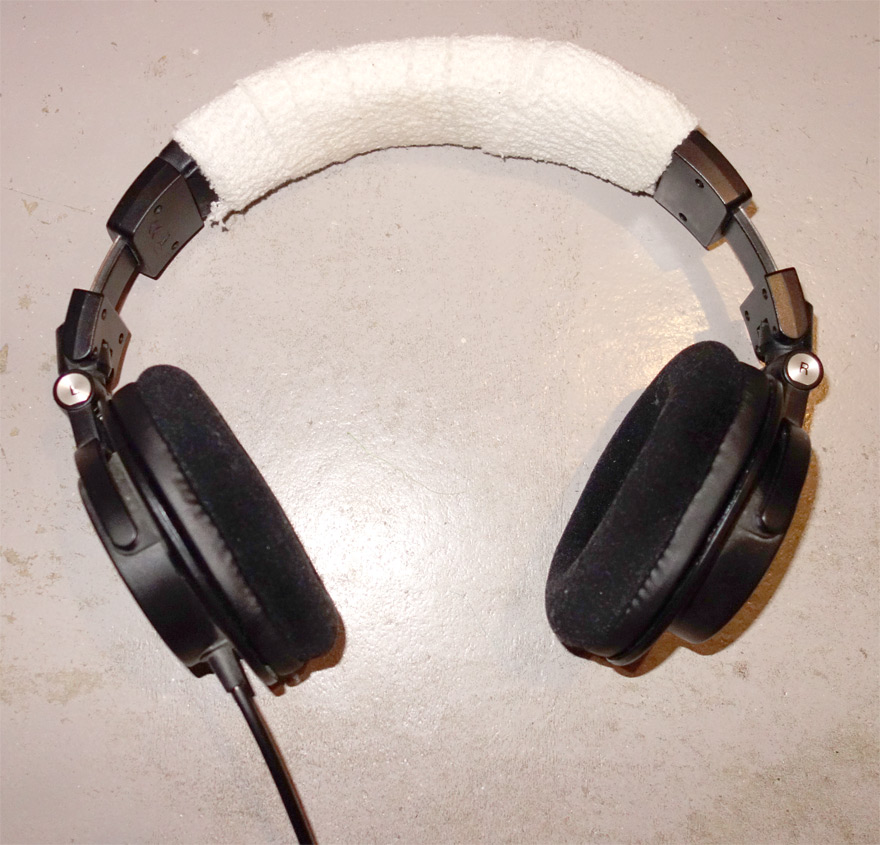
And sounded like shit.
Yep, the secret to the M50s sound was the hard ear pads that Audio-Technica supplied with the cans. Comfortable pads produce a hollow, tinny treble murder experience. I was feeling the highs in my eyes and teeth with the new pads. Cymbals were like a stun grenades going off in my room. Flinching, cringing, synesthesia inducing highs.
I went from EQing the bass down with the original pads, to boosting bass up, boosting mids more and then taking down the highs. I run a full system EQ in Windows with these levels to make the M50s with the soft pads sound good (to me).
Trying to figure out which headphones to get to replace the M50s has turned out to be a pretty daunting experience.
I want large, comfortable, over-ear, closed-back headphones with flat to slightly elevated bass, flat to slightly elevated mids and darker highs.
Under $200??? Possible? Not possible?
Look at the frequency response for the Sennheiser HD650:
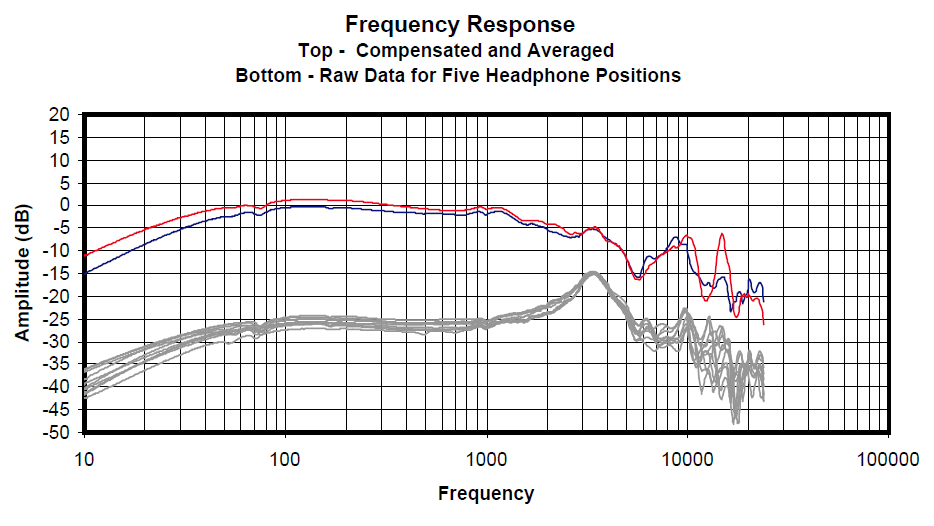
Ahhhh. Look at those highs rolling away… Lots of people say that those Sennheisers are great, but even if I got the $200 Massdrop version, I don’t think I can do the open-back thing in my tiny house. And they would need an amp for sure.
I really liked the look of the Beyerdynamic DT 770, but there are a disturbing number of people complaining about sibilance with those cans. From all the ridiculous amounts of reading and YouTube viewing I’ve done to try to get to the bottom of this, it seems that, for every person complaining about sibilance/treble murder on the DT 770s, there’s someone else saying they’re fine, they’re just bright, any sibilance is the result of poor mastering or low bitrate source files, etc.
There are also stories of people stuffing them with paper towels, foam, etc. to try to cut down the highs. My hair stands on end thinking of my effed M50s after I put the soft pads on them to make them wearable on my fat head.
So, there it is.
I’m stumped on this one.
Does anyone out there in Cryptogon-land have the Beyerdynamic DT 770s (I’m thinking 80ohm)? How do you find they handle the highs? Are you EQing down the highs?
Actually, I’d be OK with EQing the highs down a bit. If I can make my modded M50s sound good with the EQ after what I did to them, I’m fine with using the EQ on whatever headphones I wind up going with.
I wish I hadn’t seen that Sennheiser HD650 chart, though…
The Massdrop version is $200 for the next several days.
For anyone who owns Sennheiser HD650/Sennheiser HD 6XX:
Could you watch, say, Apocalypse Now at a satisfying volume in small room with children sleeping on the other side of a wall in the next room over?
I’ve never owned open-back headphones before, so I don’t have any sense of how much that leaking sound will carry to another room.
Apologies to the non-audio nerds for this off topic indulgence, but there are many people reading this who make their livings while wearing headphones and/or people who have very nice taste it headphones. (I see what some of you are buying on Amazon!) Almost certainly, someone out there will be able to give me some good advice.
Amazon Designing Some Sort of Home Robot
April 23rd, 2018Via: Bloomberg:
Ten years ago, Amazon introduced the Kindle and established the appeal of reading on a digital device. Four years ago, Jeff Bezos and company rolled out the Echo, prompting millions of people to start talking to a computer.
Now Amazon.com Inc. is working on another big bet: robots for the home.
The retail and cloud computing giant has embarked on an ambitious, top-secret plan to build a domestic robot, according to people familiar with the plans. Codenamed “Vesta,” after the Roman goddess of the hearth, home and family, the project is overseen by Gregg Zehr, who runs Amazon’s Lab126 hardware research and development division based in Sunnyvale, California. Lab126 is responsible for Amazon devices such as the Echo speakers, Fire TV set-top-boxes, Fire tablets and the ill-fated Fire Phone.
The Vesta project originated a few years ago, but this year Amazon began to aggressively ramp up hiring. There are dozens of listings on the Lab 126 Jobs page for openings like “Software Engineer, Robotics” and “Principle Sensors Engineer.” People briefed on the plan say the company hopes to begin seeding the robots in employees’ homes by the end of this year, and potentially with consumers as early as 2019, though the timeline could change, and Amazon hardware projects are sometimes killed during gestation.
Bill Gates Backs Space Based Video Surveillance System for Entire Planet
April 20th, 2018Via: TechCrunch:
A new space imaging startup called EarthNow aims to provide not just pictures of the planet on demand, but real-time video anywhere a client desires. Its ambition is matched only by its pedigree: Bill Gates, Intellectual Ventures, Airbus, SoftBank and OneWeb founder Greg Wyler are all backing the play.
Its promise is a constellation of satellites that will provide video of anywhere on Earth with latency of about a second. You won’t have to wait for a satellite to come into range, or worry about leaving range; at least one will be able to view any area at any given time, so they can pass off the monitoring task to the next satellite over if necessary.
New Zealand: Billion-Dollar Soils Washing Into Rivers
April 19th, 2018Via: Newsroom:
We’re losing soil at an alarming rate, but there are some gaping holes in our knowledge about why and where from, reports Eloise Gibson
You can’t grow a lot of food without soil, certainly not in a dairy-, wine- and vege-hungry nation like New Zealand.
Yet dirt – the foundation of our food supply – is being washed down our rivers and into the ocean at a worrying rate.
The latest report from the Ministry for the Environment and Statistics NZ, Our Land 2018, says New Zealand is losing about 192 million tonnes of soil a year.
At that rate, we’re contributing about 1.7 percent of all the sediment lost globally, despite having just 0.2 percent of the world’s land area.
Much of that is coming from underneath grassy farm paddocks, which are shedding 44 percent or 84 million tons of the lost soil into rivers.
Palantir Using War on Terror Tools to Track American Citizens
April 19th, 2018Via: Bloomberg:
The LAPD uses Palantir’s Gotham product for Operation Laser, a program to identify and deter people likely to commit crimes. Information from rap sheets, parole reports, police interviews, and other sources is fed into the system to generate a list of people the department defines as chronic offenders, says Craig Uchida, whose consulting firm, Justice & Security Strategies Inc., designed the Laser system. The list is distributed to patrolmen, with orders to monitor and stop the pre-crime suspects as often as possible, using excuses such as jaywalking or fix-it tickets. At each contact, officers fill out a field interview card with names, addresses, vehicles, physical descriptions, any neighborhood intelligence the person offers, and the officer’s own observations on the subject.
The cards are digitized in the Palantir system, adding to a constantly expanding surveillance database that’s fully accessible without a warrant. Tomorrow’s data points are automatically linked to today’s, with the goal of generating investigative leads. Say a chronic offender is tagged as a passenger in a car that’s pulled over for a broken taillight. Two years later, that same car is spotted by an automatic license plate reader near a crime scene 200 miles across the state. As soon as the plate hits the system, Palantir alerts the officer who made the original stop that a car once linked to the chronic offender was spotted near a crime scene.
The platform is supplemented with what sociologist Sarah Brayne calls the secondary surveillance network: the web of who is related to, friends with, or sleeping with whom. One woman in the system, for example, who wasn’t suspected of committing any crime, was identified as having multiple boyfriends within the same network of associates, says Brayne, who spent two and a half years embedded with the LAPD while researching her dissertation on big-data policing at Princeton University and who’s now an associate professor at the University of Texas at Austin. “Anybody who logs into the system can see all these intimate ties,” she says. To widen the scope of possible connections, she adds, the LAPD has also explored purchasing private data, including social media, foreclosure, and toll road information, camera feeds from hospitals, parking lots, and universities, and delivery information from Papa John’s International Inc. and Pizza Hut LLC.
Mentally Ill Woman Wearing a Wig and Carrying a Loaded Gun, a Passport, and $100,000 in Cash Arrested After Driving to CIA Headquarters
April 18th, 2018Via: WTOP:
A woman who drove into the CIA headquarters compound in McLean, Virginia, with a loaded gun, a passport and $100,000 in cash while wearing a wig is being held without bond.
Charging documents said Beth Huth drove her white Kia Soul onto CIA property in Langley last Friday afternoon past signs restricting access and warning against possessing weapons or ammunition.
According to an affidavit filed by CIA security protective service officer Michael Szczepanik, a CIA security protective service officer asked Huth for her badge — instead she produced a handwritten note.
The officer asked Huth if she was able to speak, and she nodded yes.
Asked if she was carrying anything illegal, Huth nodded yes, and reached for her black handbag resting on the passenger seat.
The officer ordered her to stop and write what she was searching for. She wrote “Gun.”
“I looked inside the handbag and found a loaded 9 mm pistol with four rounds of ammunition in the magazine and one round of ammunition in the chamber,” the officer wrote. “The safety mechanism for the loaded weapon was not engaged.”
Also found in the car were directions printed from a website that instructed how to drive from Ohio to “Langley, McLean, Virginia.”
Huth is charged with one count of possessing a weapon at a federal agency.
In U.S. District Court, in Alexandria, Tuesday, prosecutors said Huth suffers from mental health issues and is a flight risk, reported The Washington Post. Huth was wearing a wig when she drove to the CIA, and had a passport and $100,000 in cash.
Arming the World: Inside Trump’s ‘Buy American’ Drive to Expand Weapons Exports
April 18th, 2018Via: Reuters:
In a telephone call with the emir of Kuwait in January, U.S. President Donald Trump pressed the Gulf monarch to move forward on a $10 billion fighter jet deal that had been stalled for more than a year.
Trump was acting on behalf of Boeing Co, America’s second-largest defense contractor, which had become frustrated that a long-delayed sale critical to its military aircraft division was going nowhere, several people familiar with the matter said.
With this Oval Office intervention, the details of which have not been previously reported, Trump did something unusual for a U.S. president – he personally helped to close a major arms deal. In private phone calls and public appearances with world leaders, Trump has gone further than any of his predecessors to act as a salesman for the U.S. defense industry, analysts said.
Trump’s personal role underscores his determination to make the United States, already dominant in the global weapons trade, an even bigger arms merchant to the world, U.S. officials say, despite concerns from human rights and arms control advocates.
Those efforts will be bolstered by the full weight of the U.S. government when Trump’s administration rolls out a new “Buy American” initiative this week aimed at allowing more countries to buy more and even bigger weapons. It will loosen U.S. export rules on equipment ranging from fighter jets and drones to warships and artillery, the officials said.
North and South Korea Reportedly Set to Announce Official End to War
April 17th, 2018Via: Reuters:
North and South Korea are in talks to announce a permanent end to the officially declared military conflict between the two countries, daily newspaper Munhwa Ilbo reported Tuesday, citing an unnamed South Korean official.
Ahead of a summit next week between North Korean premier Kim Jong Un and South Korean President Moon Jae-in, lawmakers from the neighboring states were thought to be negotiating the details of a joint statement that could outline an end to the confrontation.
These Ex-Spies Are Harvesting Facebook Photos For A Massive Facial Recognition Database
April 17th, 2018Via: Fortune:
When Mark Zuckerberg appeared before the House Energy and Commerce Committee last week in the aftermath of the Cambridge Analytica revelations, he tried to describe the difference between “surveillance and what we do.” “The difference is extremely clear,” a nervous-looking Zuckerberg said. “On Facebook, you have control over your information… the information we collect you can choose to have us not collect.”
But not a single member of the committee pushed the billionaire CEO about surveillance companies who exploit the data on Facebook for profit. Forbes has uncovered one case that might shock them: over the last five years a secretive surveillance company founded by a former Israeli intelligence officer has been quietly building a massive facial recognition database consisting of faces acquired from the giant social network, YouTube and countless other websites. Privacy activists are suitably alarmed.
That database forms the core of a facial recognition service called Face-Int, now owned by Israeli vendor Verint after it snapped up the product’s creator, little-known surveillance company Terrogence, in 2017. Both Verint and Terrogence have long been vendors for the U.S. government, providing bleeding-edge spy tech to the NSA, the U.S. Navy and countless other intelligence and security agencies.
Plutonium Dust Released from Closed Hanford Nuclear Weapons Site
April 16th, 2018Via: Los Angeles Times:
As crews demolished a shuttered nuclear weapons plant during 2017 in central Washington, specks of plutonium were swept up in high gusts and blown miles across a desert plateau above the Columbia River.
The releases at the Department of Energy cleanup site spewed unknown amounts of plutonium dust into the environment, coated private automobiles with the toxic heavy metal and dispensed lifetime internal radioactive doses to 42 workers.
The contamination events went on for nearly 12 months, getting progressively worse before the project was halted in mid-December. Now, state health and environmental regulators, Energy Department officials and federal safety investigators are trying to figure out what went wrong and who is responsible.