Lesson from Iceland: Let Bondholders Eat Losses
August 24th, 2012I’m surprised that these admissions came from the IMF, which routinely promotes the types of absurd policies that lead to the economic crisis in the first place.
If investors want to roll the dice on some country’s sovereign debt, and that stuff blows up, in any sane world they should take the hit and not cry about it. If I trade some financial instrument and lose on the deal, should I be able to get a government to point a gun at its people and extract taxes from them to bail me out of my bad trade? You would think that I’d lost my mind for suggesting something so ridiculous. But look around and you’ll find that this insanity has been standard operating procedure for decades.
Well, not in Iceland.
Via: Bloomberg:
Iceland holds some key lessons for nations trying to survive bailouts after the island’s approach to its rescue led to a “surprisingly” strong recovery, the International Monetary Fund’s mission chief to the country said.
Iceland’s commitment to its program, a decision to push losses on to bondholders instead of taxpayers and the safeguarding of a welfare system that shielded the unemployed from penury helped propel the nation from collapse toward recovery, according to the Washington-based fund.
“Iceland has made significant achievements since the crisis,” Daria V. Zakharova, IMF mission chief to the island, said in an interview. “We have a very positive outlook on growth, especially for this year and next year because it appears to us that the growth is broad based.”
Iceland refused to protect creditors in its banks, which failed in 2008 after their debts bloated to 10 times the size of the economy. The island’s subsequent decision to shield itself from a capital outflow by restricting currency movements allowed the government to ward off a speculative attack, cauterizing the economy’s hemorrhaging. That helped the authorities focus on supporting households and businesses.
“The fact that Iceland managed to preserve the social welfare system in the face of a very sizeable fiscal consolidation is one of the major achievements under the program and of the Icelandic government,” Zakharova said. The program benefited from “strong implementation, reflecting ownership on the part of the authorities,” she said.
Could Microsoft Be This Cunning?
August 24th, 2012Update: Microsoft Will Allow Downgrades From Windows 8 to Windows 7, Vista
Via: PC World:
Microsoft will allow users of Windows 8 Pro to downgrade their new PCs to Windows 7 or even Vista, according to the operating system’s licensing agreement.
Not surprisingly, users may not downgrade to the still-used-but-slated-for-retirement Windows XP.
Downgrade rights — which let customers replace a newer version of Windows with an older edition without paying for two copies — are available only in Windows 8 Pro. That fits with previous practice: Only Windows 7 Professional, for instance, was allocated downgrade rights.
“Instead of using the Windows 8 Pro software, you may use one of the following earlier versions: Windows 7 Professional or Windows Vista Business,” states the software license agreement for the version of Windows 8 Pro that will be installed by computer makers (OEMs) on new PCs.
Windows XP Professional, which was one of the allowed downgrades for Windows 7 Professional, was not named. Windows XP will fall off Microsoft’s support list in April 2014.
—
I’ve been enjoying my new Windows 7 installation, trying to figure out why Microsoft didn’t simply ship Windows 8 with the option to enable a “Windows 7” mode for desktop users? It just doesn’t seem to make sense. Sure, give people the option to use the Metro touch-based interface on tablets, etc., if they want, but let keyboard, mouse and large display users continue using the desktop as they are accustomed to using it.
Why didn’t Microsoft do this?
I wonder…
There are tens of millions of Windows XP users out there. Put yourself in Microsoft’s shoes for a moment and think about this: How do you harvest the maximum amount of money from that insanely large pool of people (and sooner, rather than later)?
Did Microsoft just stupidly try to fix something that wasn’t broken and wind up breaking it really badly in the process?
Is it that simple?
That is roughly how the conventional wisdom goes in trying to understand the Windows 8 debacle.
Or, is Microsoft going to make billions of dollars from masses of XP users who are so afraid of how crappy Windows 8 is that they will pay to get into the Windows 7 lifeboat before the Windows 8 ship sinks? XP users can pay in the form of buying standalone copies of Windows 7 or by buying new computers, with Windows 7 already installed.
I was one of those XP holdouts, and I handed over my money to get into the Windows 7 lifeboat. I’m not the only one. I’ve noticed dealers in New Zealand showing no stock of OEM and full retail copies of Windows 7 recently.
While I’m not sure that Microsoft premeditated this scheme, here’s how we’ll know if they did:
At some point after Windows 8 ships, and fur is flying over how bad it is for keyboard/mouse/large display users, and people have bought Windows 7 in droves to avoid Windows 8, Microsoft pushes out an update that, with a click or two, enables a “Windows 7” mode for anyone who wants it on Windows 8. No convoluted workarounds. No apps to try to restore what people already had with Windows 7. The “Start” button comes back. Just like that, Windows 8 doesn’t suck anymore.
Now, if Microsoft had done that from the beginning with Windows 8, would they have gotten my money? Nope. Not anytime soon, anyway.
Like millions of other contented XP users, I would have continued using XP for a couple of more years, but because Windows 8 represents such a dark spot on the horizon, I jumped into Windows 7 now, while I could, partially out of fear of how bad Windows 8 is.
Just because it looks like this, doesn’t mean it is, but the fact is that they got my money two years earlier than I wanted to give it to them… is very interesting.
My guess is that, after a lot of XP users have been frightened into shelling out for Windows 7 over the next several months, look for Microsoft to send a “Windows 7” mode down the pipe for Windows 8.
Mission accomplished.
I’d like to think that this whole debacle will convince more people to use Linux, and I’m sure it will, but only in trivial numbers. Apple might pick up a few more users. The vast majority of XP users, though, will probably just pay, like I paid, in order to keep using their applications in a manner that’s familiar to them—and sooner rather than later. While the peanut gallery rants and raves and blogs and YouTubes and Facebooks about Microsoft’s apparent stupidity with regard to Windows 8, who’s going to make the most money as a result of this?
Microsoft.
Billionaire Koch Builds Frontier Town All His Own Near Aspen
August 23rd, 2012Via: Bloomberg:
Energy billionaire William Koch is developing a private 19th-century Western village, with a saloon, a jail and a train station, high in the Rocky Mountains in a region pockmarked with historic ghost towns that died when the mines that supported them played out.
Koch, 72, who made his fortune partly by developing underground coal deposits in Somerset, Colorado, is building the out-of-the-way oasis at his nearby Bear Ranch, a working cattle operation southwest of Aspen. The compound will also include a 21,762-square-foot mansion with an elevator, a wine room and his-and-hers mud rooms overlooking the 50-building frontier town. A third of the house will be underground.
Koch is a collector of Old West memorabilia, including the only known photograph of Billy the Kid, which he bought for $2.3 million at a Denver auction last year. He plans to open the make-believe town solely to his family and friends, not the public, said Brad Goldstein, a spokesman for the company Koch founded, West Palm Beach, Florida-based Oxbow Carbon LLC.
“Remember, he’s using that as his home,” Goldstein said. “Mr. Koch has offered to show the public his collection of Western artifacts here in Palm Beach and he intends to do it in Washington at the Smithsonian. There’s nothing, with the exception of the buildings, that the public isn’t going to be able to see in those exhibits.”
Goldstein declined to discuss details about the town, including whether it would house Koch’s Western art collection, saying to do so would be “just giving an art thief a road map to steal something.” Bear Ranch Project Manager Tom Newland also declined to comment, citing an agreement with Koch that “I’m not to discuss the project at all.”
Child Porn, Coke Smuggling: Hundreds of DHS Employees Arrested Last Year
August 23rd, 2012Via: Wired:
Border Patrol agents smuggling weed and coke. Immigration agents forging documents and robbing drug dealers. TSA employees caught with child porn. Those are just a few of the crimes perpetrated by Department of Homeland Security employees in just the past year.
Since the creation of the Department of Homeland Security nearly a decade ago, the agency’s inspector general has been tasked with uncovering corruption, waste and criminality within its own ranks. The IG has had his hands full.
According to a newly released DHS inspector general’s summary of its significant investigations, 318 DHS employees and contractors were arrested in 2011 (.pdf). That’s about one arrest per weekday of the men and women who are supposed to be keeping the country safe. The report lets us not only see how corrupt some agents tasked with protecting the homeland can be, it also gives us a scale of the problem. In short: There are a lot of dirty immigration and border officers.
The Solar Charging Kit for Africa You Want for Your Own Home
August 23rd, 2012Via: Good:
Mike Lin and Brian Warshawsky find themselves in the unusual but enviable position of having stumbled on an unexpected business hit. The pair set out with a social goal and built a product for poor Ugandans. But this week, the gadget the pair built to help poor Africans without electricity start micro businesses has proven to be popular with American customers. Their power system for rural Africa makes for a pretty handy camping tool as it turns out.
“It’s been particularly exciting to see our U.S. sales launch go so well on Kickstarter because we developed the ReadySet to be rugged and durable enough for Africa without the U.S. in mind,” Lin said. He’s CEO and co-founder with Warshawsky of Fenix, an energy startup designing products for the developing world.
Research Credit: RP
Why Windows 7 is the Next XP
August 23rd, 2012Why? If you ask me, it’s because I can make Windows 7 look and act pretty much like XP.
Yep, after more than a decade of using Windows XP, I’ve finally moved to Windows 7 on my main rig. Microsoft isn’t pulling the plug on XP until 2014, but there are a couple of 64-bit only applications that I want to use and I wasn’t willing to risk the possibility that Microsoft will stop selling Windows 7 after the Windows 8 disaster ships in October, so I just took the plunge.
I’ve mostly finished with the process of getting the system set up the way I want, which means that I’ve made 7 look a lot like XP.
The one thing I couldn’t figure out at first was how to restore the quick launch bar along the bottom near the start button. A Google search later, I found: Add the Quick Launch Bar to the Taskbar in Windows 7.
Windows 7 Looking A Lot Like XP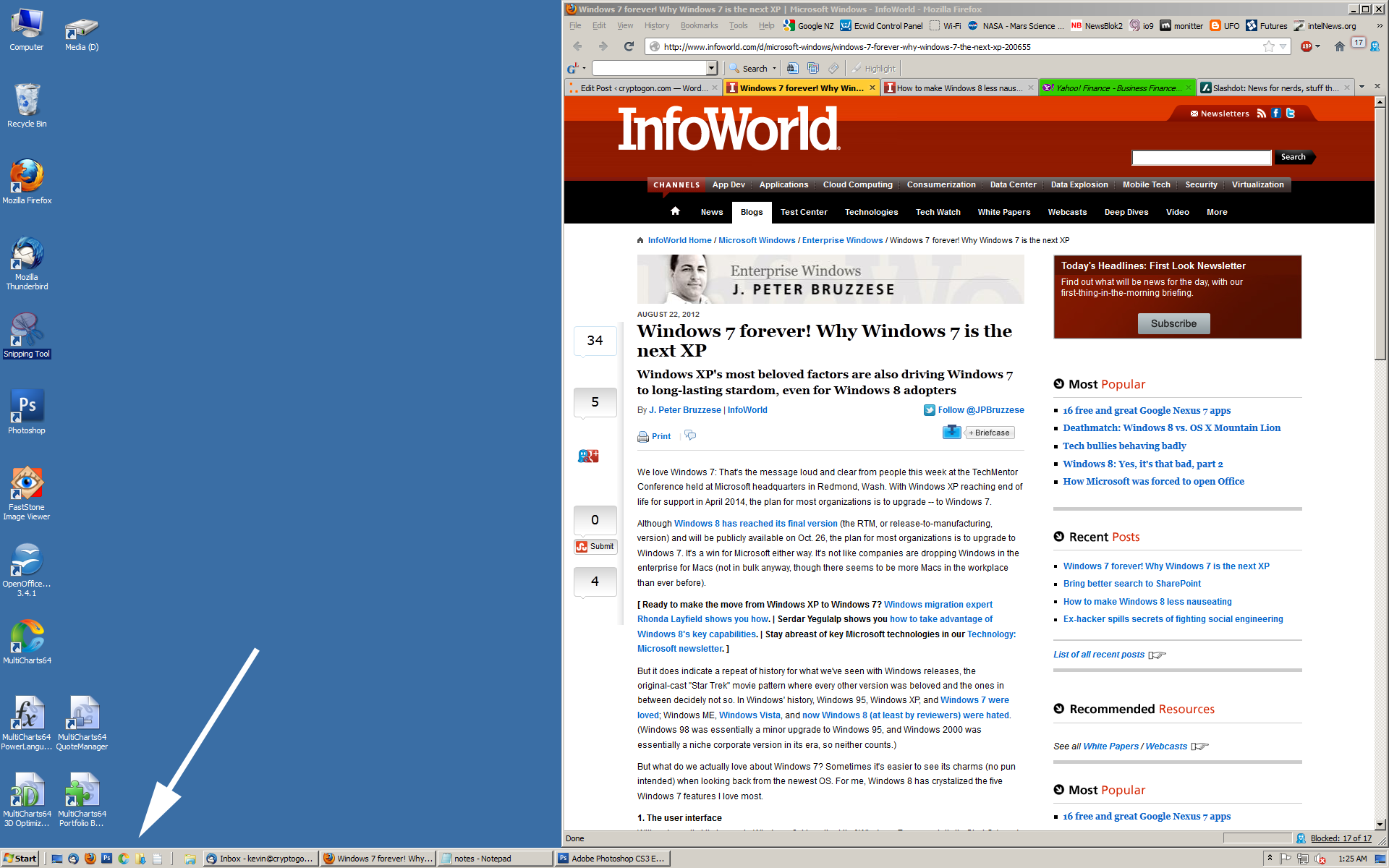
Ahh. Much better. It looks so much like XP now that I sometimes space out and forget that I’m using 7. *chortle*
Changing the topic a bit, here are a few comments about my first SSD experience:
I installed Windows 7 on an OCZ Vertex 4 128GB SSD. Although my somewhat old (2008) computer doesn’t support SATA3 speeds, I thought I’d at least get a fast drive for when I decide to shell out for a new motherboard, processor and RAM.
After seeing how fast this thing runs, even on this old Core 2 Quad Q9400 system, I’ve cancelled plans to build a new rig. While it’s a slight bummer to see the Vertex 4 throttled back to about half its maximum throughput—due to the legacy SATA2 interface—the thing just flies compared to how it used to go with the platter based drive. I can’t get over seeing Windows 7 boot all the way to the desktop in 17 seconds. Haha.
There probably aren’t many nerds left who haven’t stepped up to SSDs by now, but I was one of the holdouts. I’ve only had this Vertex 4 for two days and when I boot back into my plain old 5400RPM drive, I’m already thinking, “I’m never going back to conventional drives, at least not for the OS and applications.” So, in short, yep: Believe the hype about how great SSDs are.
Via: Infoworld:
With Windows XP reaching end of life for support in April 2014, the plan for most organizations is to upgrade — to Windows 7.
Private Crypto Key in Mission-Critical Hardware
August 23rd, 2012Via: Ars Technica:
A private encryption key embedded into widely used mission-critical routers could be exploited by hackers to attack electric substations, railroad switches, and other critical infrastructure, security researchers have warned.
The flaw, uncovered in devices made by Siemens subsidiary RuggedCom of Ontario, Canada, is the second this year to affect its Rugged Operating System. The firmware runs mission-critical routers that have been used by the US Navy, petroleum giant Chevron, and the Wisconsin Department of Transportation to help administer industrial control systems and supervisory control and data acquisition systems, which flip switches, turn valves, and manipulate other machinery in industrial settings. Rugged OS is fluent in both the Modbus and DNP3 communications protocols used to natively administer such ICS and SCADA gear.
According to security researcher Justin W. Clarke, Rugged OS contains the same private key used to decrypt secure-sockets-layer communications sent by administrators who log into the devices. This allows attackers who may have compromised a host on the network to eavesdrop on sessions and retrieve user login credentials and other sensitive details. Plenty of small and home office routers also contain private SSL keys. What’s different here is that RuggedCom devices, which are designed to withstand extreme dust, heat, and other harsh conditions, are connected to machinery that controls electrical substations, traffic control systems, and other critical infrastructure.
Many in Middle Class Say They Are Doing Worse Financially
August 23rd, 2012The Onion’s satire is the best commentary for this one: Nation’s Lower Class At Least Grateful It Not Part Of Nation’s Middle Class:
A survey released Wednesday by researchers at the University of North Carolina found that despite the many challenges they face, the nation’s lowest-income individuals are nonetheless thankful they don’t have to endure the unique hardships of the nation’s long-suffering middle class.
According to the report, the 46 million Americans who fall below the federal poverty line, though struggling mightily, are at least glad they don’t have to live up to some rapidly vanishing American dream of advancing in their career, making more money, and improving their lifestyle, the way their middle-income counterparts do.
“The unrealistic expectations and false hope they experience must be unbearable,” Camden, NJ hotel clerk Allison Jacobsen told researchers, noting that while her $22,000 annual salary barely covers her rent and groceries each month, at least she doesn’t operate under the flawed assumption that her situation will ever improve. “A life spent constantly stressing out over a dead-end job or struggling to pay off a fixed 30-year mortgage on a continuously depreciating three-bedroom townhouse? It’s horrific.”
“Can you believe people actually have to live like that?” Jacobsen added. “I feel just awful for them.”
Via: Today:
A new and comprehensive survey on how the middle class feels, released Wednesday by Pew Research Center, finds 42 percent of people who identify themselves as middle class say they are in worse shape financially than before the recession began. About 32 percent are in better shape, and the rest either don’t know or see no difference.
The recession officially ran from December of 2007 to June of 2009, although economic growth has generally been slow since and unemployment has remained high.
There is no hard and fast definition of middle class, but it’s clear from the Pew results that many people feel like the middle-class ideal is slipping through their fingers. The vast majority of the people who identified themselves as middle class also said that it’s tougher to maintain their standard of living than it was a decade ago.
40% of Food Wasted in U.S.???
August 22nd, 2012Via: Los Angeles Times:
Americans are throwing out nearly every other bite of food, wasting up to 40% of the country’s supply each year – a mass of uneaten provisions worth $165 billion, according to a new report from the Natural Resources Defense Council.
An average family of four squanders $2,275 in food each year, or 20 pounds per person per month, according to the nonprofit and nonpartisan environmental advocacy group.
Food waste is the largest single portion of solid waste cramming American landfills. Since the 1970s, the amount of uneaten fare that is dumped has jumped 50%. The average American trashes 10 times as much food as a consumer in Southeast Asia, according to the Natural Resources Defense Council.
Such profligacy is especially unwarranted in a time of record drought, high food prices expected to get higher and families unable to afford food, according to the council. Efforts are already in place in Europe to cut back on food waste.
But American consumers are used to seeing pyramids of fresh produce in their local markets and grocery stores, which results in $15 billion annually in unsold fruits and vegetables, according to the Natural Resources Defense Council. In restaurants and home kitchens, massive portions often end up partly in the trash.
Half of American soil and many other key resources are used for agriculture – the Natural Resources Defense Council says wasted food eats up a quarter of all freshwater consumed in the U.S. along with 4% of the oil while producing 23% of the methane emissions.
U.S. Slips to 47th in Press Freedom Index
August 22nd, 2012Via: Reporters Without Borders:
The United States (47th) also owed its fall of 27 places to the many arrests of journalist covering Occupy Wall Street protests.