“Merchant of Death” Viktor Bout Sentenced to 25 Years; Trial Ignored His Ties to U.S., Dick Cheney
April 7th, 2012Via: Democracy Now:
Notorious arms smuggler Viktor Bout, known as the “Merchant of Death,” has been sentenced to 25 years in prison for conspiracy to commit terrorism. Our guest, former United Nations arms trafficking investigator Kathi Lynn Austin, says the case allowed American companies to avoid exposure of their collusion with with the U.S. government and private companies linked to Dick Cheney during the Iraq war, even after United Nations sanctions against him in 2004. Authorities say Viktor Bout was involved in trafficking arms to dictators and stoking conflicts in Africa, South America and the Middle East. He has also been accused of furnishing weapons to al-Qaeda and the Taliban, and achieved particular notoriety for selling arms in Rwanda in 1998, just four years after the Rwandan genocide.
Hunger: Britain’s Silent, Scandalous Epidemic
April 7th, 2012Via: Independent:
Chris is 10. He and his brother are so malnourished that their skins are pale and they have rings under their eyes. Their older brothers have such an unhealthy diet that they have lost their adult teeth. They live in the sixth-richest city in the world – London. The boys are just four among thousands of Britain’s hungry children – victims of a “silent epidemic” of malnutrition in the capital and beyond.
Scientists Rewrite Rules of Human Reproduction
April 7th, 2012Via: Independent:
The first human egg cells that have been grown entirely in the laboratory from stem cells could be fertilised later this year in a development that will revolutionise fertility treatment and might even lead to a reversal of the menopause in older women.
Scientists are about to request a licence from the UK fertility watchdog to fertilise the eggs as part of a series of tests to generate an unlimited supply of human eggs, a breakthrough that could help infertile women to have babies as well as making women as fertile in later life as men.
Producing human eggs from stem cells would also open up the possibility of replenishing the ovaries of older women so that they do not suffer the age-related health problems associated with the menopause, from osteoporosis to heart disease.
Some scientists are even suggesting the possibility of producing an “elixir of youth” for women, where the menopause is eradicated and older women will retain the health they enjoyed when younger.
Researchers at Edinburgh University are working with a team from Harvard Medical School in Boston to be the first in the world to produce mature human eggs from stem cells isolated from human ovarian tissue.
Until now, it has only been possible to isolate a relatively small number of mature human egg cells directly from the ovaries of women who have been stimulated with hormones. This technical limitation has led to an acute shortage of human eggs, or “oocycts”, for IVF treatment as well as scientific research.
The scientists want to fertilise the laboratory-grown egg cells with human sperm to prove that they are viable. Any resulting embryos will be studied for up to 14 days – the legal limit – to see if they are normal.
These early embryos will not be transplanted into a woman’s womb because they will be deemed experimental material, but will either be frozen or allowed to perish.
I Finally Bought an Amazon Kindle DX
April 7th, 2012In 2007, with regard to the Kindle, I wrote that, “I personally wouldn’t go near that device because it’s brimming with DRM nonsense…”
A couple of years later in, Amazon Deletes Copies of 1984 and Animal Farm from Kindle Ebook Readers, I wrote that, “I don’t understand why anyone would buy a Kindle.”
There’s also, Amazon is Tracking the Most-Highlighted Kindle Passages, which mentions serious privacy concerns related to the devices.
Ok, I recently bought a Kindle DX. What happened to change my mind?
Amazon Kindle DX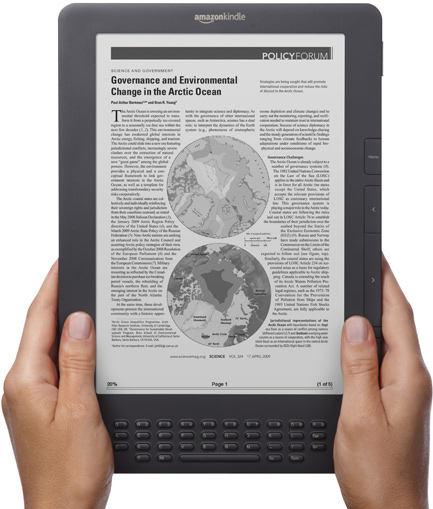
I have many lifetimes worth of reading material accumulated on my computer, but I don’t like reading longer works on standard computer displays. For a while, I printed hard copies, but this seemed silly for documents that I only wanted to read once. The costs associated with printing aren’t trivial either. Despite my philosophical hangups and concerns about privacy, I wanted a convenient, high quality solution for reading these digital files. A couple of weeks ago, someone on eBay offered several Kindle DX units for sale at a substantial discount, so I finally bought one.
I’m not going to write a full review of the Kindle DX here. There are at least many dozens of professional reviews out there already, and thousands of customer reviews on Amazon. I mainly want to say that, after several nights of reading on the Kindle DX, I’ve been trying to figure out how I’m going to come clean with you guys and admit that I like reading on the device more than some printed books. Yep. It’s true.
Think of the difference between reading a thick paperback novel, with the (usually too small) text printed so close to the spine that you have to crack it to get the pages semi flat, and a sumptuously designed hardcover, with ample margins and pages that will lie almost flat without much effort. Reading on the Kindle DX is not that unlike reading a nice, hardcover edition of a book. It is very easy on the eyes. Make the text larger or smaller to suit your taste. There’s also some control over the number of words per line.
Unfortunately, the DX does not support leading adjustments, which is weird because other Kindle’s do. Also, with Adobe PDF files, you can’t change the font size. If any area on the page is too small with a PDF, you would need to zoom in on it. (I just mentioned a couple of issues that I’ve noticed, but there are hundreds of one, two and three star reviews on Amazon where people chronicle real and perceived issues with the Kindle DX. Personally, I’d give it a solid four-stars out of five. PDF handling could be a lot better, and the text to speech feature is nothing to write home about.)
Before I pulled the trigger on this thing, I spent a lot of time trying to figure out just how dark the background is. It looked pretty dark grey to me in pictures I saw on the Internet, and I was worried that it might not be contrasty enough. After using it for a while, I have no regrets, but, if I had to split hairs on the matter, I think that I would want the background to be about 10% lighter. I found that reading with a bright light makes the text pop much more than with dim or barely adequate light.
Overall, I’m very happy with the Kindle DX. As someone who reads for a living, it was not smart to have deprived myself of something this useful for so long. I’m glad that I chose the DX instead of one of the smaller Kindles. My vision isn’t getting any better and, given a choice, I’d always picked larger format books to read over smaller ones. That said, the large DX version comes at an astonishing price premium over the smaller Kindles. If you don’t think that you need or want the big screen, save hundreds of dollars and pick one of the standard sized models instead.
Now that I’m using the Kindle DX daily, I’ve come to see the book vs. e-reader debate as pointless. While the device feels sturdy, I get the feeling that one drop to the floor would almost certainly kill it. I’d never just slip the device into a backpack without some kind of protective case because I’d wonder if it would get scratched or broken. So, let’s just forget about comparing this to printed books. In terms of durability, good old printed books win by a wide margin. Nobody in their right mind should see these digital wonders as replacements for printed versions of treasured literature, manuals, textbooks or any other written material that might need to pass from one generation to another. For example, would I keep my gardening books exclusively as digital versions? No way. And never mind that some of them are in full color while the Kindle has a monochrome display.
I want to quickly mention Calibre.
Calibre is an extremely powerful and free utility that is akin to a Swiss Army knife for managing e-books and e-readers. If you have documents in formats that are not e-reader friendly, Calibre can probably help you out. I’m getting fine results by converting PDFs into Kindle friendly .mobi files. Admittedly, these are pretty basic, all text documents. Conversion quality from PDFs decline as formatting complexity increases.
If you’re going to be sideloading your own documents on to your Kindle, you’ll probably appreciate Calibre. I’d say that this program is a must have for the many multi-prop beanie wearers, beardy-weirdies and other non-normals out there in Cryptogon land.
I’m going on much longer than I thought I would. Let’s wrap it up.
Cryptogon readers buy hundreds of printed books on Amazon per month. While my Kindle and e-book sales are growing steadily, they’re miniscule compared to traditional books. So, going by the numbers, the average Cryptogon reader/supporter, wouldn’t touch a Kindle with a barge pole. But I’m here to tell you: The Kindle is a useful tool, and my guess is that you would agree if you try one.
Here’s a link to Amazon’s Kindle Store
Strange But True Afterword: I wasn’t able to buy a Kindle DX from Amazon because, while they will ship them from Albania to Zimbabwe, they will not ship them to New Zealand. Other Kindle models can go to New Zealand, but not the DX. Nobody outside of Amazon seems to know why that is, despite lots of guesses. (I’ve seen threads where Kiwis’ heads were about to explode over this stupid situation.)
If you happen to know, for sure, what the story is with the DX and New Zealand, please enlighten us. Content delivery on the DX works fine in New Zealand over 3G, by the way—even out in the deep wopwops where I live. Unsurprisingly, the free web browsing feature is disabled.
Children Perceive Humanoid Robot as Emotional, Moral Being
April 6th, 2012I’m posting this more for its comedic value than because I think it’ll happen anytime soon.
My four-year-old son, left to his own devices, would destroy that bot inside of ten minutes. His goal wouldn’t be to destroy it; he just wants to figure out what makes machines go. If he had access to screw drivers, wrenches and hammers, it would be on like Donkey Kong.
So, tell me another one about the robotic child minders and I’ll be waiting to see some good posts on Shit My Kids Ruined after children encounter these types of robots in real-world settings.
Via: PhysOrg:
Robot nannies could diminish child care worries for parents of young children. Equipped with alarms and monitoring capabilities to guard children from harm, a robot nanny would let parents leave youngsters at home without a babysitter.
Sign us up, parents might say.
Human-like robot babysitters are in the works, but it’s unclear at this early stage what children’s relationships with these humanoids will be like and what dangers lurk in this convenient-sounding technology.
Will the robots do more than keep children safe and entertained? Will they be capable of fostering social interactions, emotional attachment, intellectual growth and other cognitive aspects of human existence? Will children treat these caregivers as personified entities, or like servants or tools that can be bought and sold, misused or ignored?
“We need to talk about how to best design social robots for children, because corporations will go with the design that makes the most money, not necessarily what’s best for children” said Peter Kahn, associate professor of psychology at the University of Washington. “In developing robot nannies, we should be concerned with how we might be dumbing down relationships and stunting the emotional and intellectual growth of children.”
To guide robot design, Kahn and his research team are exploring how children interact socially with a humanoid robot. In a new study, the researchers report that children exchanged social pleasantries, such as shaking hands, hugging and making small talk, with a remotely controlled human-like robot (Robovie) that appeared autonomous. Nearly 80 percent of the children – an even mix of 90 boys and girls, aged 9, 12 or 15 – believed that the robot was intelligent, and 60 percent believed it had feelings.
In Other News: New DARPA Grand Challenge for Humanoid Robots
Research Credit: midnightagain
Majority of Landmark Cancer Studies Cannot Be Replicated
April 6th, 2012Mmm hmm.
Via: Slashdot:
“During a decade as head of global cancer research at Amgen, C. Glenn Begley identified 53 ‘landmark’ publications — papers in top journals, from reputable labs — for his team to reproduce. Begley sought to double-check the findings before trying to build on them for drug development. Result: 47 of the 53 could not be replicated. He described his findings in a commentary piece published on Wednesday in the journal Nature (paywalled) . … But they and others fear the phenomenon is the product of a skewed system of incentives that has academics cutting corners to further their careers.”
Related: American Society for Microbiology: ‘Has Modern Science Become Dysfunctional?’
5000+ Artists Line Up For a Pirate Bay Promotion
April 6th, 2012“I have even gone so far that I have left my major record label and started up my own. I call it: ‘Do It Yourself Bitch Productions.'”
—Soso
Via: TorrentFreak:
Record labels and Hollywood have described The Pirate Bay as one of the biggest threats to their business, but thousands of artists clearly disagree with this view. In recent weeks more than 5000 independent artists have signed up to be promoted by the world’s largest torrent site. Those who were lucky enough to be featured are overwhelmed by the career boost and the positive responses from the public.
For many independent artists obscurity is a bigger problem than piracy, but it’s a problem that The Pirate Bay is trying to solve.
Earlier this year the site rolled out a new promotion platform for filmmakers, musicians, writers and all other artists alike. To help them reach an audience of tens of millions of people, The Pirate Bay started offering the artists a prime advertising spot on the site’s homepage, replacing the iconic logo.
Britain: Proposed Law Would Require ISPs and Device Makers to Filter Internet by Default
April 6th, 2012Will VPNs be outlawed? *chortle*
Via: PC Pro:
A new bill presented to the House of Lords demands both ISPs and device makers filter adult content.
The Online Safety Bill, raised in the Lords by Baroness Howe of Ildicote, asks for ISPs and mobile operators to “provide a service that excludes pornographic images” and for device makers to include ways to filter content at the point of purchase.
The proposal is a Private Members Bill, which rarely make it into law without Government support, and has yet to be subject to any debate.
Poland to Ban Monsanto’s GM Maize
April 6th, 2012Via: AFP:
Poland will impose a complete ban on growing the MON810 genetically modified strain of maize made by US company Monsanto on its territory, Agriculture Minister Marek Sawicki said Wednesday.
“The decree is in the works. It introduces a complete ban on the MON810 strain of maize in Poland,” Sawicki told reporters, adding that pollen of this strain could have a harmful effect on bees.
On March 9, seven European countries — Belgium, Britain, Bulgaria, France, Germany, Ireland and Slovakia — blocked a proposal by the Danish EU presidency to allow the cultivation of genetically-modified plants on the continent.
Seven days after that, France imposed a temporary ban on the MON810 strain.
Talks on allowing the growing of genetically-modified plants on EU soil are now deadlocked as no majority has emerged among the 27 member states.
Arizona Passes Sweeping Law Criminalizing Internet Speech
April 5th, 2012Via: Jonathan Turley:
In one of the most sweeping attacks on free speech in America, the Arizona legislature has passed a draconian bill that would criminalize speech on the Internet (“any electronic or digital device”) that prosecutors consider “obscene, lewd or profane language or . . . suggest[ing] a lewd or lascivious act if done with intent to ‘annoy,’ ‘offend,’ ‘harass’ or ‘terrify.’” The law is largely undefined and is in my view facially unconstitutional. The law would drive a stake in the heart of free speech. Yet, people like Bill Clinton have been calling for such a crackdown on Internet speech for years.
The inclusion of terms like “profane” (defined as including “Abusive, vulgar, or irreverent language” in standard dictionaries) is perfectly bizarre. I cannot imagine that the law was put through any serious legal review. The state will end up paying for litigation of this unconstitutional law. Indeed, I am reluctant to quote from the law on this blog in fear of being prosecuted or being charged with the inclusion of something so obscene and profane.
Arizona Governor Jan Brewer will now have to decide whether to sign this law.