“Plastic Soup” Found in Atlantic Ocean
April 18th, 2010Via: CBS / AP:
Researchers are warning of a new blight on the ocean: a swirl of confetti-like plastic debris stretching over thousands of square miles in a remote expanse of the Atlantic Ocean.
The floating garbage – hard to spot from the surface and spun together by a vortex of currents – was documented by two groups of scientists who trawled the sea between scenic Bermuda and Portugal’s mid-Atlantic Azores islands.
The studies describe a soup of micro-particles similar to the so-called Great Pacific Garbage Patch, a phenomenon discovered a decade ago between Hawaii and California that researchers say is likely to exist in other places around the globe.
“We found the great Atlantic garbage patch,” said Anna Cummins, who collected plastic samples on a sailing voyage in February.
The debris is harmful for fish, sea mammals – and at the top of the food chain, potentially humans – even though much of the plastic has broken into such tiny pieces they are nearly invisible.
Since there is no realistic way of cleaning the oceans, advocates say the key is to keep more plastic out by raising awareness and, wherever possible, challenging a throwaway culture that uses non-biodegradable materials for disposable products.
“Our job now is to let people know that plastic ocean pollution is a global problem – it unfortunately is not confined to a single patch,” Cummins said.
Research Credit: ltcolonelnemo
Tattooing Patients With UV Ink Could Protect Pacemakers From Hackers
April 18th, 2010Oh sure.
Via: Popular Science:
More and more implantable devices, like pacemakers or defibrillators, are turning to wireless signals as a means to communicate with external devices, but in doing so they open themselves to security breaches. Several solutions are in the works that tackle this problem by upping device defenses, but by piling on security measures, yet another risk emerges: that at a critical time an authorized physician might not be able to access the device.
So Microsoft Research proposes putting a new technological spin on an old, time-tested security protocol: protect every device with a password, then tattoo the password right onto the patient in invisible UV ink.
Feds Indict Ex-Blackwater President
April 17th, 2010Via: AP:
The former president of Blackwater Worldwide was charged Friday with using straw purchases to stockpile automatic weapons at the security firm and filing false documents to cover up gifts given to the King of Jordan.
The federal indictment charges Gary Jackson, 52, who left the company last year in a management shakeup, along with four other former workers. The charges against Jackson include a conspiracy to violate firearms laws, false statements and possession of an unregistered firearm.
Also indicted were former general counsel Andrew Howell, 44; former executive vice president Bill Mathews, 44; former procurement vice president Ana Bundy, 45; and, 65-year-old Ronald Slezak, a former weapons manager.
The charges open a new front of the government’s oversight of the sullied security company. Several of the company’s contractors have previously been charged with federal crimes for their actions in war zones, but the company’s executives have so far weathered a range of investigations.
The company has been trying to rehabilitate its image since a 2007 shooting in Baghdad left 17 people dead, outraged the Iraqi government and led to a federal charges against several Blackwater guards — accusations later thrown out of court after a judge found prosecutors mishandled evidence. Around the time that Jackson left the company, Blackwater changed its name to Xe Services.
The latest case stems from a raid conducted by federal agents at the company’s headquarters in Moyock in 2008 that seized 22 weapons, including 17 AK-47s.
Blackwater signed agreements in 2005 in which the company financed the purchase of 34 automatic weapons for the Camden County sheriff’s office. Sheriff Tony Perry became the official owner of the weapons, but Blackwater was allowed to keep most of the guns at its armory.
The indictment accuses Blackwater officials of enticing the local sheriff’s office to pose as the purchaser of the weapons, something prosecutors called essentially a straw purchase. The office provided blank letterhead to the company, which then used the stationery to prepare letters ordering weapons.
Prosecutors said company officials, hoping to land a lucrative overseas contract, presented the king of Jordan with several firearms as gifts then realized that they were unable to account for where the weapons went. To cover it up, they falsified four federal documents “to give the appearance that the weapons had been purchased by them as individuals,” according to the indictment.
Federal law prohibits licensed firearms dealers such as Blackwater to have more than two of the same style of weapon. Law enforcement agencies can have fully automatic weapons.
Kenneth Bell, an attorney for Jackson, said the former executive was a true American hero. Jackson spent two decades in the military as a Navy Seal.
“These charges are false,” Bell said. “He will defend himself, as he defended this country, in what he calls the greatest justice system in the world.”
Venice Was a Quiet Mena
April 16th, 2010Via: Mad Cow Productions:
“Venice was a kind of quiet Mena (Arkansas),” stated a former drug pilot for The Company. “Jackson Stephens built this huge headquarters next to the airport. And he was in charge. But I do remember seeing Porter Goss around the airport a lot.”
The airport where three of the four terrorist pilots in the 9/11 attack learned to fly was a hub of operations in the 1970’s and early ‘80’s for “The Company,” an international drug smuggling organization headquartered in Lexington, Kentucky and Mena, Arkansas.
Led by a mysterious Cuban exile, who used the alias “Frank Guzman,” The Company’s contingent at the Venice Airport numbered as many as a dozen pilots and associates. The Company began receiving national attention in the early 1980’s.
“The Company,” whose name is a commonly-used euphemism for the CIA, was profiled in Sally Denton’s best-selling book “The Blue-Grass Conspiracy,” which raised pointed questions about the involvement of the CIA with the group.
The 60-year secret history of covert CIA and military operations at the Venice Municipal Airport now coming to light goes well beyond anything previously known to have taken place there.
Goldman Sachs Charged with Fraud Related to Subprime Securities
April 16th, 2010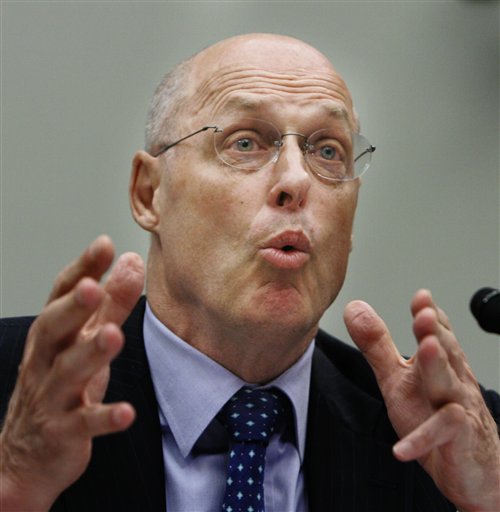
When will Hank be arrested?
Via: AP:
The government has accused Goldman Sachs & Co. of defrauding investors by failing to disclose conflicts of interest in mortgage investments it sold as the housing market was faltering.
The Securities and Exchange Commission said in a civil complaint Friday that Goldman failed to disclose that one of its clients helped create — and then bet against — subprime mortgage securities that Goldman sold to investors.
Investors in the mortgage securities lost more than $1 billion, the SEC said. The agency is seeking to recoup profits reaped on the deal.
Goldman Sachs denied the allegations. In a statement, it called the SEC’s charges “completely unfounded in law and fact” and said it will contest them.
The charges come as lawmakers seek to crack down on Wall Street practices that helped cause the financial crisis. Among proposals Congress is weighing are tougher rules for complex investments like those involved in the alleged Goldman fraud.
The Goldman client implicated in the fraud is one of the world’s largest hedge funds, Paulson & Co., which paid Goldman roughly $15 million for structuring the deals in 2007.
Goldman Sachs shares fell more than 13 percent after the SEC announcement, which also caused shares of other financial companies to sink. The Dow Jones industrial average fell more than 140 points in midday trading.
The civil lawsuit filed by the SEC in federal court in Manhattan was the government’s most significant legal action related to the mortgage meltdown that ignited the financial crisis and helped plunge the country into recession. The SEC’s enforcement chief said the agency is investigating a broad range of practices related to the crisis.
The agency also charged a Goldman vice president, Fabrice Tourre, 31, who it said was principally responsible for devising the deal and marketing the securities.
The SEC is seeking unspecified fines and restitution from Goldman Sachs and Tourre.
Asked why the SEC did not also pursue a case against Paulson, Enforcement Director Robert Khuzami said: “It was Goldman that made the representations to investors. Paulson did not.”
Goldman told investors that a third party, ACA Management LLC, had selected the underlying mortgages in the investment. But, the SEC alleges, Goldman misled investors by failing to disclose that Paulson & Co. also played a role in selecting the mortgages and stood to profit from their decline in value.
“Goldman wrongly permitted a client that was betting against the mortgage market to heavily influence which mortgage securities to include in an investment portfolio, while telling other investors that the securities were selected by an independent, objective third party,” Khuzami said in a statement.
The SEC charges come after Goldman Sachs denied last week it bet against clients by selling them mortgage-backed securities while reducing its own exposure to them.
In an annual letter to shareholders, Goldman said it began reducing its exposure to the U.S. mortgage market in late 2006. It said it did so by selling mortgage investments or buying credit default swaps. The swaps are a form of insurance that pays out if the value of the underlying asset declines.
Those hedges, also known as short positions, served Goldman well. As the housing market began cratering and losses piled up for other big banks, Goldman suffered less damage. That led to criticism that the bank benefited at the expense of clients who bought mortgage-backed securities that became toxic. Goldman denied that.
“Our short positions were not a ‘bet against our clients,'” Goldman said in the letter. “Rather, they served to offset our long positions. Our goal was, and is, to be in a position to make markets for our clients while managing our risk within prescribed limits.”
In the letter, Goldman also rejected claims that it profited from the mortgage market meltdown.
New Zealand: Scientists Given Permission to Put Human Genes Into Goats, Sheep and Cows
April 16th, 2010Via: New Zealand Herald:
Scientists have been given permission to put human genes into goats, sheep and cows for the next 20 years, to see if the animals will produce human proteins in their milk.
But people will not be pouring the genetically modified milk on their Weetbix just yet – the milk will be discarded.
AgResearch won Environmental Risk Management Authority approval to allow a handful of scientists to breed and keep genetically-modified animals at the Ruakura research facility, near Hamilton.
The work will begin with genetically modified cows, and could be expanded to genetically modified goats within the next year.
There are no immediate plans to genetically modify sheep at Ruakura.
Simon Terry, of environmental consultancy the Sustainability Council, welcomed conditions making it clear the milk could not be made for commercial sale but he was concerned the 20-year time limit was three times as long as the last GM experiment at the facility.
And he feared Ruakura would become a “GM animal warehouse” because there were no limits on the number of animals.
Jon Carapiet, of GE-free NZ, said the decision was the beginning of a “mega-transformation” of New Zealand agriculture.
But AgResearch’s applied biotechnology head Jimmy Suttie said there were no plans to release any genetic material into the food chain.
He said human genetic material in the animals would be “switched on” only in the mammary glands of lactating animals, leaving the beasts otherwise unchanged.
AgResearch hopes human proteins made by the animals could eventually be used to make “biopharmaceuticals” to treat rare human diseases and boost New Zealand’s income in the pharmaceuticals market.
Keeping GM goats will be a first for the facility, and people who spoke at the public hearing on the application were eager to warn the company about goats’ incredible abilities to escape.
Dr Suttie said any human DNA used would almost certainly not be from a traceable person. It was now possible to build wholly synthetic human genes in a test tube using information bought from overseas databanks, he said. Agresearch has said it will not use Maori DNA because of cultural concerns.
Meanwhile, ERMA is considering broader plans by AgResearch to modify livestock to make antigens, biopharmaceuticals, enzymes, hormones and other products after the Court of Appeal overturned a High Court decision blocking the applications.
Apple App Store Bans Pulitzer-Winning Satirist for Satire
April 16th, 2010Via: Wired:
Editorial cartoonist Mark Fiore may be good enough to win this year’s Pulitzer Prize, but he’s evidently too biting to get past the auditors who run Apple’s iPhone app store, who ruled that lampooning public figures violated its terms of service.
Fiore irked Apple’s censorious staffers with his cartoons making fun of the Balloon Boy hoax and the pair that famously crashed a White House party, according to Laura McGann at the Neiman Journalism Lab.
Fiore won a Pulitzer Monday for animations he made for the SFGate, the online home of the San Francisco Chronicle. But Fiore, who is a freelancer who runs a syndication business, was rejected by Apple in December for an app called NewToons that features his work.
According to a Dec. 21 e-mail reprinted by Neiman, Apple rejected his app because it “contains content that ridicules public figures and is in violation of Section 3.3.14 from the iPhone Developer Program License Agreement which states: Applications may be rejected if they contain content or materials of any kind (text, graphics, images, photographs, sounds, etc.) that in Apple’s reasonable judgment may be found objectionable, for example, materials that may be considered obscene, pornographic, or defamatory.”
Neither Fiore nor Apple responded to requests for comment.
The news of the rejection comes not long after Apple decided to purge its App store of content that included nudity, a retroactive ban that included apps from respected German publications such as Bild and Der Spiegel.
Fiore’s rejection may be especially disconcerting to news and media organizations, many of which are betting heavily on iPad apps as a way to get users to pay to read magazines and newspapers, and to get advertisers to pay print-ad prices for online content. (Online ads cost a small percentage of what ads in glossy magazines cost, in no small part because the net has almost infinite advertising space.)
Apple has built a little slab of Disneyland with its iPad, which is meant to be an experience unsullied by provocative or crude material. It’s beautiful and enticing — the company has already sold more than a half million of them in the first two weeks it’s been available — but it’s not the real world.
Ex-NSA Worker Charged in Classified Leak Case
April 16th, 2010Hmm. I’m throwing a tick in COINTELPRO because it strikes me as bizarre that someone at such a high level in the NSA allowed himself to get burned like this.
Via: AP:
A former senior executive at the National Security Agency was charged Thursday with lying and obstruction of justice in an investigation of leaks of classified information to a newspaper.
Federal prosecutors said Thomas Drake, 52, served as a source for many articles about the NSA in an unidentified newspaper, including articles that contained classified information.
A federal indictment filed in Maryland charges that Drake used a nongovernment e-mail account to transmit classified and unclassified information. Authorities also charge that Drake lied to federal agents about what he’d done.
The indictment does not identify the reporter, the newspaper or the subject matter of the stories. It says the stories were published between February 2006 and November 2007.
The place, time, and type of stories described in the indictment generally match articles published in The Baltimore Sun, though federal officials would not confirm that paper was the one cited in the case. Judy Berman, a spokeswoman for the newspaper, declined to comment.
The Washington Post said that the reporter was Siobhan Gorman, an intelligence correspondent for The Baltimore Sun at the time and subsequently at the Wall Street Journal. Calls to the Sun seeking comment were not returned and the Journal declined to comment.
The Justice Department defended the charges against Drake.
“Our national security demands that the sort of conduct alleged here — violating the government’s trust by illegally retaining and disclosing classified information — be prosecuted and prosecuted vigorously,” said the Justice Department’s assistant attorney general Lanny Breuer.
Drake faces five counts of willfully retaining documents related to national defense. He is also charged with obstruction of justice and four counts of making false statements to the FBI.
The most serious charge in the 10-count indictment carries a maximum possible sentence of 20 years in prison.
Prosecutors say Drake exchanged hundreds of e-mails with the reporter, researched stories for the reporter by asking other NSA employees questions and accessing classified documents, and sent the reporter copies of classified and unclassified documents.
Lucy Dalglish, executive director of the Reporters Committee for Freedom of the Press, said the case is likely to have “a chilling effect on government employees who have information they wish to share with the public.”
Dalglish said prosecutors do not appear to have subpoenaed any reporters in the case, which she called an encouraging sign.
“It is a reminder that if you are going to talk to a reporter and you don’t want to be identified, you should not use technology to do it,” she said.
Legislation Seeks to Wall Off Derivative Trading from Bank Depositors’ Money
April 15th, 2010Via: Bloomberg:
Goldman Sachs Group Inc., JPMorgan Chase & Co. and their biggest rivals would be forced to wall off derivatives trading operations from their commercial banks under a measure to be introduced by Senate Agriculture Committee Chairman Blanche Lincoln, a congressional aide said.
Lincoln, an Arkansas Democrat, will propose a “no-bailout provision” as part of an overhaul of derivatives regulation she plans to unveil today, according to the aide, who declined to be identified because the plan isn’t public. The measure aims to ensure banks don’t endanger depositors’ money with risky trading of over-the-counter derivatives, the aide said.
The proposal is already drawing opposition from banks that dominate the $605 trillion over-the-counter market. Derivatives regulation being weighed by Congress could cost JPMorgan from “$700 million to a couple billion dollars,” Jamie Dimon, the bank’s chief executive officer, said yesterday during a conference call with analysts.
“I imagine their lobbyists have already contacted their best contacts in the government,” said Darrell Duffie, a finance professor at Stanford University in Palo Alto, California.
The five biggest dealers in the largely unregulated market — all commercial banks — earned $28 billion from derivatives trading last year, according to reports collected by the Federal Reserve and people familiar with the matter.
Research Credit: dagobaz
Library of Congress Acquires Entire Twitter Archive
April 15th, 2010Via: Library of Congress:
Have you ever sent out a “tweet” on the popular Twitter social media service? Congratulations: Your 140 characters or less will now be housed in the Library of Congress.
That’s right. Every public tweet, ever, since Twitter’s inception in March 2006, will be archived digitally at the Library of Congress. That’s a LOT of tweets, by the way: Twitter processes more than 50 million tweets every day, with the total numbering in the billions.
We thought it fitting to give the initial heads-up to the Twitter community itself via our own feed @librarycongress. (By the way, out of sheer coincidence, the announcement comes on the same day our own number of feed-followers has surpassed 50,000. I love serendipity!)
We will also be putting out a press release later with even more details and quotes. Expect to see an emphasis on the scholarly and research implications of the acquisition. I’m no Ph.D., but it boggles my mind to think what we might be able to learn about ourselves and the world around us from this wealth of data. And I’m certain we’ll learn things that none of us now can even possibly conceive.
Research Credit: JH