Federal War Spending Exceeds State Government Outlays
December 26th, 2009Via: Public Record:
The U.S. spends more for war annually than all state governments combined spend for the health, education, welfare, and safety of 308 million Americans.
Joseph Henchman, director of state projects for the Tax Foundation of Washington, D.C. says the states collected a total of $781 billion in taxes in 2008.
For a rough comparison, according to Wikipedia data, the total budget for defense in fiscal year 2010 will be at least $880 billion and could possibly top $1 trillion. That’s more than all the state governments collect.
Henchman says all American local governments combined (cities, counties, etc.) collect about $500 billion in taxes. Add that to total state tax take and you get over $1.3 trillion. This means Uncle Sam’s Pentagon is sopping up nearly as much money as all state, county, city, and other governmental units spend to run the country.
If the Pentagon figure of $1 trillion is somewhat less than all other taxing authorities, keep in mind the FBI, the various intelligence agencies, the VA, the National Institutes of Health (biological warfare) are also spending on war-related activities.
A question that describes the above and answers itself is: In what area can the Federal government operate where states and cities cannot tread? The answer is: foreign affairs—raising armies, fighting wars, conducting diplomacy, etc. And so Uncle Sam keeps enlarging this area. His emphasis is not on diplomacy, either.
For every buck spent by the State Department, which gets some $50 billion a year, the Pentagon spends $20. As for the Peace Corps, its budget is a paltry $375 million—hardly enough to keep the Pentagon elephant in peanuts.
Nobel Prize economist Joseph Stiglitz and finance authority Linda Bilmes write in their “The Three Trillion Dollar War”(W.W. Norton), “defense spending has been growing as a percentage of discretionary funding (money that is not required to be spent on entitlements like Social Security), from 48 percent in 2000 to 51 percent today. That means that our defense needs are gobbling up a larger share of taxpayers’ money than ever before.”
And they add, “The Pentagon’s budget has increased by more than $600 billion, cumulatively, since we invaded Iraq.” With its 1,000 bases in the U.S. and another 800 bases globally, the U.S. truly has become a “Warfare State.” Today, military-related products account for about one-fourth of total U.S. GDP. This includes 10,000 nuclear weapons. Indeed, the U.S. has lavished $5.5 trillion just on nukes over the past 70 years.
No other nation has anything remotely like this menacing global presence. The Pentagon strengthens its grip by running joint “training” exercises with the military of 110 other nations, including outright dictatorships that suppress internal unrest.
The U.S. spends more on weaponry than the next dozen nations combined and is by far the No. 1 world arms peddler. “The government employs some 6,500 people just to coordinate and administer its arms sales program in conjunction with senior officials at American embassies around the world, who spend most of their ‘diplomatic’ careers working as arms salesmen,” writes Chalmers Johnson in “Blowback: The Costs and Consequences of American Empire(Henry Holt).”
Johnson goes on to say the U.S. military establishment today is “close to being beyond civilian control” and that despite its ability to “deliver death and destruction to any target on earth and expect little in the way of retaliation” it demands more and newer equipment “while the Pentagon now more or less sets its own agenda” and “monopolizes the formulation and conduct of American foreign policy.”
How long will it be before this tyrannical, anti-democratic, colossus that is sucking up as much money for war as all states, counties and cities spend on peace—and which straddles the globe, boosts dictators, and beats the war drums—turns on its own people?
Fannie, Freddie: Unlimited Fail
December 25th, 2009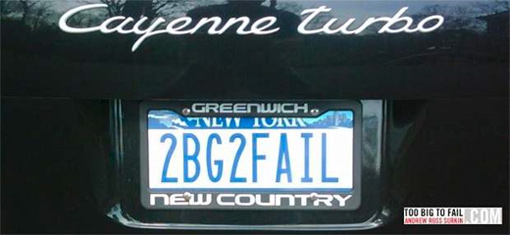
Change
Via: Reuters:
The Obama administration pledged on Thursday to back beleaguered mortgage finance giants Fannie Mae and Freddie Mac no matter how big their losses may be in the next three years.
It also jettisoned a demand that the two companies cut the size of their mortgage-related investment portfolios next year, allowing them to provide even more support in the near term for a housing market recovering from its worst slump in decades.
The Treasury Department said it made the changes to assure financial markets it stood firmly behind both companies and to buy more time for the two government-sponsored enterprises to whittle down their mortgage-related holdings.
The two agencies each had a Treasury credit line of $200 billion. Combined, they have so far tapped about $111 billion.
The Treasury’s announcement came just hours after the companies said their chief executives would be paid up to $6 million on an annualized basis for 2009.
Market Moves and the Lunatic Fringe
December 24th, 2009Via: The Australian:
IMPLODING equities, exploding credit default swaps, soaring gold and slumping oil — if, at any time over the past 18 months, it seemed that markets were in the grip of lunacy, it may be because investors are, technically, lunatics.
The market mayhem since the global financial meltdown began in 2008 has provided fertile soil for proponents of a branch of investment theory which holds that market cycles move in phase with the Moon.
Now, backed with decades of data and behaviour that can no longer be explained by purely rational analysis, the lunar theory has slipped into the mainstream.
In a piece of research that involved 14 of its senior analysts from across five leading financial centres scrutinising data from 32 leading indices over several decades, Macquarie Securities has arrived at a startling discovery: the two days on either side of the new lunar month represent most of the positive returns on equity markets for the next four weeks.
“Using data since 1988 for a wide variety of indices,” the report concluded, “it is quite clear that a strong surge in returns can be seen leading into the turn of the (lunar) month.”
The analysts are quick to dismiss the idea that the theory applies only to markets in Asia — a part of the world where belief in the lunar theory, especially in Hong Kong and Japan, is better established.
“The effect is not just an Asian effect, it happens globally,” the Macquarie report said.
Research Credit : SW
Cryptogon Readers Send Contributions
December 23rd, 2009Thank you.
AF CA$5
MW $20
RM $25
AS €100!
Eileen $45
Trading Shares in Milliseconds
December 23rd, 2009I like the part about how NASDAQ is looking at requiring all brokers to use a specified length of network cable on the links to the exchange’s servers. HA.
The article assumes the reader will get it, but just in case you don’t, the point is that the length of the cable affects the latency. A shorter cable will have shorter latency. A longer cable will have longer latency. As absurd as it sounds, the speed of light is a factor to consider for these strategies. (More information on latency issues as they relate to trading.)
Via: Technology Review:
Today’s stock market has become a world of automated transactions executed at lightning speed. This high-frequency trading could make the financial system more efficient, but it could also turn small mistakes into catastrophes.
If Manoj Narang is about to bring down the markets, he’s certainly relaxed about it. Narang, who wears a goatee and wire-frame glasses, is casually dressed in a brown shirt and dark gray sweatshirt. Sitting on a swivel chair with one leg tucked under the other, he seems positively composed, especially for a man who has just bought and sold 15 million shares with a total value of $600 million. For Narang, however, such volume represents just the start of a normal day. Though it’s about noon on a Friday morning, he has barely begun.
Narang is the head of Tradeworx, a hedge fund and financial-technology firm that makes purely automated trades; all decisions are reached and acted on at near light speed by computers running preprogrammed algorithms. “Actually, we run two businesses,” he says. “The first trades in and out of shares in about a second and holds them for an average of two or three days. That’s the medium-speed fund. The high-speed fund could make thousands of trades a second and holds them for a matter of minutes.”
By the end of the day, his computers will have bought and sold about 60 million to 80 million shares, with the heaviest activity in the last hour of trading, from three to four in the afternoon. Tradeworx and similar firms around the country will race to close billions of bets that hinge on things like tiny differences between the prices of shares in an exchange-traded fund holding the S&P 500 and the individual shares that make up the same index. The profits go to the company with the fastest hardware and the best algorithms–advantages that enable it to spot and exploit subtle market patterns ahead of everyone else. At the end of a typical day, the Tradeworx high-speed business holds no shares at all. Come Monday, Narang will look to trade millions more shares. It seems like a lot, and it is, but Narang estimates that he’s probably only somewhere in the middle of the top 50 traders by volume.
Just five years ago, automated trades made up about 30 percent of the market, and few of those moved as quickly as today’s trades do. Since then, however, automated trading has become much more widespread, and much quicker. Narang acknowledges starting his ultrafast group as a defensive maneuver when he began to notice faster traders eroding the performance of his medium-speed strategy. Now the medium-speed fund is adopting the techniques he developed in the ultrafast fund.
TheTabb Group, a consultancy based in Westborough, MA, estimates that high-frequency automated trading now accounts for 61 percent of the more than 10 billion shares traded daily across the numerous exchanges that make up the U.S. market. Tabb estimates profits from high-frequency trading in the first nine months of last year at $8 billion or more. With the rise of automation, the bulk of U.S. stock trading has moved from the once-crowded floor of Manhattan’s New York Stock Exchange (NYSE) to silent server farms run by exchanges and broker-dealers across the country: the proportion of all trades that the NYSE handles has shrunk from 80 percent in 2005 to 40 percent today. Trading is now essentially a virtual art, and its practitioners put such a premium on speed that NASDAQ has considered issuing equal 100-foot lengths of cable to the brokers who send orders to its exchange servers.
Swindler Duped CIA Over Al-Qaeda Decoding Scam
December 23rd, 2009Related “research”: U.S. Government Funding Research Into “Malintent” Detector?
Via: AFP:
A con artist convinced the CIA and other US agencies in 2003 that he could decode secret messages sent by Al-Qaeda through Al-Jazeera broadcasts, Playboy magazine reported.
Duped by claims that “bar codes” on Al-Jazeera television contained targeting information for Al-Qaeda attacks, former president George W. Bush’s administration raised the terror alert and cancelled several transatlantic flights in December 2003, the report said, citing former CIA officials.
The swindler at the center of the scam was Dennis Montgomery, head of a small software company in Reno, Nevada. He persuaded the Central Intelligence Agency and the Department of Homeland Security that his technology could decipher messages with flight numbers and longitudes and latitudes meant for Al-Qaeda operatives.
With assistance from French intelligence, CIA officials eventually concluded there were no secret messages in Al-Jazeera television broadcasts, said the report, published in the magazine’s latest edition.
“A branch of the French intelligence services helped convince the Americans that the bar codes were fake,” it said.
CIA and French officials asked another technology company to find or re-create codes from Al-Jazeera transmissions and “found definitively that what Montgomery claimed was there was not,” it said.
But even after the CIA stopped cooperating with Montgomery, he succeeded in convincing other government agencies that he had valuable code-breaking technology.
In January 2009, he signed a three-million-dollar research contract with the US Air Force, according to Playboy.
“We were testing some of the software. We were just looking at it to see if there was anything there,” Joseph Liberatore, an Air Force program manager, told the magazine.
Montgomery has faced a number of lawsuits and last year was charged with bouncing nine checks worth a total of one million dollars in Las Vegas.
Mumbai Terror Suspect David Headley Connected to U.S. Intelligence, Heroin Smuggling
December 23rd, 2009Via: Times Online:
A key terror suspect who allegedly helped to plan last year’s attacks in Mumbai and plotted to strike Europe was an American secret agent who went rogue, Indian officials believe.
David Headley, 49, who was born in Washington to a Pakistan diplomat father and an American mother, was arrested in Chicago in October. He is accused of reconnoitring targets in India and Europe for Lashkar-e-Taiba (LeT), the Pakistan-based terror group behind the Mumbai attacks and of having links to al-Qaeda. He has denied the charges.
He came to the attention of the US security services in 1997 when he was arrested in New York for heroin smuggling. He earned a reduced sentence by working for the US Drug Enforcement Agency (DEA) infiltrating Pakistan-linked narcotics gangs.
Indian investigators, who have been denied access to Mr Headley, suspect that he remained on the payroll of the US security services — possibly working for the Central Intelligence Agency (CIA) — but switched his allegiance to LeT.
“India is looking into whether Headley worked as a double agent,” an Indian Home Ministry official said yesterday.
Mr Headley, who changed his name from Daood Gilani, was in Mumbai until two weeks before the attacks on the city, which claimed 166 lives last November. It is alleged that he spent months checking targets in India’s commercial capital, using his Western looks and anglicised name to move in elite social circles, hobnob with Bollywood actors and even to pass himself off as Jewish.
Despite being firmly on the radar of the US intelligence agencies, he was allowed to return to India as recently as March. Indian officials are furious that their American counterparts did not share details of that visit at the time. The Indian media has raised the possibility that Mr Headley was being protected by his American handlers — a theory that experts say is credible.
“The feeling in India is that the US has not been transparent,” said B. Raman, a former counter-terrorism chief in the Indian foreign intelligence service, the Research and Analysis Wing.
“That Headley was an agent for the DEA is known. Whether he was being used by the CIA as well is a matter of speculation, but it is almost certain that the CIA was aware of him and his movements across the subcontinent.”
According to Mr Raman, it is probable that Mr Headley, who was arrested when the US authorities learned that he was about to fly to Pakistan, was listed on the main database of the US National Counterterrorism Centre, a facility used by the CIA and several other American agencies to track terror suspects.
Indian officials suspect that US agencies declined to share intelligence to avoid compromising other secret operations and to to be able to deny any link with Mr Headley.
Analysts believe that the US may also have been anxious to avoid sharing information that could further raise tensions between India and Pakistan, nuclear-armed neighbours who have fought three wars.
According to documents put before a court in Chicago, Mr Headley had links with the Pakistan Army and, through it, with al-Qaeda.
As well as helping to co-ordinate the Mumbai atrocity, Mr Headley is accused of planning attacks on Mumbai’s Bollywood film industry, the Shiv Sena, a Hindu extremist group also based in Mumbai, a major Hindu temple, and a Danish newspaper that had published cartoons depicting the Prophet Muhammad.
The US authorities allege that he was close to Tahawwur Hussain Rana, a former Pakistani schoolmate and businessman who is also being charged with planning to attack the Danish newspaper, Jyllands-Posten. Mr Rana is accused of having known about the attack on Mumbai in advance.
The CIA denied that Headley had worked for the organisation.
“Any suggestion that Headley was working for the CIA is complete and utter nonsense. It’s flat-out false,” Paul Gimigliano, from the CIA’s Office of Public Affairs, said.
The Indian Home Secretary, Gopal Krishna Pillai, has said that his Government would seek the extradition of Mr Headley — a request that has so far been stonewalled by US officials.
Cost to Fight Each Al Qaeda Member in Afghanistan Per Year: $300 Million
December 23rd, 2009War is a Racket by Smedley D. Butler
Via: ABC News:
As he justified sending 30,000 more troops to Afghanistan at a cost of $30 billion a year, President Barack Obama’s description Tuesday of the al Qaeda “cancer” in that country left out one key fact: U.S. intelligence officials have concluded there are only about 100 al Qaeda fighters in the entire country.
A senior U.S. intelligence official told ABCNews.com the approximate estimate of 100 al Qaeda members left in Afghanistan reflects the conclusion of American intelligence agencies and the Defense Department. The relatively small number was part of the intelligence passed on to the White House as President Obama conducted his deliberations.
President Obama made only a vague reference to the size of the al Qaeda presence in his speech at West Point, when he said, “al Qaeda has not reemerged in Afghanistan in the same number as before 9/11, but they retain their safe havens along the border.”
A spokesperson at the White House’s National Security Council, Chris Hensman, said he could not comment on intelligence matters.
Ford Offers Retirement, Buyouts to All Hourly Workers With at Least a Year of Service
December 22nd, 2009Via: AP:
Ford Motor Co. has offered buyout or retirement incentive packages to all of its 41,000 U.S. hourly workers as it tries to further reduce its factory work force.
Ford, the healthiest of Detroit’s three automakers and the only one to avoid government aid and bankruptcy protection, still has more workers than it needs to produce cars and trucks at current sales levels, said company spokesman Mark Truby.
He would not say how many workers Ford expects to take the packages, which include cash payments and other incentives such as vouchers to buy cars and short-term health insurance coverage.
“We’re just going to try to right-size our manned capacity and align it with demand,” Truby said.
Ford currently has 634 blue-collar workers on layoff in the U.S.
Under the terms of a new contract with the United Auto Workers union, the employees get most of their pay for a year depending on seniority, and a portion of their wages for another year before they are removed from the company payroll.
In the past, laid-off workers went into the “jobs bank” and were paid indefinitely even if their factory had been shut down. But the union agreed to scrap the jobs bank earlier this year when all three Detroit automakers ran into financial troubles.
The buyout package, offered to workers with at least a year of service, includes $50,000 cash and the choice of a $25,000 voucher to buy a vehicle or $20,000 more in cash. The deal also includes basic health care coverage for six months, Ford said. Retirement-eligible workers can take the buyout but must wait up to 18 months before retiring.
The retirement package includes $40,000 for skilled trades workers and $20,000 for nonskilled employees. To be eligible, workers have to have either 30 or more years of service, be age 55 or older with 10 or more years of work, or they can be 65 with at least one year of service, the company said.
Earlier this year, only 1,000 workers took similar packages, the company said in July.
Trillions of Troubles Ahead
December 21st, 2009Via: Forbes:
If the government stays on the course it’s been on for the past forty years without a radical change, the federal government will soon have a $10 trillion budget.
In other words, the federal budget deficit will be $1.4 trillion. Just to make the size more visible, that’s $1,400 billion.
Our colleague Rob Arnott, who always does terrific research, wrote in his recent report that “at all levels, federal, state, local and GSEs, the total public debt is now at 141% of GDP. That puts the United States in some elite company–only Japan, Lebanon and Zimbabwe are higher. That’s only the start. Add household debt (highest in the world at 99% of GDP) and corporate debt (highest in the world at 317% of GDP, not even counting off-balance-sheet swaps and derivatives) and our total debt is 557% of GDP. Less than three years ago our total indebtedness crossed 500% of GDP for the first time.”
Add the unfunded portion of entitlement programs and we’re at 840% of GDP.