Israel: Harvest Time
December 21st, 2009Via: Guardian:
Israel has admitted pathologists harvested organs from dead Palestinians, and others, without the consent of their families – a practice it said ended in the 1990s – it emerged at the weekend.
The admission, by the former head of the country’s forensic institute, followed a furious row prompted by a Swedish newspaper reporting that Israel was killing Palestinians in order to use their organs – a charge that Israel denied and called “antisemitic”.
The revelation, in a television documentary, is likely to generate anger in the Arab and Muslim world and reinforce sinister stereotypes of Israel and its attitude to Palestinians. Iran’s state-run Press TV tonight reported the story, illustrated with photographs of dead or badly injured Palestinians.
Ahmed Tibi, an Israeli Arab MP, said the report incriminated the Israeli army.
The story emerged in an interview with Dr Yehuda Hiss, former head of the Abu Kabir forensic institute near Tel Aviv. The interview was conducted in 2000 by an American academic who released it because of the row between Israel and Sweden over a report in the Stockholm newspaper Aftonbladet.
Channel 2 TV reported that in the 1990s, specialists at Abu Kabir harvested skin, corneas, heart valves and bones from the bodies of Israeli soldiers, Israeli citizens, Palestinians and foreign workers, often without permission from relatives.
The Israeli military confirmed to the programme that the practice took place, but added: “This activity ended a decade ago and does not happen any longer.”
Hiss said: “We started to harvest corneas … whatever was done was highly informal. No permission was asked from the family.”
However, there was no evidence that Israel had killed Palestinians to take their organs, as the Swedish paper reported. Aftonbladet quoted Palestinians as saying young men from the West Bank and Gaza Strip had been seized by the Israeli forces and their bodies returned to their families with missing organs. The interview with Hiss was released by Nancy Scheper-Hughes, professor of anthropology at the University of California-Berkeley who had conducted a study of Abu Kabir.
She was quoted by the Associated Press as saying that while Palestinians were “by a long shot” not the only ones affected, she felt the interview must be made public, because “the symbolism, you know, of taking skin of the population considered to be the enemy, [is] something, just in terms of its symbolic weight, that has to be reconsidered.”
Israel demanded that Sweden condemn the Aftonbladet article, calling it an antisemitic “blood libel”. Stockholm refused, saying that to so would violate freedom of speech in the country. The foreign minister then cancelled a visit to Israel, just as Sweden was taking over the EU’s rotating presidency.
Hiss was removed from his post in 2004, when some details about organ harvesting were first reported, but he still works at the forensic institute.
Israel’s health ministry said all harvesting was now done with permission. “The guidelines at that time were not clear,” it said in a statement to Channel 2. “For the last 10 years, Abu Kabir has been working according to ethics and Jewish law.”
U.S. General Declares War on Pregnancy
December 21st, 2009Via: AP:
A US Army general in Iraq has added pregnancy to the list of reasons a soldier under his command could be court-martialled.
The policy, outlined last month by Major-General Anthony Cucolo, would apply to female soldiers who become pregnant while deployed in combat zones and the male soldiers who impregnate them.
Civilians reporting to General Cucolo also could face criminal prosecution under the guidelines.
General Cucolo told the BBC: ”I’ve got a mission to do; I’m given a finite number of soldiers with which to do it and I need every one of them.”
An army spokesman, George Wright, said the service typically sends home from the battlefield soldiers who become pregnant. It is not an army-wide policy to punish them under the military’s legal code, he said. However, division commanders, such as General Cucolo, have the authority to impose restrictions on personnel under their command, Mr Wright said.
General Cucolo oversees forces in northern Iraq, an area that includes the cities of Kirkuk, Tikrit and Mosul.
General Cucolo’s order outlines about 20 barred activities. Most are aimed at keeping order and preventing criminal activity, such as selling a weapon or taking drugs. But others seem aimed at preventing soldiers from leaving their unit short-handed, including becoming pregnant or undergoing elective surgery that would prevent deployment.
They are also prohibited from ”sexual contact of any kind” with Iraqis or spending the night with a member of the opposite sex, unless married to them or expressly permitted to do so.
GE Attempting to Silence a Danish Academic from Discussing Dangers of Omniscan
December 20th, 2009Via: Times Online:
Two years ago in a conference room in the Randolph hotel in Oxford, Henrik Thomsen gave his inside account of a medical “nightmare”.
In a presentation to about 30 colleagues, Thomsen, one of Europe’s leading radiologists, revealed how patients treated at his hospital had subsequently contracted a rare and potentially fatal disease.
Thomsen and other doctors at his Copenhagen University hospital were baffled as to why 20 kidney patients who had been given routine scans were afflicted by a disorder — nephrogenic systemic fibrosis (NSF) — in which the skin gradually swells, thickens and tightens. Some sufferers were confined to wheelchairs. At least one died. There was no known cure.
Then, in March 2006, there was a breakthrough. It was confirmed that all those who had fallen ill with NSF had been given the same drug in advance of a magnetic resonance imaging (MRI) scan.
Omniscan was used to enhance the images produced by the scan. The product was sold around the world and was manufactured by GE Healthcare, a subsidiary of General Electric, one of the world’s largest corporations.
Thomsen’s presentation lasted no more than 15 minutes, with the final slide reading: “I hope none of you meets a similar medical hurricane.”
The quietly spoken 56-year-old, director of the department of diagnostic sciences at the University of Copenhagen, is part of a small group of clinicians credited with alerting patients and regulators to the potential risks of Omniscan for renal patients.
The Medicines and Healthcare Products Regulatory Agency this weekend said there had been 20 reports in the UK of NSF after patients were given Omniscan. Five of the patients died.
Last month, European medical regulators recommended that anybody who needed an MRI scan should be given a check to ensure their kidneys were healthy if they were to be given Omniscan or two similar products. In America, the Food and Drug Administration (FDA) is reviewing its advice.
Thomsen, however, now refuses to speak anywhere in England on the possible risks of Omniscan. The reason is that he faces another kind of storm: GE Healthcare is suing him in the High Court for libel.
Carcinogenic Fire Retardant Being Phased Out (Finally)
December 20th, 2009Via: New York Times:
Three manufacturers of a commonly used fire retardant have voluntarily agreed to phase out its production within three years in a pact with the Environmental Protection Agency.
Environmentalists have long advocated a ban on the retardant decabromodiphenyl ether, or DecaBDE, which is used widely in consumer electronics, furniture and textiles, among other items. It has been found to be a potential carcinogen and to be toxic to the nervous system.
The agreement, with the manufacturers Chemtura, Albemarle and ICL Industrial Products, would end the production, importation and use of the chemical in all consumer products by December 2012. A full ban would take effect one year later.
No accord has been reached with a Japanese manufacturer that exports products with the substance to the United States.
The chemical “persists in the environment, potentially causes cancer and may impact brain function,” Steve Owens, the E.P.A.’s top toxics official, said in announcing the deal late Thursday. Mr. Owens said it could also degrade into more toxic chemicals hazardous to wildlife.
U.S. Participated in Slaughter of Dozens of Civilians in Yemen
December 20th, 2009Via: AFP:
A local Yemeni official said on Sunday that 49 civilians, among them 23 children and 17 women, were killed in air strikes against Al-Qaeda, which he said were carried out “indiscriminately.”
Exiled southern leader Ali Salem al-Baid had accused the Yemeni authorities of killing at least 62 civilians in Thursday’s air strikes Sanaa said targeted an Al-Qaeda training camp in the southern province of Abyan.
The local official from the Al-Mahfed region, which includes the village of Al-Maajala where the strike took place, on Sunday confirmed civilian deaths.
“The raid was carried out indiscriminately and killed 49 civilians, including 23 children and 17 women,” said the official, who did not wish to be named due to the sensitivity of the issue.
A tribal leader from the Al-Kazam tribe too confirmed civilian deaths.
“In total, 49 civilians were killed,” he told AFP. “Al-Qaeda has chosen to build its training centre on land where bedouin nomads pitch their tents, and the government forces believe the nomads harbour Al-Qaeda forces,” said the leader, also speaking on condition of anonymity.
Yemeni government officials said the Thursday air strikes against Al-Maajala killed 30 suspected Al-Qaeda members, and that four Al-Qaeda members were also killed Thursday in a ground raid in Abhar, 35 kilometres north of Sanaa.
Yemen’s defence ministry said on its website that “several” local Al-Qaeda leaders were killed in the air strikes. It identified five of them, including Mohammad Saleh Al-Kazimi, whom it said was the commander of the training camp.
The ministry also said that a Saudi, identified as Ibrahim al-Najdi, was among those killed in Abyan.
The province of Abyan has in recent years become a base area for Islamist fighters, including veterans of fighting in Afghanistan. It is outside the control of Yemeni security forces.
Since the air strikes, more than 30 members of Al-Qaeda have been arrested by government forces, the defence ministry said on Saturday.
The New York Times reported Saturday that US President Barack Obama approved firepower, intelligence and other support for Yemen’s efforts against Al-Qaeda.
U.S. Immigration and Customs Enforcement: Secret Detention
December 20th, 2009Via: The Nation:
“If you don’t have enough evidence to charge someone criminally but you think he’s illegal, we can make him disappear.” Those chilling words were spoken by James Pendergraph, then executive director of Immigration and Customs Enforcement’s (ICE) Office of State and Local Coordination, at a conference of police and sheriffs in August 2008. Also present was Amnesty International’s Sarnata Reynolds, who wrote about the incident in the 2009 report “Jailed Without Justice” and said in an interview, “It was almost surreal being there, particularly being someone from an organization that has worked on disappearances for decades in other countries. I couldn’t believe he would say it so boldly, as though it weren’t anything wrong.”
Pendergraph knew that ICE could disappear people, because he knew that in addition to the publicly listed field offices and detention sites, ICE is also confining people in 186 unlisted and unmarked subfield offices, many in suburban office parks or commercial spaces revealing no information about their ICE tenants–nary a sign, a marked car or even a US flag. (Presumably there is a flag at the Veterans Affairs Complex in Castle Point, New York, but no one would associate it with the Criminal Alien Program ICE is running out of Building 7.) Designed for confining individuals in transit, with no beds or showers, subfield offices are not subject to ICE Detention Standards. The subfield office network was mentioned in an October report by Dora Schriro, then special adviser to Janet Napolitano, secretary of Homeland Security, but no locations were provided.
I obtained a partial list of the subfield offices from an ICE officer and shared it with immigrant advocates in major human and civil rights organizations, whose reactions ranged from perplexity to outrage. Andrea Black, director of Detention Watch Network (DWN), said she was aware of some of the subfield offices but not that people were held there. ICE never provided DWN a list of their locations. “This points to an overall lack of transparency and even organization on the part of ICE,” said Black. ICE says temporary facilities in field or subfield offices are used for 84 percent of all book-ins. There are twenty-four listed field offices. The 186 unlisted subfield offices tend to be where local police and sheriffs have formally or informally reached out to ICE. For instance, in 2007 North Carolina had 629,947 immigrants and at least six subfield offices, compared with Massachusetts, with 913,957 immigrants and one listed field office. Not surprisingly, before joining ICE Pendergraph, a sheriff, was the Joe Arpaio of North Carolina, his official bio stating that he “spearheaded the use of the 287(g) program,” legislation that empowers local police to perform immigration law enforcement functions.
A senior attorney at a civil rights organization, speaking on background, saw the list and exclaimed, “You cannot have secret detention! The public has the right to know where detention is happening.”
Alison Parker, deputy director of Human Rights Watch, wrote a December comprehensive report on ICE transit policies, “Locked Up Far Away.” Even she had never heard of the subfield offices and was concerned that the failure to disclose their locations violates the UN’s Covenant on Civil and Political Rights, to which the United States is a signatory. She explained that the government must provide “an impartial authority to review the lawfulness of custody. Part and parcel is the ability of somebody to find the person and to make their presence known to a court.”
The challenge of being unable to find people in detention centers, documented in the Human Rights Watch report, is worsened when one does not even know where to look. The absence of a real-time database tracking people in ICE custody means ICE has created a network of secret jails. Subfield offices enter the time and date of custody after the fact, a situation ripe for errors, hinted at in the Schriro report, as well as cover-ups.
ICE refused a request for an interview, selectively responded to questions sent by e-mail and refused to identify the person authorizing the reply–another symptom of ICE thwarting transparency and hence accountability. The anonymous official provided no explanation for ICE not posting a list of subfield office locations and phone numbers or for its lack of a real-time locator database.
Research Credit: ltcolonelnemo
Telecom XT Blues: Resolved with Directional, High Gain Antenna
December 20th, 2009Update: Tennatron Directional Antenna Works Great
As anticipated, the antenna did the trick.
I bought and installed Tennatron’s antenna for mobile networks in New Zealand. With the antenna installed, my XT connection hit 2.6 megabits/sec down and 1.5 megabits up. (That’s *bleeping* fantastic; considering our deep wopwops location.) More importantly, the connection is stable. I haven’t tested it extensively, but constant ping returns successful 99% of the time. I haven’t had any timeouts so far.
If you’re struggling with Telecom XT mobile broadband in a difficult coverage area, I’d highly recommend this antenna from Tennatron. It’s working out very well for me.
Some notes for anyone who is using this antenna:
The reception bars on the modem’s connection manager software aren’t very helpful. To make sure that your antenna is pointed in the best direction, sweep it around in a full circle and check your latency and speed as you go. Since the antenna is so directional, orientation is critical. Depending on where I pointed it, the download speed ranged from 500 kilobits per second to 2.6 megabits per second.
—End Update—
Update: Screen Door
Check this out:
ScreenDoorFi
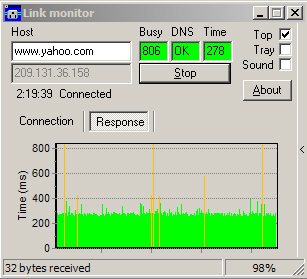
This is in a dead zone area outside the house, or so I thought. Right near a metal screen door-type thing, it picked up one bar. I’ve been using the connection for a few hours and it has been pretty stable.
Move the modem more than a few inches from the screen door and the link goes dead again.
—End Update—
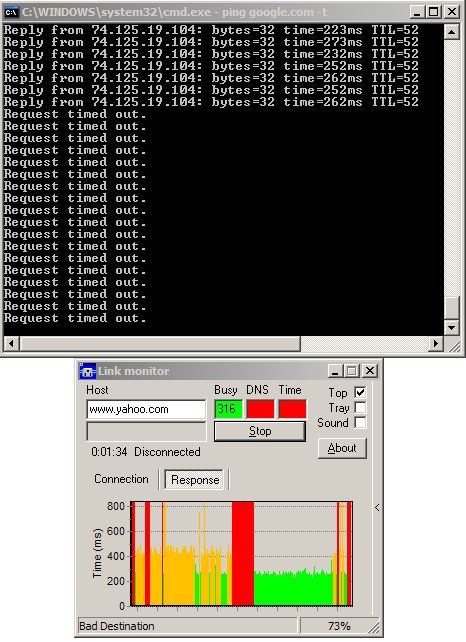
I don’t know what has happened, but over about the last two days, my Telecom XT mobile broadband connection has become pretty much unusable. The connection manager program shows that I have three out of five bars reception, like it usually does, but the link is extremely unstable and is going dead 30%-40% of the time.
Telecom assures me that nothing has changed on their side, and that this has nothing to do with the issue that took out the entire network south of Taupo a few days ago. I went all the way through their tech support hoops. They’re baffled. I’m baffled. It’s a fascinating coincidence, though.
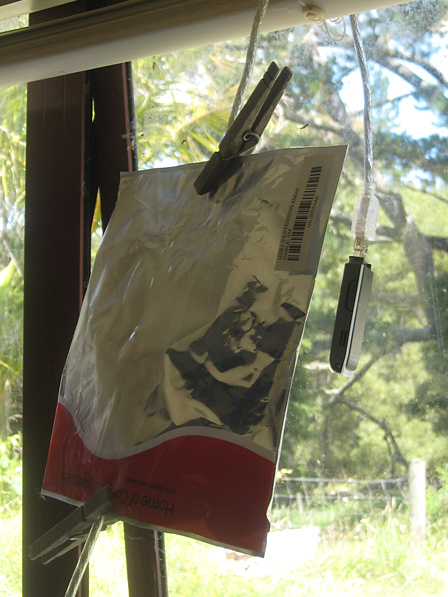
This was never a great area for reception to begin with. So, I’m hoping that this is somehow a reception/reflection issue. But now, no amount of wokfi is enough to make this thing work right. An anti static bag with clothes pegs has yielded the best result so far. Without that clipped behind the modem, no dice, nothing, zilch. Totally dead.
BagFi
I convinced Telecom to send me out a new mobile broadband modem (MF668+) at the discounted contract price; this one has an external antenna connection. When I signed up, there were no options for modems with external antenna connections. I’m going to buy a high gain antenna that’s designed for these situations. It should work fine once I install the antenna.
All of this is a roundabout way of telling you that I’m having a really hard time using the Internet right now. I run Link Monitor to let me know when the connection is working. Green is normal. Yellow means latency is above normal. Red is a dead connection, like right now.
Telecom XT Blues
So, I’ll wait a few minutes and try to post this… *sigh*
With any luck, the new gear should be here this week… But the annual Northern Hemisphere Winter Solstice Pagan Ritual (Christmas), could delay my infrastructure upgrades until the following week.
“Double the holdings? It is definitely impossible.”
December 19th, 2009Via: Shanghai Daily:
IT is getting harder for governments to buy United States Treasuries because the US’s shrinking current-account gap is reducing supply of dollars overseas, a Chinese central bank official said yesterday.
The comments by Zhu Min, deputy governor of the People’s Bank of China, referred to the overall situation globally, not specifically to China, the biggest foreign holder of US government bonds.
Chinese officials generally are very careful about commenting on the dollar and Treasuries, given that so much of its US$2.3 trillion reserves are tied to their value, and markets always watch any such comments closely for signs of any shift in how it manages its assets.
China’s State Administration of Foreign Exchange reaffirmed this month that the dollar stands secure as the anchor of the currency reserves it manages, even as the country seeks to diversify its investments.
In a discussion on the global role of the dollar, Zhu told an academic audience that it was inevitable that the dollar would continue to fall in value because Washington continued to issue more Treasuries to finance its deficit spending.
He then addressed where demand for that debt would come from.
“The United States cannot force foreign governments to increase their holdings of Treasuries,” Zhu said, according to an audio recording of his remarks. “Double the holdings? It is definitely impossible.”
“The US current account deficit is falling as residents’ savings increase, so its trade turnover is falling, which means the US is supplying fewer dollars to the rest of the world,” he added. “The world does not have so much money to buy more US Treasuries.”
China continues to see its foreign exchange reserves grow, albeit at a slower pace than in past years, due to a large trade surplus and inflows of foreign investment. They stood at US$2.3 trillion at the end of September.
FDIC Friday
December 19th, 2009Via: CNN:
Banks in six U.S. states were closed Friday, bringing the total number of failed banks this year to 140, at a cost of over $1 billion to the Federal Deposit Insurance Corporation.
Among the institutions seized by regulators was a so-called “bankers’ bank” in Illinois called Independent Bankers’ Bank (IBB), which had about 450 client banks in four U.S. states.
France: Former President Chirac Indicted for Embezzlement
December 18th, 2009Via: France24:
A drawn-out case involving claims that former French president Jacques Chirac set up fictitious jobs while he served as mayor of Paris is heading to court after a judge ordered Chirac’s indictment on embezzlement charges.




