U.S. Senator Jim Bunning on Ben Bernanke: “Your Fed has become the The Creature from Jekyll Island”
December 5th, 2009Related: The Creature from Jekyll Island by G. Edward Griffin
Gold: Down $46, Quasi Shooting Star for the Week
December 5th, 2009WARNING: This is not a recommendation to buy, sell or hold any financial instrument.
This is from Questions on Gold, November 13, 2009:
Shorter term dollar bears and gold bulls, that upper channel line is your line in the sand.
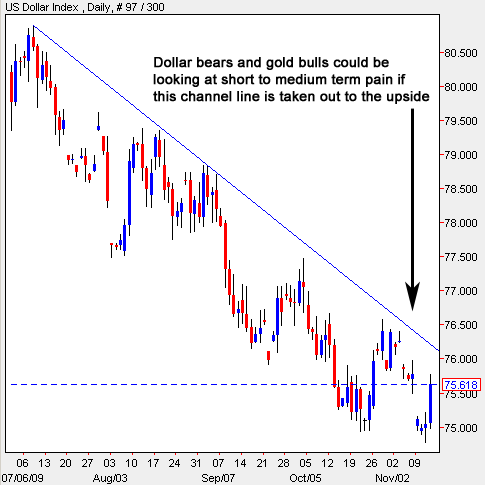
U.S. Dollar Index, Daily Interval
Short to medium outlook dollar bears and gold bulls: Stay the course as long as the downtrending channel on the USDX remains intact. Keep in mind, however, that a move up and out of the downtrending channel on the USDX above could mean substantial pain in the weeks and months ahead for dollar bears and gold bulls.
Now, let’s look at some charts with today’s closes printed. Anyone who has been following along doesn’t need this explained yet again. In case it’s not clear, here’s the summary:
There is an uptrending support line on the USDX that goes back to March 2008. The USDX is subtly indicating that it is going to bounce off of that support. On gold, we see a weekly quasi shooting star—a bearish pattern—that occurred after gold reached a new high. It is not a “text book” shooting star because there is some candle shadow below the body, indicating that bargain hunters were still buying. This bearish formation, however, must be considered along with the bullish divergence and channel breaks on the USDX.

U.S. Dollar Index Daily Interval

U.S. Dollar Index Weekly Interval

Spot Gold Weekly Interval
FCC Now Planning “All-IP” Phone Transition
December 5th, 2009Via: Ars:
The writing is on the wall for old school circuit-switched phone networks, and the world is going all-IP. Now, the FCC is gathering data to guide the next major transition of the country’s communications network.
Fat Finger: Tokyo Stock Exchange Told to Pay $121 Million in Damages
December 5th, 2009Via: BBC:
A Japanese court has ordered the Tokyo Stock Exchange (TSE) to pay 10.7bn yen ($121m; £73m) in damages for failing to stop a huge trading error in 2005.
The TSE must pay Mizuho Securities the compensation after admitting that a system fault prevented a trader from cancelling an erroneous share sale.
The trader had entered an order to sell 610,000 shares for one yen each instead of one share at 610,000 yen.
The error cost the firm 40.7bn yen. The TSE said it would consider appealing.
Google Offers Public DNS Service
December 4th, 2009Update: Some Thoughts on Google DNS
Interesting post from the CEO of DNS services company OpenDNS, who probably feels the bull’s-eye painted on his chest:
Google claims that this service is better because it has no ads or redirection. But you have to remember they are also the largest advertising and redirection company on the Internet. To think that Google’s DNS service is for the benefit of the Internet would be naive. They know there is value in controlling more of your Internet experience and I would expect them to explore that fully…
…It’s not clear that Internet users really want Google to keep control over so much more of their Internet experience than they do already — from Chrome OS at the bottom of the stack to Google Search at the top, it is becoming an end-to-end infrastructure all run by Google, the largest advertising company in the world. I prefer a heterogeneous Internet with lots of parties collaborating to make this thing work as opposed to an Internet run by one big company.
—End Update—
Update: What if DNS on my ISP sucks?
Someone mentioned that this could be helpful for people who use an ISP with crappy DNS. Ok, so if you don’t want to change ISPs pick a nearby university (public or private) type its name into a search engine along with DNS. Click around for a few seconds and you’re likely to find the DNS server addresses. I’m not saying that all of them offer public DNS, but many of them do.
—End Update—
My only commentary would be: You’d have to be out of your f*&%$#@ mind to use this.
But here’s a more balanced view, if you want it.
Via: PCWorld:
Today’s news can prompt two very different views of Google, based on the announcement of its free Google Public DNS.
In one view, Google is our best friend and a noble public servant. In the other, Google may be the darkest force on the Internet. Which is it? We all must decide.
Here’s the news: Today Google has begun offering an experimental, but stable, Public Domain Name Server (DNS), described in a Thursday post to Google’s Official Blog.
The goal is for the new DNS to increase browsing speed and improve Internet security. I have read the technical description and believe it to the extent that I have already changed the DNS at my office to point to the new Google Public DNS. It is, however, too early to tell if my browsing has become faster.
…
The downside is that Google’s Public DNS will also give the Internet giant an unparalleled look what people are doing on the Internet. It will, for example, be able to log every DNS request made by every user of its system. If that doesn’t frighten you at least a little, it perhaps ought to.
While I generally trust Google, whose response to most paranoia is, “Why would we risk our whole business to do something as stupid as that?” I am aware that many others don’t trust the company and feel they have good reasons.
We also don’t know about “passive” uses for all the data Google collects. Things we are not aware of but wouldn’t like if we knew about them. I am not accusing, just making the case that Google’s activities require careful monitoring.
Do I believe Google tries to do the right thing? Yes, but I am also one of the few people who generally trusts Microsoft and always trusts Bill Gates. The paranoids say I am a fool.
Will Update Later
December 4th, 2009We’re back home from Auckland, but all I wanted to do was watch Moon (which I highly recommend for sci-fi fans), and now it’s late/early.
Updates will resume in about 12 hours.
The Swiss and Guns
December 4th, 2009What to Do About Europe’s Secret Nukes
December 3rd, 2009Via: Time:
Is Italy capable of delivering a thermonuclear strike? Could the Belgians and the Dutch drop hydrogen bombs on enemy targets? And what about Germany — a country where fear of atomkraft is so great that the last government opposed all civilian nuclear power? Germany’s air force couldn’t possibly be training to deliver bombs 13 times more powerful than the one that destroyed Hiroshima, could it?
It is Europe’s dirty secret that the list of nuclear-capable countries extends beyond those — Britain and France — who have built their own weapons. Nuclear bombs are stored on air-force bases in Italy, Belgium, Germany and the Netherlands — and planes from each of those countries are capable of delivering them. The Federation of American Scientists believes that there are some 200 B61 thermonuclear gravity bombs scattered across these four countries. Under a NATO agreement struck during the Cold War, the bombs, which are technically owned by the U.S., can be transferred to the control of a host nation’s air force in times of conflict. Twenty years after the fall of the Berlin Wall, Dutch, Belgian, Italian and German pilots remain ready to engage in nuclear war.
Large Petroleum Products Market Participants Storing Distillates at Sea, Distorting the Demand Picture
December 3rd, 2009I like one of the comments on the source page:
“You won’t see any boats loaded with gold stuck in the ocean.”
HAR!
Via: Globe and Mail / Reuters:
Oil product tankers idling in quiet waters of the world’s oceans are unlikely to move on until well into 2010 when more refinery shutdowns could curb production and force vessels to unload.
Floating oil product volumes, comprising mostly distillates such as diesel and the heating fuel gas oil, have surged to unprecedented levels of about 100 million barrels, but refiners are still pumping out more than the world can consume.
“We see no quick solution for the floating storage issue. It might run into the third quarter of next year,” said analyst David Wech at JBC Energy, adding, “the high contango reflects the supply-demand imbalance which is most dramatic in distillates.
Banks, oil majors and trading companies with access to cheap credit are looking to reap the benefits of a market structure known as contango, where future prices are higher than the prompt, that tends to emerge in times of oversupply.
They are buying gas oil, storing it on idle tankers in sheltered parts of the English Channel, Singapore and the Mediterranean and selling it at a higher price later.
Buying for storage at sea, dubbed “floating storage demand” by physical traders, creates the illusion of consumption in the products market, and keeps profit margins for distillates positive. This in turn sends a false signal to refiners to keep churning it out.
A senior official at French oil major Total said in an interview with Reuters in November that the market will have to accept high levels of floating storage until at least the middle of next year.
While the contango on crude futures has been volatile and as slender as 3 cents in October, the spread between the front two contracts of the gas oil curve on the IntercontinentalExchange (ICE) has widened since the summer.
Crude oil volumes in floating storage are estimated at around 35 million barrels.
The prompt spread of ICE gas oil futures flipped to contango in November last year from narrow backwardation and has grown steeper.
Last month, the contango was the second highest since the latest sea storage trend began in early 2009 at an average of $10 (U.S.) a tonne.
Trade sources estimate the contango storage play will be profitable until the contango narrows to around $7 a tonne.
“Some guys with deeper pockets are still looking to put more into storage and they can keep doing so until we get to $7 a tonne,” said a London-based distillates trader.
Eventually, deep refinery run cuts to near 80 per cent in Europe and the United States could slow the build of floating storage while further refinery shutdowns and the emergence of real demand could drain them, analysts said.
“It is tough to see an end to this situation. We need to see further shutdowns of refineries,” said Petromatrix analyst Olivier Jakob.
Many refineries in Europe and the United States are already up for sale or idled because of depressed demand since the start of the global economic slowdown.
For some analysts, sea storage at present levels is so high it could meet all of the expected oil demand growth for next year.
“The current stocks afloat should meet most of next year’s demand increase, which would leave onshore stocks basically unchanged from the current record highs,” said Mr. Jakob.
“An adjustment in forward demand should be made for this amount of oil sitting idle at anchor.”
Pilot for 9/11 Flight School Considered Grave Threat to National Security
December 3rd, 2009Via: Mad Cow Productions:
A U.S. Customs Agent on duty when controversial drug pilot and “soldier of fortune” Michael Brassington attempted to re-enter the US through Fort Lauderdale International Airport in April of 2004 was instructed by a Supervisor at Immigrations & Customs Enforcement (ICE) to treat Brassington—a long-time employee and business associate of Wallace J. Hilliard, owner of the flight school that taught Mohamed Atta to fly— as a “grave threat to national security.”
…
A notation had been placed after Brassington’s name on his computer screen, Sanders said.
It provided—at long last—official confirmation of our reporting.
“Brassington had an “active lookout” for narcotics,” sander explained. “And there was the date, July 25, 2000, that he’d got caught.”
“Come to find out later, he’d been working for a 9/11 flight school owner named Wally Hilliard. But I only found that out after I discovered your website, www.madcowprod.com. Its kind of strange that the whole subject never came up while I was working down there. And I just couldn’t have imagine that this was all connected to 9/11.”
While Customs Agent Sanders was examining his narcotics record in the computer Brassington began brandishing a letter from a top official in the U.S. Dept of Homeland Security.
“I was looking at Brassington’s narcotics record on the computer,” says Sanders, still incredulous at the memory, “when he handed me a letter from Washington!”
Despite Brassington’s ongoing participation in a criminal enterprise, the letter seemed clearly designed to smooth his re-entry into the U.S.
…
“Bright was a local ICE Agent and I guess he was tracking Brassington,” said Sanders. “So I called him up, and I told him about the letter.
“He said you can just disregard the letter, and told me to ignore it. And he described Mike Brassington to me as a ‘grave threat to national security. He told me that I needed to check him, search him, and search all his passengers.”




