Dubai: Another Ponzi Scheme Collapses
January 4th, 2009Via: CBS News:
Over the years, booming oil prices helped turn Dubai into a land of opportunity and playground for the ultra rich.
But that was then and this is now. And as CBS News correspondent Sheila MacVicar reports, even Dubai is feeling the pinch of the worldwide economic crisis.
The gulf city state’s property prices went up as fast and as high as the towering buildings. But reality has suddenly intruded.
One investor said it was as if someone had thrown a switch, as the global credit crunch slammed a city that was, in effect, the world’s biggest construction site
It took just 20 years for Dubai to go from a desert outpost with a handful of office towers to a world metropolis, where one fifth of the world’s cranes operate, and property became a very hot commodity, with some people playing real estate the way others play poker.
“People were buying and flipping properties on a launch basis,” says Manesh Khadri of Century 21 Real Estate. “You launch a property and you flip it within the same day.”
Before an apartment was even built you could away with tens, or even hundreds of thousands of dollars.
Developers promised: Pay $140,000 for an unbuilt apartment, and within six months, reap a $46,000 profit. So as fast as the city expanded, investors snapped up the real estate, taking on big debt.
American Internet entrepreneur Mahmood Panjwani understands the risk of building a business
But, “I really did not know what risk was until I came here,” Panjwani says. “I mean Dubai is like Silicon Valley on steroids from a risk perspective.”
Buying real estate with little money down and lots of debt is risky indeed. Panjwani saw trouble coming and got his cash out of the market.
“There’s a lot of fear,” he said. “How low can it go down? How long will it stay down?”
Take the world’s tallest building, the Burj Dubai, which remains under construction. In the last month prices there dropped at least 50 percent.
House prices on the man-made Palm – the iconic frond-shaped island colony – down 40 percent.
A seven bedroom villa? $10 million last year, under $6 million now.
Banks aren’t lending. Projects are shelved. And the normally secretive government has had to acknowledge it has one of the highest levels of per-capita debt in the world — and not enough oil to pay for it.
“The worst is still yet to come in the sense of people losing properties” Khadri says. “That will happen.”
Of course, Dubai will come back eventually, many say, perhaps without the speculators and the insane price increases. So while the fizz might be gone, they insist, the water still sparkles.
Research Credit: ltcolonelnemo
MADOFF’S ASSETS TO BE KEPT SECRET
January 4th, 2009Via: Bloomberg:
THE US Securities and Exchange Commission, which sued Bernard Madoff last month for allegedly directing a $US50 billion ($71 billion) fraud, is to withhold public access to a list of his assets filed on Wednesday.
A federal judge ordered Madoff to provide the commission with an account of all investments, loans, lines of credit, business interests, brokerage accounts and other holdings. The court
did not authorise its public disclosure, said a commission spokesman, Andrew Calamari, who confirmed receipt of the list.
“I think one of the fears here is that much of this money may be in offshore funds,” said Professor John Coffee, of Columbia Law School, adding the commission wanted to keep the assets secret to protect them. “There is the danger that foreign regulators and foreign creditors may seek to seize that money if the names and sources are made public.”
Madoff was charged last month by federal prosecutors with directing an alleged Ponzi scheme through his New York investment firm. His lawyer, Ira Sorkin, has said Madoff’s company is co-operating with the Government.
Shortly before he was arrested, Madoff allegedly told employees that he had $US200 million to $US300 million left, according to an FBI complaint. Mr Sorkin declined to comment on the amount of Madoff’s remaining assets.
Madoff’s firm collapsed after he was arrested on December 11. He told his sons that he directed the Ponzi scheme, in which old investors are paid off with money from new ones.
The firm is in liquidation under the Securities Investor Protection Corporation.
The list of Madoff’s assets may be attractive to his investors, including hedge funds, celebrities, universities and charities, as they sue to recover their money. His advisory business could have had more than 4000 customers, investigators said.
Losses disclosed by some clients could have been inflated by gains held in their accounts with Madoff.
Yeshiva University, which had valued its holdings with Madoff at $US110 million, said this week its net investment was about $US14.5 million before inflation by “fictitious” profits.
Research Credit: Lagavulin
Oil
January 4th, 2009WARNING: This is not a recommendation to buy, sell or hold any financial instrument.
I was going to buy the United States Oil ETF on Friday, but it was sharply higher. I refuse to chase, though, so I’m going to wait for a pullback (that may or may not come).
I’ve never touched oil before, but my guess is that, in addition to pricing in demand destruction brought on by the economic collapse, oil has overshot to the downside as market participants moved to raise cash to cover losses elsewhere in the casino. Then the speculators brought their boots down and it got bloody for oil longs/peak oil snake handlers/commodity holy rollers/etc.
The trend on oil is very clear: Down. But I see a sort of blowoff negative volume situation leading into the recent low. And look at the OBV creeping back up. RSI is finally managing to unstick itself from the lower bands. Finally, the price has climbed over one of the down trending channel lines.
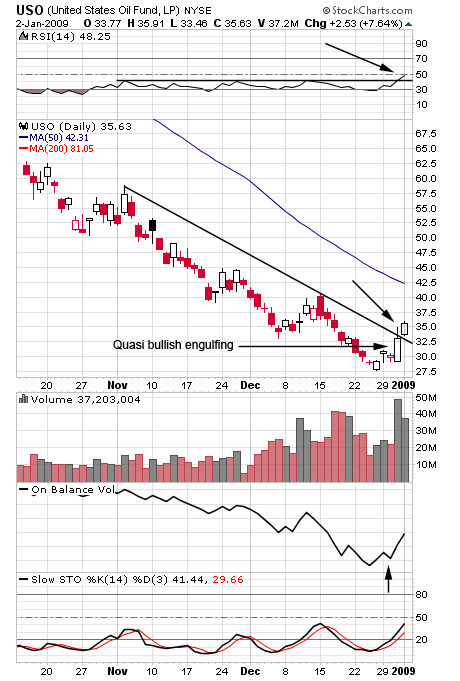
United States Oil Fund, daily interval
I almost never use fundamental analysis when considering a trade, but I am this time. Several oil infrastructure projects have been postponed or canceled due to the slide in oil prices. The collapse of production at the Cantarell field in Mexico should play a role in sending prices higher.
What really has my attention, however, is the fact that, right now, more oil is being stored on ships at sea than at any point in the last twenty years… Just waiting for higher oil prices.
This situation is begging for a false flag attack or war to help oil prices move higher.
The oil industrial complex is the second largest criminal racket in operation on the planet at this time. (Banking is the first.) How many false flag operations or wars would it take to get oil back up? I don’t know, but I’d be willing to bet that lots of crooks are thinking about it. In fact, I am going to bet money on it.
Think about it: If you had all of that oil bobbing around on the high sees, would you just let it pile up until the point at which you would have to dump it into the market, driving prices even lower?
No.
You’d get long, blow something up, blame “the terrorists,” take profit on your paper bets and sell your oil at much higher prices.
Of course, this is all theoretical and probably won’t happen, and even if it did, it would just be a coincidence anyway.
Another factor which could lead to higher oil prices is Obama’s upcoming trillion dollar clusterf*ck orgy of government spending on “recovery.” I don’t know what that’s going to entail, but it will, by definition, require a hell of a lot of oil.
Israeli Troops Launch Attack on Gaza
January 3rd, 2009Via: New York Times:
Israeli tanks and troops swept across the border into Gaza on Saturday night, opening a ground war against the militant group Hamas after a week of intense airstrikes.
U.S. MANUFACTURING DECLINES TO LOWEST LEVEL SINCE 1948
January 3rd, 2009Via: Bloomberg:
The decline in U.S. manufacturing deepened in December as demand for such products as cars, appliances and furniture reached the lowest level since at least 1948, signaling further cutbacks in factory jobs and production this year.
The Institute for Supply Management’s factory index fell to 32.4, below economists’ forecasts and the lowest level since 1980, from 36.2 the prior month. Readings less than 50 signal contraction. The group’s new-orders measure reached the lowest level on record and prices slid the most since 1949.
“Every component suggests that the weakness is going to carry over into 2009,” Mark Vitner, a senior economist at Wachovia Corp. in Charlotte, North Carolina, said in a Bloomberg Television interview. “There’s just not a whole lot of new business coming in,” and companies will have a “painful adjustment” as consumers shun spending.
Today’s figures underscore that, with private demand collapsing, manufacturers’ best hope for new business this year may be President-elect Barack Obama’s plans for an unprecedented stimulus package. Obama has pledged an investment program in roads, schools and the U.S. energy network akin to the 1950s-era interstate highway construction boom.
UK: Thefts of Food, Metal, and Petrol Increasing
January 3rd, 2009Via: Independent:
Supermarkets have been forced to tag cuts of meat because shoplifters have turned to stealing food during the credit crunch. Retailers warn that the recession has changed the pattern of crime in high street stores, with thieves switching from luxury items to basic foodstuffs.
Shops have been forced to step up security around food counters after sharp increases in the quantity of beef, chicken, bacon and cheese going missing.
Tesco, Iceland and Marks & Spencer have all reported rises in theft in their stores this year. The problem has become so acute in some areas that retailers, including Somerfield, have experimented with fitting electronic tags to expensive cuts of meat.
Over the past decade, most shoplifters have pilfered small high-value items – such as perfumes, packets of razor blades and DVDs – to fund drug habits.
Richard Dodd, spokesman for the British Retail Consortium, said: “In difficult times likes these, there is evidence that the range of people stealing expands. They are stealing a bigger range of items and going for things they want to use rather than sell.
“Retailers believe there has been an increase in theft as a result of the downturn and are tightening their security. More security staff are being taken on and the tagging of items is becoming more widespread.”
Richard Garside, director of the Centre for Crime and Justice Studies at King’s College in London, said: “If members of the public are risking prosecution to steal basic staples, that adds to the evidence that families are experiencing real hardship. It’s not just shops feeling the pinch. Their customers are too.”
Police are also reporting an increase in thefts of metal, and petrol being siphoned from cars and stolen from filling stations. Mick Giannasi, the chief constable of Gwent, said: “We’re starting to pick up crime trends associated with the economic situation. We ask ourselves where can we best put our resources. Metal thefts started to increase, so we put a response in and that had an impact in bringing it down. We’re now looking at petrol thefts using our roads policing unit.”
Research Credit: GP
UK: Flawed Accounting Method Hides True Scale of Pension Fund Losses
January 2nd, 2009Via: Guardian:
Many of Britain’s biggest companies are preparing year-end accounts that show their pension schemes moved into surplus last year despite the collapse in world markets, which wiped hundreds of billions from their assets.
The latest figures from the pensions advisers Aon Consulting show that a steep decline in the FTSE 100 over last year and a sharp drop in commercial property values has sent most final-salary schemes into crisis and pushed fund deficits to new lows. According to government figures, company pension fund deficits rose in the 12 months to November from £58bn to £155bn.
Aon Consulting warned that the figures underestimated the problem and pension funds had suffered a £226bn loss on their investments in the year to October.
However, accounting rules – which critics argue distort company pension scheme fund values – will show a rise in assets. For the top 200 companies in Britain, that will mean a £13bn surplus at the end of 2008. Aon says the top 100 firms have seen a £5bn improvement over the last year, based on current accounting rules.
Auditors must calculate deficits using the IAS19 accounting method, which assumes pension funds are invested entirely in corporate bonds and ties the value of the fund to current bond yields. Calculations under IAS19 put pension deficits at £2bn in December 2007. Figures from Aon show that a subsequent rise in bond yields turned that small deficit into a surplus of £3bn.
Marcus Hurd, of Aon, said when bond yields were low IAS19 exaggerated deficits, but now it was hiding them. In 2007, yields were 5.75% whereas last November they stood at 6.8%. He said that while a handful of schemes were heavily invested in corporate bonds, most had a mix of assets and tended to rely heavily on stockmarket investments. “They will be invested in stocks and shares, commercial property and bonds, which have all gone down in value, but the accounting rule says it is only the bond yield that counts.”
Is a Generalized Crackup Occurring in Britain? The Average Person Spends 2-1/4 Hours of Every Day Worrying
January 2nd, 2009Could this possibly be true?
Via: Reuters:
Britain is becoming a nation of worriers, according to a new survey, with the financial crisis giving people ever more reason to fret about their lives.
The average person now spends 2-1/4 hours of every day worrying — six and half years of the average life span — a figure up 30 minutes a day from last year, according to the worry index compiled by reallyworried.com, a support group.
Young adults — those aged between 16 and 24 — worry the most, and women worry substantially more than men, according to the survey of 1,400 people nationwide.
The top five concerns in 2008 were: the cost of living, energy prices, personal health, outgoings and income, and personal debt.
Job security, which last year didn’t figure in the top 25 worries, shot up to number 7 in the rankings, one notch below recession and a bigger concern than crime.
So much fretting can take a terrible toll on people’s health and their sex lives, according to the survey’s compilers.
One in five questioned said they drowned their concerns in drink, up 50 percent on last year. One in six said they now shy away from sex because of their constant fretting.
“It is alarming to learn from this research just how many people in Britain are chronic worriers,” said Phillip Hodson, a member of the British Association for Counselling and Psychotherapy.
“Worry is the central component of all anxiety disorders and most depression. It is a sign of a double difficulty — that we cannot get our problems into perspective nor take effective action to solve them.”
Welcome to Your New Job: One that Pays 30%, 50%, 70% Less than Your Old One
January 2nd, 2009According to CNN, phone service is an, “extravagance”?
The bankers and politicians who created this mess must really think that this is hilarious. As people are getting financially screwed to within an inch of their lives, the Wall Street pricks buy new homes with taxpayer bailout money and the crooked Congress gets an automatic pay raise.
What a country.
Via: CNN:
Happy New Year and welcome to your new job. One that pays 30%, 50%, 70% less than your old one.
That’s right: With more than three job seekers for every opening, more workers are having to take significant pay cuts to find employment.
“For people who have been laid off, this is obviously a buyer’s market,” said Ravin Jesuthasan, a managing principal at Towers Perrin. “We’re seeing pay levels in new positions coming down.”
In fact, 63% of unemployed workers said they would be willing to accept a job offer that pays less than their previous job, according to a recent survey conducted by the National Employment Law Project. Still, only 37% of respondents expressed high confidence in finding a job in the next four months despite being willing to make such a sacrifice.
Nearly 2 million jobs were lost in 2008 and economists say the unemployment rate, which stands at 6.7%, will continue to rise into 2010.
“People realize that this is a different environment, said Jeff Joerres, chairman and CEO of employment services firm Manpower. “People are more anxious and are willing to secure something even if it is less.”
Shaun Chedister, 30, is one of those people. Chedister was laid off from his job at Washington Mutual at the end of last year. After eight months of actively looking for work to help support his wife and four children, he accepted an offer from Ernst & Young even though the new position as an executive administrator paid less than half of what he was making before.
“My unemployment had run out, and I had to get something,” he explained.
But the adjustment to making $66,000 a year from $125,000 has been hard. “For the last four to five years I’d been making six figures,” Chedister said. “My lifestyle had been at a certain level.”
Now Chedister said he’s looking for a more affordable home. Last week one of the family’s cars was repossessed after he got behind on the payments.
“It could be worse,” he said, I could still be unemployed.”
Often the hardest part of accepting a pay cut is the change in lifestyle that goes along with it, says Manpower’s Joerres. “When you recalibrate your earnings expectations that means you have to recalibrate your lifestyle as well.”
And for those living paycheck to paycheck, that can mean having to move, sell possessions or give up everyday extravagances such as cable TV or phone service.
After Jarrod Posner, 34, was laid off from his $110,000-a-year job as a mortgage lender for D.R. Horton, he had to change careers to find employment. After months of looking he took a job as an enrollment counselor at the University of Phoenix – a position that paid $33,000.
“I was actually thankful because I was getting a job, but at the same time my wife and I realized we had to make a lot of lifestyle changes,” Posner said.
Since then, the Posners, who have two children, foreclosed on their home, moved into a rental property, downgraded from two cars to one and learned how to budget, he said. They’ve also given up their telephone and cable TV package. “All the little luxuries we don’t enjoy anymore,” he said.
Despite the dramatic downsizing that came with a 70% salary reduction, “I’m kind of happy,” Posner said. “It’s nice to know that I have pretty steady employment.”
Mexican Federal Agents Arrested in Covina
January 2nd, 2009Via: Los Angeles Times:
The residents of North Monte Verde Drive, a stretch of oak-shaded suburban calm in the Covina area, normally would feel safe knowing that two off-duty police officers were visiting the neighborhood.
Not this time. These officers were far from home — agents of the Mexican federal police — and they ended up on the wrong side of a bust, with a fortune in cash that prosecutors say was tied to narcotics trafficking.
The raid in July raised the specter that the often-brutal workings of the Mexican drug trade have reached deep into Southern California. But five months later, the fuller background of the case remains a mystery.
“We all just sort of went, ‘Yikes!’ ” Susan Wood, a longtime Monte Verde resident, said of the possible link between her neighborhood and the mayhem a country away. “This isn’t a drug-trafficky area at all.”
No connections to Mexican drug syndicates have been alleged in the Covina case, and defense attorneys say there are none. But speculation has been fueled by the fact that authorities have been unusually tight-lipped about the circumstances surrounding the arrests and the direction of their investigation.
One of the Mexican suspects, a federal police commander based in the border city of Mexicali, is believed to have been the target of an assassination attempt there last summer, when gunmen shot up his car and killed two of his aides.
The commander, Carlos Cedano Filippini, 35, was not in the vehicle at the time. Mexican media reported that Cedano abandoned his job after the shooting.
He was the second Mexican federal officer arrested in a Southern California drug probe in three weeks. Earlier in July, agents from the state Bureau of Narcotic Enforcement arrested Omar Lugo and another man in Riverside County on suspicion of transporting 154 pounds of cocaine in their car. A judge later ordered the two suspects released, ruling in favor of defense attorneys who said officers had lacked probable cause to search the car, said Orlando Lopez, a special agent in charge for the bureau. That ruling is under appeal and an investigation is continuing, Lopez said.
Narcotics-related violence in Mexico claimed more than 5,000 lives last year, as rival drug cartels battle over smuggling routes and beleaguered government forces press a crackdown. The spoils of the carnage are narcotics bound for the United States — Southern California is a top trans-shipment point — but there have been few outward signs here of cartel operations and attendant bloodshed.
Like Wood, other Monte Verde residents said they know nothing about the case beyond what they had learned in news reports, and very little about the occupants of the spacious home where the Mexicans were taken into custody. Some residents were fearful of being quoted by name.
“It’s like a TV show,” a neighbor said of the case.
Arrested along with the agents were two U.S. citizens, siblings Hector and Julissa Lopez. Their parents, who live in the 4,800-square-foot house at the end of a long driveway, have not been implicated, authorities say.
Julissa Lopez, 36, is the common-law wife of Cedano, the commander from Mexico’s Federal Investigative Agency, that nation’s equivalent of the FBI. Also charged is one of Cedano’s officers, Victor M. Juarez, 36.
The four have pleaded not guilty and are awaiting trial in Los Angeles County Superior Court on charges of possessing more than $630,000 as part of an alleged drug transaction. If convicted, they face a maximum of four years in prison.
A stakeout team of narcotics investigators stormed the house and spotted the defendants walking out of a bedroom, according to prosecutors. Seized along with the suitcase full of cash were a money-counting machine, other bundles of currency, heat-sealable packets for the bills, and lists of payments and debts for narcotics, authorities say. Defense attorneys have said the lists were innocent jottings of family activities.
No drugs were found, but a police dog trained to sniff out narcotics residue showed a positive response to the suitcase and to other items in the bedroom, investigators say.
A preliminary hearing provided scant insight into the probe, with testimony focusing mainly on details of the surveillance and search of the house.
Deputy Dist. Atty. Oscar Plascencia, who is prosecuting the case, declined to comment, as did officials of the U.S. Drug Enforcement Administration and the Los Angeles Police Department, which are conducting the investigation. Shortly after the arrests, a DEA spokeswoman said the stakeout team had not expected to encounter Mexican agents at the house, but she did not elaborate.
Mexican authorities did not return phone calls.
The court record already could fill a wheelbarrow. Defense attorneys have filed lengthy motions seeking to dismiss the charges on grounds that there was no probable cause to believe a crime had been committed. They also challenged the bail amounts — originally $2 million — and got them reduced.
In addition, the defense has filed a writ with the state appeals court asking that the case be thrown out because investigators have refused to answer questions about what led them to the house and why they had concluded that drug dealing was involved.
“Their case is based on guesswork, not evidence,” said Mark Werksman, an attorney for Julissa Lopez. “All they’ve got is a bunch of money. They’re trying to make a mountain out of a molehill.”
Investigators say they saw Hector Lopez and Juarez arrive at the home with bags of what appeared to be bricks of drugs or cash.
Later, they say, they stopped a woman who drove away from the house with a suspicious parcel — she has not been charged — and they discovered that it contained only meat, which Werksman said was for a restaurant the Lopez family owns. The investigators say they then entered the house to make the arrests.
To date, Hector Lopez, 33, is the lone defendant to be released on bail. Attempts to reach him for comment were unsuccessful, and his attorney did not return calls.
A friend of Julissa Lopez, Heidy Gallegos, submitted a letter to the court as a character reference. In an interview, she said Lopez’s arrest was “very shocking. . . . It’s scary.”
Gallegos, a nurse, said she did not believe Lopez could do anything illegal. She said Lopez helped out at her father’s tire business but otherwise spent all of her time with the three children she has with Cedano.
“She’s your typical soccer mom — very loving. Her priority is her kids,” said Gallegos, adding that she met Lopez when she was her patient more than a year ago.
Lopez would talk about the strain of having a husband who worked across the border, Gallegos recounted.
“All she would tell me is that she would miss him, because he had to travel back and forth with his job,” Gallegos said. “I remember the kids saying how much they missed their dad, how much they loved their dad.”
Gallegos also recalled the day that Lopez told her about the attempt on Cedano’s life: “I thought, ‘Wow!’ I was amazed.”
An attorney for Cedano has said his client had to flee to the United States to escape the would-be assassins. It is not clear what prompted the shooting in Mexicali.
Neighbors on Monte Verde, which runs along the Covina-West Covina line, told of having no inkling of trouble at the Lopez home, whose wrought-iron driveway gate has been adorned with Christmas decorations.
“Everybody was surprised,” said one neighbor who resides on the same side of the street, where old horse corrals share sprawling lots with newer homes. “We have no problems here.”
Virginia Yeager lives in a house that her husband’s family built in 1932. She said the neighborhood had changed a lot over the decades, with newcomers from Latin America and Asia moving in. She said burglaries are a worry, but there has been nothing to suggest the faintest echo of a distant drug war.
“I haven’t heard about that up here,” Yeager said. “You just kind of keep in your own little enclave.”




