New Law in Russia Ends Jury Trials for ‘Crimes Against State’
January 2nd, 2009Via: Los Angeles Times:
President Dmitry Medvedev signs the controversial measure with little publicity. A pending Putin-backed law widens the definition of treason. Government critics fear the stage is set for a crackdown.
Russian President Dmitry Medvedev paused in the last, quiet hours of a dying year to sign into law a controversial bill that eliminates jury trials for “crimes against the state,” a move that lawyers and human rights groups fear will be the start of a dangerous exertion of Kremlin control over government critics.
The law does away with jury trials for a variety of offenses, leaving people accused of treason, revolt, sabotage, espionage or terrorism at the mercy of three judges rather than a panel of peers. Critics say the law is dangerous because judges in Russia are vulnerable to manipulation and intimidation by the government.
A parallel piece of legislation, pushed by Prime Minister Vladimir Putin and still awaiting discussion in parliament, seeks to expand the legal definition of treason to such a degree that observers fear that anybody who criticizes the government could be rounded up by police — and, because of the law signed Wednesday, tried without a jury.
Human rights groups and lawyers have warned that the changes to Russia’s criminal code, largely undiscussed in the state media, would allow the government to crack down on any whispers of dissent. The changes also seek a stronger hand for the FSB, the modern incarnation of the Soviet KGB, by giving the state wider latitude in cases that fall under intelligence agency rather than police jurisdiction. Some critics point to the days of dictator Josef Stalin as a comparable legal structure.
“It’s a preparation for terror, although not the grand terror of the 1930s,” said Andrei Illarionov, a fellow at Washington’s Cato Institute and a former economic advisor to Putin. “They are much smarter now. They are preparing some kind of selective terror against those who are courageous enough to speak up.”
The purpose, many observers agree, is not only to give the government greater tools in cracking down, but also to send out tremors of fear.
“Not that they necessarily will go ahead and do it, but they are threatening us very, very seriously that they can do it and are ready to do it,” said Lev Ponomaryov, leader of the For Human Rights movement. “They want to have the legitimate possibility to call all opposition people enemies of the state.”
Medvedev’s last-minute signing had all the trademarks of a pre-holiday news dump engineered to generate the least possible media coverage. New Year’s Eve is the biggest holiday of the year in Russia, and even those watching the news were distracted by the failing negotiations over shipments of Russian gas to Ukraine. The law was announced by a single sentence on Interfax.
Human rights and civil society groups have banded together to speak out against the move toward a broader definition of treason, which will be debated in a parliament dominated by Putin’s United Russia party.
The government has framed the jury law as an anti-terrorism measure, but legal experts say its implications are broader and more ominous — especially if the treason changes go through.
A chilling effect had begun to creep into the legal system even before the bill was signed into law, critics said. Svetlana Gannushkina, a human rights lawyer and chairwoman of Russia’s Civic Assistance committee, gave the example of a man from the Dagestan region who is represented by her organization. A jury found him not guilty of sabotage more than a year ago, and Russia’s Supreme Court backed the verdict, rejecting an appeal by prosecutors. The man was cleared — until a few weeks ago.
“And now what’s happening? When this campaign to change the law began, the prosecutor’s office immediately filed a new appeal,” Gannushkina said. “And this time, the Supreme Court cancels the decision of the trial and the verdict of the jury, and the whole process starts all over again.”
“They call it ‘managing the signals,’ ” she said. “You don’t even need to pass a decision anymore, you just need to send the signals.”
In the last week, there had been a faint hope among human rights organizations that Medvedev might refuse to sign the bill. The Russian president is a lawyer who was once seen as more moderate than Putin. He campaigned on promises to uphold the rule of law in the country.
“I’m convinced that Medvedev himself understands quite well that if he signs the law on jury trials, he crosses out his own legal career,” Ponomaryov said in an interview hours before the bill became law.
“Finally, without any questions or suspicions, he becomes an outright shadow of Mr. Putin.”
Rising Desperation as China’s Exports Drop
January 2nd, 2009Maybe the Fed will bailout China? Oh, hmm, uhh… Wait, it’s supposed to be the other way around.
Via: IHT:
At the docks here, the stacks of shipping containers that used to loom above the highway overpass are gone. Logistics managers say they negotiate deeper discounts every week on ships that are leaving half empty.
In nearby Guangdong Province, so many factories are closing without paying employees that some workers are resigning pre-emptively and demanding immediate pay before their employers go bankrupt.
In Sichuan and other interior provinces, municipal officials are desperately searching for ways to provide jobs for millions of out-of-work migrant laborers whose families no longer need them for farming.
Those are the effects of millions of Americans’ cutting their spending.
American retailers, after suffering a dismal holiday shopping season, are delaying payment for Chinese goods 90 or even 120 days after shipping, in contrast to the usual 30 to 45 days, requiring their suppliers to try to borrow more money to cover the difference. Some Chinese suppliers who cannot raise the money – many already operate on thin margins – are going out of business.
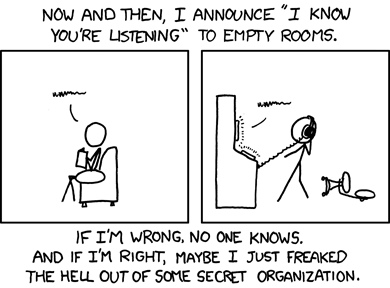
I Know You’re Listening
January 2nd, 2009hehe
Via: xkcd:
UK: Private Firm May Track All Email and Calls
January 2nd, 2009Via: Guardian:
The private sector will be asked to manage and run a communications database that will keep track of everyone’s calls, emails, texts and internet use under a key option contained in a consultation paper to be published next month by Jacqui Smith, the home secretary.
A cabinet decision to put the management of the multibillion pound database of all UK communications traffic into private hands would be accompanied by tougher legal safeguards to guarantee against leaks and accidental data losses.
But in his strongest criticism yet of the superdatabase, Sir Ken Macdonald, the former director of public prosecutions, who has firsthand experience of working with intelligence and law enforcement agencies, told the Guardian such assurances would prove worthless in the long run and warned it would prove a “hellhouse” of personal private information.
“Authorisations for access might be written into statute. The most senior ministers and officials might be designated as scrutineers. But none of this means anything,” said Macdonald. “All history tells us that reassurances like these are worthless in the long run. In the first security crisis the locks would loosen.”
The home secretary postponed the introduction of legislation to set up the superdatabase in October and instead said she would publish a consultation paper in the new year setting out the proposal and the safeguards needed to protect civil liberties. She has emphasised that communications data, which gives the police the identity and location of the caller, texter or web surfer but not the content, has been used as important evidence in 95% of serious crime cases and almost all security service operations since 2004 including the Soham and 21/7 bombing cases.
Icelandic TV Program Featuring PM Forced Off Air
January 2nd, 2009Via: AP:
A nationally televised meeting between Iceland’s prime minister and other political leaders was forced off the air Wednesday night when angry protesters disrupted the broadcast.
For more than two decades, the leaders of Iceland’s political parties have met every New Year’s Eve over champagne and spiced herring to talk about the year ahead on Iceland’s Channel 2 television.
But this year’s show with Prime Minister Geir Haarde was cut short 45 minutes into the program when a torch-wielding crowd stormed Reykjavik’s Hotel Borg in an attempt to get to the studio.
Protesters inside and outside the hotel clashed with police, who fired pepper spray to disperse the 500-strong crowd. Some demonstrators threw water balloons, while others tossed firecrackers.
At one point, the broadcaster’s television cables caught fire, interrupting the live broadcast. The program cut to commercials, followed by an announcement that Channel 2’s equipment had been damaged and the show would be suspended.
Russia Says It Will Halt Delivery of Natural Gas to Ukraine
January 1st, 2009Via: Washington Post:
Russia said Wednesday night that it planned to suspend delivery of natural gas to Ukraine on Thursday morning after negotiations to resolve a politically tinged dispute over prices collapsed without an agreement.
A cutoff of fuel shipments to Ukraine could have a ripple effect across Europe, because Russia supplies a quarter of the gas that the continent uses, and most of it is delivered through Ukrainian pipelines.
Russia briefly followed through on a similar threat in 2006. Fuel shortages resulted as far away as Italy, and concerns grew about Europe’s dependence on energy controlled by the Kremlin.
The current dispute centers on Russia’s desire to charge higher prices for gas next year and collect more than $2 billion in debts run up by Ukraine for gas this winter. But as in previous years, the commercial issues have been complicated by Moscow’s tense relations with Ukraine’s fractured, pro-Western government.
Alexei Miller, chief executive of Gazprom, Russia’s state-controlled gas monopoly, announced the collapse of talks and said the company planned to halt supplies for Ukraine at 10 a.m.
ad_icon
“All responsibility for the situation rests on the Ukrainian side,” he said.
Gazprom warned two weeks ago that it would suspend gas supplies if Ukraine failed to pay off its debts and sign a contract for next year’s deliveries by midnight Wednesday. As the deadline approached, Miller said Ukraine had met neither requirement.
Research Credit: Lagavulin
Nationalization of U.S. Auto and Other Industries Will Expand
January 1st, 2009Via: Bloomberg:
The U.S. Treasury drafted broad guidelines for aid to the auto industry that would let officials provide funds to any company they deem important to making or financing cars.
With today’s announcement, the Treasury is giving itself room to provide money from the Troubled Asset Relief Program beyond loans already committed to General Motors Corp., GMAC LLC and Chrysler LLC.
That’s consistent with analysts’ speculation yesterday that suppliers, such as GM’s bankrupt former parts unit Delphi Corp., might be eligible for assistance. The guidelines may encourage more guessing on what companies and industries are next, said Vincent Reinhart, resident scholar at the American Enterprise Institute in Washington.
Officials “much prefer discretion, and so they would view the statement as being constructively ambiguous,” Reinhart said. “It’s appropriate that they end the year the way they spent most of it — that is, adding uncertainty into an environment in which there’s a lot of uncertainty.”
GM reached an agreement on the terms of the loans today and received its first payment of $4 billion, according to statements from the automaker and the Treasury. The government is still working on the loan to Chrysler and is “committed to closing it on a timeline that will meet near-term funding needs,” said Brookly McLaughlin, a Treasury spokeswoman, in an e-mail.
Slippery Slope
The guidelines don’t bind the government, so the lack of specifics gives President-elect Barack Obama plenty of leeway to decide who succeeds and fails when he takes office in three weeks. The bailout was originally designed to buy assets from banks and has instead become a fund for Treasury to prop up lenders, insurers, carmakers, auto-finance companies, and now, any firm that may be important to those industries.
“The further you go, the slipperier the slope becomes, the more you open the door to anyone who says, ‘Look, my firm is in trouble, I need help too,’” said Lyle Gramley, a former Federal Reserve governor and now a Washington-based senior economic adviser for Stanford Group Co. “We don’t want to go any further down that road than we absolutely have to.”
The Treasury already has provided $6 billion in aid to GMAC, the financing arm of GM, and up to $17.4 billion in financing for GM and Chrysler, using funds from the $700 billion bank-rescue package.
Fails: Bond Dealers, Hedge Funds Will Face Penalty for Failed Trades
January 1st, 2009This is THE core process that animates the entire zombie money system… I’m at a bit of a loss to think of applicable analogies that might describe the failure of this mechanism.
Have you ever seen a top fuel dragster explode at maximum throttle? That’s my best guess.
The Spice must flow.
Via: Bloomberg:
Bond dealers and hedge funds that fail to complete trades in Treasury securities face a penalty of as much as 3 percent on the proceeds of transactions, according to a Federal Reserve-backed industry code to be implemented in the next six months.
The plan, which strengthens official oversight of trading, will be unveiled as soon as Jan. 5, said Thomas Wipf, chairman of the Treasury Market Practices Group and the head of institutional securities group financing at Morgan Stanley in New York.
“It seems quite obvious that the Fed and Treasury cannot and will not accept the status quo for much longer,” Wipf said in an interview.
Demand for Treasuries is so great that investors are lending cash for next to nothing to obtain the securities as collateral through repurchase agreements, or so-called repos. The problem is market participants haven’t always delivered the bonds, causing “fails” to exceed $5 trillion at their peak, according to the New York Fed.
Because the penalties will be imposed across the government debt market, unregulated investors like hedge funds will be held to the same standard as banks and bond dealers. Failures impair trading in a range of debt markets, exacerbating the worst credit crisis in 70 years. The Treasury Department needs to keep the bond market working smoothly to meet the government’s financing needs, which may reach $2 trillion next year, according to Goldman Sachs Group Inc. economists.
Rates Near Zero
The Fed this month lowered its target rate for overnight loans between banks to between zero and 0.25 percent. Rates on repos in the market for borrowing and lending government debt opened at 0.15 percent today for general collateral. Securities that can be borrowed at interest rates close to the Fed’s target rate are called general collateral.
“The fact that participants can choose to fail when low rates distort the incentives is unacceptable,” Wipf said.
The Treasury Market Practices Group, which the New York Fed helped assemble in 2007, includes managers, lawyers and compliance officers from bond dealers, banks and institutional investors.
Treasury Department and Fed officials take part in its discussions. The Fixed-Income Clearing Corp., a unit of the New York-based Depository Trust & Clearing Corp. that nets and settles government securities trades among bond dealers, will help enforce the penalties.
Impact of Low Rates
With interest rates so low, bond market participants have less incentive to solve settlement problems because they’re forgoing less return than usual on a failed trade.
The Practices Group, which released a draft of the guidelines in November, will also address margin requirements and conditions that would require cash settlement of failed trades. The recommendations also deal with trade netting, a method of consolidating trades that is an important part of untangling unsettled transactions.
“We appreciate the new policies and guidelines,” Treasury Assistant Secretary Karthik Ramanathan said in an e-mail to Bloomberg News on Dec. 29. When failed trades surged to a record in October, he put bond markets on notice that the Treasury would step in unless the industry took quick action.
“We clearly stated that private sector participants should take additional steps from a monitoring, compliance and supervisory perspective to ensure that settlement fails do not reach levels that impact financing markets,” Ramanathan said.
Lehman Aftermath
Treasury officials have voiced concern about failed trades since at least 2003. Fails climbed in the weeks following the Sept. 15 collapse of Lehman Brothers Holdings Inc. as demand for the relative safety of Treasuries increased.
Failures to deliver or receive securities rose to a record $5.311 trillion in the week ended Oct. 22. While the amount fell to $891 billion by Dec. 17, that’s still above the average of $165 billion before credit markets seized up in August of last year, according to Fed data dating to 1990.
“This is one of those issues that festered a while,” said Dino Kos, managing director at Portales Partners LLC, New York, and the former manager of open market operations at the New York Fed. “It’s time to stop dithering and get on with it.”
“Interest rates are essentially zero, and they’re going to stay here for a really long time,” Kos said. “Market efficiency will degrade with time if this situation is not addressed.”
Volumes Decline
Primary dealers’ average daily trading volume fell to $356.4 billion in the week ended Dec. 17, the smallest amount of government securities changing hands in about a year, according to Bloomberg data.
The Fixed-Income Clearing Corp. told customers last week that it expects to adopt the new policies in the second quarter of next year. Such a move would require approval by its regulator, the Securities and Exchange Commission.
FICC’s step puts dealers on the hook for all failed trades, giving them an incentive to pass the charges through to investors. In October, when fails peaked, members would have received net penalties of $110 million, with $14.8 million the biggest charge to a single firm, FICC said.
“A member will be responsible for the fails charge regardless of whether the fail to deliver was ultimately caused by the member’s non-FICC member counterparty,” the clearing group said in a note to members.
Hedge funds say they’re already affected by failed trades, noting fewer opportunities to trade with foreign investors reluctant to lend securities while fails are high.
“It’s a counterparty risk they just don’t want to take,” said Mark Spindel, chief portfolio manager at Potomac River Capital LLC, a Washington-based hedge fund that trades and invests in Treasuries.
Hedge funds doubled their share of U.S. bond trading to 30 percent in the 12 months through April 2007, according to the most recent data from Greenwich, Connecticut-based research firm Greenwich Associates.
SEC’s Top Enforcement Accountant Joins Private Firm
January 1st, 2009What did she put on her CV?
“Ignored multiple warnings that Bernard Madoff was a swindler”???
“On my watch, the largest investment scam in the history of the world went undetected”???
Via: Reuters:
The top enforcement accountant at the U.S. Securities and Exchange Commission will leave the agency in January to become a managing director at business advisory firm AlixPartners LLP.
Susan Markel, who has worked in the SEC’s enforcement division since 1994, will join the corporate investigations unit of AlixPartners, which specializes in corporate turnarounds, litigation consulting and forensic accounting services.
AlixPartners is also involved in helping locate funds and investigate the investment firm of confessed swindler Bernard Madoff, a lawyer for the trustee overseeing the liquidation said at a federal bankruptcy court hearing in New York on Tuesday. Madoff is accused of defrauding wealthy investors, banks and charities around the world of an estimated $50 billion.
Markel’s work at the SEC included enforcement actions against Xerox and six senior executives, WorldCom and Cardinal Health.
U.S. Stocks Suffer Worst Year Since Great Depression
January 1st, 2009Yeah, well, not quite, “No one.”
* snort *
Via: Financial Times:
The worst annual performance for Wall Street stocks since the Great Depression ended with a modest rally on the final day of trading as the Federal Reserve pushed ahead with its plan to buy mortgage-backed securities.
The central bank’s plan to buy up to $500bn of mortgage bonds by the middle of 2009 helped spur a 1.4 per cent gain on the day for the S&P, which finished 2008 at 903.25.
…
For the year, the S&P 500 dropped 38.5 per cent, marking its worst run since a marginally higher drop of 38.6 per cent in 1937. The Dow lost 33.8 per cent, its worst annual decline since the index fell 52.7 per cent in 1931.
“It was beyond most people’s comprehension that such a thing could happen,” said Marc Pado, chief market strategist at Cantor Fitzgerald. “No one thought the short-term could be this destructive.”




