Bailout Could Deepen Crisis; Firms Are Already Insolvent and Won’t Be Able to Keep Hiding It
September 25th, 2008That’s why Americans have to pay premium prices for this garbage.
Via: Washington Post:
The director of the Congressional Budget Office said yesterday that the proposed Wall Street bailout could actually worsen the current financial crisis.
During testimony before the House Budget Committee, Peter R. Orszag — Congress’s top bookkeeper — said the bailout could expose the way companies are stowing toxic assets on their books, leading to greater problems.
“Ironically, the intervention could even trigger additional failures of large institutions, because some institutions may be carrying troubled assets on their books at inflated values,” Orszag said in his testimony. “Establishing clearer prices might reveal those institutions to be insolvent.”
In an interview later yesterday, Orszag explained using the following example: Suppose a company has Asset X, whose value is recorded on the books as $100. Because of the current economic decline, Asset X’s real value has dropped to $50. If the company takes part in the government bailout and sells Asset X for $50, the company has to report a $50 loss on its books. On a scale of millions of dollars, such write-downs could ruin a company.
Such companies “look solvent today only because it’s kind of hidden,” Orszag said. “They actually are insolvent” already, he said.
FDIC May Need $150 Billion Bailout as Local Bank Failures Mount
September 25th, 2008Via: Bloomberg:
By the end of 2009, about 100 U.S. banks with collective assets of more than $800 billion will fail, predicts Christopher Whalen, managing director of Institutional Risk Analytics, a Torrance, California-based firm that sells its analysis of FDIC data to investors.
“It’s not going to be Armageddon,” says Mark Vaughan, an economist and assistant vice president for banking supervision and regulation at the Federal Reserve Bank of Richmond, Virginia. “But it’s going to be bad.”
FDIC’s Secret List
The FDIC knows which banks are at risk; it has a watch list with 117 institutions. The agency won’t disclose their names because doing so could cause depositors to panic and pull out all of their funds.
It won’t take many more failures before the FDIC itself runs out of money. The agency had $45.2 billion in its coffers as of June 30, far short of the $200 billion Whalen says it will need to pay claims by the end of next year. The U.S. Treasury will almost certainly come to the rescue.
Regardless of who wins control of the White House and Congress in November, no politician is likely to vote in favor of leaving federally insured depositors out in the cold.
A taxpayer bailout of the FDIC would come on the heels of intervention by the U.S. Treasury Department and Federal Reserve to save investment bank Bear Stearns Cos., mortgage giants Fannie Mae and Freddie Mac and the world’s largest insurer, American International Group Inc.
Feds Give Customs Agents Free Hand to Seize Travelers’ Documents
September 25th, 2008Via: San Francisco Chronicle:
The Bush administration has overturned a 22-year-old policy and now allows customs agents to seize, read and copy documents from travelers at airports and borders without suspicion of wrongdoing, civil rights lawyers in San Francisco said Tuesday in releasing records obtained in a lawsuit.
The records also indicate that the government gives customs agents unlimited authority to question travelers about their religious beliefs and political opinions, said lawyers from the Asian Law Caucus and the Electronic Frontier Foundation. They said they had asked the Department of Homeland Security for details of any policy that would guide or limit such questioning and received no reply.
Research Credit: Pookie
China Banks Told to Halt Lending to U.S. Banks
September 25th, 2008Update: China Denies Report It’s Banned Lending to U.S. Banks
Some weird financial ripples from China in the last couple of days…
Via: Reuters:
Chinese regulators have told domestic banks to stop interbank lending to U.S. financial institutions to prevent possible losses during the financial crisis, the South China Morning Post reported on Thursday.
The Hong Kong newspaper cited unidentified industry sources as saying the instruction from the China Banking Regulatory Commission (CBRC) applied to interbank lending of all currencies to U.S. banks but not to banks from other countries.
“The decree appears to be Beijing’s first attempt to erect defences against the deepening U.S. financial meltdown after the mainland’s major lenders reported billions of U.S. dollars in exposure to the credit crisis,” the SCMP said.
A spokesman for the CBRC had no immediate comment.
Research Credit: EB
Cryptogon Readers Sign Up for Hosting with BlueHost
September 25th, 2008Thanks to the owners of the following sites for signing up for hosting with BlueHost:
Cryptogon Readers Send Contributions
September 25th, 2008Thank you.
AM $25
MW $20
Eileen $40
Eileen $40 Farmlet
NH $25
TB $20
Country’s Top Chevrolet Dealer Closes
September 25th, 2008Via: Auto Channel:
According to Automotive News’ Chrissie Thompson, Bill Heard Enterprises, the country’s top Chevrolet dealer group, is closing the doors at all of its 13 dealerships at the end of business today, according to a person with knowledge of the situation.
The company notified the stores’ general managers at 2 p.m. today, the source said, who spoke anonymously because he was not authorized to speak.
High fuel prices, cancelled floorplanning from GMAC Financial Services, a reliance on trucks and SUVs, a soft national economy and struggles in local markets had troubled the company, which on Sept. 12 closed its store in Scottsdale, Ariz.
In the end, the company could not raise operating capital and could not finance its floorplan, the source said. Company officials have discussed closing the company since Friday, the source said.
Bill Heard Enterprises, of Columbus, Ga., ranks No. 13 on the Automotive News list of the top 125 U.S. dealership groups, with 2007 group revenue of $2.13 billion.
Rumors Touch Off Bank Run in Hong Kong
September 24th, 2008Via: Telegraph:
Panicked customers queued to withdraw their savings from branches of the Bank of East Asia in Hong Kong as rumours circulated that the bank was facing financial problems, agencies report.
The rumours were categorically denied by the bank’s management, which nevertheless had to extend business hours by 30 minutes to cope with the queues of anxious customers.
The Bank of East Asia (BEA), owned by one of Hong Kong’s wealthiest families, blamed “malicious rumours” that it said had been circulating in the market since Monday and questioned the bank’s financial stability.
The bank, Hong Kong’s third-largest lender, said it had asked police to investigate. The shares fell 11pc.
“The management of BEA hereby states in the strongest possible terms that such rumours have no basis in fact,” BEA said in an e-mailed statement. “The bank’s financial position is sound and stable.”
Hong Kong’s central bank said it would provide liquidity to Bank of East Asia if necessary and reiterated that the bank and the city’s banking system were sound.
“I can confirm categorically that these rumours are unfounded,” Joseph Yam, Chief Executive of the Hong Kong Monetary Authority, told reporters, referring to rumours about Bank of East Asia’s financial stability.
“The banking system of Hong Kong is very robust,” he added.
The BEA’s statement said the bank had assets of more than $50bn (£27bn) in June and its capital adequacy ratio was 14.6pc – a level it described as “well above the international required level”.
It said the bank’s total exposure to the collapsed US investment bank Lehman Brothers and American International Group, the world’s largest insurer that was bailed out last week, was HK$422.8m (£29m) and HK49.9m, respectively.
The assurance did little to calm the bank’s customers, however, who feared the bank might be another casualty of the global credit crunch and flocked to its 130 city branches to withdraw money.
“We’re a little bit concerned,” said Sonny Hsu, a Hong Kong-based analyst at Fitch Ratings, told Bloomberg. “We’ll keep an eye on what’s going on. If you just look at the numbers, I think the bank is financially still sound.”
Bernanke: Not Only Should Taxpayers Buy the Toxic Waste, They Should Pay Premium Prices for It
September 24th, 2008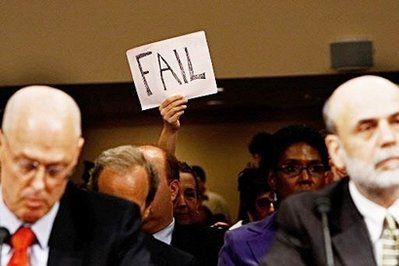
In a sane world, these monsters would be torn limb from limb and shredded into maggot food—a role in which they could actually do some good.
Drill holes around the base of a bucket. Place some banker parts in the bucket with a bit of straw and hang it a couple of feet above your chickens. After a few days (during warm weather), the maggots will spill out onto the ground. The chickens will gather below the bucket, waiting for the protein packed morsels to fall from above.
Of course, I’m not actually suggesting that people should kill bankers and turn them into maggot food.
The stench would be overpowering. And that’s before the maggots could do their handy work.
Via: AP:
Federal Reserve Chairman Ben Bernanke told Congress Tuesday the government should pay more than “fire-sale” prices for the toxic assets it would acquire under a proposed $700 billion bailout plan. That could mean both higher initial costs for taxpayers and reduced returns when the assets are later resold.
Bernanke’s comment was the first indication of how he and Treasury Secretary Henry Paulson are thinking about formulating the rescue plan’s medicine in a way that doesn’t kill the patients. Requiring banks and other financial institutions to sell troubled loans and other assets anywhere close to recent sales prices of only a few cents on the dollar could wipe out the net worth of many and lead to a new wave of bank failures.
The Fed chairman said he favors buying the assets based on their “hold-to-maturity” value, which would require an estimate to be made of what each security will eventually be worth as payments come in over the years.
“If the Treasury bids for and then buys assets at a price close to the hold-to-maturity price, there will be substantial benefits,” Bernanke told the Senate Banking Committee. “First, banks will have a basis for valuing those assets and will not have to use fire-sale prices. Their capital will not be unreasonably marked down.”
FBI Investigating Companies at Heart of Meltdown
September 24th, 2008Things started to get interesting when They sent a memo to all employees on what to say to anyone who presented themselves as auditors or investigators. We were to refer them to some flunkie.
I thought, “Oh goodie, we’re going to get raided by a three-letter agency and guys wearing guns and blue wind-breakers are going to wheel the servers out on dollies!
Don’t hold your breath, waiting for any meaningful prosecutions to come from this.
Via: IHT:
The FBI is investigating four major U.S. financial institutions whose collapse helped trigger a $700 billion bailout plan by the Bush administration, The Associated Press has learned.
Two law enforcement officials said Tuesday the FBI is looking at potential fraud by mortgage finance giants Fannie Mae and Freddie Mac, and insurer American International Group Inc. Additionally, a senior law enforcement official said Lehman Brothers Holdings Inc. also is under investigation.
The inquiries will focus on the financial institutions and the individuals that ran them, the senior law enforcement official said.
The law enforcement officials spoke on condition of anonymity because the investigations are ongoing and are in the very early stages.
Officials said the new inquiries bring to 26 the number of corporate lenders under investigation over the past year.




