Energy Pipeline That Supplies West Threatened by Georgia Conflict
August 9th, 2008Via: Times:
The conflict that has erupted in the Caucasus has set alarm bells ringing because of Georgia’s pivotal role in the global energy market.
Georgia has no significant oil or gas reserves of its own but it is a key transit point for oil from the Caspian and central Asia destined for Europe and the US.
Crucially, it is the only practical route from this increasingly important producer region that avoids both Russia and Iran.
The 1,770km (1,100 miles) Baku-Tbilisi-Ceyhan pipeline, which entered service only last year, pumps up to 1 million barrels of oil per day from Baku in Azerbaijan to Yumurtalik, Turkey, where it is loaded on to supertankers for delivery to Europe and the US. Around 249km of the route passes through Georgia, with parts running only 55km from South Ossetia.
The security of the BTC pipeline, depicted in the James Bond film The World is Not Enough, has been a primary concern since before its construction.
The first major attack on the pipeline took place only last week – not in Georgia but in Turkey where part of it was destroyed by PKK separatist rebels.
Output from the pipeline, which is 30 per cent owned by BP and carries more than 1 per cent of the world’s supply, is likely to be on hold for several weeks while the fire is extinguished and the damage repaired.
But the threat of another attack by separatists in Georgia itself is very real.
Only a few days before the Turkish explosion, Georgian separatists threatened to sabotage the pipeline if hostilities continued.
The latest eruption of violence could easily spur fresh attacks. The BTC pipeline, which is buried throughout most of its length to make sabotage more difficult, was a politically highly charged project. It was firmly opposed by Russia, which views the Caucasus as its own sphere of influence and wants central Asian oil to be exported via its own territory.
Russia also backs the South Ossetian and Abkhazian separatists in Georgia and relations between Moscow and Tbilisi have curdled into outright hostility in recent months.
The BTC pipeline, which cost $3 billion to build, is a key plank of US foreign policy because it reduces Western reliance on oil from both the Middle East and Russia.
RUSSIAN FORCES ATTACKING TARGETS THROUGHOUT GEORGIA
August 9th, 2008Via: CNN:
Bombs rocked Tbilisi early Saturday morning as the fight between Georgia and Russia over a breakaway region intensified and moved into the Georgian capital.
Government buildings, including the Parliament, were evacuated when the bombs fell.
Heavy casualties have reported on both sides since Russian forces moved Friday into South Ossetia, a pro-Russian autonomous region of Georgia.
Russian bombers were targeting Georgia’s economic infrastructure, National Security Council secretary Alexander Lomaia said, including the country’s largest Black Sea port, Poti, and the main road connecting the southern part of Georgia with the east and the airport.
Georgian television reported that the port had been destroyed.
Georgia, a former Soviet state, sent troops into South Ossetia on Thursday, aiming to crack down on the separatists, who want independence or unification with North Ossetia, which is in Russia. Russia responded Friday, sending troops into the Georgian province where it had peacekeepers stationed.
Vista’s Security Rendered Completely Useless by New Exploit
August 8th, 2008Put a fork in it.
Via: NeoWin:
This week at the Black Hat Security Conference two security researchers will discuss their findings which could completely bring Windows Vista to its knees.
Mark Dowd of IBM Internet Security Systems (ISS) and Alexander Sotirov, of VMware Inc. have discovered a technique that can be used to bypass all memory protection safeguards that Microsoft built into Windows Vista. These new methods have been used to get around Vista’s Address Space Layout Randomization (ASLR), Data Execution Prevention (DEP) and other protections by loading malicious content through an active web browser. The researchers were able to load whatever content they wanted into any location they wished on a user’s machine using a variety of scripting languages, such as Java, ActiveX and even .NET objects. This feat was achieved by taking advantage of the way that Internet Explorer (and other browsers) handle active scripting in the Operating System.
While this may seem like any standard security hole, other researchers say that the work is a major breakthrough and there is very little that Microsoft can do to fix the problems. These attacks work differently than other security exploits, as they aren’t based on any new Windows vulnerabilities, but instead take advantage of the way Microsoft chose to guard Vista’s fundamental architecture. According to Dino Dai Zovi, a popular security researcher, “the genius of this is that it’s completely reusable. They have attacks that let them load chosen content to a chosen location with chosen permissions. That’s completely game over.”
According to Microsoft, many of the defenses added to Windows Vista (and Windows Server 2008) were added to stop all host-based attacks. For example, ASLR is meant to stop attackers from predicting key memory addresses by randomly moving a process’ stack, heap and libraries. While this technique is very useful against memory corruption attacks, it would be rendered useless against Dowd and Sotirov’s new method. “This stuff just takes a knife to a large part of the security mesh Microsoft built into Vista,” said Dai Zovi to SearchSecurity.com. “If you think about the fact that .NET loads DLLs into the browser itself and then Microsoft assumes they’re safe because they’re .NET objects, you see that Microsoft didn’t think about the idea that these could be used as stepping stones for other attacks. This is a real tour de force.”
RUSSIAN ARMOR SENT INTO GEORGIA
August 8th, 2008It’s war.
What will NATO do now???
Via: Telegraph:
Russia sent troops and dozens of tanks into the breakaway Georgian province of South Ossetia today, throwing the two former Soviet neighbours into a sudden yet undeclared state of war.
In the most serious regional crisis since the collapse of the Soviet Union in 1991, at least 50 tanks – and possibly many more – rumbled through the Roki tunnel, which cuts through the Caucasus mountains separating South Ossetia from the Russian province of North Ossetia.
“One hundred and fifty Russian tanks, armoured personnel carriers and other vehicles have entered South Ossetia,” President Saakashvili of Georgia told reporters in Tbilisi. “This is a clear intrusion on another country’s territory. We have Russian tanks on our territory, jets on our territory in broad daylight.”
Mr Saakashvili added that Georgian forces had downed two Russian jet fighters over Georgian territory.
Two Additional United States Aircraft Carriers Are Heading to the Gulf
August 8th, 2008Right off the bat: Take it or leave it.
I wasn’t going to post this because it’s almost like a “Fool me once / fool me twice” kind of thing every few months.
I believe that there are always two carrier groups operating in and around the Persian Gulf. So, if this means that four will be on station… yep, that might be interesting.
So, for whatever it’s worth…
Via: Jerusalem Post:
Two additional United States naval aircraft carriers are heading to the Gulf and the Red Sea, according to the Kuwaiti newspaper Kuwait Times.
Kuwait began finalizing its “emergency war plan” on being told the vessels were bound for the region.
The US Navy would neither confirm nor deny that carriers were en route. US Fifth Fleet Combined Maritime Command located in Bahrain said it could not comment due to what a spokesman termed “force-protection policy.”
While the Kuwaiti daily did not name the ships it believed were heading for the Middle East, The Media Line’s defense analyst said they could be the USS Theodore Roosevelt and the USS Ronald Reagan.
Within the last month, the Roosevelt completed an exercise along the US east coast focusing on communication among navies of different countries. It has since been declared ready for operational duties. The Reagan, currently with the Seventh Fleet, had just set sail from Japan.
The Seventh Fleet area of operation stretches from the East Coast of Africa to the International Date Line.
Meanwhile, the Arabic news agency Moheet reported at the end of July that an unnamed American destroyer, accompanied by two Israeli naval vessels traveled through the Suez Canal from the Mediterranean. A week earlier, a US nuclear submarine accompanied by a destroyer and a supply ship moved into the Mediterranean, according to Moheet.
Currently there are two US naval battle groups operating in the Gulf: one is an aircraft carrier group, led by the USS Abraham Lincoln, which carries some 65 fighter aircraft. The other group is headed by the USS Peleliu which maintains a variety of planes and strike helicopters.
The ship movements coincide with the latest downturn in relations between Washington and Teheran. The US and Iran are at odds over Iran’s nuclear program, which the Bush administration claims is aimed at producing material for nuclear weapons; however, Teheran argues it is only for power generation.
Kuwait, like other Arab countries in the Gulf, fears it will be caught in the middle should the US decide to launch an air strike against Iran if negotiations fail. The Kuwaitis are finalizing details of their security, humanitarian and vital services, the newspaper reported.
The six members of the Gulf Cooperation Council (GCC) – Kuwait, Saudi Arabia, Bahrain, Qatar, the UAE and Oman – lie just across the Gulf from Iran. Generals in the Iranian military have repeatedly warned that American interests in the region would be targeted if Iran is subjected to any military strike by the US or its Western allies.
Bahrain hosts the US Fifth Fleet, while there is a sizeable American base in Qatar. It is assumed the US also has military personnel in the other Gulf states, The Media Line’s defense analyst said.
Iran is thought to have intelligence operatives working in the GCC states, according to Dubai-based military analysts.
The standoff between the US and Iran has left the Arab nations’ political leaders in something of a bind, as they were being used as pawns by Washington and Teheran, according to The Media Line analyst.
Iran has offered them economic and industrial sweeteners, while the US is boosting their defense capabilities. US President George W. Bush and Iranian President Mahmoud Ahmadinejad have paid visits to the GCC states in a bid to win their support.
FIGHTING RAGES IN GEORGIAN SEPARATIST CAPITAL
August 8th, 2008Via: Reuters:
Fighting raged in and around the capital of Georgia’s breakaway South Ossetia region on Friday as Georgian troops, backed by tanks and warplanes, pounded separatist forces in a bid to re-take the territory.
A Reuters correspondent said the roar of warplanes and the explosions of heavy shells were deafening more than three km (two miles) from the town. Many houses were ablaze.
Georgia’s pro-Western president, Mikheil Saakashvili, said his forces had “freed” the greater part of the territory’s capital, Tskhinvali, and ordered a full-scale mobilization of military reservists.
Russia confirmed fighting in the centre of town.
Georgia said four Russian jets entered Georgian airspace and dropped bombs on two places just south of the territory, which has been outside central government control since the 1990s.
There was no immediate comment on the report from Moscow.
The crisis, the first to confront Russian President Dmitry Medvedev since he took office in May, has fuelled fears of full-blown war in a region emerging as a key energy transit route and where Russia and the West are vying for influence.
NATO, the European Union and the United States, a vocal Georgian ally, all urged a halt to the bloodshed while Moscow vowed to respond after it said several Russian peacekeepers were killed by Georgian artillery fire.
U.S. Dollar Index: Bears, the Squeeze Is On
August 8th, 2008WARNING: This is not a recommendation to buy, sell or hold any financial instrument.
NOTE: I’m posting this ASAP, without this week’s candle close fully printed.
Who? What? Where? Why? How is the dollar going up?
I have no idea, but let’s take a look at the big picture:
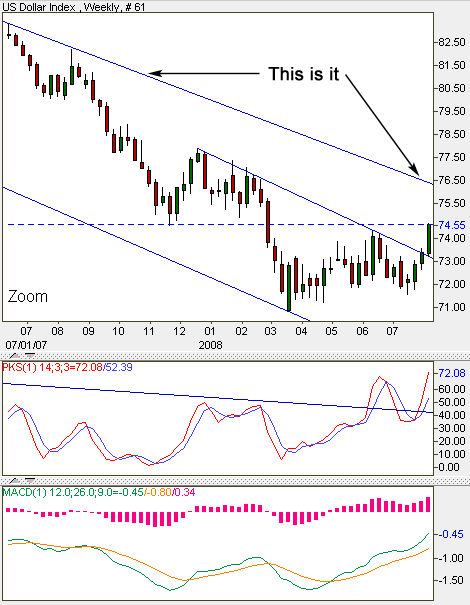
U.S. Dollar Index, Weekly Interval
While the larger downtrend is still intact, we’re seeing the dollar attempting to retest the upper channel resistance. Again, don’t ask me how, because I don’t know. Lots of people, including me, thought that the dollar was about to retest the all time low over the last couple of weeks. Lots of people, including me, were wrong.
Instead, we’re getting squeezed here, quite violently.
On the shorter intervals, the dollar looks very strong. While that’s true, look at what’s just overhead. That’s a hard resistance.
The dollar has been beaten down so far and for so long that it has been easy for dollar bears to get lulled into complacency. Anytime an asset starts to look like it’s giving free money away to investors, watch out! Shorting the dollar has been just such a ticket for a long time. Squeezes are pretty easy to pull off.
Now, while I’m of the opinion that dollar bears are being squeezed here, short term, we need to keep a close eye on this now because it has the potential to turn very ugly. I encourage everyone to draw their own lines in the sand.
Here’s mine:
I’m not staying short the dollar if we get a weekly green candle close above that upper channel line.
I know, the snake handling gold bugs and feral dollar bears are frothing at the mouth, speaking in tongues and pulling out what’s left of their hair right now, citing thousands of articles and endless evidence about why the dollar will collapse further. None of it matters. I’ve allocated my money along those lines, but, unlike a lot of these guys, it’s not a religious conviction for me.
I’m content to watch these antics up to that point (top blue line), but that’s it. If the USDX breaks up and out of its long term, down trending channel, I’ll start holding dollars again, instead of trying to exchange them for something else as soon as possible, like I’ve been doing for the last two years. I should have been holding some US$ all along, as a hedge, as per my recommendations on Cryptogon. But I didn’t take my own advice…
I don’t really expect it to break out, but I want to get the word out early so it’s clear: IT COULD HAPPEN. Devise your strategy in advance.
My guess is that there’s a better than average chance that it’s going bounce off that resistance. Why? The weekly stochastic is heading into extreme territory with a hard resistance overhead. Looking ahead a few days to a couple of weeks, aggressive dollar bears who are looking to take on new short positions might have an interesting opportunity there. Above that top blue line, though, watch out.
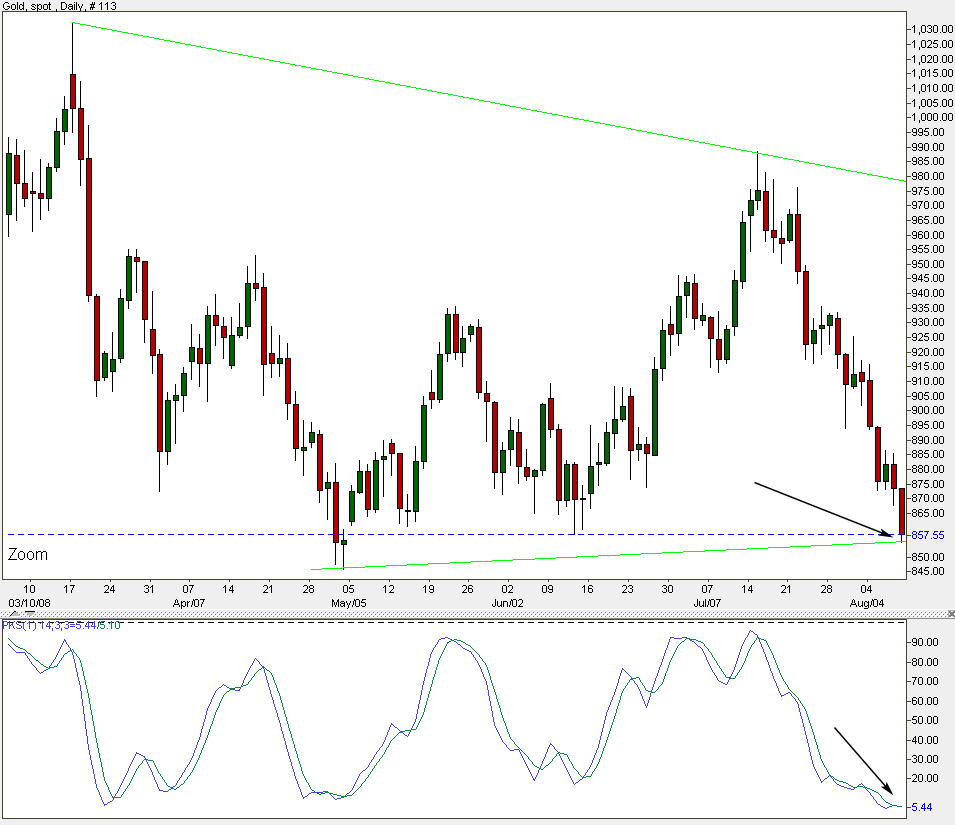
UPDATE: Gold Longs Hail Mary
Chart pic. The beauty of this is that you’ll know if it worked, or not, really fast!
Secret EU Security Draft Proposes Sharing Vast Amounts of Intelligence and Information on Europeans with the U.S. to Form “Euro-Atlantic Area of Cooperation”
August 7th, 2008Soviet Union 2.0.
Via: Guardian:
Europe should consider sharing vast amounts of intelligence and information on its citizens with the US to establish a “Euro-Atlantic area of cooperation” to combat terrorism, according to a high-level confidential report on future security.
The 27 members of the EU should also pool intelligence on terrorism, develop joint video-surveillance and unmanned drone aircraft, start networks of anti-terrorism centres, and boost the role and powers of an intelligence-coordinating body in Brussels, said senior officials.
The 53-page report drafted by the Future Group of interior and justice ministers from six EU member states – Germany, France, Sweden, Portugal, Slovenia, and the Czech Republic -argues Europe will need to integrate much of its policing, intelligence-gathering, and policy-making if it is to tackle terrorism, organised crime, and legal and illegal immigration.
The report, seen by the Guardian, was submitted to EU governments last month following 18 months of work. The group, which also includes senior officials from the European Commission, was established by Germany last year and charged with drafting a blueprint for security and justice policy over the next five years.
Baroness Scotland, the UK attorney general, had observer status with the group to assess the implications for Britain, whose legal system, unlike continental Europe, is based on the common law.
The group’s controversial proposals are certain to trigger major disputes, not least its calls for Europe to create an expeditionary corps of armed gendarmerie for paramilitary intervention overseas.
The report said the EU would fail to beat terrorism unless it developed a full partnership with Washington, a process currently pushing ahead in fits and starts.
“The EU should make up its mind with regard to the political objective of achieving a Euro-Atlantic area of cooperation with the United States in the field of freedom, security and justice,” it said.
Such a pact, which should be finalised by 2014 at the latest, would entail the transfer of vast volumes of information on European citizens and travellers to the US authorities. Negotiations have long been under way to agree such a pact, but have been bedevilled by divergences in privacy law and data protection regimes.
The US is already demanding that EU countries sign up for a battery of security measures on transatlantic flights and the supply of personal information on passengers if they are to enjoy visa-free travel to the US. Under one such accord struck in March between Washington and Berlin, the Germans are to make DNA and biometric information on travellers available.
The European Commission and the US homeland security department are also trying to iron out discrepancies in privacy laws to allow the wholesale exchange of data. The aim is to reach a binding international agreement this year or next.
Last month the American Civil Liberties Union wrote to MEPs pressing Brussels to reject US pressure because the US is “a country that, in privacy terms, is all but lawless … US privacy laws are weak. They offer little protection to citizens and virtually none to non-citizens.”
While urging a comprehensive transatlantic electronic pact, the Future Group focuses mainly on boosting police cooperation and integration between EU states, policies which would reinforce the powers of European agencies and institutions bearing acronyms such as Europol, Eurojust, Frontex, and Sitcen and perhaps see new agencies established to deal with security and intelligence operations.
Several member states, not least Britain, will have deep qualms about the proposals, with the British likely to balk at automatic pooling of national intelligence.
Anti-terrorist campaigns can only be effective if “maximum information flow between [EU] member states is guaranteed,” the report said. “Relevant security-related information should be available to all security authorities in the member states.” It said “networks of anti-terrorist centres” was a possible solution.
While cooperation between national police forces in the EU was advancing, the report conceded that the sharing of espionage and intelligence material was a “considerable challenge” as it clashed with the “principle of confidentiality” that is the basis for successful exchanges.
The report calls for a bigger role for “Sitcen” in coordinating intelligence sharing. Sitcen, or the Joint Situation Centre, is a shadowy intelligence body based in Brussels which started as a foreign policy tool supplying analysis on international crises to Javier Solana, the EU foreign policy chief, but which now focuses on counter-terrorism and internal security policy.
AIG WHACKED
August 7th, 2008WTF is happening on the dollar? The worse the news, the more it gaps up! Amazing. I’ll have to get out the squiggly lines and chicken entrails on the USDX very soon.
I saw this story and I smugly thought, “Surely this dollar rally will be over.” WRONG!
Via: Bloomberg:
American International Group Inc., the biggest U.S. insurer by assets, fell the most since going public in 1969 after writing down more than $11 billion of holdings and saying it won’t rule out raising capital.
“It’s very hard to predict right now when and if we’ll need more capital,” Chief Executive Officer Robert Willumstad said today in a conference call with analysts. “Future losses can change that assumption and we’re obviously dependent on the condition of the U.S. housing market.”
Willumstad faces increasing pressure to turn around AIG after the insurer posted more than $18 billion in losses over the past three quarters. The second quarter’s $5.36 billion loss, reported yesterday, was worse than analysts predicted and renewed concern that AIG may need to raise cash by selling shares. Willumstad called current capital “satisfactory.”
AIG slid as much as 18 percent in New York Stock Exchange composite trading, its biggest one-day drop in 39 years, according to Los Angeles-based Global Financial Data, which keeps records on historical share prices. The stock declined $4.75 to $24.34 at 1:56 p.m., leaving the shares down almost 60 percent this year. AIG’s quarterly loss was driven by $5.56 billion in pretax writedowns tied to credit-default swaps.
Willumstad, 62, took over at New York-based AIG in June after investors including former CEO Maurice “Hank” Greenberg called for the ouster of Martin Sullivan. Willumstad, who said AIG made too many bets on the U.S. housing market, has promised to deliver a turnaround plan by late September.
Jobless Claims Rose to Their Highest Level in Six Years
August 7th, 2008Via: Bloomberg:
The number of Americans filing first- time claims for unemployment benefits unexpectedly rose last week to the highest level in six years, signaling the labor market continues to weaken.
Initial jobless claims increased by 7,000 to 455,000 in the week ended Aug. 2, the most since March 2002, from 448,000 the prior week. The number of continuing claims increased to a four- year high.
Companies are reducing staff as demand slows and raw- material costs surge. Rising unemployment adds to concerns that consumer spending will falter in coming months after the effects of the government’s tax rebate checks wane.
“The labor market is slackening,” said Michael Gregory, a senior economist at BMO Capital Markets in Toronto. “The underlying trend for jobs has got recession written all over it.”