Who’s More Innovative When it Comes to Electric Vehicles? The Soviet Ministries of Ford and GM, or a Besieged Palestinian in Gaza?
June 13th, 2008Ford and GM are asking for subsidies to accomplish a fraction of what Fayez Annan has already done… under siege conditions. Never mind Think, Phoenix, Aptera and all the rest. Let’s look at Ford and GM vs. a man living under siege conditions to see who can produce a better EV.
Story 1: DOE Awards $30 Million for Plug-in Hybrid Electric Car Research
One has to wonder if this news is too little too late already but, Ford, General Motors and General Electric will split $30 million to develop and demonstrate Plug-in Hybrid Electric Vehicles research projects over the next three years.
The Department of Energy said today the projects will hasten the development of vehicles capable of traveling up to 40 miles without recharging, which includes most daily roundtrip commutes and satisfies 70% of the average daily travel in the US. The projects will also address critical barriers to achieving DOE’s goal of making such cars cost-competitive by 2014 and ready for commercialization by 2016. Of course by then gas could cost so much people will be happy to push their cars.
Story 2: In Besieged City, Man Builds Electric Vehicle with 110 Mile Range
Fayez Annan turns the silver key to start the power, pushes the green button on the standard industrial jog-run-stop switch on the dashboard, and eases the white Peugeot 205 into the main east-west shopping street in Gaza City.
With traffic abnormally sparse, thanks to the acute fuel shortages caused by the Israeli blockade, he soon reaches the distinctly un-urban and pedestrian-scattering speed of 37 miles per hour (60kph).
But then Mr Annan is proudly trying to make a point that, while it might be electric, this Peugeot is no milkfloat. “It can do 100kph (62mph),” he says with a grin, as our knuckles whiten in the passenger seats. Whether or not Mr Annan’s friend Hesham Abu Sido, an electrical consultant, is justified in describing the electric vehicle as a “genius idea” which is “the most fantastic thing that has happened in Gaza”, it is certainly a case of turning adversity into opportunity.
It also proves that Gaza’s famous entrepreneurial spirit has not yet been snuffed out by the draconian economic blockade imposed by Israel after the Palestinian militant group Hamas seized full control of the Strip by force a year ago tomorrow.
Since then, Gaza has seen continuing conflict, ever-deepening poverty, shortages, unemployment and despair. Against that background, the white Peugeot has become a symbol of Gaza’s suppressed potential. “People who have seen it are even happier than we are,” says Mr Annan. “They see it as something to be proud of in Gaza, which they haven’t had in a long time.”
…
The electric Peugeot is the brainchild of Mr Annan, 42, whose family owns a white goods business, and his friend Wasseem Al Khazendar, 48, who runs the largest company in Gaza selling electrical motors and switchgear to industry.
“I had been wanting to do something like this for a long time,” said Mr Khazendar. “I wanted to make a car which was environment-friendly. Even if you aren’t adding cooking oil, diesel is bad for the environment and an electric car is much cheaper to run.”
As indeed it is. With desperately scarce petrol costing about £1 per litre – and more than three times that on the black market – a six or seven-hour charge provides enough power to cover 110 miles at a cost of just over 90p. And all you need to charge the batteries is a simple mains plug. “It is like charging your mobile,” says Mr Annan. “You can do it anywhere – even while you are shopping.”
British Mercenary to Stand Trial for Attempted Coup in Equatorial Guinea
June 13th, 2008Via: Reuters:
British mercenary Simon Mann will go on trial on Tuesday for leading a failed 2004 coup in Equatorial Guinea, the West African state’s public prosecutor said on Friday.
Jose Olo Obono said that Mann, arrested in 2004 in Zimbabwe with 70 mercenaries en route for oil-rich Equatorial Guinea, will face three main charges: crimes against the head of state, crimes against the government and crimes against the peace and independence of the state.
“The maximum sentence would be the death penalty … but I don’t think in this case we will seek the death penalty,” Olo Obono told Reuters.
Mann said in a television interview in March that he plotted to oust Equatorial Guinean President Teodoro Obiang Nguema, who has ruled the former Spanish colony since 1979. Mann was extradited from Zimbabwe in February.
Equatorial Guinean authorities have said Mann has also testified that Mark Thatcher, the son of former Prime Minister Margaret Thatcher, knew all about the scheme to topple the government of sub-Saharan Africa’s third largest oil producer, one of the continent’s most authoritarian.
Mark Thatcher has denied this.
Olo Obono said journalists, but not cameras, would be allowed into the courtroom to cover the Mann trial.
Related: Pentagon Link to Guinea Coup Plot
How Iran Has Bush Over a Barrel
June 13th, 2008“The Iranian strategic military plan for engaging the United States must include crippling oil exports from the Persian Gulf. Iran is (probably) in a position to close the Strait of Hormuz, the most strategically important waterway in the world.”
—Cryptogon, 7/15/2006, The Strait of Hormuz: It’s Not That Bad, It’s Worse
FYI: Robert Baer, the author of the following piece, was a CIA case officer.
Via: Time:
If wasn’t clear before it should be now: the Bush Administration can’t afford to attack Iran. With gas already at $4 a gallon and rising almost every day, Iran figuratively and literally has the United States over a barrel. As much as the Administration is tempted, it is not about to test Iran’s promise to “explode” the Middle East if it is attacked.
The Iranians haven’t been shy about making clear what’s at stake. If the U.S. or Israel so much as drops a bomb on one of its reactors or its military training camps, Iran will shut down Gulf oil exports by launching a barrage of Chinese Silkworm missiles on tankers in the Strait of Hormuz and Arab oil facilities. In the worst case scenario, seventeen million barrels of oil would come off world markets.
One oil speculator told me that oil would hit $200 a barrel within minutes. But Iran’s official news agency, Fars, puts it at $300 a barrel. I asked him if Iran is right, what does that mean?
“Four-dollar-a-gallon of gasoline only reflects $100 oil because the refiners’ margins are squeezed,” he said. “At $300, you have $12 a gallon of gasoline and riots in Newark, Los Angeles, Harlem, Oakland, Cleveland, Detroit, Dallas.”
In either case, whether at $200 or $300, Bush does not want to be the President who leaves the White House on a mule-drawn cart. But Iran’s blackmail is not just about oil. The Iranians truly believe they have us hostage in Iraq — our supply lines, the acquiescence of the Shi’a in the occupation. It would all change in an instant, though, especially if we were to borrow Iraq to attack Iran. The way Fars put it: “In Iraq, fighters would rise up in solidarity with each other and begin … making the Tet Offensive in 1968 Vietnam.”
If this all sounds very alarming, Iran meant it to, and it seems to be working. On Tuesday Bush was talking about the prospect of new sanctions rather than attacking.
Which leaves Israel. Are the Israelis, who have a lot more on their minds than the price of gas in the United States, going to launch a pre-emptive attack? One hard and fast rule in the Middle East is never rule out Israel’s readiness to turn the table over. But an Israeli hawk on Iran, with close ties to Israel’s Ministry of Defense, told me to forget about it. “There’s not a chance Israel will do anything. Maybe there’s a window after the American elections and the new President but even that’s doubtful. Washington does not have the stomach for another war.”
Israel cannot attack or contain Iran on its own; it needs the full military might of the United States behind it. So in the meantime Israel can only huff and puff, hoping new sanctions on Iran will do the trick.
Related: Zbigniew Brzezinski Before the Senate Foreign Relations Committee
Cryptogon Readers Send Contributions
June 13th, 2008Eileen sent $40 and DJ sent $50. Thank you.
Spain: Factories Close, Supermarkets Empty and Jets Run Out of Fuel as Truckers’ Strike Bites
June 12th, 2008Via: Guardian:
Strike action by thousands of Spanish and Portuguese truckers produced ominous knock-on effects on food supplies, aviation and industry yesterday, as Lisbon airport ran out of fuel, car factories shut down and petrol stations and supermarkets reported shortages.
In a worrying sign for other European countries that face rising discontent at the spiralling cost of diesel, a third day of strikes generated widespread mayhem and the mood turned ugly after the first casualties of the standoff: two strikers died in clashes on picket lines.
Tourists flying to Lisbon faced delays after the airport ran out of fuel. Some flights were diverted to Porto. Only emergency, military or state flights were allowed out of Portela airport, a spokesman said. Only emergency fuel stocks saved Spanish airlines from similar disruption.
Supermarkets, meanwhile, reported dwindling supplies. Authorities at Spain’s two biggest wholesale markets, Mercamadrid, in Madrid, and Mercabarna in Barcelona, reported deliveries of meat, fish and fruit were almost at a standstill.
In Barcelona, at a branch of Caprabo supermarket, there was no fresh fish or meat on the shelves. Shopper María Luz Martínez, 38, said: “The lorry drivers are looking after themselves while we are all suffering. But the government doesn’t appear to be that interested.”
As panic buying among motorists continued, petrol stations were running dry. Drivers in Lisbon trying to fill up their cars were turned away. In Spain, “empty” signs hung from pumps at hundreds of stations across the country. Three car firms, Seat, Nissan and Mercedes, suspended production because of parts shortages.
Some ferries from the Balearic islands to mainland Spain were cancelled due to lack of fuel. José María Pozancos, director of Spain’s fruit and vegetable export federation, said the strike was costing the industry €25m (£20m) a day.
The action is being closely watched in France, Italy, Britain and other countries where the threat of a similar strike looms. Diesel prices have shot up on average around 40% over the past year amid record jumps in oil prices, and truckers say profits have been all but wiped out. Italian hauliers are planning a five-day strike at the end of the month, while their British counterparts are targeting central London again on July 2.
With unions talking of coordinated action in several countries at a time and policymakers in Brussels refusing to countenance tax breaks, the fear is that the action in Spain and Portugal could spread. Yesterday truckers in Thailand used a half-day strike to demand financial help.
As the Spanish government yesterday deployed 25,000 police to clear major routes, the mood among strikers was increasingly turning bitter. Scores of pickets were arrested in clashes with police and two drivers were killed at blockades.
University of Illinois Crop Scientist: Planting After June 20 May Cause Yields to Shrink by Half
June 12th, 2008Via: Grainnet:
A costly deadline looms for many growers in the Midwest, as every day of waiting for the weather to cooperate to plant corn and soybeans reduces potential yields. Research indicates that Illinois growers who plant corn or soybeans near the end of June can expect a 50 percent reduction in crop yield, according to a University of Illinois agriculture expert.
The U.S. Department of Agriculture reports that corn and soybean growers in several Midwestern states are behind schedule on their planting. A cooler and wetter-than-average spring has left Illinois and Indiana furthest behind on planted corn and soybeans. Several other states are lagging behind their normal planting schedules, but by a lesser margin.
In Illinois, 95 percent of the corn is planted and 88 percent has emerged, but less than half of that is reported to be in good or excellent condition. Fully 14 percent of the acres planted are in poor or very poor condition, with another 38 percent reported as fair. Those acres in poor or very poor condition may have to be replanted. In Illinois, the corn was 7 inches high as of June 9, compared to an average of 17 inches by this time in recent years.
Illinois crop sciences professor Emerson Nafziger says cool temperatures and the third wettest January-April since 1895 in Illinois have led to delays that are undercutting potential yields.
“This has been a bad spring by most measures,” said Illinois crop sciences professor Emerson Nafziger.” We keep seeing forecasts that look favorable and then that doesn’t happen. The chance of having above-average yields has diminished greatly.” Cool temperatures and the third wettest January-April since 1895 in Illinois have led to delays that are undercutting potential yields. Nafziger’s analysis of previous years’ corn planting data in Illinois determined that “we can expect 50 percent of the maximum yield when planting is done around June 15 to 20.”
Those growing soybeans in southern Illinois may get 50 percent of their maximum yield if they plant no later than June 25 to 30, he said.
Some growers — in southern Illinois especially — will have to replant as wet conditions have caused some seed to rot.
More: Floods Have Farmers Scrambling with Crops
More: Ohio Farmers Starting from Behind After Soggy Spring
More: Iowa Floods Claim Significant Acres
High Court Sides with Guantanamo Detainees Again
June 12th, 2008Via: AP:
The Supreme Court ruled Thursday that foreign terrorism suspects held at Guantanamo Bay have rights under the Constitution to challenge their detention in U.S. civilian courts.
In its third rebuke of the Bush administration’s treatment of prisoners, the court ruled 5-4 that the government is violating the rights of prisoners being held indefinitely and without charges at the U.S. naval base in Cuba. The court’s liberal justices were in the majority.
Justice Anthony Kennedy, writing for the court, said, “The laws and Constitution are designed to survive, and remain in force, in extraordinary times.”
It was not immediately clear whether this ruling, unlike the first two, would lead to prompt hearings for the detainees, some of whom have been held more than 6 years. Roughly 270 men remain at the island prison, classified as enemy combatants and held on suspicion of terrorism or links to al-Qaida and the Taliban.
The administration opened the detention facility at Guantanamo Bay shortly after the Sept. 11, 2001, terrorist attacks to hold enemy combatants, people suspected of ties to al-Qaida or the Taliban.
The Guantanamo prison has been harshly criticized at home and abroad for the detentions themselves and the aggressive interrogations that were conducted there.
The court said not only that the detainees have rights under the Constitution, but that the system the administration has put in place to classify them as enemy combatants and review those decisions is inadequate.
The administration had argued first that the detainees have no rights. But it also contended that the classification and review process was a sufficient substitute for the civilian court hearings that the detainees seek.
Canada Apologizes for Atrocities Committed Against Aboriginal Children
June 12th, 2008Via: Reuters:
Canada, addressing one of the darkest chapters in its history, formally apologised on Wednesday for forcing 150,000 aboriginal children into grim residential schools, where many say they were sexually and physically abused.
Prime Minister Stephen Harper told a Parliamentary chamber packed with legislators and aboriginal representatives that there could be no excuses for what happened at the church-run schools, which mainly operated from the 1870s to the 1970s.
“The government of Canada sincerely apologises and asks the forgiveness of the aboriginal peoples of this country for failing them so profoundly. We are sorry,” Harper said in a 15-minute address, at one point fighting back tears.
Native leaders said they hoped the apology would lead to a new era of reconciliation between Canadians and the often marginalised aboriginal population, which routinely suffers from poor living conditions and high unemployment.
The residential schools were initially set up to educate native children but later became part of a government campaign to assimilate aboriginals and eradicate their culture — “to kill the Indian in the child”, as some put it at the time.
“There is no place in Canada for the attitudes that inspired the Indian residential schools system to ever again prevail,” Harper said.
Contemporary accounts suggest up to half the children in some institutions died of tuberculosis and other diseases.
Many survivors say they were abused mentally, physically and sexually. Children were beaten for speaking their own languages and told they would be damned unless they converted to Christianity.
Related: UNREPENTANT: Kevin Annett and Canada’s Genocide
Top Secret British Government Document Left on Train
June 12th, 2008It’s right out of Yes Minister.
Via: Guardian:
Highly classified intelligence documents relating to two of the most sensitive issues involving Britain’s security interests – al-Qaida in Pakistan and the situation in Iraq – have been found on a train near London, it was disclosed last night.
The documents, including one marked Top Secret, are believed to be detailed and up-to-date assessments by Whitehall’s Joint Intelligence Committee (JIC).
They were found on Tuesday and handed to the BBC’s security correspondent, Frank Gardner, who reported the loss. The BBC said the documents were left on the train by a senior intelligence officer.
A Cabinet Office spokesman said last night that the documents’ high security classification meant they would have had a limited circulation. “There has been a security breach, the Metropolitan police are carrying out an investigation.”
A Scotland Yard spokesperson said its counter terrorism squad would be heading the investigation. “We can confirm that we are making inquiries in connection with the loss of the documents.”
Gardner said the documents were left in an orange cardboard envelope on a train from London Waterloo to Surrey by a “very senior intelligence official” working in the Cabinet Office. A police search was launched when it was realised that they were missing, as officials were concerned at the possibility of such sensitive papers getting into the wrong hands, he said.
The envelope was picked up by a fellow passenger, who found a seven-page document inside setting out the latest government assessment on the Islamist terror network al-Qaida, along with a “top secret and in some cases damning” assessment of Iraq’s security forces, said Gardner.
The al-Qaida document, commissioned jointly by the Foreign Office and the Home Office, was classified “UK top secret”, he said. Each page was numbered and marked: “For UK, US, Canadian and Australian eyes only.” The document on Iraq was commissioned by the Ministry of Defence. Gardner said: “This was a clear breach of government rules. They should be sealed in a briefcase if taken out.”
The BBC said the two reports were JIC assessments. A British intelligence assessment of the strength of al-Qaida in Pakistan would be sensitive and potentially damaging if read either by hostile interests or the Pakistan government. An assessment of the efficiency of the Iraqi security forces could be embarrassing if seen by the Iraqi government or insurgents.
The intelligence officer had permission to take the documents out of the office as long as sufficient security was provided, meaning a locked box, Whitehall officials said.
The fact that the investigation is in the hands of the police rather than MI5 suggests the documents were lost or mislaid and the official had not been targeted. The officer was still at work, Whitehall sources said. The loss is the latest in a string of recent data security lapses.
Oil Symmetrical Triangle Intraday
June 11th, 2008WARNING: This is not a recommendation to buy, sell or hold any financial instrument.
Really quick, watch that symmetrical triangle forming on the intraday charts. Translation: Breakout higher from previous range possible. It could go sharply higher on this formation.
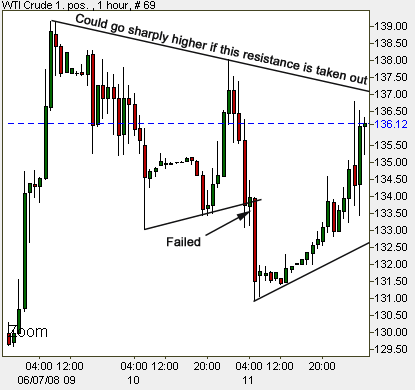
West Texas Intermediate Crude, 1 Hour Interval




