Obama: “I would reach out to the first George Bush.”
March 22nd, 2008Imagine my shock.
Via: CNN:
KING: A couple of quick things, Senator. Would you, in your administration, make use of Bill Clinton?
OBAMA: Absolutely. I think that, you know, Bill Clinton is a brilliant statesman and politician, and I think that any president would want to use his skills and his relationships around the world.
By the way, I would reach out to the first George Bush. You know, one of the things that I think George H.W. Bush doesn’t get enough credit for was his foreign policy team and the way that he helped negotiate the end of the Cold War and prosecuted the Gulf War. That cost us 20 billion dollars. That’s all it cost. It was extremely successful. I think there were a lot of very wise people. So I want a bipartisan team that can help to provide me good advice and counsel when I’m president of the United States.
“The Bear situation changed everything: people saw death before their eyes.”
March 22nd, 2008Via: Financial Times:
The Federal Reserve and Treasury are playing a dominant day-to-day role in overseeing Wall Street following this week’s rescue of Bear Stearns, raising the prospect that the central bank might be given more permanent authority over securities firms.
Bankers say the greater authority is a direct consequence of the Fed’s extraordinary decisions to extend a $30bn credit line to help JPMorgan Chase’s takeover of Bear and to lend emergency funds to securities houses for the first time in more than 70 years.
“There is a new sheriff in town,” said a senior banker. “The Bear situation changed everything: people saw death before their eyes. The Fed and Treasury are in charge now and are not going to let go”.
Under a regulatory regime dating back to the 1930s, the Fed oversees commercial banks, but investment banks are primarily regulated by the Securities and Exchange Commission.
But as the credit crunch deepened, Ben Bernanke, Fed chairman, Tim Geithner, president of the New York Fed, Hank Paulson, Treasury secretary, and Robert Steel, his number two, have been in unusually close contact with Wall Street executives.
People close to the situation said the Fed and Treasury feared further problems among securities firms could destabilise the financial system and expose US taxpayers to sizeable losses on the new Fed loans.
Their stance has triggered talk of new financial services legislation, with bankers and politicians, including Barney Frank, House financial services committee chairman, asking whether investment banks should be regulated by the SEC or the Fed.
An extension of the Fed’s powers to investment banks might force them to reduce risk and leverage in order to comply with the tougher requirements faced by deposit-taking banks.
However, any change would require legislative action, which looks increasingly difficult ahead of the November presidential election, and could be even more problematic under a new Administration.
The SEC said different agencies were functioning as “equal partners at the regulatory forefront”.
Central Banks Float Rescue Ideas: Hold on to Your Wallet
March 22nd, 2008IMF Special Drawing Rights for toxic waste mortgage backed securities?
What’s described below isn’t going to happen tomorrow, but the banking elite are clearly thinking about how They can force all of us to eat this slop. In Russia, I hear there’s a saying that describes the situation with the mob at all levels of society:
“Everybody pays.”
Related: Modern Mafia Operates at Every Level of Italian Society
Via: Financial Times:
Central banks on both sides of the Atlantic are actively engaged in discussions about the feasibility of mass purchases of mortgage-backed securities as a possible solution to the credit crisis.
Such a move would involve the use of public funds to shore up the market in a key financial instrument and restore confidence by ending the current vicious circle of forced sales, falling prices and weakening balance sheets.
The conversations, part of a broader exchange as to possible future steps in battling financial turmoil, are at an early stage. However, the fact that such a move is being discussed at all indicates the depth of concern that exists over the health of the banking system.
It shows how far the policy debate has shifted in recent weeks as the crisis has spread to prime mortgage assets in the US and engulfed Bear Stearns, the investment bank.
The Bank of England appears most enthusiastic to explore the idea. The Federal Reserve is open in principle to the possibility that intervention in the MBS market might be justified in certain scenarios, but only as a last resort. The European Central Bank appears least enthusiastic.
Any move to buy mortgage-backed securities would require government involvement because taxpayers would be assuming credit risk. There is no indication as yet that the US administration would favour such moves. In the eurozone it would require agreement from 15 separate governments.
UPDATE: Fed Denies It
Quick Note on Thursday’s Trades
March 21st, 2008WARNING: This is not a recommendation to buy, sell or hold any financial instrument.
I took profit on my FXF (Swiss Franc ETF) trade, not so much because I believe that the current dollar rally is real, but because I want to have some dry powder on hand in case I decide to get back into DBA (Powershares Agriculture ETF). DBA is collapsing nicely now. I don’t have a margin account, so I need to have settled funds on hand. Also, it was just a really good run on that Swissy, and nobody ever went broke by taking a profit (I keep telling myself).
I also bought some deep out of the money put options on XLF (Financial Select Sector SPDR), as the financials were rallying sharply. These are April expiration with strikes at 19. This is essentially a wild ass roll of the dice that the financial sector is going to have big, big problems over the next month. They were really shilling that piece of trash up on Thursday, so I pulled the trigger on some puts.
Are Dealers Running Low on Silver?
March 21st, 2008Maybe people who are into holding physical silver can provide some reports on availability with their dealers…
Via: Silver Seek:
Since my email earlier tonight, where I reported that 5-6 major silver dealers (Amark, Tulving, 2 in Vancouver, my local dealer, NWT Mint) are “out of inventory”, 13 more reports came in, saying that the dealers were out of silver inventory. Some of these names are big names in the business, Scotia bank, the Perth Mint in Australia, CNI Numismatics in LA, APMEX says they have some items, but are looking to buy.
Research Credit: EB
Your Bank, a Magic 8 Ball and the Federal Government
March 21st, 2008Via: Newsweek:
The Patriot Act gave the FBI new powers to snoop on suspected terrorists. In the fine print were provisions that gave the Treasury Department authority to demand more information from banks about their customers’ financial transactions. Congress wanted to help the Feds identify terrorist money launderers. But Treasury went further. It issued stringent new regulations that required banks themselves to look for unusual transactions (such as odd patterns of cash withdrawals or wire transfers) and submit SARs—Suspicious Activity Reports—to the government. Facing potentially stiff penalties if they didn’t comply, banks and other financial institutions installed sophisticated software to detect anomalies among millions of daily transactions. They began ranking the risk levels of their customers—on a scale of zero to 100—based on complex formulas that included the credit rating, assets and profession of the account holder.
CBOT Resembles Carnival Act as Billion Dollar Black Box Operators Move In
March 21st, 2008WARNING: This is not a recommendation to buy, sell or hold any financial instrument.
This may upset my libertarian and my commodity trader friends, at first, but I hope they hear me out. Although I’m 3/4 libertarian myself and a trader, leveraged speculation on commodities shouldn’t be allowed. Speculate on things like indexes, stocks, bonds and currencies until you’re blue in the face. None of those things are real anyway. But leveraged speculation on tangible goods actually makes a mockery of the market system by distorting prices.
If I buy a wheat contract, I should have to take delivery of the physical wheat on the specified date. If I sell a wheat contract, I should have to deliver the physical wheat on the specified date. I should not be allowed to buy or sell those leveraged contracts without having to take delivery, or deliver, physical goods. I shouldn’t be allowed to close my position without an exchange of goods.
The same should hold true for gold, coffee, palladium or any other commodity.
It is absolute madness that commodities are bought and sold using leveraged vehicles in markets that allow participation by speculators; individuals and organizations who have no interest or connection to the underlying physical commodity.
Guys, I know! I can hear you groaning. Several of you trade the gold futures. I made money on DBA, which is made up of futures contracts on wheat, corn, soybeans and sugar. I, just now, recommended gold mini futures contracts to a reader who’s using his BullionVault account for active trading—I mean, why not use the leverage that a futures account provides to trade and save money on commissions?
No sane person wants to wind up in a gun battle, but when you find yourself in the middle of one, you do what has to be done. As trader Dagobaz wrote, “If you any good at all at timing overbought / oversold conditions, you will be in the very rare position of being able to make money faster than even Bernanke can devalue it.” She’s right.
But think about what leveraged trading in real goods does!
Leverage is undead money. It’s zombie money. It can be conjured up and sent out to do the bidding of its master. What happens when infinite zombie money, in the form of leverage, enters markets where finite resources are traded?
Volatility increases and prices distort to the point where the underlying value of a thing gets lost in all the noise. This isn’t a free market; it’s a black magic trick, involving supercomputers, psychological operations and lots and lots of leverage.
Why is it allowed?
The Black Box people don’t make the big money in stable markets that are constrained by reality. They want to get in and out; fast. The more volatility, the more potential there is to pull money out of the chaos. What institutions need is a way to be upwind when they start a fire. LEVERAGE ALLOWS INSTITUTIONS TO CREATE VOLATILITY FOR EXTREMELY SHORT TERM GAINS. Participants who are trying to use the futures market in a legitimate manner, to secure supplies of goods, or to sell goods, at agreed upon prices in the future, are getting wiped out because the price action has little to do with the underlying supply and demand of the commodities!
After the Fed introduced a massive rate cut this week, gold gapped down 6%. There is a lot of head scratching in the gold bug community right now. I don’t see why. Cryptogon readers have been warned that gold is just another blinking number that updates in real time; traded with leverage. Don’t hold a scorpion in your hand and then blame it for stinging you. That’s just the nature of the beast. (On gold, I do believe the truth will emerge at some point. That’s why I’m not selling my physical gold.)
I rarely write, “This is how it should be,” posts because there’s absolutely no point. Pigs (Pork Bellies?) will fly before anyone takes my suggestion seriously. However, if you want to understand booms and busts in ANY market, you’ll find speculators who have nothing to do with the underlying assets, using leverage to create volatility for short term gains.
Welcome to fiat currency Hell.
Now… I need to go check out the collapsing grain futures to see if DBA is a buy again, or not.
Via: Forbes:
The largest price swing in the history of Chicago Board of Trade wheat futures Wednesday baffled market analysts and sparked frustration among long-time traders who have used the market as a tool to hedge risk.
The CBOT March wheat contract
Until two weeks ago, the normal daily trading limit for CBOT wheat was 30 cents a bushel, either up or down.
“This is why a lot traders won’t trade this market anymore. This kind of volatility, and lack of connection to what’s happening fundamentally in the market, have a lot of traders saying there are other things to trade that have less risk,” said analyst Shawn McCambridge at Prudential Financial (nyse: PRU – news – people ).
“You can’t afford to participate in these markets if you’re a small or medium-sized guy, as far as an elevator or producer. You could be doing everything 100 percent correctly, and the market trades like this, you could get annihilated,” McCambridge said.
Most of the CBOT wheat trade is conducted electronically, with volume in the traditional open-outcry pit comprising only 6 percent of the total Tuesday.
Tuesday is the most recent day for which the CBOT has official data on electronic and pit totals.
Bullish supply-demand fundamentals have played a lead role in the surge in CBOT wheat prices, which climbed 77 percent in 2007 and are up 44 percent so far in 2008.
The U.S. Department of Agriculture says U.S. wheat stocks will drop to a 60-year low by the end of the marketing year on May 31. Global wheat stocks are projected at a 30-year low.
Soft red winter wheat, the par grade in Chicago, is in tight supply. Spring wheat, par grade on the Minneapolis Grain Exchange, is even more scarce, and MGE wheat prices well above $20 a bushel this week have helped frazzle long-time traders.
At the CBOT, expanded daily trading limits and sharply higher margin charges to trade wheat have added to the volatility.
Yet CBOT floor traders said the market’s latest violent gyrations reflect the increasing influence of hedge funds which have been pouring money into CBOT grains.
The price action Wednesday, they said, had more to do with fund maneuvers than with bullish fundamental factors.
“There is an enormous amount of bitterness down here,” one CBOT wheat floor trader said.
Soaring commodities have enticed Wall Street investors seeking a hedge against inflation. The U.S. Producer Price Index, an inflation gauge, Tuesday showed its biggest rise in more than 26 years, climbing 1 percent in January and 7.4 percent on a year-on-year basis.
Veteran traders note the large share of the market held by commodity index funds, which typically buy and hold long positions. The long positions held by index funds represented 36.4 percent of open interest in CBOT wheat as of Feb. 19.
Increases in margins, the performance bonds required to trade wheat, have been driving smaller players out.
“When I first started, we had 1/4-cent moves and an 8-cent range, and everybody was happy. Now we have $1 swings, and everyone is mad at each other,” a longtime CBOT trader said.
Another trader sounded more sanguine: “Big orders executed in a rapid fashion, coupled with spreaders there to help absorb some of the volatility, creates extreme swings.”
A spreader is someone who simultaneously buys and sells two different futures contracts, seeking to profit on a change in the difference in price.
He added of Wall Street investors: “Multi-trillion-dollar markets moving money into these type of markets … exacerbates the problem.”
CBOT March wheat was down 49-1/2 cents at $12.30-1/2 per bushel in Asian trading hours.
Three Large Investment Banks Tap New Fed Loans
March 20th, 2008Via: Baltimore Sun:
Three of the nation’s largest investment banks said they have borrowed from a program created this week by the Federal Reserve to stimulate lending amid concern that Wall Street faced a cash shortage.
“We have tested the window because we want to remove the stigma from the window,” said Morgan Stanley Chief Financial Officer Colm Kelleher in an interview yesterday, referring to the Fed lending program. “It’s meant to be there for normal business. It’s not meant to be there as a last-recourse thing.”
Erin Callan, chief financial officer of Lehman Brothers Holdings Inc., said the company used the window Tuesday night, adding: “We wanted to show some leadership.”
Michael DuVally, a spokesman for Goldman Sachs Group Inc., said his firm also is “testing” the Fed facility, which opened Monday, and will use it “if doing so makes sense from an economic and funding diversification point of view.”
Wall Street firms were reluctant to turn to the Fed earlier this week because of concern that it might make them appear financially weak, The Wall Street Journal reported yesterday.
Malicious Traders in the City Try to Topple the Halifax Bank
March 20th, 2008Via: Times Online:
Stock market manipulators yesterday tried to bring down one of Britain’s biggest banks by spreading false rumours through the City.
The Bank of England was forced to issue an unprecedented denial that HBOS was in trouble.
The Financial Services Authority (FSA) said that it would pursue traders guilty of “market abuse” by spreading untrue claims that banks were on the brink of collapse.
The authorities believe that the fear and uncertainty in financial markets are allowing unscrupulous traders to make multimillion-pound profits by whipping up hysteria about the stability of big banks.
Yesterday’s drama began at about 8.30am when rumours started spreading through London’s stock market that HBOS, which owns Halifax, the UK’s biggest mortgage lender, and Bank of Scotland, was about to become another Northern Rock and that it had begged the Bank of England for a multi-billion-pound emergency loan. Within 20 minutes HBOS’s shares had plunged by more than 17 per cent as investors dumped their stakes. An hour later, the Bank of England announced that no bank needed emergency funding, while the FSA issued a statement warning investors to stop spreading false accusations.
It is feared that short-sellers — investors who use falling share prices to make money — were deliberately spooking the market in order to profit from plunging stocks in a practice called trash ’n’ cash.
Rumours that the American investment bank Bear Stearns was short of cash contributed to its near-collapse last week after its lenders were scared into demanding that it repay them immediately.
Gold Correction
March 20th, 2008WARNING: This is not a recommendation to buy, sell or hold any financial instrument.
I drew a Fibonacci fan on the weekly gold chart. The fan is defined from the low on 16 August 2007 to the high on 8 November 2007. Gold has now broken down to the 50 Fibonacci fan line, exactly.
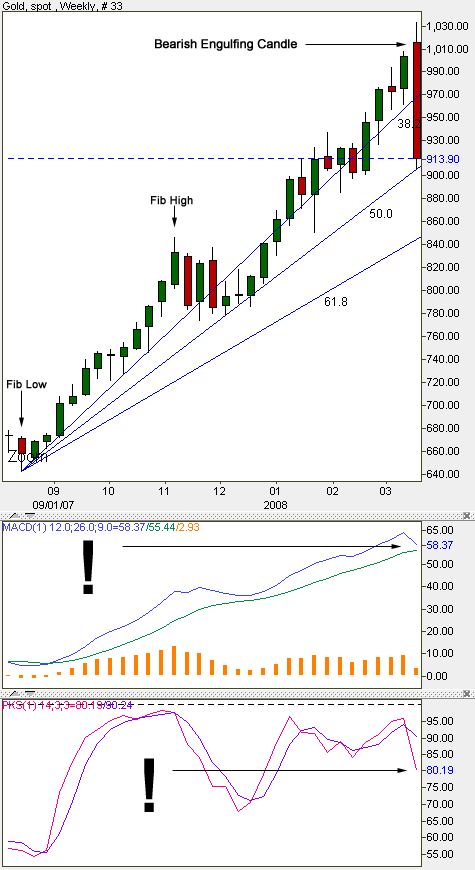
Spot gold, weekly interval
There are a couple of ways to look at this:
Very aggressive traders would be making a case to go long right here in a classic “catch the falling knife” move. Daily stochastics and RSI are going extreme oversold and the 50 fan line support is intact at this time. The stop loss on the trade is a break below that 50 fan line.
Traders looking to preserve longer term profits, or traders with shorter time horizons, might consider using that 50 line as a stop loss target. A move below around $900 probably means that the unwinding weekly stochastics are in force and that a full oscilation down is likely. The resulting move down could easily reach $850 (major support), or below. Weekly MACD, while still positive, is threatening to turn negative for the first time since mid August 2007. A retest to around $850 would meet the historical price support at that level as well as the 61.8 fan line.
Market participants with time horizons of years or decades are probably yawning and wondering what all the fuss is about.
One last thing: Making the case for a near term top…
The weekly chart shows an obvious bearish engulfing candle formation, where a new high is reached during the period, but it closes down, engulfing previous positive candles. While that weekly candle isn’t closed out yet, you get the idea.
Also, weekly stochastics have crossed down from extremes. MACD is threatening to cross down, but hasn’t yet.




