World’s Largest Maker of Crop Nutrients: Famines May Occur Without Record Harvests
February 20th, 2008“In 2008, food could become an out front national security issue in the developed world.”
—Cryptogon, Some Guesses About 2008
I don’t know what I have to do to make this clear to people, or how many times I have to say it…
I hope you guys get it.
Via: Bloomberg:
Grain farmers will need to harvest record crops every year to meet increasing global food demand and avoid famine, Potash Corp. of Saskatchewan Inc. Chief Executive Officer William Doyle said.
People and livestock are consuming more grain than ever, draining world inventories and increasing the likelihood of shortages, Doyle said yesterday in an interview on Bloomberg Television. Global grain stockpiles fell to about 53 days of supply last year, the lowest level since record-keeping began in 1960, according to the U.S. Department of Agriculture.
“If you had any major upset where you didn’t have a crop in a major growing agricultural region this year, I believe you’d see famine,” Doyle, 57, said in New York.
…
“We keep going to the cupboard without replacing and so there is enormous pressure on agriculture to have a record crop every year,” Doyle said. “We need to have a record crop in 2008 just to stay even with this very low inventory situation.”
HEALTH MINISTER OF INDONESIA: U.S. MAY TURN AVIAN FLU INTO BIOWEAPON
February 20th, 2008Now that they know why bird flu isn’t readily transmissible from human to human, how long until a weaponized version is engineered?
That’s me being optimistic; assuming that a weaponized form doesn’t exist already.
—Why Bird Flu Has Been Kept at Bay
It’s one thing for me to sit here, in my tinfoil underwear, writing about engineered Kill Off, etc., but I really don’t expect to be out-tinfoiled by high government officials!
For f*#%$ sake. I’ve seen just about enough for today…
Full text follows.
Via: ABC AM:
AM – Wednesday, 20 February , 2008 08:24:00
Reporter: Geoff Thompson
PETER CAVE: Indonesia’s Health Minister has suggested that the United States may be involved in a conspiracy to use the bird flu virus to develop biological weapons.
The extraordinary allegation is included in a new book, endorsed by President Susilo Bambang Yudhoyono, which describes Indonesia’s fight to assert its ownership of its virulent strains of avian influenza.
Concerns over that issue prompted Indonesia last year to stop sharing virus samples with the World Health Organization as Jakarta correspondent Geoff Thompson reports.
GEOFF THOMPSON: No country in the world has been hit by bird flu like Indonesia. Already this year 11 people have died and ten of those were from Jakarta or surrounding areas.
Indonesia’s uniquely virulent strain of H5N1 gave the country “bargaining power” according to Indonesia’s Health Minister Dr Siti Fadilah Supari, in her new book called “It’s Time for the World to Change” and strangely subtitled “The Divine Hand Behind Avian Influenza”.
It’s this bargaining power which led Dr Supari in late 2006 to stop sharing Indonesia’s strains of bird flu with World Health Organization laboratories because of fears that any vaccines developed would then be sold for profit to developing countries with no benefit to Indonesia.
In essence, Indonesia sought to retain the “virus rights” and any profits to be made from its bird flu problem.
Back then on AM, Dr Supari effectively accused Australia of stealing Indonesia’s strain of H5N1 to make bird flu vaccines.
SITI FADILAH SUPARI: I never, I never give permission to send sample to the, send a specimen of the virus to Australia.
GEOFF THOMPSON: Now in her book Dr Supari has revealed, the full scope of the conspiracy she believes she is up against. “Developed countries become richer”, she writes, “because they have the capability to develop the vaccine and control the world”.
Dr Supari expresses alarm at WHO laboratories sharing bird flu virus data with the United States national laboratory in Los Alamos, New Mexico, where nuclear weapons are developed.
“Whether they use is it to make vaccine or develop chemical weapons, would depend on the need and interest of the US Government. It is indeed a very dangerous situation for the destiny of humanity”, she writes and goes on to say “.. it is a matter of choice whether to use the material for vaccines or biological weapon development”.
Despite the clear implication contained in her book, last night Dr Supari told the ABC, she didn’t intend to accuse the United States of being interested in turning H5N1 into a biological weapon.
SITI FADILAH SUPARI: I didn’t know whether our virus will be develop into a vaccine or will be develop into a biological weapon. So just a question – I didn’t blame United States, I didn’t blame any country.
PETER CAVE: Indonesia’s Health Minister, Dr Siti Fadilah Supari, speaking there to Indonesia correspondent Geoff Thompson.
America’s Economy Risks the Mother of All Meltdowns
February 20th, 2008I’m posting the entire article because it sums up the situation in a concise and accessible manner. Highly recommended.
Via: Business Spectator / Financial Times:
Martin Wolf, Financial Times
Twelve steps to meltdown
“I would tell audiences that we were facing not a bubble but a froth – lots of small, local bubbles that never grew to a scale that could threaten the health of the overall economy.” So wrote Alan Greenspan in The Age of Turbulence.
That used to be Mr Greenspan’s view of the US housing bubble. He was wrong, alas. So how bad might this downturn get? To answer this question we should ask a true bear. My favourite one is Nouriel Roubini of New York University’s Stern School of Business, founder of RGE Monitor.
Recently, Professor Roubini’s scenarios have been dire enough to make the flesh creep. But his thinking deserves to be taken seriously. He first predicted a US recession in July 2006. At that time, his view was extremely controversial. It is so no longer. Now he states that there is “a rising probability of a ‘catastrophic’ financial and economic outcome”. The characteristics of this scenario are, he argues: “A vicious circle where a deep recession makes the financial losses more severe and where, in turn, large and growing financial losses and a financial meltdown make the recession even more severe.”
Prof Roubini is even fonder of lists than I am. Here are his 12 – yes, 12 – steps to financial disaster.
Step one is the worst housing recession in US history. House prices will, he says, fall by 20 to 30 per cent from their peak, which would wipe out between $4,000 billion and $6,000 billion in household wealth. Ten million households will end up with negative equity and so with a huge incentive to put the house keys in the post and depart for greener fields. Many more home-builders will be bankrupted.
Step two would be further losses, beyond the $250 billion-$300 billion now estimated, for sub-prime mortgages. About 60 per cent of all mortgage origination between 2005 and 2007 had “reckless or toxic features”, argues Roubini. Goldman Sachs estimates mortgage losses at $400 billion. But if home prices fell by more than 20 per cent, losses would be bigger. That would further impair the banks’ ability to offer credit.
Step three would be big losses on unsecured consumer debt: credit cards, auto loans, student loans and so forth. The “credit crunch” would then spread from mortgages to a wide range of consumer credit.
Step four would be the downgrading of the monoline insurers, which do not deserve the AAA rating on which their business depends. A further $150 billion writedown of asset-backed securities would then ensue.
Step five would be the meltdown of the commercial property market, while step six would be bankruptcy of a large regional or national bank.
Step seven would be big losses on reckless leveraged buy-outs. Hundreds of billions of dollars of such loans are now stuck on the balance sheets of financial institutions.
Step eight would be a wave of corporate defaults. On average, US companies are in decent shape, but a “fat tail” of companies has low profitability and heavy debt. Such defaults would spread losses in “credit default swaps”, which insure such debt. The losses could be $250 billion. Some insurers might go bankrupt.
Step nine would be a meltdown in the “shadow financial system”. Dealing with the distress of hedge funds, special investment vehicles and so forth will be made more difficult by the fact that they have no direct access to lending from central banks.
Step 10 would be a further collapse in stock prices. Failures of hedge funds, margin calls and shorting could lead to cascading falls in prices.
Step 11 would be a drying-up of liquidity in a range of financial markets, including interbank and money markets. Behind this would be a jump in concerns about solvency.
Step 12 would be “a vicious circle of losses, capital reduction, credit contraction, forced liquidation and fire sales of assets at below fundamental prices”.
These, then, are 12 steps to meltdown. In all, argues Roubini: “Total losses in the financial system will add up to more than $1,000 billion and the economic recession will become deeper more protracted and severe.” This, he suggests, is the “nightmare scenario” keeping Ben Bernanke and colleagues at the US Federal Reserve awake. It explains why, having failed to appreciate the dangers for so long, the Fed has lowered rates by 200 basis points this year. This is insurance against a financial meltdown.
Is this kind of scenario at least plausible? It is. Furthermore, we can be confident that it would, if it came to pass, end all stories about “decoupling”. If it lasts six quarters, as Roubini warns, offsetting policy action in the rest of the world would be too little, too late.
Can the Fed head this danger off? In a subsequent piece, Roubini gives eight reasons why it cannot. (He really loves lists!) These are, in brief: US monetary easing is constrained by risks to the dollar and inflation; aggressive easing deals only with illiquidity, not insolvency; the monoline insurers will lose their credit ratings, with dire consequences; overall losses will be too large for sovereign wealth funds to deal with; public intervention is too small to stabilise housing losses; the Fed cannot address the problems of the shadow financial system; regulators cannot find a good middle way between transparency over losses and regulatory forbearance, both of which are needed; and, finally, the transactions-oriented financial system is itself in deep crisis.
The risks are indeed high and the ability of the authorities to deal with them more limited than most people hope. This is not to suggest that there are no ways out. Unfortunately, they are poisonous ones. In the last resort, governments resolve financial crises. This is an iron law. Rescues can occur via overt government assumption of bad debt, inflation, or both. Japan chose the first, much to the distaste of its ministry of finance. But Japan is a creditor country whose savers have complete confidence in the solvency of their government. The US, however, is a debtor. It must keep the trust of foreigners. Should it fail to do so, the inflationary solution becomes probable. This is quite enough to explain why gold costs $920 an ounce.
The connection between the bursting of the housing bubble and the fragility of the financial system has created huge dangers, for the US and the rest of the world. The US public sector is now coming to the rescue, led by the Fed. In the end, they will succeed. But the journey is likely to be wretchedly uncomfortable.
NATO Takes Control of Kosovo Border Crossing with Serbia; Re-Establishes Order
February 20th, 2008Maybe the EU learned from the horrors of the 1990s??? Is that possible?
It is a very good thing that NATO stepped in quickly here.
Right now, the Serbian leadership is playing it cool, in public, but I really have to wonder what the tone is like in the diplomatic traffic between Belgrade and Moscow…
Know that I’ll be keeping an eye on developments, even if I’m not posting about it regularly.
Via: Reuters:
NATO thwarted overnight a bid by Kosovo Serbs to assert their authority in a northern slice of the newly independent republic, restoring control on the border with Serbia where crowds had burnt down two crossing points.
“I just want everybody to be fully aware of my determination to maintain, restore a safe and secure environment wherever in Kosovo,” said General Xavier de Marnhac, commander of the NATO-led peacekeeping force, KFOR.
He said Kosovan and U.N. authority would be restored at the crossings, known as Gate 1 and Gate 3-1, which would reopen once the destroyed customs and police buildings had been repaired.
The test of Western resolve to back up Kosovo’s independence with military force came on Tuesday, two days after Pristina declared its secession from Serbia, a step the West has backed.
NATO said the attacks were clearly an organised challenge.
Destroying the border posts was “perhaps not pretty, but legitimate”, said Serbia’s Minister for Kosovo, Slobodan Samardzic, who added that Serbia planned to take over customs authority in northern Kosovo.
Kosovo’s U.N. administrator Joachim Ruecker said the action was no legitimate at all.
“The Serbian government is bound by their commitment to refrain from all acts that could be seen as encouraging violence and this was really violence so I disagree with that statement,” he told a news conference with KFOR commander de Marnhac.
ORDER RESTORED
The crossings were empty for some hours on Tuesday after Kosovo and U.N. police pulled out and called NATO for help.
Some 40 French and U.S. troops moved in and put coils of razor wire across the Jarinje post, where Serbs had burnt down the buildings and pushed official vehicles over a ravine.
The peacekeepers were harassed by stone-throwing Serb men but held the position without major incident, backed by Polish U.N. riot police. NATO also secured the other crossing near Zubin Potok town.
The NATO force commander accused “some local leaders” in the Serb-dominated north of putting women and children at risk.
“Everybody has been very lucky, the way it went. But the leaders should think very deeply on their responsibility when they trigger this type of demonstration,” de Marnhac said.
Kosovo Prime Minister Hashim Thaci said the comments by the Serbian minister Samardzic “belong to the past and do not at all fit with the current situation”.
Pristina’s declaration of independence from Serbia, quickly recognised by the United States and EU powers, was denounced by Serbia and Russia as an illegal violation of a U.N. resolution on Kosovo, whose population is mainly Albanian.
Serbia has recalled envoys and plans a mass protest march in Belgrade for Thursday but says it will not resort to violence.
The border attacks highlight the challenge facing an EU law-enforcement mission deploying soon to Kosovo, which has been under U.N. administration for nearly nine years following NATO’s air war to push out Serb forces.
The EU mission does not have a U.N. mandate.
Serbia does not recognise its authority, and Serb ally Russia has warned it will not permit any attempts at “repressive measures should Serbs in Kosovo decide not to comply”.
“The EU’s unilateral decision to send a mission … to Kosovo … is in breach of the highest international law,” Russian Foreign Minister Sergei Lavrov said on Wednesday.
Russia, which has no troops in the Balkans, says Western recognition of Kosovo will open a “Pandora’s Box” of separatist tension across Europe.
Pieter Feith, the EU’s new special representative in Pristina, told a news conference Kosovo Serbs should stay and feel welcome in the new republic but the Serb-dominated north would not be permitted to opt out.
“It is the intention of the European Union to deploy its presences … the rule-of-law mission, for police, judges, prosecutors … that we will deploy all over Kosovo,” he said. “And all over the territory of Kosovo includes the north.”
“It should be clear to the Serb community that we are not a threat to their way of life and they should not feel afraid.”
EU defence ministers will review security arrangements in the Balkans on Thursday.
NATO says it has no immediate plans to reduce the strength of KFOR, which is about 17,000 made up by contingents from 35 countries led by Germany, Italy, France and the United States.
Cryptogon Readers Sign Up for Hosting with BlueHost
February 20th, 2008Thanks to the owners of doomers.us and gamegumbo.com for signing up for hosting with BlueHost. Cryptogon received $130.
Cryptogon Readers Send Contributions
February 20th, 2008Pookie $79.50
DT $10
JR $5
MW $20
Eileen $50
Thank you.
Pentagon: “Psychologically Devastating” Microwave Weapon Can Cause People to Hear Voices in Their Heads
February 20th, 2008Via: Wired:
Application of the microwave hearing technology could facilitate a private message transmission. It may be useful to provide a disruptive condition to a person not aware of the technology. Not only might it be disruptive to the sense of hearing, it could be psychologically devastating if one suddenly heard “voices within one’s head.”
…
Because the frequency of the sound heard is dependent on the pulse characteristics of the RF energy, it seems possible that this technology could be developed to the point where words could be transmitted to be heard like the spoken word, except hat it could only be heard within a person’s head. In one experiment, communication of the words from one to ten using “speech modulated” microwave energy was successfully demonstrated. Microphones next to the person experiencing the voice could not pick up the sound. Additional development of this would open up a wide range of possibilities.
…
This technology requires no extrapolation to estimate its usefulness. Microwave energy can be applied at a distance, and the appropriate technology can be adapted from existing radar units. Aiming devices likewise are available but for special circumstances which require extreme specificity, there may be a need for additional development. Extreme directional specificity would be required to transmit a message to a single hostage surrounded by his captors. Signals can be transmitted long distances (hundreds of meters) using current technology. Longer distances and more sophisticated signal types will require more bulky equipment, but it seems possible to transmit some of the signals at closer ranges using man-portable equipment.
Britain: Northern Rock Deal Could Cost £3,500 Per Person
February 20th, 2008Via: Telegraph:
The cost of the Northern Rock crisis has reached the equivalent of £3,500 for every taxpayer as experts warned that the nationalisation rescue of the bank was bound to fail.
Taxpayers’ exposure to the beleaguered bank has doubled since the beginning of the year and now stands at about £110 billion – more than the annual budget of the NHS and the equivalent of 27p on the basic rate of income tax.
Lamp Lit by Gravity Wins Greener Gadget Award
February 20th, 2008UPDATE: This lamp can’t work as described. Inventor admits it.
Via: Pure Energy Systems:
A Virginia Tech student has created a floor lamp powered by gravity.
Clay Moulton of Springfield, Va., who received his Master of Science in Architecture with a concentration in industrial design from the College of Architecture and Urban Studies in 2007, created the lamp as a part of this master’s thesis. The LED lamp, named Gravia, has just won second place in the Greener Gadgets Design Competition as part of the Greener Gadgets Conference in New York City.
The light output will be 600-800 lumens – roughly equal to a 40 watt incandescent bulb. Each drop of the gravity mechanism runs the light over a period of four hours.
To “turn on” the lamp, the user moves weights from the bottom to the top of the lamp. An hour-glass like mechanism is turned over and the weights are placed in the mass sled near the top of the lamp. The sled begins its gently glide back down and, within a few seconds, the LEDs come on and light the lamp, Moulton said. “It’s more complicated than flipping a switch but can be an acceptable, even enjoyable routine, like winding a beautiful clock or making good coffee,” he said.
Moulton estimates that Gravia’s mechanisms will last more than 200 years, if used eight hours a day, 365 days a year. “The LEDs, which are generally considered long-life devices, become short-life components in comparison to the drive mechanisms,” he said.
The acrylic lens will be altered by time in an attractive fashion, Moulton said. “The LEDs produce a slightly unnatural blue-ish light. As the acrylic ages, it becomes slightly yellowed and crazed through exposure to ultraviolet light,” he said. “The yellowing and crazing will tend to mitigate the unnatural blue hue of the LED light. Thus, Gravia will produce a more natural color of light with age.”
He predicted that the acrylic will begin to yellow within 10 to 15 years when Gravia is used in a home’s interior room.
Energy Conflicts and Differential Profits: Poor Performance of Oil Stocks Predicts Middle East Conflicts
February 19th, 2008Via: Alternative Information Center — Economy of the Occupation 10: Cheap Wars:
The key beneficiaries of this new, indirect link are the large oil companies. The geographic centre of this process is the Middle East. After the Vietnam War, the Middle East has become the hot spot of global conflict, with obvious corollaries for the price of oil. The relationship between these conflicts and the differential profits of the oil companies, however, has received little or no attention.
The reason for this neglect is not difficult to see. Most analyses of Middle-East conflict and oil are situated in the disciplinary intersection of ‘international relations’ and ‘international economics.’ Their basic reasoning boils down to a struggle among states over raw materials. On the one hand, there are the industrialized countries that need cheap oil in order to sustain their growth and expanded reproduction. On the other hand there are the countries of the Middle East , organized through OPEC, whose intention is to extract from the process as much rent as they can. This broad conflict is complicated by various factors: for example, inter-state rivalry—say between the United States and the Soviet Union (previously) and Europe and Asia (presently); religious and ethnic hostilities in the Middle East itself; or the interests of various sectors and capitalist fractions in the industrialized countries.
In this polemic of high politics and resource economics, few have bothered to break through the aggregate front, fewer have done empirical work, and almost no one has dealt with the question of how exactly accumulation by the oil companies fits into the picture. Figure 2 offers a glimpse into what is missing from the story. The chart shows the history of differential accumulation by the ‘Petro-Core’ of leading oil companies—specifically: BP, Chevron, Exxon, Mobil, Royal-Dutch/Shell and Texaco.[6]
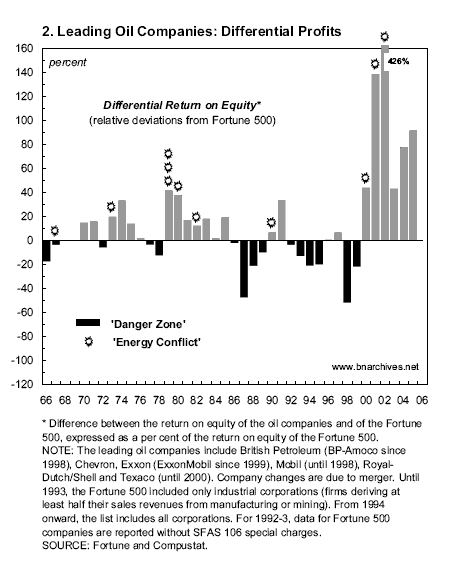
Each bar in the figure measures the difference between the rate of return on equity of these companies and the average rate of return on equity of the Fortune 500 benchmark (with the result expressed as a percent of the Fortune 500 average). The grey bars show years of differential accumulation; that is, years in which the leading oil companies beat the average with a higher rate of return. The black bars show periods of differential decumulation; that is, years in which the leading oil companies trailed the average. For reasons that will become apparent in a moment, these latter periods signal ‘danger’ in the Middle East . Finally, the explosion signs show ‘Energy Conflicts’—namely, conflicts that were related, directly or indirectly, to oil.[7] The figure exhibits three related patterns, all remarkable in their persistence:
First, every energy conflict in the Middle East was preceded by a danger zone, in which the oil companies suffered differential decumulation.
Second, every energy conflict was followed by a period during which the oil companies beat the average.
And, third, with only one exception in 1996-7, the oil companies never managed to beat the average without an Energy Conflict first taking place.




