A Look at the U.S. Dollar Index
January 17th, 2008WARNING: This is not a recommendation to buy, sell or hold any financial instrument.
I’m still bearish, overall, on the U.S. Dollar, but I have slightly less confidence in the bets that I’ve made. There’s no point in trying to parse all the bullshit in the financial press. Let’s look at the chicken entrails instead.
Let’s use a daily chart for the tactical picture:

U.S. Dollar Index, daily interval
I drew a fib fan over the rally up from 74.50. You can see how that has broken down nicely (back through all three fan lines). I then drew a fib fan and a fib retracement to check the progress back down toward 74.50.
I like that the retracement grid is still overhead from the first speed bump on the way down. Dollar bears don’t want it to crawl above that retracement grid, or above the fan. See that green candle above the fan? That kind of thing bugs me, as a dollar bear. Not much, but it has my attention.
Worry? Not yet.
The strategic view still looks promising for dollar bears. Here’s a weekly chart:
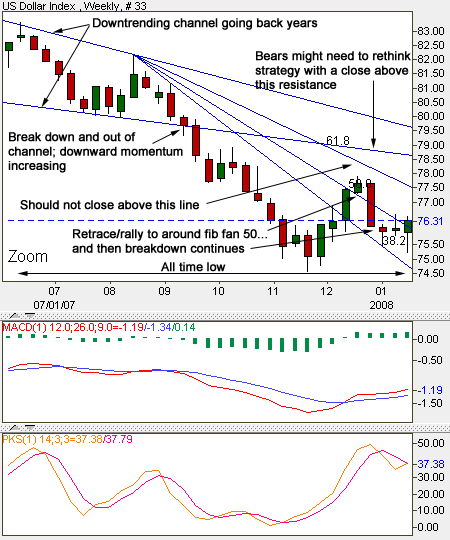
U.S. Dollar Index, weekly interval
In short, Helicopter Ben needs to cut rates to keep those candles inside that down trending fan. We don’t care which band it’s in, as long as the pig is going down. And dollar bears should hope that the cut isn’t priced in already!
When will I begin to lose faith in the collapsing dollar?
I don’t see any need to go there just yet, but I wouldn’t want to see green candles coming up and out of that fib fan. I really wouldn’t want to see those green candles climb through the overhead resistance formed by the previous channel.
But let’s not get ahead of ourselves.
For now, the mantra is, “Lean over you pig. Leeeeaaaaannnnnnnn over! Daddy needs to see some long, red candles. Come on, Ben, put the pedal to the metal on the confetti shredder.”
What could possibly go wrong?
Well, you may have noticed that creditor countries from around the world are essentially buying up Wall Street. A few billion here. A few billion there… Are they converting their own currencies into dollars when they go shopping, or are they using dollars that they already have? I don’t know the answer to that important question. If America is for sale, the purchasers need dollars… If you’re betting against the dollar… Well, I don’t want to cause your morning coffee to seize up on you…
What I do know is that I don’t want to see green candles above that fan on the weekly chart.
Gold Support Holding
January 17th, 2008WARNING: This is not a recommendation to buy, sell or hold any financial instrument.
For everyone who’s not trading this thing…
Near term support might be in at around $876, as per this recent post:
If it can manage to breakdown below $888, look for support around the first fib fan line.
Now, a current two hour interval chart:
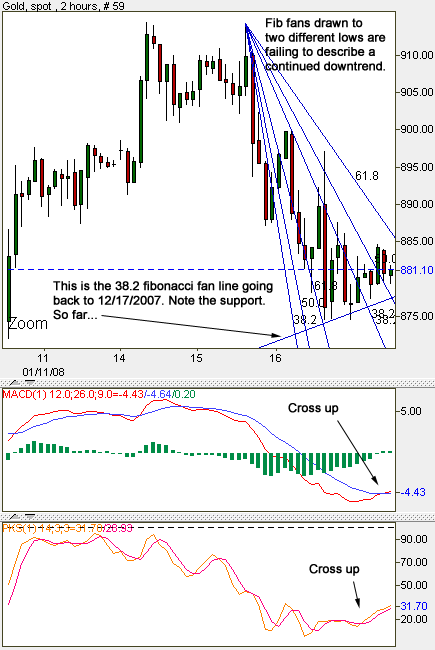
Spot gold, two hour interval
The stochastic and MACD crosses up are nice touches, too.
Oh yeah, read the WARNING again.
UPDATE: 38.2 Fibonacci Support Eventually Failed, Next Stop $865
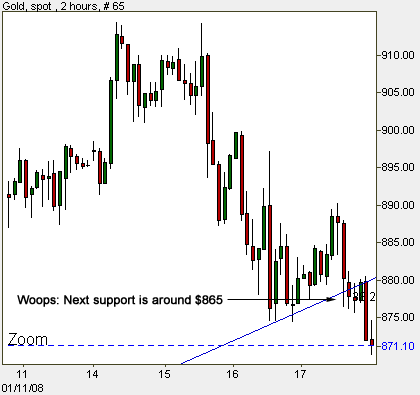
Spot gold, two hour interval
Looking at the weekly chart for a strategic overview, it’s shockingly overbought, and that slow stochastic looks like it may need to relieve itself. It has crossed down. (The daily stochastic is in full retreat to lower bands now.) That’s ok. As you can see, this leg is still very intact.
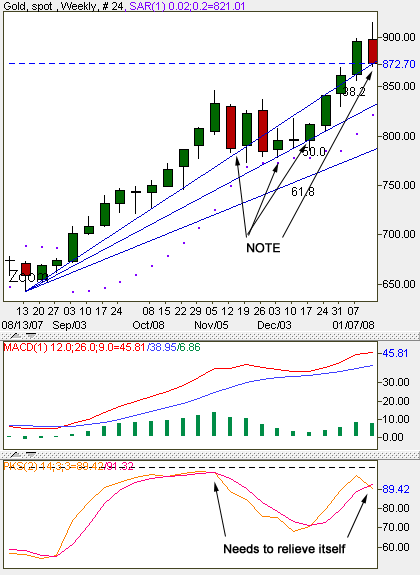
Spot gold, two hour interval
Note: that last red candle isn’t quite complete here. The U.S. and Europe still have Friday trade ahead, but I wanted to provide an update ASAP.
Former Republican Congressman Charged in al-Qaida and Taliban Fundraising Case
January 17th, 2008Via: Yahoo / AP:
A former congressman and delegate to the United Nations was indicted Wednesday as part of a terrorist fundraising ring that allegedly sent more than $130,000 to an al-Qaida and Taliban supporter who has threatened U.S. and international troops in Afghanistan.
Mark Deli Siljander, a Michigan Republican when he was in the House, was charged with money laundering, conspiracy and obstructing justice for allegedly lying about lobbying senators on behalf of an Islamic charity that authorities said was secretly sending funds to terrorists.
A 42-count indictment, unsealed in U.S. District Court in Kansas City, Mo., accuses the Islamic American Relief Agency of paying Siljander $50,000 for the lobbying — money that turned out to be stolen from the U.S. Agency for International Development.
Siljander, who served in the House from 1981-1987, was appointed by President Reagan to serve as a U.S. delegate to the United Nations for one year in 1987.
He could not immediately be reached for comment Wednesday. His attorney in Kansas City, J.R. Hobbs, had no immediate comment.
Wealthy May be Next in Line in Home Crisis
January 17th, 2008Use this handy Realty Track tool to see how many distressed properties are in your area.
Hint: Prepare to experience shock and awe.
Via: Reuters:
A house in this wealthy Chicago suburb is far beyond the reach of most Americans. Unfortunately, Hinsdale may also now be too expensive for some of the people who already live here.
“There is a section of the population here that over-extended themselves to buy here and then keep up the facade of wealth,” said Sharon Sodikoff, a broker associate at local real estate agency Prudential Homelife Realty. “In the next year or so they’ll be forced out in dribs and drabs.”
With a picturesque little downtown area and large, expensive houses — according to the Headrick-Wagner Consulting Group, the average home sale price here in the 12 months to September 30, 2007, was around $1.15 million — Hinsdale seems a world away from the housing slowdown that may have brought the U.S. economy to the brink of a recession.
But even here, far from the housing crisis’ epicenter, high earners with good credit may be heading for trouble as their adjustable rate mortgages (ARMs) adjust beyond their means, local real estate agents and others say. In a normal housing market they’d be able to sell, but now they are stuck.
“The next wave of problems will come from prime borrowers who bought too much house or borrowed too much against it,” said Michael van Zalingen, director of home ownership services at Neighborhood Housing Services of Chicago. A “prime” borrower is one with good credit.
Real estate agents warn that some high-income borrowers have already been forced to sell or leave their homes and more will follow. Especially those who used their homes as ATMs, withdrawing cash via home equity loans.
“For those who utilized home equity loans for five to ten years to finance their lifestyle, the chickens are coming home to roost,” said Chicago-based real estate agent Marki Lemons.
How Will You Spend Your Government Cheese?
January 17th, 2008I wonder what would happen if just five percent of people refused to consume according to Their plan?
Hint: This is my affiliate link to BullionVault.
Via: Guardian / Reuters:
An economic stimulus package to help stave off recession is on the fast track in Congress after Democratic and Republican leaders in the U.S. House of Representatives on Wednesday reached a rare agreement to quickly pull together a bipartisan plan.
…
A jump in the U.S. jobless rate to a two-year high, falling retail sales and a downturn in factory activity have combined with the housing market’s deep slump to stir fears that a six-year expansion may be coming to an end. Some economists warn the economy may already be in recession.
…
Lawmakers are looking at an election-year package of about $100 billion to $125 billion that is likely to include tax rebates of about $250 to $600 to get money quickly into the hands of consumers.
Microsoft Seeks Patent for Office ‘Spy’ Software
January 16th, 2008You betcha.
Via: Telegraph:
Microsoft is developing Big Brother-style software capable of remotely monitoring a worker’s productivity, physical wellbeing and competence.
The Times has seen a patent application filed by the company for a computer system that links workers to their computers via wireless sensors that measure their metabolism. The system would allow managers to monitor employees’ performance by measuring their heart rate, body temperature, movement, facial expression and blood pressure. Unions said they fear that employees could be dismissed on the basis of a computer’s assessment of their physiological state.
Technology allowing constant monitoring of workers was previously limited to pilots, firefighters and Nasa astronauts. This is believed to be the first time a company has proposed developing such software for mainstream workplaces.
Microsoft submitted a patent application in the US for a “unique monitoring system” that could link workers to their computers. Wireless sensors could read “heart rate, galvanic skin response, EMG, brain signals, respiration rate, body temperature, movement facial movements, facial expressions and blood pressure”, the application states.
The system could also “automatically detect frustration or stress in the user” and “offer and provide assistance accordingly”. Physical changes to an employee would be matched to an individual psychological profile based on a worker’s weight, age and health. If the system picked up an increase in heart rate or facial expressions suggestive of stress or frustration, it would tell management that he needed help.
The Information Commissioner, civil liberties groups and privacy lawyers strongly criticised the potential of the system for “taking the idea of monitoring people at work to a new level”. Hugh Tomlinson, QC, an expert on data protection law at Matrix Chambers, told The Times: “This system involves intrusion into every single aspect of the lives of the employees. It raises very serious privacy issues.”
Peter Skyte, a national officer for the union Unite, said: “This system takes the idea of monitoring people at work to a new level with a new level of invasiveness but in a very old-fashioned way because it monitors what is going in rather than the results.” The Information Commissioner’s Office said: “Imposing this level of intrusion on employees could only be justified in exceptional circumstances.”
Japan Poised to Assist Wall Street Banks
January 16th, 2008The Matrix is robust. Look how so many nodes close ranks when a situation threatens to take it down.
Simple greed is another explanation that works well here.
Via: Telegraph:
The three wealthiest Japanese finance houses are set to step into the worsening sub-prime carnage as the “silent investment partners” of Wall Street and Europe’s stricken banking titans.
Senior sources at the “big three” Tokyo megabanks told The Times that they had readied a combined cashpile of as much as $10 billion (£5 billion) and were open to negotiation with any struggling Wall Street bank that approached them for a cash infusion.
Mitsubishi UFJ (MUFJ), Mitsui Sumitomo Financial Group (SMFG) and Mizuho Financial – banks that have been scarred only very lightly by the sub-prime crisis in the United States – are understood to have already opened preliminary talks with several American firms.
One MUFJ insider said that his firm was planning to compete directly with the leading Asian sovereign wealth funds as a long-term investor in the troubled American banks. The Japanese banks, flush with cash and desperate to find ways of raising their return on capital, are keen to become central players in what some predict will be an all-Asian solution to the sub-prime woes contorting America and Europe.
Thieves Target Kansas Grain Elevators
January 16th, 2008Via: KMBC:
The high cost of corn, wheat and soybeans is leading to a rash of thefts from grain elevators in western Kansas.
The thieves have driven big rigs to the grain elevator, filled the truck with cash crops and then sold the grain somewhere else.
“There’s incentives there for the wrong people,” said Adrian Derousseau, who runs the Ottawa Coop grain elevator.
sponsor
Derousseau said he suspects the grain thefts are inside jobs.
“Some of the people that are actually stealing the grain probably know how to run the elevator as well as our own people. And that’s where it becomes very scary,” Derousseau told KMBC’s Martin Augustine.
Augustine reported that a thief could fill up a semi-trailer with 1,000 bushels of corn in about five minutes. That load would be worth $5,000.
The owners of grain elevators are the ones whose profits are swept away.
“When you start losing a $12,000 load of soybeans, it takes a lot of bushels to make up for that,” Derousseau said. “It all comes out of our bottom line. It hurts us.”
Derousseau said he’s so concerned about the grain thefts that he’ll hold a meeting later this week with staff from 14 elevators around Ottawa, encouraging them to be on alert and to review security measures.
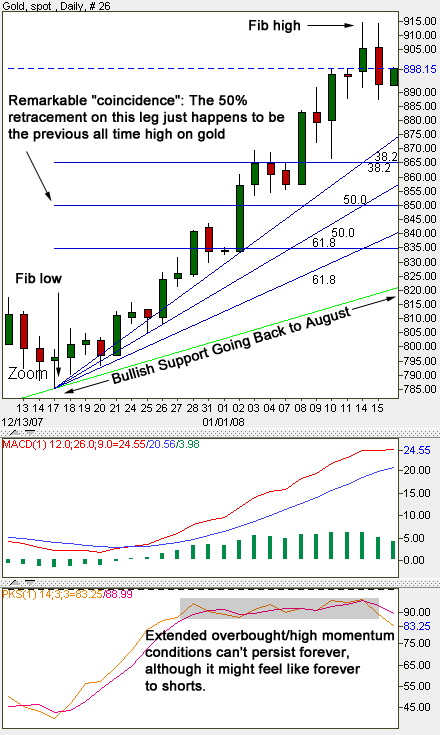
Recent Daily Gold Action with Fibonacci Fan and Retracement Grid
January 16th, 2008WARNING: This is not a recommendation to buy, sell or hold any financial instrument.
The move on gold has been so extreme for so long that I thought I’d take a look at it from a technical perspective. Since we’re above the previous all time high of $850 (yes, I know that the dollar is worth less now than in 1980), and the usual indicators aren’t reliable in these extended overbought / high momentum times, I drew a Fibonacci fan and retracement grid on the recent daily gold chart to try to get an idea of where some near term supports might be.
Recent Daily Gold Action with Fibonacci Fan and Retracement Grid
Guys, it’s so whacked out. I don’t even see a decent dip yet for a buying opportunity. (Even though I bought a gram on some short interval oversold stochastics.) Bears have a bit of traction on intraday charts, but that’s it so far. To look at the idiot press, they make it seem like the price is crashing. HAHA. Well, those PSYOP efforts aren’t working well so far to drive it down.
There was a notable failure to retake $900 on the upside, intraday, but the downside is contained at around $888 so far.
If it can manage to breakdown below $888, look for support around the first fib fan line. Beyond that, $865 for the first retracement. $850… That’s the king daddy support of them all so far. That better hold. (Ben, you better cut. Do ya hear me?) I like stochastic crosses around those levels. Your results may vary. Batteries not included.
Again, I’m not trading gold, I’m accumulating it.
WHOLESALE PRICES IN 2007 UP 6.3%
January 15th, 2008WARNING: This is not a recommendation to buy, sell or hold any financial instrument.
You’re going to cut, Ben.
Don’t even give me any of this “dilemma” nonsense. The Fed can continue to cut, and keep the coke heads on Wall Street twitching for another few weeks or months, or not, and crash the whole damn show. Those appear to be the options, as far as I can tell.
I’ve got to look at some charts. 74.50 on the U.S. Dollar Index must be taken out. If not, all of us gold hoarding dollar bear freaks might need to take evasive action, hedge, cover some positions, etc.
I’ll try to post a USDX chart later today.
HINT: I’m already thinking about laying on a hedge with some Feb DIA and QQQQ puts, but I know it’s just insurance, because, Ben, dammit, you’re going to cut.
Via: AP:
Wholesale inflation last year shot up by the largest amount in 26 years while retailers suffered their worst December shopping season in five years as mounting economic woes caused consumers to put away their wallets.
The Labor Department reported that wholesale inflation was up 6.3 percent for all of 2007, reflecting a huge increase for the year in various types of energy costs ranging from gasoline to home heating oil.
Meanwhile, retail sales fell by 0.4 percent in December, the worst showing in six months, the Commerce Department reported. Consumer confidence has plunged, reflecting the worsening housing slump and a lingering credit crisis.
For inflation, the year ended on a more positive note, with wholesale prices falling by 0.1 percent in December. That reflected decreasing costs last month for gasoline and other energy products. It was a significant slowdown after prices had soared by 3.2 percent in November, which had been the biggest one-month increase in 34 years.
The combination of rising inflation pressures and a weak economy represent a dilemma for the Federal Reserve over whether to cut rates to boost economic growth even at the risk of making inflation worse.
Federal Reserve Chairman Ben Bernanke last week sent a strong signal that the Fed is more worried at the moment about weak growth than inflation — given a series of weaker-than-expected data in recent weeks. He is expected to give an economic outlook update on Thursday to the House Budget Committee.
The economy skidded to a virtual standstill in the final three months of last year, raising fears the country could fall into a recession, unable to withstand the multiple blows from the prolonged downturn in housing, a severe credit crisis and soaring energy costs.
Already, unemployment is rising. The jobless rate jumped to 5 percent in December, up from 4.7 percent in November. That was the biggest one-month surge in unemployment since October 2001 in the wake of the 2001 terrorist attacks.
The various economic threats have sent consumer confidence plunging and pushed the economy to the top of voters’ concerns. Political leaders have responded, with President Bush, Democrats in Congress and presidential candidates from both parties putting forward economic stimulus proposals.
The 6.3 percent increase in the Producer Price Index, which measures cost pressures before they reach the consumer, followed a much more moderate 1.1 percent increase in 2006.
It was the biggest annual price gain since a 6.3 percent rise in 1981, a year when the Federal Reserve was aggressively raising interest rates in a successful effort to combat a decade-long bout of stagflation, rising inflation in conjunction with weak economic growth.
The big increase last year reflected the fact that energy prices rose by 18.4 percent after having declined by 2 percent in 2006. It was the biggest annual increase in energy costs at the wholesale level since they rose by 23.9 percent in 2005.




