US, UK, Australia, Canada and New Zealand Building Biometric Database
January 15th, 2008This article expands on points touched on in FBI Prepares Vast Biometrics Database.
Of course, there’s still no mention of the fact that the states involved make up the ECHELON club.
A couple of interesting notes: Northrop Grumman built the systems that comprise the UK’s biometric fusion center known as IDENT1. Also, a future database for EU member states will also contain DNA profiles!
Via: Guardian:
Senior British police officials are talking to the FBI about an international database to hunt for major criminals and terrorists.
The US-initiated programme, “Server in the Sky”, would take cooperation between the police forces way beyond the current faxing of fingerprints across the Atlantic. Allies in the “war against terror” – the US, UK, Australia, Canada and New Zealand – have formed a working group, the International Information Consortium, to plan their strategy.
Biometric measurements, irises or palm prints as well as fingerprints, and other personal information are likely to be exchanged across the network. One section will feature the world’s most wanted suspects. The database could hold details of millions of criminals and suspects.
The FBI is keen for the police forces of American allies to sign up to improve international security. The Home Office yesterday confirmed it was aware of Server in the Sky, as did the Metropolitan police.
The plan will make groups anxious to safeguard personal privacy question how much access to UK databases is granted to foreign law enforcement agencies. There will also be concern over security, particularly after embarrassing data losses within the UK, and accuracy: in one case, an arrest for a terror offence by US investigators used what turned out to be misidentified fingerprint matches.
Britain’s National Policing Improvement Agency has been the lead body for the FBI project because it is responsible for IDENT1, the UK database holding 7m sets of fingerprints and other biometric details used by police forces to search for matches from scenes of crimes. Many of the prints are either from a person with no criminal record, or have yet to be matched to a named individual.
IDENT1 was built by the computer technology arm of the US defence company Northrop Grumman. In future it is expected to hold palm prints, facial images and video sequences. A company spokeswoman confirmed that Northrop Grumman had spoken to the FBI about Server in the Sky. “It can run independently but if existing systems are connected up to it then the intelligence agencies would have to approve,” she said.
The FBI told the Guardian: “Server in the Sky is an FBI initiative designed to foster the advanced search and exchange of biometric information on a global scale. While it is currently in the concept and design stages, once complete it will provide a technical forum for member nations to submit biometric search requests to other nations. It will maintain a core holding of the world’s ‘worst of the worst’ individuals. Any identifications of these people will be sent as a priority message to the requesting nation.”
In London, the NPIA confirmed it was aware of Server in the Sky but said it was “too early to comment on what our active participation might be”.
The FBI is proposing to establish three categories of suspects in the shared system: “internationally recognised terrorists and felons”, those who are “major felons and suspected terrorists”, and finally those who the subjects of terrorist investigations or criminals with international links. Tom Bush, assistant director at the FBI’s criminal justice information service, has said he hopes to see a pilot project for the programme up and running by the middle of the year.
Although each participating country would manage and secure its own data, the sharing of personal data between countries is becoming an increasingly controversial area of police practice. There is political concern at Westminster about the public transparency of such cooperation.
A similar proposal has emerged from the EU for closer security cooperation between the security services and police forces of member states, including allowing countries to search each other’s databases. Under what is known as the Prum treaty, there are plans to open up access to DNA profiles, fingerprints and vehicle registration numbers.
Modeling Urban Panic
January 15th, 2008Via: Pruned:
Paul Torrens is someone after our hearts, for he has developed a realistic computer 3D model that can predict crowd behavior in various spatial configurations.
It can simulate, for instance, how people navigate through busy city streets, shoppers through urban shopping centers, and tourists through unfamiliar landscapes.
“The goal of this project is to develop a reusable and behaviorally founded computer model of pedestrian movement and crowd behavior amid dense urban environments, to serve as a test-bed for experimentation,” says Torrens. “The idea is to use the model to test hypotheses, real-world plans and strategies that are not very easy, or are impossible to test in practice.”
Such as the following: 1) simulate how a crowd flees from a burning car toward a single evacuation point; 2) test out how a pathogen might be transmitted through a mobile pedestrian over a short period of time; 3) see how the existing urban grid facilitate or does not facilitate mass evacuation prior to a hurricane landfall or in the event of dirty bomb detonation; 4) design a mall which can compel customers to shop to the point of bankruptcy, to walk obliviously for miles and miles and miles, endlessly to the point of physical exhaustion and even death; 5) identify, if possible, the tell-tale signs of a peaceful crowd about to metamorphosize into a hellish mob; 6) determine how various urban typologies, such as plazas, parks, major arterial streets and banlieues, can be reconfigured in situ into a neutralizing force when crowds do become riotous; and 7) conversely, figure out how one could, through spatial manipulation, inflame a crowd, even a very small one, to set in motion a series of events that culminates into a full scale Revolution or just your average everyday Southeast Asian coup d’état — regime change through landscape architecture.
More: Geosimulation
Related: Synthetic Environments for Analysis and Simulation
Government Must Have Access to All Internet Traffic in the U.S.
January 15th, 2008They already have it, so I don’t know WTF black hole the next round of funding and bleating is going to be about.
Via: Wall Street Journal:
Spychief Mike McConnell is drafting a plan to protect America’s cyberspace that will raise privacy issues and make the current debate over surveillance law look like “a walk in the park,” McConnell tells The New Yorker in the issue set to hit newsstands Monday. “This is going to be a goat rope on the Hill. My prediction is that we’re going to screw around with this until something horrendous happens.”
At issue, McConnell acknowledges, is that in order to accomplish his plan, the government must have the ability to read all the information crossing the Internet in the United States in order to protect it from abuse. Congressional aides tell The Journal that they, too, are also anticipating a fight over civil liberties that will rival the battles over the Foreign Intelligence Surveillance Act.
Part of the lawmakers’ ire, they have said, is the paltry information the administration has provided. The cyberspace security initiative was first reported in September by The Baltimore Sun, and some congressional aides say that lawmakers have still learned more from the media than they did from the few Top Secret briefings they have received hours before the administration requested money in November to jump start the program.
Naval Incident Involving the U.S. and Iran Almost Certainly a Covert Attempt to Start War
January 14th, 2008You may have noticed that I refused to touch that incident. I knew it was total bullshit, but I had nothing to point at whatsoever to back up my “gut” feeling.
It’s a few days later…
So, with U.S. and Iranian warships in close proximity in the Strait of Hormuz, threatening radio traffic was transmitted, from points unknown, that purported to be from the Iranian vessels. That’s right. The threats delivered to the U.S. Navy didn’t come from the Iranian navy vessels.
I thought Bush and Cheney had been reigned in on Iran.
Maybe not.
Well, WWIII hasn’t broken out. Yet.
Via: Telegraph:
Threats to US ships in the Strait of Hormuz heard at the end of a Pentagon-released recording of an incident between Iranian patrol boats and US Navy warships last week may have been the work of a local heckler known as the “Filipino Monkey”, The Navy Times has reported.
A video released on Friday showed several small Iranian boats approaching US ships in an incident that President Bush has described as “provocative”, while a previously-released audio recording included a threat to destroy the ships.
The Pentagon says the threat was received during the incident.
In accented English a voice is heard to say “I am coming to you … You will explode in a few minutes.” Pentagon officials had previously stated that the voice came from one of the boats, but they are now distancing themselves from that claim, saying instead that they do not know the source of the transmission.
The Navy Times said that the voice in the audio did not match that of an Iranian officer shown speaking to Navy cruiser USS Port Royal over the radio in a video released by the Iranian authorities.
This has led several Navy experts to raise the possibility that a heckler, known locally as the “Filipino Monkey” – or a copycat – could have made the threats.
“Filipino Monkey” is believed to be more than one person. Its modus operandi is to listen in to ship-to-ship radio traffic before jumping in with insults and threats.
According to The Navy Times, US Navy women come in for particularly harsh treatment.
A civilian mariner told the paper that the “Filipino Monkey” phenomenon is worldwide, but more common in areas of heavy shipping such as the Strait of Hormuz.
Despite the discovery that Iran may not have been behind the threats, US President George W Bush has not toned down his rhetoric against the Islamic state. Speaking during his eight-day tour of the Middle East, Mr Bush described Iran as “the world’s leading state sponsor of terror,” which funds extremists, stirs up unrest in Lebanon, arms the Taliban, and threatens the stability of the entire Middle East with its refusal to fully disclose the facts surrounding its nuclear programme.
More: The Cheneyites Nearly Started WWIII Over “Filipino Monkey” Radio Signal
£50bn Bill to ‘Nationalise’ Northern Rock
January 14th, 2008“Sterling holders, consider reducing or eliminating your exposure to GBP denominated assets immediately…
The British government’s guarantee might seem like good news to the average sterling holder, but think about how the government would guarantee those funds, in practice.
Printing presses.”
—September, 2007: EMERGENCY: U.K. GOVERNMENT TO COVER 100% OF NORTHERN ROCK DEPOSITS
I don’t use the EMERGENCY label often. When I do, I’m not kidding. That Northern Rock situation was as close as we have come to the curtain coming down on the whole show. Of course, the British government just bought some time, and everyone who has held sterling got screwed even worse than those who held the doomed dollar!
Like many of the other crises out there, this one if far from over.
And imagine my shock that Goldman Sachs is behind the latest machinations related to getting the British people to pay for this disaster!
Via: Telegraph:
Northern Rock faces effective nationalisation by the end of the month at a potential cost to the taxpayer of over £50 billion.
Mr Darling, who has appointed the City banker Ron Sandler to chair the new company, will justify the move by claiming that the Government is using “state oversight” to run the bank while it tries to sell its assets.
But by failing to find a private buyer, Mr Darling has been unable to reduce the billions of pounds in loans that Northern Rock has received from public funds.
So far the Government’s attempt to rescue the bank is threatening to cost each taxpayer £1,800 – a combination of the loans and public guarantees to investors.
The move towards nationalisation, which will add more than £50 billion to the national debt, will be a major blow to Labour and the Chancellor. Last night the Conservatives said it would evoke images of Labour governments of the 1970s.
Philip Hammond, the shadow chief secretary to the Treasury, said: “This would be a damaging admission that the policy in September had failed. It is hugely damaging to Britain’s reputation.
“The idea that London calls itself the premier banking centre and yet needs the Government to step in to nationalise a bank sends out the wrong message completely.”
Northern Rock will hold an extraordinary general meeting tomorrow at which shareholders will try to limit the board’s power to sell off the bank.
But Treasury sources say this is unlikely to be the trigger for the Government putting the bank in state hands. Instead it is likely to be another point within two weeks.
The Goldman Sachs report is understood to have concluded that there are no viable private buyer options open to the Treasury.
Related: Sterling Takes Bigger Beating than the Dollar
GOLD BREAKS ABOVE $900
January 14th, 2008Printing $911 intraday.
Via: Guardian:
Gold surged through the $900 barrier this morning, hitting a record high of $906.70 an ounce as investors continued to pile in to the precious metal. Platinum also reached a new record and silver hit a 27-year high.
Turmoil in world financial markets in recent months has heightened the appeal of gold and other precious metals as a safe haven investment. Speculators have also been buying on expectations that further cuts in US interest rates will push the dollar lower.
Retail in a State of “Anarchy” as Consumers Retreat
January 14th, 2008If consumer stocks bounce on the latest Fed confetti shredder action, let’s all work together to draw up a target list of the most succulent pigs to short/buy puts on to profit from a whipsaw back down. My logic is that the rate cuts will cause more inflation, making things more difficult for consumers.
—Helicopter Ben About to Shift the Confetti Shredder Into Afterburner
“Paging Helicopter Ben: We need a sucker bounce out there so we can short some pigs from higher up. Thank you.”
Via: Reuters:
U.S. chain stores, reeling from the slowest holiday shopping season in five years, got some more bad news on Sunday: 2008 will not be any better and could see changes that may shift the retail playing field forever.
As the National Retail Federation kicked off its annual convention in New York, two retail consultants offered negative outlooks for the U.S. retail industry, which has seen consumers pull back amid higher gasoline and food prices, a credit crunch and a prolonged housing market decline.
“It’s anarchy,” said Wendy Liebmann, chief executive of WSL Strategic Retail, frequently repeating the word she used to sum up the latest results of her company’s bi-annual shopper study.
“Americans cannot control the big things such as oil prices, falling home values, mortgage costs and rising property taxes, so they want to control the small things,” Liebmann said. “They are watching what they spend on everything.”
Liebmann said most shoppers were making fewer weekly shopping trips and spending significantly less on discretionary items such as home appliances and decor, fashion accessories, electronics, perfume, computers and software.
The only two categories getting a larger share of consumers’ wallets are food and pet supplies, Liebmann said, noting however, that food prices have increased.
PAKISTANI TROOPS ESCORT WHEAT TRUCKS
January 14th, 2008What do you get when you multiply the perfect storm in the grain markets with a state on the brink of failure?
Pakistan.
And don’t forget the nukes.
Via: Reuters:
Pakistani paramilitary troops have begun escorting trucks carrying wheat to stop supplies being stolen amid shortages of flour that have inflamed anger against the government before an election, an official said on Sunday.
Pakistanis are complaining bitterly about a shortage of wheat flour and rising prices of the staple food which the government has blamed on hoarding and smuggling to neighboring countries.
Farooq Ahmed Khan, chief of the National Disaster Management Authority, said some supplies had been going missing somewhere along the supply chain.
“It seemed there could be something wrong along the chain from warehouses to mills and then to distribution points,” Khan told Reuters.
“Basically, we’re providing escorts and will monitor the entire chain so there is no chance of pilferage,” said Khan, whose authority is supervising the monitoring.
Authorities have also been given “special powers” to detain hoarders and smugglers, he said.
Khan said wheat stocks were sufficient and he described the flour shortage as “artificial”. The government was monitoring borders to stop flour being smuggled out of the country, he said.
“Within a few days thing should change for the better,” he said.
Most Pakistanis eat roti or unleavened bread at almost every meal.
In recent days, angry shoppers have been queuing for hours to get their hands on flour, adding to worries for the government in the run-up to a February 18 general election.
A top Agriculture Ministry official said the government had sufficient wheat stocks and about 1.5 million tonnes of imported wheat would reach Pakistan by the end of February.
Authorities were releasing more than enough supplies to meet demand, especially from the country’s urban population, said Ministry secretary Zia-ur-Rehman.
“There’s no shortage. Forty-two thousand tonnes a day is now being released which is more than enough,” Rehman said.
Soybeans Soar to Record, Grains Rally as Demand Erodes Supply
January 14th, 2008WARNING: This is not a recommendation to buy, sell or hold any financial instrument.
Corn, wheat and soybeans were all limit up on Friday.
I almost fell out of my chair when I saw the one day gain on PowerShares DB Agriculture (DBA). It was up 5.65% at $36.45. You may remember that I put out my first bullish call on DBA when it was trading around $27 back on September 18th of last year.
And here was my assessment for 2008 on food:
In 2008, food could become a out front national security issue in the developed world. My top concerns are wheat and corn. For hundreds of millions of people, especially in America and Europe, this will translate into higher food costs across the board.
I want to take a look at DBA from a technical perspective, especially after Friday’s close.
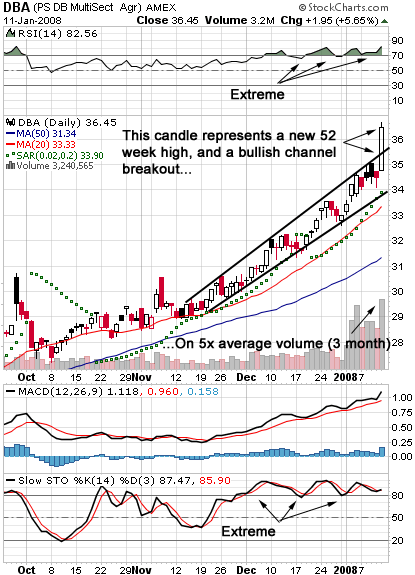
PowerShares DB Agriculture (DBA)
I think I’m going to have to stick with it. I see strength piling on top of strength here. Although RSI and stochastics are extremely overbought, the break up and out of the channel trumps the other indicators for me. The channel breakout was also a new 52 week high on five times the three month average volume.
With RSI and stochastics so extreme for so long, I will look at buying protective February put options just in case the thing unwinds violently; a real possibility. If it comes down, I’ll pocket some winnings on the put options without having to exit my main position. I’d probably buy more on any pullback with supports in tact.
Now, note the comments of the trader in the Bloomberg piece below:
“We can’t grow our way out of this grain-shortage hole,” said Jim Gerlach, president of A/C Trading Inc. in Fowler, Indiana. “We’ll have to price our way out. I’m bullish until further notice. We’ll see ups and downs, but the trend will remain higher.”
“We’ll have to price our way out.”
Did you catch that?
The translation of, “We’ll have to price our way out,” is: A) People are going to starve to death because of this; and B) States with too many people facing starvation are going to have national security crises on their hands.
Via: Bloomberg:
Soybeans jumped to a record, corn reached an 11-year high and wheat rallied after U.S. government reports showed that production is failing to keep pace with rising global demand for food and biofuels.
The world soybean harvest will fall 6.5 percent this year, U.S. corn inventories will be 20 percent less than estimated a month ago, and wheat farmers in Kansas and Texas planted less even as the price of the grain doubled, the Department of Agriculture said in separate reports today.
Tighter supplies will boost the cost of feed for hog processor Smithfield Foods Inc. and poultry producer Pilgrim’s Pride Corp. General Mills Inc., the second-biggest U.S. cereal- maker, said today it raised the price of Pillsbury refrigerated dough to offset higher wheat costs. Globally, food prices have doubled on average in the past five years, UN data show.
“We can’t grow our way out of this grain-shortage hole,” said Jim Gerlach, president of A/C Trading Inc. in Fowler, Indiana. “We’ll have to price our way out. I’m bullish until further notice. We’ll see ups and downs, but the trend will remain higher.”
Mysterious $100 ‘Supernote’ Counterfeit Bills Appear Across World
January 13th, 2008I’ve seen vague stories in the media about these “supernotes” for years, but this article goes much further than anything I’ve read before. Highly recommended.
Via: Kansas City Star:
Whatever the origin of the bills, “it’s by far the most sophisticated counterfeiting operation in the world,” said James Kolbe, a former congressman from Arizona who oversaw funding for the Secret Service. “We are not certain as to how this is being done or how it’s happening.”
—The paper appears to be made from the same cotton and linen mix that distinguishes U.S. currency from others. It includes the watermarks visible from the other side of the bill, colored microfibers woven into the substrate of the banknote and an embedded strip, barely visible, that reads USA 100 and glows red under ultraviolet light.
—The bills include tiny microprint that appears as a line to the naked eye, but under magnification is actually lettering around the coat of Benjamin Franklin or hidden in the number 100 that reads either USA 100 or The United States of America.
—The same optically variable ink, or OVI, is used on the number 100 on the bottom right side of the bill. Exclusively made for, and sold to, the United States, this OVI ink gives the appearance of changing color when a banknote is viewed from different angles.
—At least 19 different versions have been printed, each corresponding to a tiny change in U.S. engraving plates — an odd thing for any counterfeiter to do. Also, they show practically invisible but intriguing additions.
—Stranger yet, the number of supernotes found indicates that whoever is printing them isn’t doing so in large quantities. Only $50 million worth of them have been seized since 1989, an average of $2.8 million per year and not even enough to pay for the sophisticated equipment and supplies needed to make them.
Industry experts such as Thomas Ferguson, former director of the Bureau of Engraving and Printing, said the supernotes are so good that they appear to have been made by someone with access to some government’s printing equipment.
Some experts think North Korea does not have the sophistication to make the bills; others suspect Iran and others speak of criminal gangs in Russia or China.
Klaus Bender, the author of Moneymakers: The Secret World of Banknote Printing, said the phony $100 bill is “not a fake anymore. It’s an illegal parallel print of a genuine note.” He claims that the supernotes are of such high quality and are updated so frequently that they could be produced only by a U.S. government agency such as the CIA.




