GOLD SMASHES THROUGH ALL TIME HIGH TO $861.80 INTRADAY
January 2nd, 2008“From a technical analysis perspective, a move above $850 will probably set off buy triggers as shorts move to cover.”
—Cryptogon, December December 29, 2007
Ok, support is now $850. Let’s look for consolidation anywhere above $850.
GOLD COULD TEST ALL TIME HIGH TODAY
January 2nd, 2008It was a Guesses for 2008 post, not a Guesses for Later Today post!
Sheesh!
Congrats to all gold longs.
Via: Reuters:
Gold swept to a 28-year high on Wednesday driven by surging oil, a weaker dollar and simmering geopolitical tension, making a test of record highs at $850 an ounce a real possibility on the first business day of 2008.
Other metals jumped on bullion’s bandwagon with platinum closing in on a record $1,542 an ounce, silver hitting a five-week high and palladium at its best in six weeks.
Spot gold surged to $848.60 an ounce — its highest since January 1980 when gold prices were fixed at a record $850.
It later backtracked slightly to $846.30/847.00 by 9:07 a.m. EST, compared with $832.70/833.50 quoted late in New York on Monday.
“The fundamentals are very strong for gold — there’s no doubt about it,” said David Thurtell, metals analyst at BNP Paribas.
“Certainly the safe-haven bid, weaker dollar and credit market turmoil has been favorable for gold, and oil hitting $97 is not doing it any disservice,” he added.
Gold gained more than 30 percent in 2007, in its biggest annual gain since 1979.
The euro was up half a percent on the day versus the dollar with investors betting that upcoming U.S. economic news might be weak enough to confirm a need for more U.S. interest rate cuts.
Ireland: Stock Market Crashed in 2007
January 2nd, 2008Via: Wall Street Journal:
Ireland’s decade-long Celtic Tiger economy not only ran out of steam in 2007, it bled copiously, judging by the woeful performance of its stock market.
After faring better than most major global indexes over several years, the benchmark ISEQ index was one of the worst-performing markets in the world this year, tumbling 26.1%.
“The party’s over” has become the favorite phrase among commentators after 10 years of rapid economic growth, a buoyant stock market, record house prices, near-full employment and ballooning consumer borrowing.
But while economists don’t see an end to the souring of sentiment toward the Irish stock market, they say the past year’s terrible performance is a massive overreaction, given Ireland’s still-healthy economic outlook.
The reason? Ireland has been caught in a double whammy of the international liquidity crunch, started this summer in the U.S. subprime-mortgage market, and its own housing slump, said Robbie Kelleher, head of research at Davy Stockbrokers. As a result, the price/earnings ratios of some Irish companies have fallen to levels not seen in as many as 20 years.
Blue-chip financials make up 40% of the ISEQ, while the construction sector accounts for around 20%. Both have taken a battering. Some fear that the steep declines could continue well into 2008, particularly if housing prices fall 10%, as some have predicted.
Economists have likened Ireland to Spain, which also began to suffer a construction meltdown in 2007. As in Spain, the Irish construction woes have been enough of a catalyst for international investors to unload their stocks.
A slowdown in building also is a big reason that the Irish economy is expected to slow in 2008. The Economic & Social Research Institute, based in Dublin, expects that gross national product, which excludes earnings from multinational companies that are based in Ireland and were a key driver of the 1990s boom, will grow by 2.8%, the slowest rate of expansion in 16 years.
The think tank also said house prices are overvalued by about 15%. They fell an average of 6% in 2007 after rising 12% in 2006.
In another sign that the Celtic Tiger is fading, Finance Minister Brian Cowen in December unveiled a conservative 2008 budget that foresees real gross domestic product growth of only 3%, down from 4.75% in 2007 and earlier government estimates for 2008 of 3.25%. The budget also foresees a rise in unemployment to 5.5% in 2008, from around 4.5%.
Already, some banks have issued profit warnings. Bank of Ireland PLC in November cut its growth projection for underlying earnings per share for the fiscal year ending March 31 to a high-single-digit rate from previous guidance of low-double-digit growth, citing tightening global credit markets. The announcement cast a pall on all financial stocks. Bank of Ireland shares plummeted 42% in 2007.
RiverGlass
January 2nd, 2008I bet my nga.mil reader will click the link, and all the other spooks who finally started masking their IPs.
Via: RiverGlass:
Keeping pace with new data has emerged as the critical issue facing government intelligence operations. The variety and volume of incoming data and the responsibility to respond appropriately now more than exceeds the volume of archived records to consult during an investigation. Analysts are simply unable to effectively monitor this massive influx of data. Tools that continuously analyze and automatically connect incoming data to open investigations have become a necessity for intelligence-led policing.
NSA are encountering problems with the flood of information that people [in the outside world] won’t see for an [IT] generation or two, we’ve seen the future and the problems of a ‘tidal wave’ of data.
– Senior official, Office of the Director of National Intelligence
RiverGlass has responded to this critical national security issue by applying its sophisticated machine learning techniques for analyzing streams of disparate data to the information overload problems facing intel analysts today. RiverGlass and the Statewide Terrorism Intelligence Center (STIC) of the Illinois State Police have jointly developed a suite of tools tailored to the specific needs of analysts working in a fusion center environment. Along with unique visualizations and analytics, this collaboration has produced an ontology of more than 85,000 terms – to both enhance and simplify analytical results – with built-in expert knowledge of STIC analysts. This RiverGlass public safety ontology contains data definitions of the entities important to a fully-compliant extension of the Global Justice XML standard.
The end result is an analytics solution specifically geared toward fusion centers and other government intelligence agencies, enabling them to gain and maintain a complete intelligence picture, 24/7.
RiverGlass Enables Government & Intelligence to:
Find relevant entities contained within the data. By mapping query results into distinct categories, RiverGlass organizes and presents information according to these real-world concepts. Analysts view data in terms of the subjects of an investigation – people, methods, places, targets and more – and can also quickly find and access documents that show relationships across different subjects.
Automatically seek out and monitor websites that relate to criminal investigations or other intel needs. Information posted to the Internet from diverse sources like CNN, MSNBC, Southern Poverty Law Center, the Anti-Defamation League, and Department of Justice, as well as sites that post threatening or criminal content is critical to effective data analysis. The Web, however, is expanding at an exponential rate and analysts are faced with extreme information overload. RiverGlass tools allow analysts to activate searches that intelligently and continuously scan the web for information relevant to them and their organization. Because of its access to the context of an organization through a customized ontology, RiverGlass tools can more quickly discover where relevant content exists.
Be alerted to meaningful connections in incoming data – enabling true intelligence-led policing. RiverGlass works with government and intelligence agencies to appropriately monitor incoming data and alert analysts as soon as important information becomes available. The alert criteria can be anything from monitoring for simple changes in a suspect profile to sophisticated threat-assessments using statistical and machine learning pattern detection techniques.
Access all data from a single place. Single sign-on federated query allows analysts to quickly access data across databases, file systems, web documents, and services like Westlaw and LexisNexis without juggling multiple applications and login information.
Streamline the consumption of daily intel reports. Although communication between agencies has improved, the resulting volume of text that must be read by analysts on a daily basis – much of it cut-and-paste from other reports – has created a significant burden. RiverGlass develops intuitive visualizations that give an analyst a comprehensive view of the information in a collection of reports without ever being forced to read the same information twice. RiverGlass’ ability to distill information found in periodic intelligence reports, and to identify redundant sections across these reports, is particularly useful.
Nightmares
January 2nd, 2008Via: Psychology Today:
If dreams evolved to simulate the threats in our environment, then being exposed to more dangers in real life should activate the nightmare function, overstuffing our dreams with threats. This is precisely what happens. Even a single exposure to a life-threatening situation can plunge a person into an inferno of post-traumatic nightmares, dreams in which the threatening event—the attack, the rape, the war—is repeated over and over in every possible variation.
Studies of traumatized Iraqi and Palestinian children who grew up in extremely violent environments, some of whom witnessed their parents’ deaths, show that their dreams are phantasmagoric carnivals of threatening events. People who watched more television on September 11, 2001, and saw threatening images were more likely to dream about the events of that day; people who merely talked about it with others were less likely to dream about it.
Traumatic dreams do seem to rehearse relevant threats. Just four weeks into the first Gulf War, as Scud missiles were raining down on Tel Aviv and Haifa, the war was already encroaching on the dreams of Israeli college students, according to a study. The most prominent topic: gas masks.
Related: The Power of Nightmares
Some Guesses About 2008
January 2nd, 2008WARNING: This is not a recommendation to buy, sell or hold any financial instrument.
This took me a bit longer to write than I thought it would. Apologies.
Here are some issue areas that I think will be interesting to watch in 2008.
Economy
I don’t see the U.S. Dollar catching much of a break in 2008. All of the factors that contributed to the dollar’s steep decline in 2007 will persist going forward, and intensify. The ARM (Adjustable Rate Mortgage) resets don’t peak until March 2008. My guess is that homeowners with these loan products will wind up in very dire situations within six months of the reset. That puts the crescendo of the economic crisis in September 2008. Even if the ridiculous subprime bailout manages to keep some people in their McMansions for a few months more, the cost of the program is going to be paid by U.S. Dollar holders.
How is the U.S. Government going to cover all of those reckless bets?
With printing presses, of course.
From a technical perspective, the U.S. Dollar Index chart shows extreme weakness. On the weekly chart, the USDX can’t even get a foot hold over the 20 period moving average, never mind the 50 period MA. You can see how it broke down and out of the intermediate term channel as negative momentum piled on. Note how the bottom of that channel line now forms an overhead resistance. I think that the way to read the shorter interval stochastic and MACD indicators is to think of the last few weeks as a dead cat bounce with central banks loaning “unlimited” ones and zeros to distressed commercial banks. At a minimum, look for a retest of 74.50 on the downside.

Weekly Interval U.S. Dollar Index
When a move has been so extreme for so long, I start drawing more squiggly lines on charts and flinging more chicken entrails at the wall. I don’t see anything there that looks like a bottom or consolidation yet. I wouldn’t be surprised if we were to see range bound action between 74.50 and 78, maybe for months. If you forced me to guess at the likelihood of a break below 74.50 in 2008, I’d put it at 70%. On the long side, don’t ask me how it would happen, but take note of a weekly green candle above 78. Dollar shorts/foreign currency holders will need to reassess their strategies at that point. If it rallies above 80, regardless of what dollar shorts/foreign currency holders know to be true, the squeeze from here could leave people walking funny. This is why we’re diversified. Right? Right.
I don’t know what’s going to happen, but what I do know is that the dollar, gold and oil are all near critical (make or break) levels. Those levels are:
USDX 74.50 — all time low
Gold $850 — all time high
Oil $98 — all time high
While people can and do argue about the correlations, if the USDX crosses below 74.50, gold and oil are almost certainly going over their all time highs in 2008. However, any number of factors could push gold and oil over their all time highs at any moment, even if the dollar consolidates and trades sideways (rangebound).
With the peak in global oil production almost certainly behind us (July 2006 @ 85.47 mbpd), oil appears to be building a base over $90. What has been passed off as a risk premium for months is giving way to the brutal reality that production is declining.
Barring demand destruction—resulting from some unforeseen wildcard event or events—energy costs will almost certainly continue to rise in 2008. There are lots of energy technologies in the pipeline [pun intended—but you’ll have to wait to see what I’m referring to here], but I don’t see any of it ameliorating energy prices this year.
In the case of gold, economic uncertainty could make gold VERY attractive to both sterling and euro holders who are looking to move out of their fiat currencies that have gained so much in value recently due to the dollar crash.
Think of the longer term effects on European economies of the dollar collapse and Americans becoming unable to purchase goods from Europe. Germany is the most vulnerable. The U.S. is Germany’s second-largest trading partner and the U.S. runs huge bilateral trade deficits with Germany. (See: U.S. State Department.)
The largest German firms have expertly used hedging strategies in the Forex markets to mitigate the effects of dollar declines in the past. Smaller exporters, though, could be facing a very hard year. The U.S. and Germany have tied ropes around each other. If the U.S. slips off the cliff, Germany will go with it.
Now, I could have written a similar analysis about lots of other countries and their relationship to the U.S. (New Zealand, in particular), but Germany is the economic powerhouse in Europe. This is a key bilateral relationship to watch.
How about China?
China is a very curious puzzle. Is 2008 the year when the diabolical greed, non existent environmental focus and the repressive nature of the regime starts to gum up the works? (Again, this is about China, not the U.S. It can get confusing, I know.)
Of course not! The Olympics are going to be held in Beijing.
As the scientifically engineered propaganda oozes from the various fascist information ministries in China, the collapse indicators have gone off the chart:
Birth Defects in Chinese Infants Have Soared Nearly 40 Percent Since 2001
China: Food Crops Grown in Soil Polluted with Heavy Metals
CHINA: 36 MAJOR CITIES TOLD TO KEEP FOOD, OIL RESERVES
In other words, in 2008, China will continue to collapse AND spew iPods by the millions.
One last thing to keep in mind with China: The regime has amassed a reserve of about US$1.3 trillion. Might the Chinese have invited the biggest Trojan Horse weapon in the history of the world inside their gates? A Dollar Bomb, if you will. Right now, the strategic calculus for China involves spending those doomed dollars on food, energy and raw materials in a way that doesn’t panic markets.
Food
Food prices are perfect storm indicators. Food prices reflect top soil depletion/erosion, drought and rising energy costs. Just a few stories:
Fastest rise in food prices for 14 years
From milk to meat, US food prices spike upward
In 2008, food could become an out front national security issue in the developed world. My top concerns are wheat and corn. For hundreds of millions of people, especially in America and Europe, this will translate into higher food costs across the board.
2008 U.S. Presidential Election
As you know, I feel as though a focus on U.S. national elections is a gross waste of time. It’s the wrong level of analysis. But I’ll go there anyway for this piece.
To Dennis Kucinich and Ron Paul supporters: I’d encourage you to read the Waiting for Clarity on the Brink of Oblivion post, if you haven’t already. Kucinich and Paul supporters are very sincere and, quite frankly, I haven’t had the heart to apply my grim perspectives on the U.S. political system to their candidates.
But…
Dennis Kucinich won’t be allowed anywhere near the White House.
Ron Paul won’t be allowed anywhere near the White House.
Is that why I don’t support Paul or Kucinich?
No. I have serious problems with both of them.
I don’t support Kucinich because I feel that individuals need more freedom, not less freedom.
I don’t support Paul because I feel as though corporations need less freedom, not more freedom.
Both of these candidates come with hefty amounts of rat poison. But, hey, this is American politics and these are the two best candidates, as far as I can tell.
For the record, I’ve read the candidates’ positions and Ron Paul would be my first pick and Dennis Kucinich would be my second pick, if, that is, I decided to participate in the absurd process. That Kucinich would be my second choice if Ron Paul was first might not seem to make sense, at first.
Here’s why it does. You have to enter a fantasy world, though. Don’t worry, this won’t take long. I’d like to see a Kucinich/Paul co presidency. If you’re an officer of a corporation, or other responsibility avoidance scheme, Dennis Kucinich is your president. If you’re NOT an officer of a corporation, or other responsibility avoidance scheme, Ron Paul is your president. Anyway, that’s enough lollygagging in fantasy land for now.
My best guess about the (s)election is that it will be a Democrat. The next phases of the globalist script probably involve the collapse of the U.S. economy and the creation of the North American Union. Hillary seems like the best shill, but Obama is closer to representing the strange false hope that millions of fools fell for with Bill Clinton’s presidency.
I can’t see how Rudy, or any of the Snake Handlers, can serve the interests of the elite as well as Clinton or Obama in the next phase.
Ok, I’m going to cut this off here. It’s getting too long, and the regular grist is piling up beyond manageable levels.
Several Updates to Bhutto Thread
January 1st, 2008FYI: There have been several updates to: Benazir Bhutto Assassinated:
UPDATE #7: U.S. Special Forces Standing By to “Seize or Disable” Pakistan’s Nuclear Weapons
UPDATE #6: The Benazir Bhutto Dossier: ‘Secret Service Was Diverting U.S. Aid for Fighting Militants to Rig the Elections’
UPDATE #5: Bhutto Was Shot in the Head, Despite Absurd Statements by Pakistani Government
UPDATE #4: Benazir Bhutto: Osama Bin Laden Murdered
UPDATE #3: Pentagon Says Pakistan Nuclear Arsenal Secure (See Update 7 for translation)
UPDATE #2: Al-Qaida
UPDATE #1: U.S. Special Forces Are to Increase Presence in Pakistan
Click through to read updates, or leave a comment.
Open Thread: Happy New Year
December 31st, 2007Happy New Year, everyone. I tried to think of an inspired and inspiring image to post here, but, somehow, I kept coming back to this. HA You’re either a Charles Bukowski fan, or you’re not:
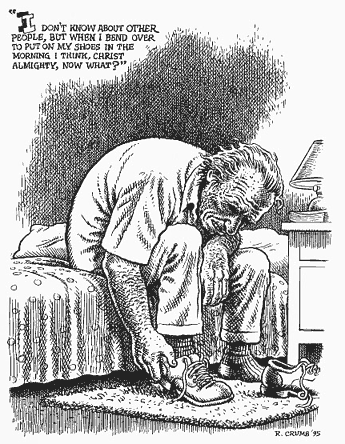
Chuck greets the morning
In 2008, lots of us are going to be thinking, “Christ Almighty, now what?”
Cryptogon Reader Contributes $100
December 31st, 2007JW, a core Cryptogon contributor, closed out a remarkable year of reader generosity by sending $100.
Thank you.
He suggested a post about what I think might be ahead in 2008. Wow. That’s a hard one. I’ll have to put on my (tinfoil) thinking cap AND get out the famous Cryptogon Magic 8-Ball. Seriously, there are a couple of issues that are so dire that it’s difficult to imagine how they will turn out. And, yep, it’s nearly time for another U.S. Presidential (S)election circus.
I better start writing…
How to Lose Your Job on Your Own Time
December 31st, 2007Via: New York Times:
WERE Henry Ford brought back to life today, he would most likely be delighted by the Internet: the uninhibited way many people express themselves on the Web makes it easy to supervise the private lives of employees.
In his day, the Ford Motor Company maintained a “Sociological Department” staffed with investigators who visited the homes of all but the highest-level managers. Their job was to dig for information about the employee’s religion, spending and savings patterns, drinking habits and how the worker “amused himself.”
Home inspections are no longer needed; many companies are using the Internet to snoop on their employees. If you fail to maintain amorphous “professional” standards of conduct in your free time, you could lose your job.
Employment law in most states provides little protection to workers who are punished for their online postings, said George Lenard, an employment lawyer at Harris Dowell Fisher & Harris in St. Louis. The main exceptions are workers who are covered by collective bargaining agreements or by special protections for public-sector employees; members of these groups can be dismissed only “for cause.” The rest of us are “at will” employees, holding on to our jobs only at the whim of our employers, and thus vulnerable.




