TSA “Behavioral Detection Officers” Looking for Face Criminals in U.S. Airports
January 3rd, 2008Via: Seattle Post Intelligencer:
If a pair of Transportation Security Administration officers strolling by a Sea-Tac Airport ticket counter wish you happy holidays and ask where you’re traveling, it might be more than just Christmas spirit.
Travelers at Sea-Tac and dozens of other major airports across America are being scrutinized by teams of TSA behavior-detection officers specially trained to discern the subtlest suspicious behaviors.
TSA officials will not reveal specific behaviors identified by the program — called SPOT (Screening Passengers by Observation Technique) — that are considered indicators of possible terrorist intent.
But a central task is to recognize microfacial expressions — a flash of feelings that in a fraction of a second reflects emotions such as fear, anger, surprise or contempt, said Carl Maccario, who helped start the program for TSA.
“In the SPOT program, we have a conversation with (passengers) and we ask them about their trip,” said Maccario from his office in Boston. “When someone lies or tries to be deceptive, … there are behavior cues that show it. … A brief flash of fear.”
Such people are referred for secondary screening, which can include a pat-down search and an X-ray exam. The microfacial expressions, he said, are the same across many cultures.
GOLD TRYING $865
January 3rd, 2008There are some big green candles out there right now.
On the Record with Oil at $100 per Barrel
January 3rd, 2008WARNING: This is not a recommendation to buy, sell or hold any financial instrument.
As you can see below, I saved up a bunch of stories for the day when oil finally hit $100 per barrel.
In addition to posting all of those stories to mark the occasion, I’m going on the record to say that, based on everything I’ve seen so far, the chances of a hard crash due to energy scarcity are slim to none. At best.
We’re all experiencing a great, big shakedown. Nothing more. Nothing less.
You’ll know the grifters are finished with us when the kill off begins.
Reminder: Why Comments are Off on Most Energy Posts
Scientific American: A Solar Grand Plan
January 3rd, 2008Expensive? HA. They could have built this out FIVE TIMES OVER for what the war in Iraq will ultimately cost.
Put another way, Chart: The Cost of the War in Iraq vs. Spending on Solar Energy Research:

Clean energy is expensive? Hmm.
Via: Scientific American:
A massive switch from coal, oil, natural gas and nuclear power plants to solar power plants could supply 69 percent of the U.S.’s electricity and 35 percent of its total energy by 2050.
A vast area of photovoltaic cells would have to be erected in the Southwest. Excess daytime energy would be stored as compressed air in underground caverns to be tapped during nighttime hours.
Large solar concentrator power plants would be built as well.
A new direct-current power transmission backbone would deliver solar electricity across the country.
But $420 billion in subsidies from 2011 to 2050 would be required to fund the infrastructure and make it cost-competitive.
Good Commentary on This: Energy Blog
Solar Cell Production Jumps 50 Percent in 2007
January 3rd, 2008“If this society doesn’t come down, if the genetic engineering, artificial intelligence, robotics and surveillance research all continue apace, your children are going to inherit a dystopia that is so incomprehensible that science fiction authors will be struck dumb by it. A total, systemic collapse would be extremely bad, and it’s the best of all possible outcomes at this point. Pray for it.”
People, didn’t get it then, they don’t get it now and they won’t get it when the terminators are running on clean, green energy. Oh yeah, the phrase, “your children,” above should be replaced with, “our children,” now. I wrote that piece long before Owen was born.
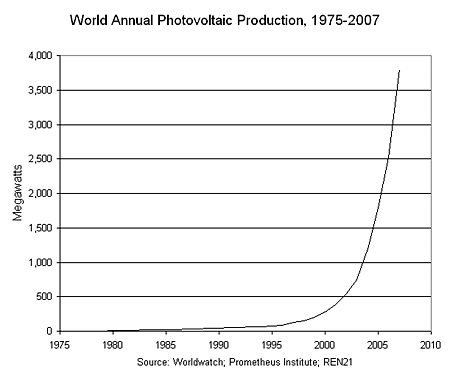
Saying, “I told you so,” feels pretty hollow, looking at the exponential roll out of PV systems below. That is a truly horrifying chart.
Via: The Energy Blog:
According to The Earth Policy Institute production of photovoltaics (PV) jumped to 3,800 megawatts worldwide in 2007, up an estimated 50 percent over 2006. At the end of the year, according to preliminary data, cumulative global production stood at 12,400 megawatts, enough to power 2.4 million U.S. homes. Growing by an impressive average of 48 percent each year since 2002, PV production has been doubling every two years, making it the world’s fastest-growing energy source.
A key force driving the advancement of thin-film technologies is a polysilicon shortage that began in April 2004. In 2006, for the first time, more than half of polysilicon production went into PVs instead of computer chips. While thin films are not as efficient at converting sunlight to electricity, they currently cost less and their physical flexibility makes them more versatile than traditional solar cells. Led by the United States, thin film grew from 4 percent of the market in 2003 to 7 percent in 2006. Polysilicon supply is expected to match demand by 2010, but not before thin film grabs 20 percent of the market.
Related: Clean Energy and Turning What’s Left Into Trash
Related: All Electric Vehicles and the Concept of Enough
Sandia’s Sunshine to Petrol Project Seeks Fuel from Thin Air
January 3rd, 2008I’d love to know the funding allocation for this project, in terms of the cost of the wars in Iraq and Afghanistan per second.
Now, you might be asking: Why not just put the money and effort into developing some kind of solar electric system.
Two reasons:
1) They want to extend the profits that can be extracted from what remains of oil and natural gas.
2) As far as I can tell, there is no viable propulsion system on the horizon for aircraft outside of liquid fuels. Affordable, highway capable electric vehicles from China are about to start flooding the market (here and here). The Aptera pure EV and extended range hybrid vehicles will ship in about a year. Phoenix Motorcars is taking fleet orders for their pure EV SUV now… (There are lots of other EV projects in the pipeline, too many to mention; and no, I didn’t forget that Tesla thing, which doesn’t even count, in my opinion, because of the six figure price, and the faulty transmission. HAHA)
Having said all of that: You won’t see a plug-in Boeing 747 anytime soon. For this reason, we’re going to see increasing amounts of jet fuel derived from a number of sources (shale, algae, and, that’s right, out of “thin air” as the article describes below.)
Indeed, without endless supplies of diesel/Jet A the U.S. military would grind to a halt. Note DARPA’s interest in this.
Nope, definitely no hurry to roll this stuff out. Lots of oil to be sold at $100 (or more) per barrel.
Bend over, grab ankles. The oil companies aren’t done with us yet. Not even close.
Via: sandia.gov:
Using concentrated solar energy to reverse combustion, a research team from Sandia National Laboratories is building a prototype device intended to chemically “reenergize” carbon dioxide into carbon monoxide using concentrated solar power. The carbon monoxide could then be used to make hydrogen or serve as a building block to synthesize a liquid combustible fuel, such as methanol or even gasoline, diesel and jet fuel.
The prototype device, called the Counter Rotating Ring Receiver Reactor Recuperator (CR5, for short), will break a carbon-oxygen bond in the carbon dioxide to form carbon monoxide and oxygen in two distinct steps. It is a major piece of an approach to converting carbon dioxide into fuel from sunlight.
The Sandia research team calls this approach “Sunshine to Petrol” (S2P). “Liquid Solar Fuel” is the end product — the methanol, gasoline, or other liquid fuel made from water and the carbon monoxide produced using solar energy.
Sandia is a National Nuclear Security Administration (NNSA) laboratory.
CR5 inventor Rich Diver says the original idea for the device was to break down water into hydrogen and oxygen. The hydrogen could then fuel a potential hydrogen economy.
The Sandia researchers came up with the idea to use the CR5 to break down carbon dioxide, just as it would water. Over the past year they have shown proof of concept and are completing a prototype device that will use concentrated solar energy to reenergize carbon dioxide or water, the products of combustion. This will form carbon monoxide, hydrogen, and oxygen, which ultimately could be used to synthesize liquid fuels in an integrated S2P system.
Coresearchers on the project are Jim E. Miller and Nathan Siegel. Project champion is Ellen B. Stechel, manager of Sandia’s Fuels and Energy Transitions Department.
Stechel says that researchers have known for a long time that theoretically it might be possible to recycle carbon dioxide, but many thought it could not be made practical, either technically or economically.
“Hence, it has not been pursued with much vigor,” she says. “Not only did we think it was possible, the team has developed a prototype that they fully anticipate will successfully break down carbon dioxide in a clever and viable two-step process.”
Stechel notes that one driver for the invention is the need to reduce greenhouse gases.
“This invention, though probably a good 15 to 20 years away from being on the market, holds a real promise of being able to reduce carbon dioxide emissions while preserving options to keep using fuels we know and love,” she says. “Recycling carbon dioxide into fuels provides an attractive alternative to burying it.”
Providing funding for Sunshine to Petrol is Sandia’s internal Laboratory Directed Research and Development (LDRD) program. The research has also attracted interest and some funding from DoD/DARPA (Defense Advanced Research Projects Agency).
“What’s exciting about this invention is that it will result in fossil fuels being used at least twice, meaning less carbon dioxide being put into the atmosphere and a reduction of the rate that fossil fuels are pulled out of the ground,” Diver says.
As an example, he says, coal would be burned at a clean coal power plant. The carbon dioxide from the burning of the coal would be captured and reduced to carbon monoxide in the CR5. The carbon monoxide would then be the starting point of making gasoline, jet fuel, methanol, or almost any type of liquid fuel.
The prospect of a liquid fuel is significant because it fits in with the current gasoline and oil infrastructure. After the synthesized fuel is made from the carbon monoxide, it could be transported through a pipeline or put in a truck and hauled to a gas station, just like gasoline refined from petroleum is now. Plus it would work in ordinary gasoline and diesel engine vehicles.
Miller says that while the first step would be to capture the carbon dioxide from sources where it is concentrated — e.g., power plants, smokestacks, and breweries — the ultimate goal would be to snatch it out of the air. A S2P system that includes atmospheric carbon dioxide capture could produce carbon-neutral liquid fuels.
Shell’s $30 per Barrel Oil Shale Process
January 3rd, 2008For years, I wanted to believe that Peak Oil could bring this horror show down. My problem, of course, was that I couldn’t ignore simple, observable realities and the fact that evil people have many plans up their sleeves.
Some of you view collapse due to Peak Oil as a given. I understand that desire. Unfortunately, it’s just not going to go that way. The people of the “developed world” are going to be handled in a manner similar to the way conventional Western medicine treats cancer patients. We’re going to be kept alive only to the extent that corporations can lift our wallets. And somehow, guess what: This system is going to limp on, creaking and grinding and murdering and polluting all the way into the grim dystopia of clean, green fascism.
Hell is going to be built right here. Shell has the patents. And their process works.
There’s no conspiracy in the world of Peak Oil. Corporations don’t do things in secret or hold back on technology in that reality.
We’re just running out of oil. Malthus. Scarcity. Etc.
It’s that simple for many Peaknics. (Mention enough absurdities surrounding the energy scarcity arguments and they’ll change the subject to topsoil. I agree, Peak Soil is a much more compelling issue than Peak Oil.)
In the real world, outside the blatherphere, it’s not that simple and after the energy corporations lift your wallet, they’re going to flip you upside down and shake loose any spare change that might have remained in your pockets. In addition to being closely monitored, tracked, traced and chipped, chances are, you’ll exist in a state of near financial ruin. You will, however, probably have enough money left over to pay an annual fart tax on your pets and children to whatever fascist nanny state you’re unfortunate enough to suffer under… Or else. The rumors of what really happens to people who don’t pay their fart taxes on time will be enough of an incentive to comply.
Note: The oily foilheads will jump up and down, screaming, “Natural gas. Natural gas. Shell uses natural gas in the process. And water. Die off! Overshoot!! DOOOOOOOOOOOOOOOOM!!!” They’re a twitchy lot, aren’t they? But the oily foilers can stick geothermal in their pipes and smoke it. And, while the Peaknic religion doesn’t allow it, they should check out Global Resource Corporation’s tuned microwave process that extracts oil and natural gas from any hydrocarbon source (stories: here and here). Yes, they have an insitu version as well. The psychopathic corporations even have nuclear power on the table for the tar sands! Sure, why not? And it takes lots of water. Rivers?! Who needs ’em? F-em. F-em twice. More oil.
The point is: If you think that energy scarcity is going to hinder the recovery of oil from the alternative deposits, you are flat out shitting yourself. It’s too big a prize.
Energy will be the last thing to take down this horror show. As for the much more serious top soil and water scarcity issues, that’s nothing a bit of kill off can’t solve.
Seriously, DO NOT TAKE MY WORD FOR IT. Read the Fortune article all the way through. Note the money and decades of research. Do you really think that the physicists doing this work just didn’t get the memo from the Peak Oil bloggers? Is Shell buying back its own shares because they think that things are going to get rough for them? No. Companies buy back their own shares when they know they’ve got something good. If your company had a way of getting oil out of a stone for some fraction of the current market price per barrel, you’d be buying back your own shares too.
My wishful thinking can only take me so far down the energy collapse fantasy. Unfortunately, this horror show grinds on, whether we want it to, or not. And those of us who survive the cull will all wish that Peak Oil could have done the job that we were afraid to do.
Via: CNN / Fortune:
The reason you probably haven’t heard about the Green River Formation is that most of the methods tried for turning oil shale into oil have been deeply flawed – economically, environmentally or usually both. Because there have been so many false starts, oil shale tends to get lumped with cold fusion, zero-point energy, and other “miracle” fuels perpetually just over the horizon.
“A lot of other companies have bent their spears trying to do what we’re now doing,” Vinegar says of his 28-year quest to turn oil shale into a commercial energy source. “We’re talking about the Holy Grail.”
Unlike the Grail, though, Shell is convinced that oil shale is no myth and that after years of secret research, it is close to achieving this oil-based alchemy. Shell is not alone in this assessment. “Harold has broken the code,” says oil shale expert Anton Dammer, director of the U.S. Department of Energy’s Office of Naval Petroleum and Oil Shale Reserves.
Vinegar has developed a cutting-edge technology that, according to Shell, will produce large quantities of high-quality oil without ravaging the local environment – and be profitable with prices around $30 a barrel. Now that oil is approaching $90, the odds on Shell’s speculative bet are beginning to look awfully good.
Shell declines to get too specific about how much oil it thinks it can pump at peak production levels, but one DOE study contends that the region can sustain two million barrels a day by 2020 and three million by 2040. Other government estimates have posited an upper range of five million. At that level, Western oil shale would rival the largest oilfields in the world.
Of course, considering the U.S. uses almost 21 million barrels a day and imports about ten million (and rising), even the most optimistic projections do not get the country to the nirvana of “energy independence.” What oil shale could do, though, is reduce the risk premium built into oil prices because energy traders could rest easy knowing that the flow of oil from Colorado or Utah won’t ever be cut off by Venezuelan dictators, Nigerian gunmen or strife in the Middle East. In a broader sense, U.S. energy security lies in diversity of supply, so enhancing domestic sources is appealing.
U.S. Will not Tap SPR
January 3rd, 2008This, almost certainly, isn’t temporary. They know it, since They engineered this crisis. So, there’s no point in easing the pain a bit for a couple of weeks by emptying the SPR.
There’s plenty of oil to go around at $100, or more, per barrel.
Via: Bloomberg:
President George W. Bush doesn’t plan to release oil from the Strategic Petroleum Reserve to counter crude oil prices that hit $100 a barrel today, his spokeswoman said.
The reserve “is used for emergencies,” White House press secretary Dana Perino said in response to a question at the regular White House briefing. The oil reserve is intended to cushion the U.S. in the event of a disruption of oil supplies and “this president would not use the SPR to manipulate” prices, she said.
Crude oil rose to $100 a barrel for the first time in New York today as record global fuel consumption threatens to outpace production. The price gained on concern that violence may further cut output in Nigeria, Africa’s biggest producer, and on speculation U.S. petroleum inventories fell for a seventh week.
“Doing a temporary release of the SPR is not going to change prices very much,” Perino said.
OIL HITS $100
January 3rd, 2008Via: AP:
Crude oil prices briefly soared to $100 a barrel Wednesday for the first time, reaching that milestone amid an unshakeable view that global demand for oil and petroleum products will outstrip supplies.
Surging economies in China and India fed by oil and gasoline have sent prices soaring over the past year, while tensions in oil producing nations like Nigeria and Iran have increasingly made investors nervous and invited speculators to drive prices even higher.
Violence in Nigeria helped give crude the final push to $100. Bands of armed men invaded Port Harcourt, the center of Nigeria’s oil industry Tuesday, attacking two police stations and raiding the lobby of a major hotel. Word that several Mexican oil export ports were closed due to rough weather added to the gains, as did a report that OPEC may not be able to meet its share of global oil demand by 2024.
GOLD SMASHES THROUGH ALL TIME HIGH TO $861.80 INTRADAY
January 2nd, 2008“From a technical analysis perspective, a move above $850 will probably set off buy triggers as shorts move to cover.”
—Cryptogon, December December 29, 2007
Ok, support is now $850. Let’s look for consolidation anywhere above $850.




