CIA Jet Used for “Rendering” Suspects Crashes with Four Tons of Cocaine on Board
September 29th, 2007Just another day at the office.
Full text follows.
Via: McClatchy:
U.S. authorities are assisting the Mexican government in the investigation of an American business jet that crashed near Cancun this week with four tons of cocaine on board, officials said Thursday.
One of the men listed as the registered owners of the plane, Joao Luiz Malago, said in a telephone interview from Brazil that his Florida-based company sold the aircraft for $2 million on Sept. 16 to a Lakeland, Fla., man and his partner, who Malago believed was from Miami.
Malago said he feared the man was dead because he hasn’t been picking up the phone.
Officials at the U.S. Embassy in Mexico had no information on any American citizens being killed or arrested in connection with the aircraft, a 1975 model Gulfstream II.
“We’re in the process of a judicial investigation that the Mexican government is conducting and we are providing information,” said an embassy official, who wasn’t authorized to speak on the record. “Part of that investigation is to find out more about where this plane came from and who had it before.”
Some news reports have linked the plane to the transport of terrorist suspects to the U.S. detention center at Guantanamo Bay, Cuba, but those reports cite logs that indicate only that the plane flew twice between Washington, D.C., and Guantanamo and once between Oxford, Conn., and Guantanamo. No terrorist suspects are known to have been transferred to Guantanamo directly from the United States.
The jet, carrying the tail number N987SA, changed hands twice in recent weeks. But how it ended up in the hands of suspected drug traffickers remains a mystery.
The Mexican attorney general’s office said the blue and white Gulfstream II crashed on Monday in a remote jungle area on the Yucatan Peninsula. Authorities seized 132 bags of cocaine weighing four tons. Two men were arrested and jailed on drug trafficking charges in Merida, officials said. They declined to identify the men, however.
The aircraft was sold on Aug. 30 to Donna Blue Aircraft, owned by two Brazilians: Malago and his partner Eduardo Dias Guimaraes. In separate telephone interviews from different parts of Brazil, both men said they’d sold the aircraft to two Florida men on Sept. 16.
“We are not the owners of the plane,” said Guimaraes, reached in Goiania in central Brazil.
He deferred most questions to his partner, Malago, who said from Sao Paulo that Donna Blue purchased the aircraft in July from a company that had owned it for 10 years, and then flipped it quickly to two Florida businessmen who paid for it in full.
McClatchy is withholding the names of the alleged new owners of the plane because they couldn’t be reached for confirmation.
The Gulfstream was awaiting documentation when it departed on Sept. 18 at 5:10 pm from Fort Lauderdale Executive Airport to Toluca, outside Mexico City, Malago said. He said he learned of Monday’s crash after receiving a call from an insurance company, but had been unable to reach the new owner by phone and feared he was dead.
He said he knew nothing of the plane’s history or what use it had been put to previously. He said he’d been a pilot for 25 years and had bought and sold planes throughout Latin America. “Generally you don’t know the history of the plane,” he said.
At the time of the Guantanamo flights, the plane’s operation was managed by Air Rutter International, a California-based air charter service, but was owned by someone else. Air Rutter’s owner, Bill Cripe, refused to identify that owner, except to say he was a reputable businessman. Cripe also said he didn’t know about any flights to Guantanamo.
More: Drugs on Crashed Plane Belonged to Mexico’s Biggest Dealer
The four tons of cocaine found aboard a U.S.-registered business jet that crashed in Mexico’s Yucatan Peninsula on Monday belonged to Joaquin “El Chapo” Guzman, this country’s most notorious drug trafficker, Mexican authorities said Friday.
The business jet that was transporting the dope to Mexico from Colombia was purchased just a week before the crash by a U.S. pilot with a history of legal and financial problems in Florida, interviews and official records indicate, but whether the pilot still owned the plane at the time of its crash is unknown.
The complex sale of the Gulfstream II jet and its end in the Mexican jungle highlight the increasingly complicated illicit drug trade. A recent report by the U.S. Government Accountability Office said the trade generates as much as $23 billion a year for Mexico-based drug cartels.
U.S. authorities say as much as 90 percent of the cocaine sold in the U.S. is shipped through Mexico.
At least three suspects, including a Mexican pilot, are in Mexican custody. Mexican authorities say two of the men offered them money if they would give back the cocaine and release any crewmembers.
The Gulfstream II departed Fort Lauderdale, Fla., on Sept. 18. In the days between then and the plane’s crash, it apparently flew to Mexico, then to Colombia and was on its way back to Mexico when Mexican anti-drug aircraft intercepted it.
“The cocaine was to be delivered to El Chapo,” said an official in the Mexican attorney general’s office, who spoke on condition of anonymity. “We do know it was from Colombia.”
Guzman has acquired an almost mythic status in Mexico. After breaking out of jail in 2001, he has repeatedly eluded capture and is revered in some parts of this impoverished nation as a Robin Hood figure who distributes some of his ill-gotten gains to the poor.
How the U.S.-registered Gulfstream ended up in the hands of Guzman’s violent Sinaloa Cartel isn’t clear.
A bill of sale obtained by McClatchy Newspapers indicates that Florida pilot Clyde O’Connor bought the plane on Sept. 16 — eight days before it went down in the Yucatan jungle. Another Florida pilot, identified by his license number and signature as Greg Smith, also signed the document, but his relationship to O’Connor isn’t detailed.
According to electronic court records, O’Connor, 42, was found guilty of criminal safety violations — described as “improper/insufficient safety equipment or lights” — in 2001. Records also show two bankruptcy filings, one in 1997 and another in 1998.
Ten years later, his financial problems apparently had abated. Two Brazilians — the last registered owners of the plane — said O’Connor wired them $2 million to purchase the business jet earlier this month.
The Brazilians provided McClatchy with the bill of sale, but the Federal Aviation Administration said it hadn’t received the change-of-ownership paperwork.
Attempts to reach O’Connor and Smith weren’t successful; the listed phone number for one of O’Connor’s companies, Execstar Aviation in Fort Lauderdale, was disconnected.
Interviewed by phone from the Brazilian city of Sao Paulo, one of the Brazilians, Joao Luiz Malago, said Friday that O’Connor and Smith had told him they planned to resell the aircraft. The FAA confirmed that the two men are licensed Florida pilots in good standing.
Malago said O’Connor struck a hard bargain, negotiating him down from a desired sale price of $2.3 million to $2 million.
“This guy was a pain,” recalled Malago. “Finally we got to a point that we found a good number for me and for him was $2 million.”
Logs found on a plane-tracking Web site, www.flightaware.com, show that a flight plan was filed for the Gulfstream two days later for a trip from Fort Lauderdale to Cancun, but who piloted the craft is unknown. FAA records show that neither O’Connor nor Smith was certified to fly a multiengine aircraft like the Gulfstream. The plane crashed near Merida, 200 miles from Cancun.
Getting to the bottom of the plane’s ownership and circuitous trajectory are key pieces of a criminal investigation that Mexican authorities are conducting with the aid of American diplomats and law enforcement, including the U.S. Drug Enforcement Agency, officials said.
“U.S. law enforcement and other government authorities are still looking into the history of the plane and its ownership and any possible implications that would have for criminal activity,” said Judith Bryan, a spokeswoman for the U.S. Embassy in Mexico.
Malago and his business partner, Eduardo Dias Guimaraes, had owned the plane only since August, when their Florida-based Donna Blue Aircraft, an aviation sales company, bought the plane from a holding company owned by New York real estate developer and thoroughbred horse owner William Achenbaum.
Adding to the plane’s mystery are allegations that it made trips in 2003, 2004 and 2005 between the United States and Guantanamo Bay, Cuba, where the U.S. detention center for suspected terrorists is located.
Employees of Achenbaum wouldn’t discuss how the plane was used while he owned it. They referred calls to William Cripe, who runs Air Rutter International in Long Beach, Calif. Cripe said he leased the plane for a year until it was sold, using it in his charter service. He said the plane didn’t fly to Cuba or to the Caribbean while his company operated it.
Several Readers Contribute to Cryptogon
September 29th, 2007The following readers sent contributions:
PR $50
RH $25
RR $20
Thank you all very much.
Thanks also to the owner of japanexclusive.com for choosing to host with BlueHost. Cryptogon received $65 as a result.
Gold: Tactical Assessment
September 29th, 2007Warning: This is not a recommendation to buy, sell or hold any financial instrument.
Since many of you won’t know your stochastic from your MACD, I’m going to summarize this right at the beginning.
Summary: Use extreme caution if considering adding to long gold positions in the near term. There is a strong possibility of a pullback. If you are looking to lock in profits, tighten stops, or consider a stop target of $738. Consider long entries under $738 but over $721. Under $721, consider long accumulation using range strategies.
Now, for you squiggly lines, chicken entrails and Magic 8-Ball people, let’s look at recent hourly and daily gold charts.
As all traders know, stochastics and RSI can go extreme for days, or whatever interval the little voices in our heads tell us to pay attention to. But while I don’t know of a good way to know when the reversal will actually happen during these weird times, I very rarely take extreme band trades in the direction of the trend. The exception is momentum piling on after a major support or resistance breech. And I don’t hold those for long. Why? Going long with stochastics over 80 is for thrill seekers, maniacs and people who know something. Most of the time, I don’t fall into any of those categories.
We’ve had 1 hour and daily stochastics in extremes for days. RSI, same thing on daily. RSI hourly hit extreme levels and pulled back.
But this is why I decided raise the blood pressure of gold bug technicians this weekend: I don’t like that one hour MACD cross at all, or the negative slope, or the fact that it has gone below the zero line. On daily, the negative slope has my attention because I know hourly has already broken down. Is it just taking a breather?
With stochastics and RSI indicators in whacked-out, overbought states, guess what’s hanging overhead? The nice fat $750 resistance.
“But, Kevin, aren’t ascending triangles your favorite setup?”
Yes, BUT not with 1 hour MACD crossing down, along with RSI and stochastics in whacked out overbought states… I like ascending triangles, but I’m no chainsaw juggler.
Guys, like I said, I don’t know anything and gold could blow through $750 like a hot knife through butter, but going in heavy here would be VERY VERY risky.
I general, for me, the acme of skill in trading is buying dips during uptrends and shorting peaks during downtrends.
Gold is in a strong uptrend in all meaningful intervals (Look at that powerful DMI), but the move has gone extreme in the short term. If you feel as though you must play these extreme bands, consider going in with less, to capture the move if They squeeze it above $750. That could happen. I think, however, that there’s a much better chance of being able to get a better entry closer to $721, during a nice consolidation period closer to those longer interval moving averages.
“But how close to $721?”
In strong uptrending markets, your stochastics often won’t get down below 20. Consider believing 1 hour stochastic cross up under 60 with $721 intact. Want a more traditional stochastic play? Shorten your interval and you’ll get more juice under 20.
While I’m providing relatively narrow targeting guesses, you should also know that I’m not trading this. I buy very small amounts during dips. I’m not selling because I strongly suspect that we have seen NOTHING in terms of the banking chaos yet.
I just hate botched entries. From years of trading, I learned to wait for quality entries. So, in that regard, I can’t help myself. While I might be thinking like a trader, all I’m doing is buying the dips and laughing when it goes down, because I get to buy more lower.
It sounds nuts, but you’ve got to have an almost playful attitude with this crap. If looking at those charts causes your stomach to turn and your pulse to quicken, you’re in too heavy, you’re not diversified enough and you’re setting yourself up for serious pain.
As always, diversification, diversification, diversification.
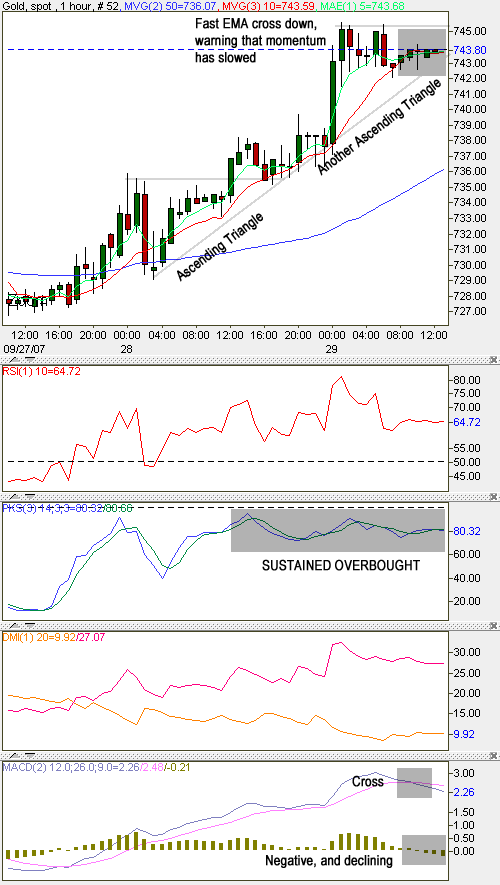
Recent gold chart, one hour interval
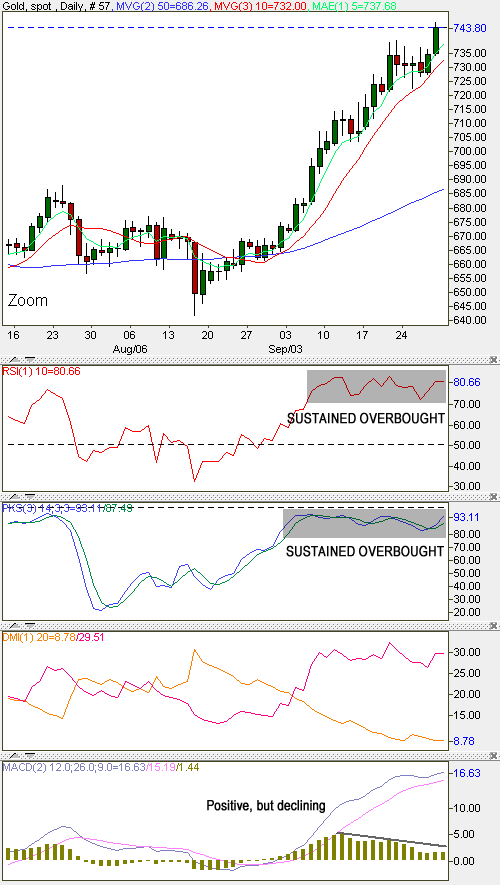
Recent gold chart, one day interval
U.S. Federal Regulators Close NetBank
September 28th, 2007Watch those FDIC limits, people. (And in any real crisis, forget FDIC.) While the Federal Reserve and the U.S. Government are eroding the value of your dollars by the minute, at least they’re going to guarantee you 100,000 of the things on deposit. How many loaves of bread you’ll be able to buy with your 100 grand, well, that remains to be seen.
Via: CNN:
Federal regulators closed NetBank Inc. (NTBK), a $2.5 billion thrift based in Alpharetta, Ga., on Friday partly due to significant mortgage-related losses the company sustained in 2006 and 2007.
NetBank marked the largest bank to fail since since the early 1990s, which marked the end of the savings and loan crisis. The Office of Thrift Supervision closed NetBank at 3 p.m. EDT, the federal regulator said, and the company was immediately taken into receivership by the Federal Deposit Insurance Corp.
The OTS said weak underwriting standards, failed business strategies, and a lack of proper controls forced NetBank to suffer significant losses starting in 2006.
“They had significant problems with respect to loan underwriting, poor documentation, and a high amount of early payment defaults,” OTS spokesman Kevin Petrasic said. “All of those factors led to fairly significant losses that increased substantially in 2007.”
The OTS said NetBank’s board of directors unsuccessfully tried to orchestrate a private sale of the company.
“These efforts were unsuccessful, and the institution had no remaining prospects for raising capital and achieving profitability,” the OTS said.
NetBank doesn’t have branches, and its business model is based on interacting with customers over the Internet.
Bank failures have become very rare because of recent strong performance by the U.S. banking industry. But problems, particularly related to mortgage lending, has put pressure on many financial institutions, particularly smaller banks. For example, the FDIC said last month that loans at least 90 days past due rose in the second quarter by $11.4 billion, or 36%, compared with the second quarter of 2006.
“A couple of years ago, it was almost impossible for a bank to fail,” said Jaret Seiberg, a financial services policy analyst at the Stanford Group Co. ” Today, that’s no longer true.”
GOLD BREAKOUT HIGHER
September 28th, 2007WARNING: This is not a recommendation to buy, sell or hold any financial instrument.
There it is.
The U.S. dollar is getting slammed again. USDX stands at 78 even.
I’m watching it in realtime and we’ve got EUR/USD printing above 1.42 now. This must be causing a few hairs to be standing on end in and around the power centers of Europe.
Gold is up and out of the previous short term range. Next hurdle: $750.
Remember the last magic number I mentioned? $721 on the gold. Well, that magic number for oil is that $83.90. We’re at $83.60 right now.
The dollar collapse is whipping up a perfect storm in the commodities.
Via: Marketwatch:
Gold futures rose sharply early Friday, buoyed by the dollar’s plunge to a new all-time low against the euro. Gold for December delivery surged $8.60, or 1.1%, at $748.50 an ounce on the New York Mercantile Exchange. The euro hit a fresh all-time high of $1.4197 against the dollar. The common currency was last trading up 0.2% at $1.4182. “Gold remains underpinned by robust oil prices and a renewed rise in the euro against the dollar, which both increase the appeal of the precious metal as a hedge against inflation,” said analysts at Action Economics.
U.S. War on Drugs Outsourcing Contract Worth $15 Billion
September 28th, 2007Security for the CIA’s private opium plantation?
Via: CNN:
The U.S. Defense Department has invited five contractors to bid on elements of a new, multibillion dollar effort to combat the global flow of illegal drugs allegedly used to finance terrorism.
Awarded by the Pentagon’s Counter-Narcoterrorism Technology Program Office in Dahlgren, Va., the contract vehicle has a potential value of $15 billion over five years. One participant is ARINC, a Maryland-based provider of airline communications systems.
“This gives us the opportunity to bid on this work,†said Linda Hartwig, an ARINC spokesperson. “We don’t have a lot of details yet, but we do know that this is an expansion of what [the U.S] is already doing to fight drug trafficking, and that 80 percent of the work will be overseas.â€
Hartwig said the other participating vendors are defense giants Lockheed Martin, Northrop Grumman and Raytheon, and security contractor Blackwater USA. Blackwater confirmed its participation, but the other vendors did not respond to inquiries.
The vendors will compete for a series of task orders covering a wide range of products and services. These could include anti-drug technologies and equipment, special vehicles and aircraft, communications, security training, pilot training, geographic information systems, and in-field support.
Gold Make or Break Right Now
September 28th, 2007WARNING: This is not a recommendation to buy, sell or hold any financial instrument.
Attempting to break higher out of recent range…
Goldbugs adjust stops or otherwise lock and load as necessary.
New Home Sales Hit 7-Year Low
September 27th, 2007The whole show is rigged to blow.
Via: CNN:
The pace of new home sales fell to a seven-year low in August, according to a government report Thursday that showed the battered housing and home building markets even weaker than forecasts.
New homes sold at an annual pace of 795,000 in August, according to the Census Bureau, down 8 percent from the revised 867,000 sales pace in July.
It was the slowest pace of sales since June 2000, as buyers had trouble finding mortgages or selling their existing homes. Economists surveyed by Briefing.com had forecast that sales would fall to a pace of 825,000.
The report also showed the median price of a new home fell 7.4 percent from year earlier levels to $225,700 in the month, as prices were pressured by both the problems in mortgage finance and the excess supply of homes on the market.
The inventory of new homes on the market rose to an 8.2 month supply, as the glut of completed homes without a buyer was near a record high, with 180,000 completed homes listed for sale, just off the record high of 182,000 set in May of this year.
The July report wasn’t the only month revised lower by the Census Bureau; it also dropped its sales estimates for May and June, leaving sales 34,000 below the previous estimates.
Sarkozy Calls for “New World Order” at UN
September 27th, 2007Via: eux.tv:
World powers turned to the United Nations on Tuesday to resolve protracted problems that have defied solutions, from climate change to the equal distribution of wealth and human rights issues.
US President George W Bush urged the UN to uphold the Universal Declaration of Human Rights, the document that led to other human rights conventions over the past 60 years dealing with the freeing of people from tyranny, violence, hunger and diseases.
“As we gather for this 62nd General Assembly, the standards of the declaration must guide our work in the world,” Bush said.
“The mission of the United Nations requires liberating people from tyranny and violence,” Bush told the body, in which many governments had disagreed with his policy in Iraq and global anti-terror campaign.
France’s President Nicolas Sarkozy, in his first appearance before the assembly, called on the UN to avail itself as an instrument for a “new world order of the 21st century.”
“In the name of France, I call upon all states to join ranks in order to found the new world order of the 21st century on the notion that the common goods that belong to all of humankind must be the common responsibility for us all,” he told the General Assembly.
U.S. Dollar Holders Getting Decapitated
September 27th, 2007WARNING: This is not a recommendation to buy, sell or hold any financial instrument.
The U.S. Dollar Index is below 78.20 now.
This morning, bond traders have priced in a 90% chance of ANOTHER Fed rate cut in October. My guess is that the Fed knows about that ARM reset chart I referenced yesterday.
Goldbugs, hope that some central bank doesn’t dump metal and piss on our parade.
Via: IHT / Bloomberg:
The dollar fell to a record low against the euro Tuesday as declines in consumer confidence and home resales fanned expectations that the Federal Reserve would cut borrowing costs for a second time this year.
The U.S. currency weakened to a 15-year low against a basket of six major peers on worries that another decrease in lending rates would make U.S. assets less attractive to international investors. The Fed cut its target overnight rate by a half-percentage point last week to prevent the housing slowdown from weakening the U.S. economy.