“The Only Terrorist Most Americans Will Ever Encounter Is a Policeman with a Badge, Nightstick, Mace and Taser”
September 27th, 2007Via: Populist America:
Bush’s “war on terror” quickly became Bush’s war on Iraqi civilians. So far over one million Iraqi civilians have lost their lives because of Bush’s invasion, and four million have been displaced. Iraq’s infrastructure is in ruins. Disease is rampart. Normal life has disappeared.
Self-righteous Americans justify these monstrous crimes as necessary to ensure their own safety from terrorist attack. Yet, Americans are in far greater danger from their own police forces than they are from foreign terrorists. Ironically, Bush’s “war on terror” has made Americans less safe at home by diminishing US civil liberty and turning an epidemic of US police brutality into a pandemic.
The only terrorist most Americans will ever encounter is a policeman with a badge, nightstick, mace and Taser. A Google search for “police brutality videos” turns up 2,210,000 entries. Some entries are foreign and some are probably duplications, but the number is so large that a person could do nothing but watch police brutality videos for the rest of his life. A search on “You Tube” alone turned up 2,280 police brutality videos. PrisonPlanet has a selection of the most outrageous recent cases.
Police brutality has crossed the line from using excessive force against a resisting Rodney King to unprovoked gratuitous violence against persons offering no resistance, such as the elderly, women, students, and elected officials. Americans are not safe anywhere from police. Police attack Americans in university libraries, in public meetings, and in their own homes.
Orgiastic Spending on Technologies of Political Control
September 27th, 2007Via: Reuters:
Americans are facing a brave new world of post-September 11 technology marvels that could soon find their way into billions of dollars of projected homeland security spending.
Gee-whiz know-how — from swarms of tiny airborne sensors to ever-sharper satellite imagery — is being developed by companies chasing potentially lucrative federal, state and local deals to address 21st-century security threats.
Already in use are such things as infrared cameras with built-in brains that capture license plate images and match them in milliseconds to police records of vehicles of interest to the authorities.
Such license plate recognition systems, fixed and mobile, already are stopping criminals in cars in New York City, Washington D.C. and 23 states, according to Mark Windover, president of Remington ELSAG Law Enforcement Systems, which is marketing its product to 250 U.S. police agencies.
“Seventy percent of all criminal activity can be tied to a vehicle,” he said. “Had to get there, had to go home.”
Remington ELSAG says its algorithms — which turn images into data in the blink of an eye — could guard airports, military bases and other federal facilities as well as crack down on the drug trade, robberies and other crime hinging on stolen cars.
In other surveillance developments, the Department of Homeland Security, or DHS, is defending a plan to make broader use of eyes in the sky that, until now, have mostly fed military and scientific needs.
“The use of geospatial information from military intelligence satellites may turn out to be a valuable tool in protecting the homeland,” Democrats on the House of Representatives Homeland Security Committee wrote to Homeland Security Secretary Michael Chertoff this month.
Lehman Brothers Forced to Juggle Some of Its Own Hand Grenades; Where Are the Rest and When Will They Blow?
September 26th, 2007When the Wall Street Wizard couldn’t unload his mortgage backed securities anymore, he started to scrap bits and pieces his weirder paper generating machinery:
Finance America: Gone
BNC: Gone
Aurora Loan Services: Uh, what’s left of it will see a name change
Lehman Brothers bought these firms because they generated paper, and lots of it. Lehman repackaged and sold that paper to other institutions—like foreign banks—that were flush with cash.
And who wouldn’t want a piece of that big, fat, juicy U.S. real estate bubble? What could possibly go wrong…
As long as interest rates were low and there were buyers for the debt products that Lehman was peddling, the band played on. But as interests rates rose and terms like f@cked buyer and liar loan entered the discussion of the real estate bubble, one by one, Lehman closed down its paper mills and fired employees.
As we know, of course, the music stopped playing and Lehman got caught without a chair.
The fact that they have been forced to take several billion dollars worth of that dog shit paper onto their own books—as the supply of greater fools willing to buy it from them evaporated—seems like a semi-happy ending to this diabolical tale.
Not so fast.
The problem is that the $10.3 billion in paper that Lehman was forced eat represents just the tail end of the thing as the music stopped playing and their racket collapsed.
They have been generating and selling that stuff for years. Where did it wind up, and when is it going to blow?
I think that when might be easier to know than where:
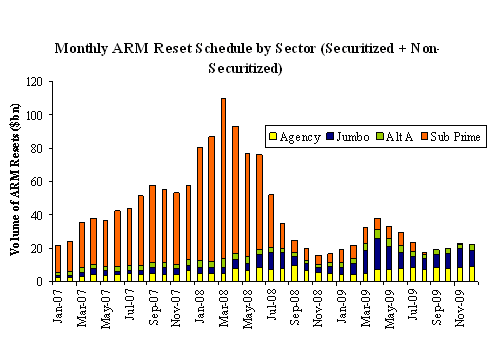
Higher bars = more foreclosures = more liquidity problems months later
We are definitely not out of the woods with the subprime debacle. In fact, we are in for a year of steady increases in foreclosures and liquidity problems. There are no buyers for these securities now. If banks are holding these bombs, they’re stuck with them and the clock is ticking.
As those teaser rate loans reset, and f*cked buyers go bankrupt in increasing numbers (see chart above), banks are going to have serious problems.
Which banks will be affected?
I don’t know.
Oh yeah, Lehman has decided to stop hiding behind the names of the mom and pop shops it acquired to run this game. From here on out, it’s going to be Lehman Mortgage Capital.
Man, if that’s not a name you can trust, I don’t know what is.
Via: Wall Street Journal:
Lehman, a big player in the bond market hit hard by the recent trouble in the “subprime” business of issuing risky mortgages that has shaken the broader stock market, set the tone in terms of markdowns, taking a $700 million loss on assets that have fallen in value in recent months. At the same time, Chief Financial Officer Christopher O’Meara said “the worst of the credit correction is behind us.”
The $700 million in markdowns were cushioned, Mr. O’Meara said, by a combination of short, or bearish, positions on certain securities and a variety of hedges Lehman used to protect itself. More broadly, he added, the firm’s diverse business mix shielded it from more significant losses during the quarter.
Still, Mr. O’Meara said the difficulty of selling loan commitments to third parties and the lack of buyers for securitized mortgages caused Lehman to take $10.3 billion in assets onto its balance sheet, a move it wouldn’t likely have make under calmer market conditions.
Of that total, $4 billion is deal financing, and most of the remaining $6.3 billion is newly originated home loans that haven’t been sold off as part of securitized products, he said. Bringing such loans and securities onto its books could subject Lehman to losses if markets continue to erode. The move also ties up a portion of the firm’s balance sheet it might have wanted to deploy elsewhere.
One data point investors focused on yesterday was the percentage markdown Lehman appeared to be taking on its leveraged loan commitments as it tried to sell off deal financing to third parties at depressed prices.
Research Credit for ARM Reset Crart: Idleworm, Calculated Risk
U.S. Homes Post Steepest Price Drop in 16 Years
September 26th, 2007This is what traders call, “The Big Mo.” Momentum. See these old stories on Cryptogon where I described this in more detail:
Home Sellers Learning Day Trading Skills
Home Sellers Learning Day Trading Skills (Continued…)
Via: AP:
The decline in U.S. home prices accelerated nationwide in July, posting the steepest drop in 16 years, according to the S&P/Case-Shiller home price index released Tuesday.
Home prices have fallen by more every month since the beginning of the year.
An index of 10 U.S. cities fell 4.5 percent in July from a year ago. That was the biggest drop since July 1991.
Quick Magic 8 Ball Update on U.S. Dollar Index
September 26th, 2007WARNING: This is not a recommendation to buy, sell or hold any financial instrument.
The USDX has breached 78.33 and made a feeble attempt at bouncing above that critical point. It has now slipped back under 78.33 again. I have no idea whether it’s going to bounce or collapse, but I have seen this happen many times before: At major support breakdowns, the thing will actually retrace back up before it falls off the cliff.
Not long to wait now, one way or the other.
Finally: Amazon’s MP3 Store
September 26th, 2007I might have titled this story, “If You Can’t Beat ‘Em, Sell ‘Em DRM Free MP3s.”
Years ago, when Apple released iTunes, I looked at the DRM involved and said, “Not only no, f*@% no.” I’m really glad to see an alternative to Apple’s Tamper Proof Vending Machine reality. Of course, I’d rather just pay artists directly for MP3s. If we directly paid an artist $2 for their album on MP3, that would be more than they make when the same ones and zeros have been sold through the middlemen. But we’re not quite there yet.
In long tail economies, though, the middlemen can be good for helping people find artists that they might not have been able to find otherwise. You can’t enter a Google search for, “music I’d like.” But Amazon’s big brother suggestion systems are pretty good. I know, I like Pandora, too, but most people will never hear about that type of thing. Hint: If you’re outside the U.S., you will have to use innovative methods to access Pandora. Or, use LastFM instead.
For artists and music fans alike, a combination of no-middle-man music sales and social networking sites like Pandora and LastFM would be very nice. Must. Try. To. Hold. Breath…
Until then, you can get your consumer crack tunes AND help out Amazon affiliates like Cryptogon. * wink *
Just make sure to remove your iPod before standing in front of the Homeland’s directed energy pain weapon! For U.S. customers only. Your results may vary. Batteries not included.
Check it out: Amazon’s MP3 Store
Step Right Up: Public Demonstrations of Raytheon’s Directed Energy Pain Gun
September 26th, 2007Will it re-heat your freedom fries?
Via: Daily Mail:
“Where do I put my finger? There … OK? Nothing’s happening … is it on?”
“Yes, it’s on. Move your finger a bit closer.”
“Er … ow! OW!” Not good. I try again. “OWWW!” I pull my hand away sharpish. My finger is throbbing, but seems undamaged.
I was told people can take it for a second, maximum. No way, not for a wimp like me.
I try it again. It is a bit like touching a red-hot wire, but there is no heat, only the sensation of heat. There is no burn mark or blister.
Its makers claim this infernal machine is the modern face of warfare. It has a nice, friendly sounding name, Silent Guardian.
I am told not to call it a ray-gun, though that is precisely what it is (the term “pain gun” is maybe better, but I suppose they would like that even less).
And, to be fair, the machine is not designed to vaporise, shred, atomise, dismember or otherwise cause permanent harm.
But it is a horrible device nonetheless, and you are forced to wonder what the world has come to when human ingenuity is pressed into service to make a thing like this.
Silent Guardian is making waves in defence circles. Built by the U.S. firm Raytheon, it is part of its “Directed Energy Solutions” programme.
What it amounts to is a way of making people run away, very fast, without killing or even permanently harming them.
That is what the company says, anyway. The reality may turn out to be more horrific.
I tested a table-top demonstration model, but here’s how it works in the field.
A square transmitter as big as a plasma TV screen is mounted on the back of a Jeep.
When turned on, it emits an invisible, focused beam of radiation – similar to the microwaves in a domestic cooker – that are tuned to a precise frequency to stimulate human nerve endings.
It can throw a wave of agony nearly half a mile.
Because the beam penetrates skin only to a depth of 1/64th of an inch, it cannot, says Raytheon, cause visible, permanent injury.
But anyone in the beam’s path will feel, over their entire body, the agonising sensation I’ve just felt on my fingertip. The prospect doesn’t bear thinking about.
“I have been in front of the full-sized system and, believe me, you just run. You don’t have time to think about it – you just run,” says George Svitak, a Raytheon executive.
Silent Guardian is supposed to be the 21st century equivalent of tear gas or water cannon – a way of getting crowds to disperse quickly and with minimum harm. Its potential is obvious.
Related: Say Hello to the Goodbye Weapon
Deposit Worries Hit Sterling
September 25th, 2007Via: Financial Times:
Sterling took a hit on Tuesday as worries over UK deposit protection raised fresh concerns over the health of the UK financial system in the wake of the recent run on Northern Rock, the troubled mortgage lender.
Analysts said reports that the UK’s deposit protection scheme might not be enough to pay for the government’s plan to guarantee consumers’ deposits up to £100,000 pounds weighed on the currency.
The UK’s Financial Services Compensation Scheme’s resources were estimated at only £4.4m – compared with a comparable fund of $49bn in the US.
IMF: Fallout from Global Financial Crisis Will be Long Lasting
September 25th, 2007Just as long as it’s economic fallout and not some other kind of fallout.
Via: Independent:
The global credit crisis is not over, and its effects will be long lasting, the International Monetary Fund has warned.
The organisation’s twice-yearly Global Financial Stability report warned that many of the lax lending practices of the past few years will have to change, and economic growth will be crimped by the current correction.
Adding to the gloom, Rodrigo Rato, the IMF’s managing director, said yesterday the US will bear the brunt of the economic consequences of the crisis, with the bulk of the impact not being felt until next year.
Debt markets have convulsed after finally recognising the extent to which credit discipline has deteriorated in recent years, the IMF’s report stated. “The potential consequences of this episode should not be underestimated, and the adjustment process is likely to be protracted. Credit conditions may not normalise soon, and some of the practices that have developed in the structured credit markets will have to change.”
The practice of rolling together lots of different kinds of debt, including low quality US mortgage loans, and selling them on piecemeal in the global financial markets has diffused the responsibility for checking that the underlying loans are sound, the IMF said. The use of off-balance sheet funding vehicles has also made it harder to judge the creditworthiness of major banks.
Consumers Cutting Back on Restaurants
September 25th, 2007Via: AP:
More than half of U.S. consumers plan to eat out less in the next three months due to jitters over declining home values, high gas prices and the overall economy, according to a survey by RBC Capital Markets.
The survey of 1,000 people found that 54 percent of Americans said they would eat at restaurants less often over the next three months. Two of five respondents said they are already dining out less frequently than they were six months ago.
“Volatile stock markets, declining home values, higher energy costs and overall concern about the economy are reducing Americans’ appetite for dining out,” RBC analyst Larry Miller said in a statement.
The survey’s results come as many sit-down restaurant chains are struggling to reel in customers, while cheaper fast-food restaurants are generally seeing strong sales.