Tapping Fiber is Easy
September 25th, 2007While some of the people who work aboard the U.S.S. Jimmy Carter might laugh at this, I think it’s pretty interesting.
Via: Tech Republic:
Copper cable has been known as the easily tapped physical transmission medium for years. Conscientious network and security managers either provided tight physical security for cabling or used fiber as an alternative. Many network managers considered fiber relatively safe due to the perceived challenges associated with tapping into an optical cable run. However, fiber is no safer than copper.
For less than $1,000, an attacker can purchase the hardware necessary to tap into a fiber run. The tap consists of bending the fiber to the point that it leaks light.
…
The fiber cable to be tapped is placed into a micro-bend clamping device (1). The light pulses leaking from the cable are detected by the optical photo detector (2) and sent to an optical-electrical converter (3). The converter changes the light pulses to electrical information that is placed on an Ethernet cable attached to an attacker’s laptop. The laptop, running sniffer software, provides the attacker with a view into the data traveling through the tapped fiber cable.
Bank of England: We Don’t Understand the Markets
September 25th, 2007Via: Telegraph:
The Bank of England is looking at improving the way it monitors UK credit conditions after admitting that the growing sophistication of the financial markets has made it more difficult to manage monetary policy.
Bank of England governor Mervyn King speaking to the Commons Treasury Committee
Mervyn King has come under increasing pressure over his handling of the Northern Rock crisis
Amid accusations that it failed to respond quickly enough to the crisis at Northern Rock, the Bank has admitted that it is struggling to determine the impact of the credit meltdown on the economy.
Charles Bean, chief economist, said assessing conditions in the economy is “subject to considerable uncertainty”.
Writing in the Bank’s quarterly bulletin, Mr Bean said: “One important step in analysing monetary demand and supply shocks involves improving the Bank’s information about credit conditions.”
The Bank’s admission that it needs to improve its understanding of the credit markets comes as John McFall, chairman of the Treasury Select Committee, voiced his frustration following the appearance of Bank of England staff before the government watchdog.
In an interview with The Daily Telegraph, Mr McFall said: “The responses that people gave were unconvincing as a whole. I’m looking at the system and asking the question: Is it working? And it’s not working.”
In its bulletin the Bank said that to achieve its core purposes of maintaining confidence in the economy and identifying and reducing threats to the financial system, it needs to better understand “developments in the markets for money and credit”.
Roger Bootle, managing director of Capital Economics, said: “The Bank’s job is getting much tougher. [In the face of more sophisticated markets], I do not think you’ve seen a corresponding increase in technology and monitoring on the Bank’s part. It is a one-sided thing.”
Mervyn King, Governor of the Bank of England, has come under increasing pressure over his handling of the Northern Rock crisis amid accusations the Bank failed to react quickly enough to reduce problems in the money markets.
Gordon Brown yesterday defended Mr King, telling the BBC that he had done a “brilliant” job, but stopped short of backing him for another five-year term as Governor.
The Bank has set out several initiatives to better monitor the credit markets and their impact on inflation and the economy. The Bank said it was examining the effect of institutions such as pension and insurance funds on the supply of money into the UK economy and their impact on inflation. The Bank said: “Improving the understanding of money growth… is a key challenge.”
Bush, the Little Voice in Hillary’s Head
September 25th, 2007I’d be more curious about what Senior is whispering in her ear. The Clintons are decades long servants of the Bush Dynasty.
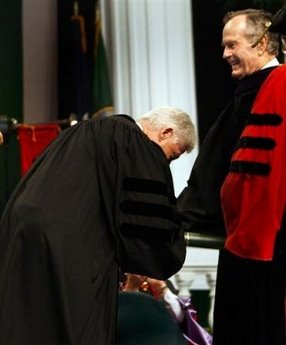
What is thy bidding, my Master?
Former President Bill Clinton bows to former President George H. W. Bush after he receives a honorary degree during the Tulane University Commencement in New Orleans on Saturday May 13, 2006. Former President Clinton also received a degree.(AP Photo/Alex Brandon, Pool)
This isn’t just a Bush/Clinton thing. While they represent the longest running and most sickening example it, this is standard operating procedure in the U.S. as the regime pretends to change every four or eight years. In Tragedy and Hope: A History of the World in our Time, Carroll Quigley wrote:
The argument that the two parties should represent opposed ideals and policies, one, perhaps, of the Right and the other of the Left, is a foolish idea acceptable only to doctrinaire and academic thinkers. Instead, the two parties should be almost identical, so that the American people can “throw the rascals out” at any election without leading to any profound or extensive shifts in policy.
Keep that one in mind as you try to read the following without your guts and valves seizing up on you.
Via: Examiner:
President Bush is quietly providing back-channel advice to Hillary Rodham Clinton, urging her to modulate her rhetoric so she can effectively prosecute the war in Iraq if elected president.
In an interview for the new book “The Evangelical President,†White House Chief of Staff Josh Bolten said Bush has “been urging candidates: ‘Don’t get yourself too locked in where you stand right now. If you end up sitting where I sit, things could change dramatically.’ â€
Bolten said Bush wants enough continuity in his Iraq policy that “even a Democratic president would be in a position to sustain a legitimate presence there.â€
“Especially if it’s a Democrat,†the chief of staff told The Examiner in his West Wing office. “He wants to create the conditions where a Democrat not only will have the leeway, but the obligation to see it out.â€
To that end, the president has been sending advice, mostly through aides, aimed at preventing an abrupt withdrawal from Iraq in the event of a Democratic victory in November 2008.
U.S. Financial Institutions Involved with Three Week Bird Flu Pandemic Simulation
September 25th, 2007Liquidity problems? What liquidity problems?
Via: AP:
WASHINGTON Don’t be alarmed if your local bank teller is looking a bit sickly over the next three weeks. It is only a cyber-illness.
Hundreds of banks and other financial institutions are participating in the largest test of its kind ever conducted to ensure the nation’s financial system can keep functioning in case of an outbreak of pandemic flu.
The test began today and is scheduled to run for three weeks. More than 2,700 financial institutions have signed up to participate, about five times the number the Treasury Department expected.
“This shows how much the business sector is focused on pandemic flu planning,†Valerie Abend, Treasury’s deputy assistant secretary for critical infrastructure protection, said in an interview with The Associated Press.
Treasury, aided by other federal agencies and the private sector, has devised a three-week script for how a serious outbreak of bird flu might affect operations at banks, from the very biggest to the smallest, as well as at credit unions, securities firms and insurance companies.
The exercise also covers companies that provide critical behind-the-scenes processing to keep the flow of checks and money circulating around the country.
According to the doomsday scenario devised by Treasury, a number of cases of bird flu in humans are reported overseas and the illness spreads quickly to the United States by people traveling on international flights.
From that beginning, the Treasury scenario presents financial institutions with a number of challenges over the course of the three-week exercise. The financial institutions got the first week’s scenario during the weekend from an Internet site where the test is being conducted.
The whole exercise is part of a plan unveiled by President Bush in May 2006 directing various government agencies to upgrade their planning for pandemic outbreaks. The Government Accountability Office earlier this month criticized the administration for failing to conduct sufficient tests to make sure that the agencies understand their responsibilities.
Related: The New PSYOP Payload: Bird Flu and the Collapse of the Internet
The Alchemy of Mezzanine-CDOs: “One of the Biggest Financial Illusions the World has Ever Seen”
September 24th, 2007Please review my Wall Street Chop Shop piece before you read this jaw dropping report below. I have a sneaking suspicion about which firm this is referring to because I think I used to work for them. I worked for one of the subsidiaries, out on the periphery. This account below sounds like it comes from deep within the Mother Ship.
Here’s the part to keep in mind from my essay on this:
The firm externalized the financial risks of being in this business by selling all of the paper they generated into the secondary mortgage market at the end of every month. This is an institutional marketplace that trades in commoditized mortgages, “debt paper.” In other words, at the end of each month, the firm had none of the impossible-to-payback-negative-amoritization-no-money-down loans on their books!
I handled some issues for the secondary marketing department, even, would you believe, for the person who pulled the trigger on these paper dumps at the end of the month.
“Who buys this stuff?” I asked.
“Oh lots and lots of people. Well, banks and insurance companies mostly. [Large European Bank name deleted] buys a lot of it.”
As usual, it’s not that bad. It’s worse.
Via: Deal Breaker:
I recently spent some time with a senior executive in the structured product marketing group (Collateralized Debt Obligations, Collateralized Loan Obligations, Etc.) of one of the largest brokerage firms in the world. I was in Roses, Spain attending a wedding for a good friend of mine who thought it would be an appropriate time to put the two of us together (given our shared interests in the structured credit markets). This individual proceeded to tell me how and why the Subprime Mezzanine CDO business existed. Subprime Mezzanine CDOs are 10-20X levered vehicles that contain only the BBB and BBB- tranches of Subprime debt. He told me that the “real money†(US insurance companies, pension funds, etc) accounts had stopped purchasing mezzanine tranches of US Subprime debt in late 2003 and that they needed a mechanism that could enable them to “mark up†these loans, package them opaquely, and EXPORT THE NEWLY PACKAGED RISK TO UNWITTING BUYERS IN ASIA AND CENTRAL EUROPE!!!! He told me with a straight face that these CDOs were the only way to get rid of the riskiest tranches of Subprime debt. Interestingly enough, these buyers (mainland Chinese Banks, the Chinese Government, Taiwanese banks, Korean banks, German banks, French banks, UK banks) possess the “excess†pools of liquidity around the globe.
These pools are basically derived from two sources: 1) massive trade surpluses with the US in USD, 2) petrodollar recyclers. These two pools of excess capital are US dollar denominated and have had a virtually insatiable demand for US dollar denominated debt…until now. They have had orders on the various desks of Wall St. to buy any US debt rated “AAA†by the rating agencies in the US. How do BBB and BBBtranches become AAA? Through the alchemy of Mezzanine-CDOs. With the help of the ratings agencies the Mezzanine CDO managers collect a series of BBB and BBB-tranches and repackage them with a cascading cash waterfall so that the top tiers are paid out first on all the tranches – thus allowing them to be rated AAA. Well, when you lever ONLY mezzanine tranches of Subprime RMBS 10-20X, POOF…you magically have 80% of the structure rated “AAA†by the ratings agencies, despite the underlying collateral being a collection of BBB and BBB- rated assets… This will go down as one of the biggest financial illusions the world has EVER seen. These institutions have these investments marked at PAR or 100 cents on the dollar for the most part. Now that the underlying collateral has begun to be downgraded, it is only a matter of time (weeks, days, or maybe just hours) before the ratings agencies (or what is left of them) downgrade the actual tranches of these various CDO structures. When they are downgraded, these foreign buyers will most likely have to sell them due to the fact that they are only permitted to own “super-senior†risk in the US. I predict that these tranches of mezzanine CDOs will fetch bids of around 10 cents on the dollar. The ensuing HORROR SHOW will be worth the price of admission and some popcorn.
Fear of a Dollar Collapse, Part II
September 24th, 2007Via: Seeking Alpha:
As you can clearly see above (bottom left chart), the amount of MZM (repos) versus M2 during 2007 is enormous. This means that the Fed is “inflating” at a rate faster today than it did right after 9/11, or during the deflationary scare of 2003.
As we asked Wednesday night, “What did the Fed Chair and the FOMC see that spooked them into a half point (over) reaction?” I am not sure what is was (and we’ve discussed many of the potential issues over the past 2 years), but the Fed is obviously scared witless.
The manifestations of this free printing press are many: Any commodity priced in plentiful dollars will cost more. Crude is now $82; and Inflation Fears Send Gold to 27-Year High.
Why? One way to think about it is supply and demand. Print A LOT more dollars and each one is worth a little less. Or, consider it this way: Extracting Oil or Gold from the earth ain’t easy: We have to explore for Oil, determine where it is, how deep, what quality, etc. Then we have to use lots of heavy machinery to extract it, ship it to where it gets processed, refined, used in chemical manufacturing. Some of it gets refined into gasoline, and it is then transported to a network of gasoline stations, and it gets pumped into your car — all for less per gallon than diet Coke or peach Snapple!
For gold, the process is not all that dissimilar.
Just crank up the printing press: It’s cheap and easy. But why should us gold and oil producers exchange our hard won commodities (it’s hard work) for pieces of paper you people are simply cranking out for free? Either give us something of real value — or instead, we will insist on more of your crappy little pieces of green paper.
Thus, the inflationary repercussions of a “free money” policy. In fact, every commodity that is priced in dollars can potentially see much higher prices: Gold, Oil, Wheat, Soybeans, Copper, Timber, Corn, etc.
It’s easy to understand why inflation has been called The Cruelest Tax.
Cryptogon Reader Has Joint Account with Siblings, Can’t Diversity Family Assetts, Losing Money by the Minute
September 24th, 2007A Cryptogon reader is desperately trying to diversity her family’s assets, but the funds are held in a joint account with this person’s siblings who have no idea how dire the global financial situation is. Unless her siblings can somehow come to see how serious this situation is, the funds cannot be moved.
The question to all of you is: How can this person convey to her siblings the seriousness of the situation so that better informed decisions can be made about future investments?
I don’t think that sites like Cryptogon are the way to go for people who are arriving this late in the game (this reader’s siblings). Even though I’ve been getting it right all along, I don’t maintain the right appearances. It’s too much, too fast and without enough context for beginners. We need mainstream sources that are concise and readable by laypeople. We need materials written by people who mainstream sources would refer to as ‘knowledgeable professionals.’
I’m sure that many of us can relate to this person’s situation. Years ago, I gave up trying to talk to my family about these matters. Eventually, my wife and I packed some books, some clothes and flew away to a better place; for good. I accepted that there was nothing I could do to help my family change their outlook. That makes me sad, but I accept it and don’t dwell on it much.
This Cryptogon reader doesn’t have that choice; she can’t cut the strings like I did. Her siblings have tied themselves to the mast of a sinking ship and she needs their help to lower the lifeboat into the water.
So, whadya reckon?
Northern Rock Still Lending ‘Recklessly’
September 24th, 2007Imagine my shock.
Via: Times Online:
Northern Rock stands accused of “reckless†lending after it emerged this weekend that the beleaguered bank is still offering mortgages of six times salary to potential borrowers.
Despite provoking the worst banking crisis for decades, the bank last week offered a reporter posing as a first-time buyer a £180,000 mortgage even though he had a salary of only £30,000.
The loan was at least £30,000 more than other leading lenders were prepared to offer. Repayments for the loan would have accounted for more than 60% of the fictional buyer’s take-home salary.
The reporter, posing as another potential customer, was also offered a so-called “negative equity mortgage†worth 117% of the value of the property he claimed to be interested in buying. The mortgages offered by other banks to the same potential borrower were significantly lower.
Financial experts were this weekend stunned that Northern Rock is offering such loans a week after it was forced to turn to the Bank of England for emergency funding. Yesterday it emerged that Northern Rock has been forced to borrow about £3 billion from the Bank in the past week.
Northern Rock is to court further controversy by pushing ahead with a plan to pay a £59m dividend to shareholders and executives this week. The Financial Services Authority gave special dispensation to the bank in July to dip into its assets to pay out the dividend – which is 30% higher than last year’s payout.
Politicians yesterday expressed dismay that the government and its regulators had not stepped in to supervise Northern Rock’s business practices following the government bail-out.
Research Credit: Idleworm
U.S. Dollar Index Slips Under 78.33
September 24th, 2007We’re seeing prints under 78.33. Making history here. USDX has never been below 78.33.
The Angry Old Fart Oscillator seems to be doing well so far. HA
Via: Bloomberg:
The dollar fell to a record low against the euro for a third straight session on Monday, weighed down by expectations of further U.S. interest rate cuts, which are tarnishing the currency’s appeal to global investors.
Investors ignored more complaints from French officials about the euro’s strength versus the greenback, which again dropped to a 15-year low against a basket of major currencies.
“Sentiment is still sluggish for the dollar and as long as a U.S. rate cut speculation is there, the dollar will continue to remain under pressure,” said Antje Praefcke, currency strategist, at Commerzbank in Frankfurt.
The Federal Reserve’s 50-basis point cut in overnight rates last week to 4.75 percent stoked expectations of even more monetary easing that would erode the dollar’s rate appeal compared with the euro and higher-yielding currencies.
New Service Eavesdrops on Internet Calls to Display Ads Based on What’s Being Talked About
September 24th, 2007HA I thought, “Who would use this?”
The answer came to me seconds later: Drunk college students.
They’ll have to program a cunning drunken slur filter.
Via: AP:
A startup has come up with a new way to make money from phone calls connected via the Internet: having software listen to the calls, then displaying ads on the callers’ computer screens based on what’s being talked about.
For instance, a caller talking about going for dinner might see ads to local restaurants and restaurant review sites, while someone pondering whether to buy a new computer might see ads for computer stores. Relevant unsponsored links also appear.




