Treasury Gain May Falter; Foreign Holders Flee Dollar
September 11th, 2007WARNING: This is not a recommendation to buy sell or hold any financial instrument.
There is going to be great pain here as older, wealthier people wake up to the fact that their “fixed income” class investments are wild ass, risk of ruin gambles.
We’ve been through it over and over again:
Shelter, water, food, security.
Gold, guns, booze, tools.
Compost, livestock, heirloom seeds.
Still, I get about three What-should-I-do-with-my-money? emails per day.
I just walked over to my kitchen/dining room area and took this picture:
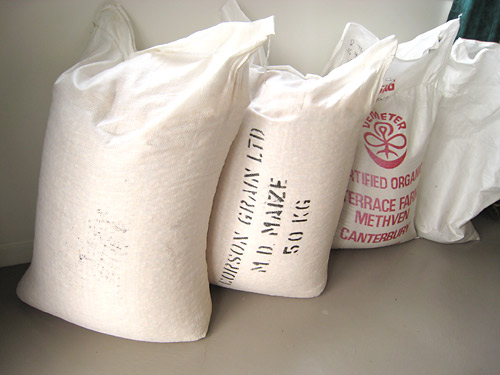
50KG sacks of maize (left), 25KG sacks of hard wheat berries (right)
What you’re looking at there is hundreds of pounds of maize and wheat. Becky and I don’t worry about the credit rating of the grains, or whether or not they’re properly capitalized. Those grains don’t have any possible exposure to the subprime mortgage apocalypse or the yen carry trade. Market liquidity isn’t an issue for those sacks of grain. Neither is event risk. We didn’t need to read a prospectus before buying them.
Sounds silly, right, to talk about all of those things with regard to some sacks of grain?
Why? Because those grains have obvious, intrinsic value. Regardless of what anyone else thinks about them, Becky and I are going to eat them.
Your paper investments have no obvious, intrinsic value.
That’s why there are a lot of lawyers and arcane words and phrases associated with them. Above board swindling is made possible by lawyers and arcane words and phrases. These things allow the people behind the swindle to avoid jail if you lose your money. The only reason that you consider stocks and bonds to be worthy places to put your money is because you have been sold a bill of goods that is likely to leave you broke and starving once appearances can no longer be maintained.
Even though many of you understand that your paper investments are part of a collapsing ponzi scheme, the dire nature of the situation still isn’t hitting home.
For me, recognition of collapse was followed by three phases:
1) Denial
2) Depression
3) Paralysis
If you’re a regular reader of Cryptogon, you’re probably past the denial phase. I’ve communicated with many of you who are in the depression and paralysis phases.
You guys already know my story. Maybe some of you who have moved into the “Taking Action” phase would be willing to share how you moved through the bog of denial-depression-paralysis.
What are you doing to prepare? But more importantly, how did you actually start to prepare, to take the action that you’re taking? What was the final straw?
People in the paralysis phase would rather stare at the wall than talk to friends and family about fiat money and debt and, energy and, uh, sacks of wheat. So how did you action takers approach friends and family who are still in the traffic-work-fastfood-tv mode? Maybe you’re like me and had to leave friends and family behind.
Obviously, I don’t share this information with anyone, but through my communications you guys in private, I know that several of you are in extraordinarily similar positions.
You’re not alone.
Via: Bloomberg:
Treasury investors basking in the biggest rally in four years have reason to fear for their profits: The largest owners of U.S. government debt are heading for the exit.
Two-year Treasuries returned 1.09 percent in August, the best monthly performance since 2003, according to indexes compiled by Merrill Lynch & Co. At the same time, holdings of U.S. bonds by governments and central banks at the Federal Reserve fell 3.8 percent, the steepest decline since 1992.
The dollar’s slump to a 15-year low against six of its most actively traded peers is turning the gains into losses for international bondholders, prompting China, Japan and Taiwan to sell. Overseas investors own more than half of the $4.4 trillion in marketable U.S. government debt outstanding, up from a third in 2001, according to data compiled by the Treasury Department.
Research Credit: JW
Banks Face 10-Day Debt Timebomb
September 11th, 2007This might be related to the massive Eurostoxx 50 put options bet that is in play now.
Related: Telegraph:
Britain’s biggest banks could be forced to cough up as much as £70bn over the next 10 days, as the credit crisis that has seized the global financial system sparks a fresh wave of chaos.
Almost 20 per cent of the short-term money market loans issued by European banks are due to mature between September 11 and September 19. Senior bankers fear that they will have to refinance almost all of these debts with funds from their own coffers, putting a further strain on bank balance sheets.
Tens of billions of pounds of these commercial paper loans have already built up in the financial system, because fear-ridden investors no longer want to buy them. Roughly £23bn of these loans expire on September 17 alone.
Fears of this impending call on bank credit lines are the true reason that lending between banks has ground to a halt, according to senior money market sources.
Banks have been stockpiling cash in preparation for this “double rollover” week, which sees quarterly loans expire alongside shorter term debts – exacerbating a problem that lies at the heart of the credit crisis.
“Banks are hoarding cash,” said David Brickman, the head of European credit strategy at Lehman Brothers. “We think the reason for that is the commercial paper markets. There was $100bn of commercial paper issued by European institutions that was scheduled to roll over in August, much of which struggled to do so.
“Those markets are just not functioning normally, so some debt has already come on to bank balance sheets and more will have to follow. We estimate that between September 11 and 19 $139bn [£68.5bn] of European commercial paper [will come] up for renewal, including monthly and quarterly maturities. That’s why banks are hoarding cash.”
Mexico: Insurgents Attack Six Oil and Gas Pipelines
September 11th, 2007Undefended critical infrastructure…
Via: Reuters:
Explosions rocked Mexico on Monday as attacks on six pipelines disrupted oil and gas supplies and forced thousands from their homes, just weeks after leftist rebels set off a string of pipeline bombs.
Huge billowing flames lit the night sky after the blasts in the early hours of the morning. More than 20,000 people were rushed from their homes to emergency shelters as gas and oil spewed from the ruptured pipes.
President Felipe Calderon, on a visit to India, condemned the sabotage and vowed to catch the perpetrators, saying: “In today’s democratic Mexico there is no place for these criminal acts.”
State energy monopoly Pemex said there were no injuries from the blasts, most of which were in Veracruz on the Gulf of Mexico, but Chief Executive Jesus Reyes Heroles said they would cost the company “hundreds of millions of dollars.”
An undetonated explosive charge was found at another oil installation in Veracruz state, Pemex said.
In July, a shadowy leftist guerrilla group claimed responsibility for a wave of bomb attacks on energy pipelines which cut natural gas supplies to thousands of businesses.
Some local media reported on Monday that the same leftist group left a message with the unexploded device — but local government and police officials denied any note was left. “It’s just a rumor,” one official said.
The pipeline damage would cut off around 25 percent of the country’s natural gas supply for 24 to 36 hours, Reyes Heroles told Mexican radio. He said the fact gas can’t be easily stored made the situation more serious than for gasoline, where ample inventory meant supplies would be less affected.
“The most important point is natural gas,” he said, adding that it could take four or five days to completely restore supply.
Crude Oil Nears Record on Signs OPEC Will Keep Output Quota
September 11th, 2007According to my Magic 8-Ball, OPEC probably can’t increase output. In the Past Peak world, look for demand destruction to occur through economic collapse or kill off or both.
Have a nice day.
Via: Bloomberg:
Crude oil rose to within 50 cents of a record on speculation rising demand and restricted OPEC production may tighten fourth-quarter supplies.
The Organization of Petroleum Exporting Countries pumps 40 percent of the world’s oil and will set its output target for the rest of the year at a meeting in Vienna today. It will probably maintain its current ceiling because of ample supplies and the prospect of slowing U.S. demand, officials said.
Chip Implants Linked to Malignant Tumors
September 11th, 2007Would you like some NutraSweet/aspartame with that?
Via: Yahoo / AP:
When the U.S. Food and Drug Administration approved implanting microchips in humans, the manufacturer said it would save lives, letting doctors scan the tiny transponders to access patients’ medical records almost instantly. The FDA found “reasonable assurance” the device was safe, and a sub-agency even called it one of 2005’s top “innovative technologies.”
But neither the company nor the regulators publicly mentioned this: A series of veterinary and toxicology studies, dating to the mid-1990s, stated that chip implants had “induced” malignant tumors in some lab mice and rats.
“The transponders were the cause of the tumors,” said Keith Johnson, a retired toxicologic pathologist, explaining in a phone interview the findings of a 1996 study he led at the Dow Chemical Co. in Midland, Mich.
Leading cancer specialists reviewed the research for The Associated Press and, while cautioning that animal test results do not necessarily apply to humans, said the findings troubled them. Some said they would not allow family members to receive implants, and all urged further research before the glass-encased transponders are widely implanted in people.
How Absurd Can it Get? Shell Considering Nuclear Power for Tar Sands Program in Canada
September 11th, 2007I thought, for sure, that this was an Onion article. Nope.
Get ready for, “The worst of all worlds.”
Via: Telegraph:
Shell is considering using nuclear power to operate its controversial tar sands programme in Canada.
Tar sands extraction – mining oil from a mixture of sand or clay, water and very heavy crude oil – uses a huge amount of energy and water. Environmentalists say it results in more than three times as many emissions of carbon dioxide compared to conventional oil production.
Now Canadian firms AECL and Energy Alberta have proposed building a nuclear reactor near the site of Shell’s vast Athabasca tar sands development. The boss of Energy Alberta has said the C$6bn (£2.8bn) reactor has the backing of a large unnamed copany that would take 70 per cent of the reactor’s energy.
A spokeswoman for Shell Canada refused to confirm that the company would take electricity from the reactor but said: “We have had a number of power options presented to us. Yes, it includes nuclear.
“If a nuclear facility proceeds, we would look at it based on a wide range of factors such as economics, sustainability and the energy [required].”
She added that the company was also looking at building biomass, renewable or co-generation plants.
Analysts estimate that Canada’s huge tar sands give it the world’s second-largest oil reserves after Saudi Arabia.
However, Walt Patterson, associate fellow at think-tank Chatham House, said: “Extracting oil from tar scares the pants off me. The whole idea is fundamentally perverse in the context of our present environmental situation. To then power it with nuclear, it seems to be the worst of all worlds.”
Was that Nuclear-Armed B-52 Flight Destined for Iran?
September 10th, 2007Via: This Can’t Be Happening:
There’s something definitely screwy about the August 30 incident in which a B-52 bomber flew from Minot AFB in North Dakota to Barksdale AFB in Louisiana carrying five fully armed Advanced Cruise Missiles, each equipped with nuclear bombs capable of exploding at anything from 5 kilotons to 150 kilotons.
The government has been quick to say that the flight, which violated a number of long-standing orders regarding shipment of nuclear weapons in US airspace, was a “mistake.â€
But was it a mistake?
Research Credit: Davcam
New Zealand: Antidepressants Given to Babies
September 10th, 2007Via: New Zealand Herald:
Medical authorities are mystified and concerned at figures suggesting antidepressant drugs are being prescribed for children, some less than a year old.
Records of the national drug buying agency Pharmac suggest thousands of prescriptions a year are being written for children under 10.
Antidepressants are powerful psychiatric drugs with potentially severe side-effects.
Research Credit: SW
Thousands of GIs Cope with Brain Damage
September 9th, 2007Via: Yahoo / AP:
The war in Iraq is not over, but one legacy is already here in this city and others across America: an epidemic of brain-damaged soldiers.
Thousands of troops have been diagnosed with traumatic brain injury, or TBI. These blast-caused head injuries are so different from the ones doctors are used to seeing from falls and car crashes that treating them is as much faith as it is science.
“I’ve been in the field for 20-plus years dealing with TBI. I have a very experienced staff. And they’re saying to me, ‘We’re seeing things we’ve never seen before,'” said Sandy Schneider, director of Vanderbilt University’s brain injury rehabilitation program.
Doctors also are realizing that symptoms overlap with post-traumatic stress disorder, and that both must be treated. Odd as it may seem, brain injury can protect against PTSD by blurring awareness of what happened.
But as memory improves, emotional problems can emerge: One of the first “graduates” of Vanderbilt’s program committed suicide three weeks later.
FBI Data Mining Reached Beyond Initial Targets
September 9th, 2007Imagine my shock.
Via: New York Times:
The F.B.I. cast a much wider net in its terrorism investigations than it has previously acknowledged by relying on telecommunications companies to analyze phone-call patterns of the associates of Americans who had come under suspicion, according to newly obtained bureau records.
The documents indicate that the Federal Bureau of Investigation used secret demands for records to obtain data not only on individuals it saw as targets but also details on their “community of interest†— the network of people that the target was in contact with. The bureau stopped the practice early this year in part because of broader questions raised about its aggressive use of the records demands, which are known as national security letters, officials said.
The community of interest data sought by the F.B.I. is central to a data-mining technique intelligence officials call link analysis. Since the attacks of Sept. 11, 2001, American counterterrorism officials have turned more frequently to the technique, using communications patterns and other data to identify suspects who may not have any other known links to extremists.