Switzerland to Vote on Banning Banks from Creating Money
December 29th, 2015Via: Independent:
Switzerland will hold a referendum to decide whether its private banks can create money after 110,000 people said they want their central bank to be solely in charge.
Seven years after the financial crisis struck, the Swiss federal government confirmed on Christmas Eve that it would ask its people whether the central bank – the SNB – should be the sole institution to be able to create money in its financial system. No date has been set for the referendum yet.
The Swiss Sovereign Money campaign is leading the initiative and aims to curtail financial speculation, demanding that commercial banks hold 100 per cent reserves against their deposits. This issue will have to go to a referendum under Swiss law now that the petition has gained more than 100,000 signatures within 18 months of launching.
“Banks won’t be able to create money for themselves any more, they’ll only be able to lend money that they have from savers or other banks,” said the campaign group, as reported by The Telegraph.
Federal Judge: Drinking Tea, Shopping at a Gardening Store Is Probable Cause for a SWAT Raid on Your Home
December 28th, 2015Via: The Washington Post:
In April 2012, a Kansas SWAT team raided the home of Robert and Addie Harte, their 7-year-old daughter and their 13-year-old son. The couple, both former CIA analysts, awoke to pounding at the door. When Robert Harte answered, SWAT agents flooded the home. He was told to lie on the floor. When Addie Harte came out to see what was going on, she saw her husband on his stomach as SWAT cop stood over him with a gun. The family was then held at gunpoint for more than two hours while the police searched their home. Though they claimed to be looking for evidence of a major marijuana growing operation, they later stated that they knew within about 20 minutes that they wouldn’t find any such operation. So they switched to search for evidence of “personal use.” They found no evidence of any criminal activity.
The investigation leading to the raid began at least seven months earlier, when Robert Harte and his son went to a gardening store to purchase supplies to grow hydroponic tomatoes for a school project. A state trooper had been positioned in the store parking lot to collect the license plate numbers of customers, compile them into a spreadsheet, then send the spreadsheets to local sheriff’s departments for further investigation. Yes, merely shopping at a gardening store could make you the target of a criminal drug investigation.
More than half a year later, the Johnson County Sheriff’s Department began investigating the Hartes as part of “Operation Constant Gardener,” basically a PR stunt in which the agency conducts multiple pot raids on April 20, or “4/20.” On several occasions, the Sheriff’s Department sent deputies out to sort through the family’s garbage. (The police don’t need a warrant to sift through your trash.) The deputies repeatedly found “saturated plant material” that they thought could possibly be marijuana. On two occasions, a drug testing field kit inexplicably indicated the presence of THC, the active drug in marijuana. It was on the basis of those tests and Harte’s patronage of a gardening store that the police obtained the warrant for the SWAT raid.
But, of course, they found nothing. Lab tests would later reveal that the “saturated plant material” was actually loose-leaf tea, which Addie Harte drinks on a regular basis. Why did the field tests come up positive for pot? As I wrote back in February, it’s almost as if these tests come up positive whenever the police need them to.
Cheap Batteries Will Give Utilities Electric Shock
December 28th, 2015Disclosure: I sell solar power systems in New Zealand.
—
Via: Reuters:
Power suppliers have long enjoyed a natural monopoly. But the arrival of budget batteries coupled with cheaper solar power will allow a growing number of consumers to pull the plug on old-fashioned electricity networks in 2016 and beyond.
Solar panel prices have already plummeted, and batteries look set to follow in the near future as manufacturers hone new technologies and ramp up production. Tesla says it can slash the cost of its own batteries by more than a third with a bigger, better factory. That’s plausible: costs dropped by 14 percent on average every year between 2007 and 2014: broker CLSA reckons they will tumble by a further 70 percent over the next five years.
The prospect of being able to generate, store and manage their own power may prompt some customers to leave the grid. In parts of developing economies where electricity has yet to arrive, power networks may not be needed. More than a fifth of India’s population does not have access to electricity. Rather than waiting for infrastructure to expand, Prime Minister Narendra Modi’s government is offering a 30 percent subsidy to encourage homeowners to use solar to become self-sufficient.
Energy companies’ initial responses to this potentially existential crisis have ranged from denial to defensiveness. Doing nothing is not a great option; but actively resisting the shift is worse. In Australia, industry lobbyists initially tried to fight special subsidies for renewable energy and raise fees for homes with solar panels. Though such bullying tactics will burn solar home-owners in the short term, it only encourages them to seek ways to harvest and hoard their own energy.
A Silicon Valley for Drones, in North Dakota
December 26th, 2015Via: New York Times:
“California and New York want what we’ve got,” said Shawn Muehler, a 30-year-old Fargo resident, gazing at a horizon of empty fields, silos, windbreak trees and hardly any people. A winged craft traces the air, mapping a field with pinpoint accuracy for his start-up, a drone software company called Botlink. “They like drones, but they’ve got a steep learning curve ahead.”
For years, entrepreneurs have come here to farm and to drill for oil and natural gas. Now a new, tech-savvy generation is grabbing a piece of the growing market for drone technology and officials want to help them do it here, where there is plenty of open space and — unlike in other sparsely populated states — lots of expertise already in place.
Approximately 62% of Americans Have Less Than $1,000 in Their Savings Accounts [???]
December 25th, 2015Could this possibly be real? It’s an online survey.
Via: MarketWatch:
Americans are living right on the edge — at least when it comes to financial planning.
Approximately 62% of Americans have less than $1,000 in their savings accounts and 21% don’t even have a savings account, according to a new survey of more than 5,000 adults conducted this month by Google Consumer Survey for personal finance website GOBankingRates.com. “It’s worrisome that such a large percentage of Americans have so little set aside in a savings account,” says Cameron Huddleston, a personal finance analyst for the site. “They likely don’t have cash reserves to cover an emergency and will have to rely on credit, friends and family, or even their retirement accounts to cover unexpected expenses.”
TSA Can Now Force Travelers to Go Through Body-Scanners
December 24th, 2015Via: Slashgear:
Your next flight might include a mandatory trip through the body scanner, with the US government quietly changing the opt-out rules for searches. In a document published earlier this month, the Department of Homeland Security outlined an update to the Advanced Imagery Technology protocols used by the TSA at US airports, adding a clause which allows officers to insist travelers go through the controversial machines.
Previously, though the body scanners were present at many airports across the country, travelers were free to opt-out of the process. Billed as a privacy consideration, it meant a physical screening was mandatory, but alleviated concerns held by some that the technology could “see them naked” and store photographs of that.
Now, though, that option is being diluted, though not completely retired.
“TSA is updating the AIT PIA to reflect a change to the operating protocol regarding the ability of individuals to opt opt-out of AIT screening in favor of physical screening,” the DHS writes. “While passengers may generally decline AIT screening in favor of physical screening, TSA may direct mandatory AIT screening for some passengers.”
Related: Corbett Sues TSA Over New Policy to Refuse Opt-Outs
Merry Christmas, Solstice, Krampus _____ (Fill in the Blank)
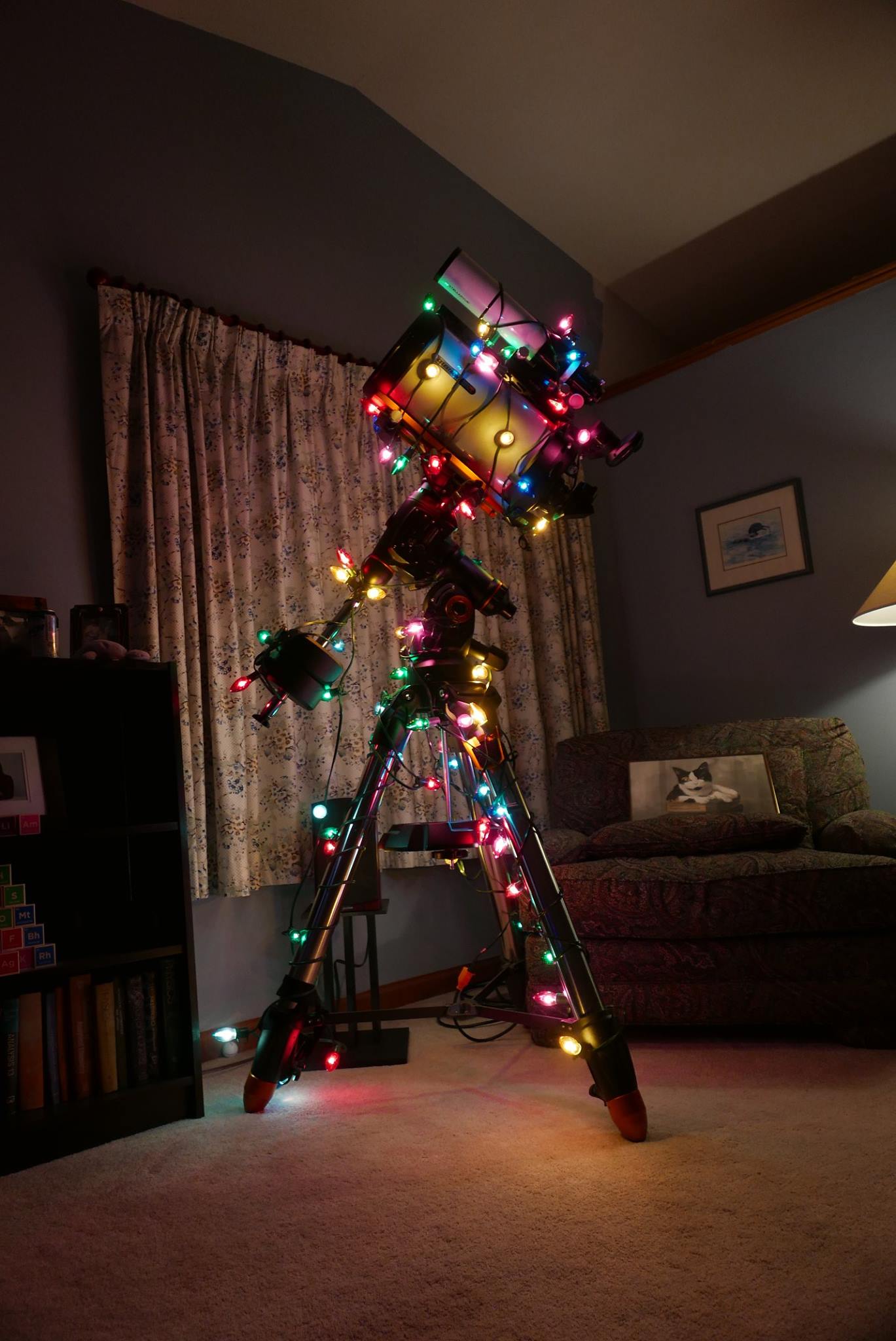
December 23rd, 2015I’m probably going to sign off for a couple of days. Whatever you believe or don’t believe during this maddening-for-some time of year, enjoy a brief pause in the firehose of doom that normally spews out of Cryptogon.
We got our eight year old son a break barrel pellet rifle. He’s been doing the Ralphy-routine from Christmas Story for months; dropping not-so-subtle hints about the fact that he wants an air rifle, leaving the sporting goods catalog on the table opened to the airgun section, etc. (No he hasn’t seen Christmas Story.)
I’ve actually been coming back at him with the immortal, “You’ll shoot your eye out, kid,” which cracks me up to no end because I was an absolute air gun nut at his age. I only had crappy Daisy and Crosman airguns, which I thought were awesome back then. It turns out that the toy grade stuff costs almost as much as higher end airguns here in NZ, so I just cut to the chase and bought him a Webley VMX D-RAM which came with a 4x scope. haha. That thing would have seemed like off-world technology back in my Powermaster 66 days.
Anyway, see ya in a bit.

Amnesty: Russian Attacks on Civilians in Syria, “May Amount to War Crimes”
December 23rd, 2015In other news, US-Backed Kurdish Forces Committing War Crimes Against Syrian Civilians.
Via: Amnesty International:
Russian air strikes in Syria have killed hundreds of civilians and caused massive destruction in residential areas, striking homes, a mosque and a busy market, as well as medical facilities, in a pattern of attacks that show evidence of violations of international humanitarian law, said Amnesty International in a new briefing published today.
Restricted Data: The Nuclear Secrecy Blog
December 23rd, 2015Some of you might find this interesting:
Restricted Data: The Nuclear Secrecy Blog
HTTP 451
December 23rd, 2015New HTTP status code. Nope, this isn’t a joke.
It was approved by the Internet Engineering Steering Group (IESG) on 18 December 2015.
Via: Wikipedia:
In computer networking, HTTP 451 Unavailable For Legal Reasons is an error status code of the HTTP protocol to be displayed when the user requests an illegal resource, such as a web page censored by a government, with the number 451 being a reference to the 1953 dystopian novel Fahrenheit 451, where books are outlawed. 451 could be described as a more descriptive variant of 403 Forbidden.
Examples of situations where an HTTP 451 error code could be displayed include web pages deemed a danger to national security, or web pages deemed to violate copyright, privacy, blasphemy laws, or any other law or court order.
However, some sites may be forced to produce HTTP 404 (File Not Found) or similar, if they are not legally permitted to disclose that the resource has been removed. Such a tactic is used in the United Kingdom (see also: Gag order, superinjunction) by some ISPs utilising the Internet Watch Foundation blacklist, returning a 404 message or another error message instead of showing a message indicating the site is blocked.




