Citigroup’s “Low Risk” Hedge Funds
August 24th, 2015Via: AFP:
US securities regulators ordered two Citigroup affiliates Monday to pay $180 million to settle charges that they defrauded investors by falsely claiming a pair of hedge funds were low-risk.
Citigroup collected nearly $3 billion from 4,000 investors by claiming the ASTA/MAT fund and the Falcon fund were low-risk investments akin to investing in government bonds, said the US Securities and Exchange Commission.
In 2008, both funds collapsed during the financial crisis.
“The funds were not bond substitutes, and an investment in the funds carried significantly greater risk than a bond investment,” the SEC said.
Both funds used “significant amounts of leverage” and were classified in an internal Citigroup rating system as having “significant risk to principal.”
“That rating, however, was not shared with the majority of investors and financial advisors,” the SEC said.
India Sues Nestle for Nearly $100 Million: Lead and MSG in Noodles
August 24th, 2015Via: Al Jazeera:
India’s government is seeking damages of nearly $100m from Nestle India for “unfair trade practices” after the food safety regulator banned its hugely popular Maggi noodles brand in June for containing unsafe levels of lead.
The government said on Wednesday that it has filed a suit with the country’s top consumer court, National Consumer Disputes Redressal Commission (NCDRC), for 6,400 million rupees ($98.6m) in damages from the Indian arm of the Swiss food giant.
“Our complaint is over their unfair trade practices and the court will now issue them notices to hear their response,” G Gurcharan, additional secretary at the Ministry of Consumer Affairs, told AFP news agency.
In April, laboratory tests ordered by some state governments found the noodles contained far higher levels of lead than legally allowed. The tests also detected the flavour enhancer chemical monosodium glutamate, or MSG, which is not mentioned in the product’s list of ingredients.
Physicists Unveil First Quantum Interconnect
August 24th, 2015Via: MIT Technology Review:
An international team of physicists has found a way to connect quantum devices in a way that transports entanglement between them.
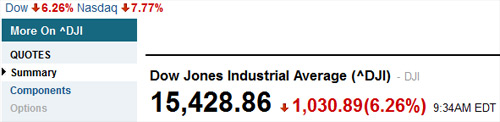
DJIA DOWN OVER A GRAND
August 24th, 2015And how about that NASDAQ!?
Plunge Protection Team: Activate!
Intel’s Optane Drive Technology
August 24th, 2015Via: MIT Technology Review:
Computers from laptops to supercomputers could get a major speed boost next year, thanks to a new kind of hard drive developed by Intel. Intel Optane drives, as they will be called, are based on a new way to store digital data that can operate as much as 1,000 times as fast as the flash memory technology inside hard drives, memory sticks, and mobile devices today.
The first Optane drives won’t be that much faster than today’s data storage. An early prototype shown by Intel at its annual developer conference in San Francisco on Tuesday was only about seven times as fast as a top-of-the-range flash disk drive available today. However, even that level of performance could have significant effects on the capabilities of consumer and corporate computers, and Optane drives may perform better by the time they hit the market in 2016.
Pesticides in Paradise: Hawaii’s Spike in Birth Defects Puts Focus on GM Crops
August 24th, 2015Via: Guardian:
Pediatrician Carla Nelson remembers catching sight of the unusually pale newborn, then hearing an abnormal heartbeat through the stethoscope and thinking that something was terribly wrong.
The baby was born minutes before with a severe heart malformation that would require complex surgery. What worried her as she waited for the ambulance plane to take the infant from Waimea, on the island of Kauai, to the main children’s hospital in Honolulu, on another Hawaiian island, was that it was the fourth one shehad seen in three years.
In all of Waimea, there have been at least nine in five years, she says, shaking her head. That’s more than 10 times the national rate, according to analysis by local doctors.
…
Waimea, a small town of low, pastel wood houses built in south-west Kauai for plantation workers in the 19th century, now sustains its economy mostly from a trickle of tourists on their way to a spectacular canyon. Perhaps 200 people work full-time for the four giant chemical companies that grow the corn – all of it exported – on some 12,000 acres leased mostly from the state.
In Kauai, chemical companies Dow, BASF, Syngenta and DuPont spray 17 times more pesticide per acre (mostly herbicides, along with insecticides and fungicides) than on ordinary cornfields in the US mainland, according to the most detailed study of the sector, by the Center for Food Safety.
That’s because they are precisely testing the strain’s resistance to herbicides that kill other plants. About a fourth of the total are called Restricted Use Pesticides because of their harmfulness. Just in Kauai, 18 tons – mostly atrazine, paraquat (both banned in Europe) and chlorpyrifos – were applied in 2012. The World Health Organization this year announced that glyphosate, sold as Roundup, the most common of the non-restricted herbicides, is “probably carcinogenic in humans”.
The cornfields lie above Waimea as the land, developed in the 1870s for the Kekaha Sugar Company plantation, slopes gently up toward arid, craggy hilltops. Most fields are reddish-brown and perfectly furrowed. Some parts are bright green: that’s when the corn is actually grown.
Both parts are sprayed frequently, sometimes every couple of days. Most of the fields lie fallow at any given time as they await the next crop, but they are still sprayed with pesticides to keep anything from growing. “To grow either seed crops or test crops, you need soil that’s essentially sterile,” says professor Hector Valenzuela of the University of Hawaii department of tropical plant and soil science.
When the spraying is underway and the wind blows downhill from the fields to the town – a time no spraying should occur – residents complain of stinging eyes, headaches and vomiting.
“Your eyes and lungs hurt, you feel dizzy and nauseous. It’s awful,” says middle school special education teacher Howard Hurst, who was present at two evacuations. “Here, 10% of the students get special-ed services, but the state average is 6.3%,” he says. “It’s hard to think the pesticides don’t play a role.”
At these times, many crowd the waiting rooms of the town’s main hospital, which was run until recently by Dow AgroSciences’ former chief lobbyist in Honolulu. It lies beside the middle school, both 1,700ft from Syngenta fields. The hospital, built by the old sugar plantation, has never studied the effects of the pesticides on its patients.
The chemical companies that grow the corn in land previously used for sugar refuse to disclose with any precision which chemicals they use, where and in what amounts, but they insist the pesticides are safe, and most state and local politicians concur. “The Hawai‘i legislature has never given the slightest indication that it intended to regulate genetically engineered crops,” wrote lawyer Paul Achitoff of Earthjustice in a recent court case.
Breathing Beijing’s Air Is the Equivalent of Smoking Almost 40 Cigarettes a Day
August 24th, 2015Via: Economist:
Pollution is sky-high everywhere in China. Some 83% of Chinese are exposed to air that, in America, would be deemed by the Environmental Protection Agency either to be unhealthy or unhealthy for sensitive groups. Almost half the population of China experiences levels of PM2.5 that are above America’s highest threshold. That is even worse than the satellite data had suggested.
Berkeley Earth’s scientific director, Richard Muller, says breathing Beijing’s air is the equivalent of smoking almost 40 cigarettes a day and calculates that air pollution causes 1.6m deaths a year in China, or 17% of the total. A previous estimate, based on a study of pollution in the Huai river basin (which lies between the Yellow and Yangzi rivers), put the toll at 1.2m deaths a year—still high.
GMO: “Independent Expert” Was Actually Paid $25,000 by Monsanto
August 24th, 2015Via: GM Watch:
In what appears to be an exercise in damage limitation, an article in the journal Nature has disclosed that Kevin Folta, a plant scientist at the University of Florida, received a US$25,000 grant last year from Monsanto. Monsanto noted that the money “may be used at your discretion in support of your research and outreach projects”, according to the journal.
Folta is active on the GMO-promoting website GMO Answers. The website is “funded by the members of The Council for Biotechnology Information, which includes BASF, Bayer CropScience, Dow AgroSciences, DuPont, Monsanto Company and Syngenta.” The site describes Folta as an “independent expert” and to date has not disclosed his Monsanto funding.
NASDAQ FUTURES: LIMIT DOWN
August 24th, 2015Via: CNBC:
U.S. stock index futures screamed lower on Monday, with Dow futures (Chicago Board of Trade: @DJ.1) briefly tumbling more than 700 points, as fears surrounding the health of China’s economy multiplied.
The Dow futures held about 650 points lower, with the S&P futures off about 70 points, and the Nasdaq 100 futures off about 5 percent.
China Shares Wipe Out 2015 Gains as Stocks Tumble 8.5%
August 24th, 2015Via: MarketWatch:
Chinese stocks plummeted Monday, erasing gains for the year, as fears about the deepening effects of a slowdown in the world’s No. 2 economy rattled investors world-wide.
Stock markets slid across Asia and a number of regional currencies fell to fresh multiyear lows. China’s main stock index, which closed 8.5% lower on Monday, has tipped into negative territory for the year after gaining as much as 60% through its June peak. Benchmarks in Japan and Australia both shed nearly 4%.