New Zealand: Grid Tie Solar System Deals for April-May
April 16th, 2015For readers in NZ:
The solar power company that I work for is discounting grid tie systems until 30 May 2015.
I got an email from the CEO last night. It’s time for us to grab more market share.
In addition to discounts on the hardware, you won’t have to pay:
* The distributed generation application fee for the lines company ($200)
* The final electrical inspection fee ($150)
* The transport fee (for systems outside of Auckland, could be up to $300)
The prices below include GST and installation on iron/coloursteel or decramastic roof types. The only additional cost would be for the import/export meter, which your electricity retailer will install. The costs vary depending on the retailer, but expect to pay between $85 and $200.
Trina Honey – Enphase Systems
1.5kW system $6,495
6 x 260W Trina Honey panels
6 Enphase M250 micro inverters
Enphase Envoy Communications Gateway
2kW system $7,795
8 x 260W Trina Honey panels
8 Enphase M250 micro inverters
Enphase Envoy Communications Gateway
3kW system $9,995
12 x 260W Trina Honey panels
12 Enphase M250 micro inverters
Enphase Envoy Communications Gateway
4kW system $14,750
16 x 260W Trina Honey panels
16 Enphase M250 micro inverters
Enphase Envoy Communications Gateway
5kW system $17,995
20 x 260W Trina Honey panels
20 Enphase M250 micro inverters
Enphase Envoy Communications Gateway
I definitely suggest Enphase micros as the way to go for power conversion (watch this), but if your budget is more constrained, we’re also doing deals on systems using Zeversolar string inverters.
Trina Honey – Zeversolar Systems
1.5kW system $5,995
6 x 260W Trina Honey panels
2kW Zeversolar inverter
2kW system $6,495
8 x 260W Trina Honey panels
3kW Zeversolar inverter
3kW system $9,495
12 x 260W Trina Honey panels
3kW Zeversolar inverter
4kW system $11,795
16 x 260W Trina Honey panels
5kW Zeversolar inverter
5kW Package $14,500
20 x 260W Trina Honey panels
5kW Zeversolar inverter
Newcastle: Inside Britain’s Busiest Food Bank
April 16th, 2015Via: Vice:
Since the coalition came to power in 2010, food poverty in Britain has risen dramatically. For those struggling to exist because of low pay, zero-hour contacts or delayed benefit payments, food banks aren’t just helpful – they’re a lifeline. They’ve also been one of the key points of contention in the build up to the imminent general election.
It’s not hard to see why. Year on year, the numbers of people turning to food banks have continued to rise. There are no government stats, but the Trussell Trust, which runs more than 430 food banks in the UK and is the only source of routinely collected data from the last decade, says 913,138 people were given food parcels by its volunteers last year – an annual increase of nearly 300 percent.
In Shy Bairns Get Nowt, VICE heads to Newcastle to go inside one of the busiest food banks in Britain, where food is being distributed for free to over 1000 people a week. We meet the dedicated volunteers and the locals for whom poverty has become a part of everyday life after decades of industrial decline and years of austerity cuts. Inevitably, in such a situation, the system will occasionally falter.
61-Year-Old Mailman Lands Gyrocopter on Capital Lawn to Bring Attention to Political Corruption
April 15th, 2015This incident is only hours old and media are already starting the character assassination routine on Doug Hughes. I haven’t looked into the message yet in detail, but here’s the Civilist Papers website in case you want to look at it without the media spin treatment:
Via: Tampa Bay Times:
Doug Hughes, a 61-year-old mailman from Ruskin, told his friends he was going to do it. He was going to fly a gyrocopter through protected airspace and put it down on the lawn of the U.S. Capitol, then try to deliver 535 letters of protest to 535 members of Congress.
The stunt seemed so outlandish that not even his closest friend thought he would pull it off.
“My biggest fear was he was going to get killed,” said Mike Shanahan, 65, of Apollo Beach, who works with Hughes for the Postal Service.
After 21/2 years of planning, Hughes came hovering low over the buildings of northeast D.C. about 1:20 p.m., like a distant bird. He rounded the Washington Monument a few minutes later, flew straight up the expanse of the National Mall and brought his small craft down right in front of the Capitol, where he was quickly surrounded by police and surrendered without incident.
The flight stunned police, Secret Service and witnesses. Authorities briefly shut down the Capitol as a security measure. The incident brought out dozens of reporters and cameras from national media outlets — exactly what Hughes had hoped for. Hughes, who sees himself as a sort of showman patriot, a mix of Paul Revere and P.T. Barnum, wanted to do something so big and brazen that it would hijack the news cycle and turn America’s attention toward his pet issue: campaign finance reform.
“No sane person would do what I’m doing,” Hughes told the Tampa Bay Times in the weeks before he took flight. He was doing it, he said, because the United States is “heading full-throttle toward a breakdown.”
“There’s no question that we need government, but we don’t have to accept that it’s a corrupt government that sells out to the highest bidder,” Hughes said.
U.S. Navy Tests Autonomous, Swarming UAVs
April 15th, 2015Via: Office of Naval Research:
A new era in autonomy and unmanned systems for naval operations is on the horizon, as officials at the Office of Naval Research (ONR) announced today recent technology demonstrations of swarming unmanned aerial vehicles (UAVs) — part of the Low-Cost UAV Swarming Technology (LOCUST) program.
LOCUST can launch swarming UAVs to autonomously overwhelm an adversary. The deployment of UAV swarms will provide Sailors and Marines a decisive tactical advantage. (Watch: LOCUST video on YouTube)
“The recent demonstrations are an important step on the way to the 2016 ship-based demonstration of 30 rapidly launched autonomous, swarming UAVs,” said ONR program manager Lee Mastroianni.
The LOCUST program includes a tube-based launcher that can send UAVs into the air in rapid succession. The breakthrough technology then utilizes information-sharing between the UAVs, enabling autonomous collaborative behavior in either defensive or offensive missions.
Since the launcher and the UAVs themselves have a small footprint, the technology enables swarms of compact UAVs to take off from ships, tactical vehicles, aircraft or other unmanned platforms.
Customer Service Robot at Japanese Bank
April 14th, 2015Via: Japan Times:
Bank of Tokyo-Mitsubishi UFJ took a first step toward employing nonhuman staff on Monday, with the introduction of a customer service humanoid robot at its flagship Tokyo outlet.
Standing 58 cm tall and weighing 5.4 kg, the Nao robot will work at reception until April 23 before potentially being rolled out full time, according to the Mitsubishi UFJ Financial Group Inc. unit.
It assisted 18 visitors on its first day, the bank said, providing information using gestures.
The robot, developed by French company Aldebaran Robotics, a subsidiary of Japanese telecom and technology giant SoftBank Corp., speaks Japanese, English and Chinese.
Robot Dies After Three Hours Inside Fukushima Reactor
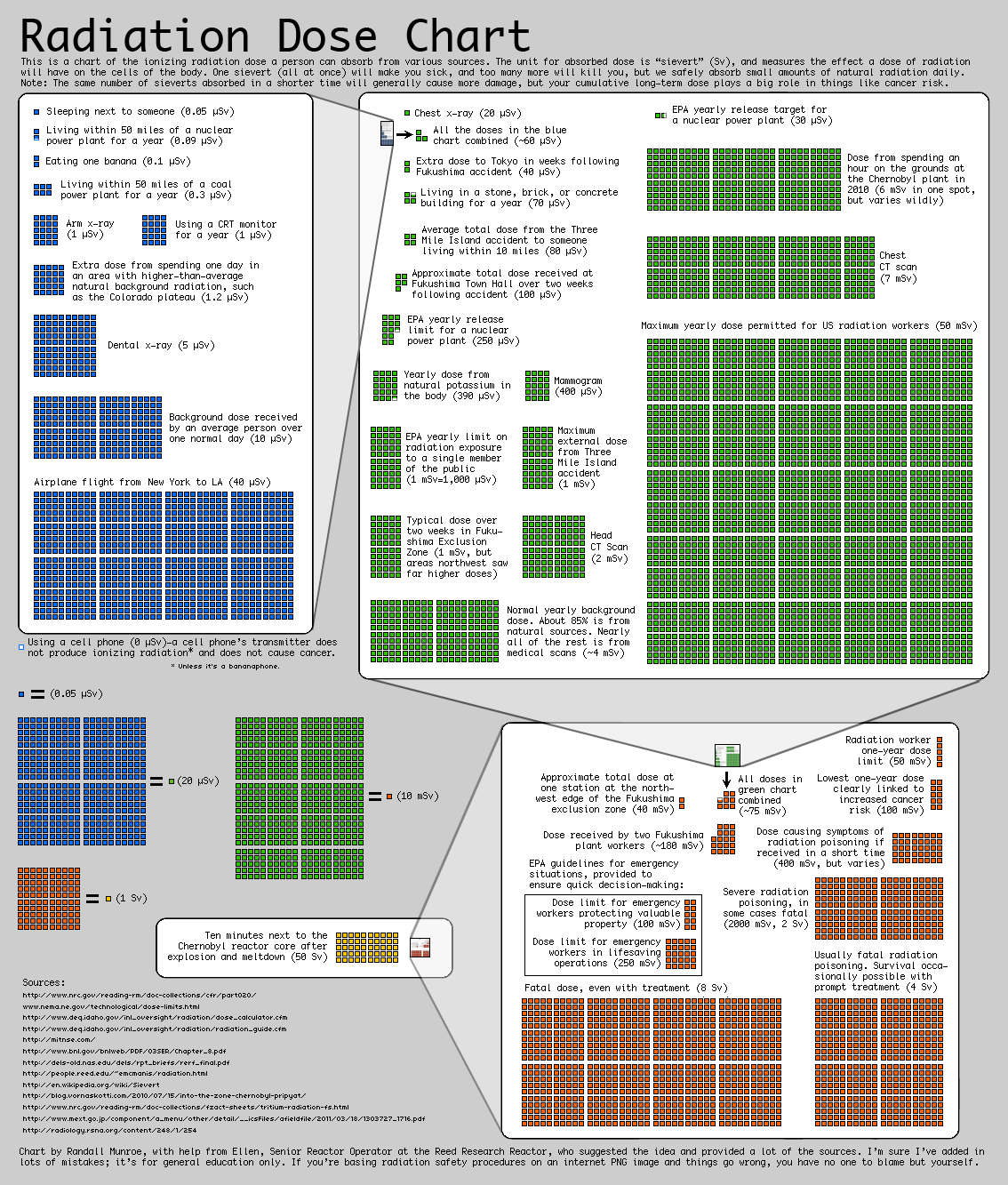
April 14th, 2015Watch the radiation monitor numbers on the video (lower right). That thing hits 24.9 sieverts per hour.
In case you don’t have an understanding of how deadly that is, see this handy radiation dose chart.
Via: Guardian:
Decommissioning work at the Fukushima Daiichi nuclear power plant has suffered a setback after a robot sent in to a damaged reactor to locate melted fuel stalled hours into its mission and had to be abandoned.
The plant’s operator, Tokyo Electric Power (Tepco), said the robot stopped moving on Friday during its first inspection of the containment vessel inside reactor No 1, one of the three reactors that suffered meltdown after the plant was struck by an earthquake and tsunami in March 2011.
Tepco, which recently conceded that the technology for robots to retrieve the nuclear fuel had yet to be developed, said on Monday it would cut the cables to the stranded robot and postpone a similar inspection using a separate device.
Developed by Hitachi-GE Nuclear Energy and the International Research Institute for Nuclear Decommissioning, the robot was supposed to be able to function for about 10 hours even when exposed to radiation at levels that would cause ordinary electronic devices to malfunction.
ZQI Ammunition Factory Tour
April 14th, 2015Curious about what a modern ammo factory looks like? I was.
Via: Military Arms Channel:
Plonk Reactor: Age Liquor 20 Years in 6 Days?
April 13th, 2015Via: Wired:
The whiskey renaissance has the world clamoring for well-aged hooch, but the so-called brown spirits—whiskey, brandy, rum—have one widely-publicized problem. It takes time, and lots of it, to make them. Or at least to make them taste good.
The booze industry has been looking for shortcuts to the aging process virtually since its inception, ranging from dumping extra oak chips into barrels of whiskey to artificially heating and cooling them to rapidly simulate the passing of seasons. While some of these tools have had modest levels of success, many have been complete failures. In fact, even Jesus weighed in on the dangers of trying to hasten the processes of nature when he said, “No one puts new wine into old wineskins; or else the new wine will burst the wineskins and be spilled, and the wineskins will be ruined.” (Luke 5:37)
If Bryan Davis has his way, that’s all about to be totally upended, sacrilege or not. Davis has come up with a method of producing spirits that taste like they’ve been aging in the barrel for 20 years, but his process only takes six days. Davis doesn’t accelerate the aging process like so many of the methods that have been tried in the past. Rather, he shortcuts it by taking new distillate and running it through his proprietary chemical reactor. Davis’s device forces the creation of the same key chemical compounds that give a well-aged spirit its unique character. Give him a week, and Davis says he can create a booze that tastes decades old.
Peak Oil? Peak Oil Demand
April 13th, 2015
Via: Bloomberg:
Naimi and other Saudi leaders have worried for years that climate change and high crude prices will boost energy efficiency, encourage renewables, and accelerate a switch to alternative fuels such as natural gas, especially in the emerging markets that they count on for growth. They see how demand for the commodity that’s created the kingdom’s enormous wealth—and is still abundant beneath the desert sands—may be nearing its peak. This isn’t something the petroleum minister discusses in depth in public, given global concern about carbon emissions and efforts to reduce reliance on fossil fuels. But Naimi acknowledges the trend. “Demand will peak way ahead of supply,” he told reporters in Qatar three years ago. If growth in oil consumption flattens out too soon, the transition could be wrenching for Saudi Arabia, which gets almost half its gross domestic product from oil exports.
Last week, in a speech in Riyadh, Naimi said Saudi Arabia would stand “firmly and resolutely” with others who oppose any attempt to marginalize oil consumption. “There are those who are trying to reach international agreements to limit the use of fossil fuel, and that will damage the interests of oil producers in the long-term,” he said.
…
The Saudis, to be sure, never thought much of peak oil. That’s the theory that global crude supplies, on an upward trajectory for a century and a half, were about to stop rising and could no longer keep up with demand. A faction of geologists and environmentalists made this argument part of the policy debate in the early years of this century. In 2005, when a book by oil analyst Matthew Simmons predicted a drop-off in Saudi output would signal that global supplies were beginning an irreversible decline, Naimi belittled the claims and promised higher production capacity. He won the argument. The Saudis pump more today than a decade ago. Saudi oil fields boast state-of-the-art technology, and at least two of them, in the middle of the desert, have gourmet restaurants. U.S. output has had a stunning rise as well, to more than 9 million barrels a day at the end of 2014 from less than 6 million five years ago. The peak that has the Saudis more worried is peak demand.
…
“The Saudis may be once again trying to prolong the age of oil,” says Bill McKibben, the author and environmental activist who has helped lead the campaign to block the Keystone XL pipeline, which would bring oil from Canada’s tar sands to the U.S. market. “But it feels like the steady, relentless fall in costs for renewables may make this different from other cycles.”
Related:
Fossil Fuels Just Lost the Race Against Renewables
The $5 Billion Race to Build a Better Battery
The Economics of Grid Defection
April 13th, 2015Disclosure: I sell solar power systems in New Zealand.
—
I am Jack’s smirking revenge.
Via: Rocky Mountain Institute:
Distributed electricity generation, especially solar PV, is rapidly spreading and getting much cheaper. Distributed electricity storage is doing the same, thanks largely to mass production of batteries for electric vehicles. Solar power is already starting to erode some utilities’ sales and revenues. But what happens when solar and battery technologies are brought together? Together they can make the electric grid optional for many customers—without compromising reliability and increasingly at prices cheaper than utility retail electricity. Equipped with a solarplus- battery system, customers can take or leave traditional utility service with what amounts to a “utility in a box.”
This “utility in a box” represents a fundamentally different challenge for utilities. Whereas other technologies, including solar PV and other distributed resources without storage, net metering, and energy efficiency still require some degree of grid dependence, solar-plus-batteries enable customers to cut the cord to their utility entirely.
Notably, the point at which solar-plus-battery systems reach grid parity—already here in some areas and imminent in many others for millions of U.S. customers—is well within the 30-year planned economic life of central power plants and transmission infrastructure. Such parity and the customer defections it could trigger would strand those costly utility assets. Even before mass defection, a growing number of early adopters could trigger a spiral of falling sales and rising electricity prices that make defection via solar-plus-battery systems even more attractive and undermine utilities’ traditional business models.