Recovery: Retirement Unlikely for Many Blue-Collar Americans
January 1st, 2014Via: AP:
Tom Edwards grew up in a family that’s been cutting trees and hauling timber in the Pacific Northwest for more than a century. The Spanaway, Wash., resident says he has worked as a logger since he was a kid — it’s just what an able-bodied youngster was expected to do.
Now, at 53, with business in a slump and little money in savings, he’s pessimistic about his chances of retiring.
“It’s never going to happen. By the time I reach retirement age, there won’t be Social Security. There’s not going to be any money,” Edwards said. “I’ll do like my father did: I’ll work ’til I die.”
Across the U.S., such concerns are common among blue-collar baby boomers — the 78 million Americans born between 1946 and 1964. Many have jobs that provide paltry pensions or none at all, as many companies have been moving toward less generous retirement packages in the past decade.
Many boomers expect to work the rest of their lives because they have little cash put away for their old age and they worry Social Security won’t cover their bills. Some hope to move to jobs that are less physically demanding.
The share of U.S. workers who are 55 and older is expected to continue growing, according to the “The Oxford Handbook of Retirement 2013.” The group comprised 12.4 percent of the workforce in 1998. The share jumped to 18.1 percent in 2008 and is expected to be almost 25 percent by 2018.
The book is edited by Mo Wang, co-director of the Human Resource Research Center at the University of Florida’s Warrington College of Business Administration. In an interview, Wang said it’s a misconception that lower-wage workers are slackers in preparing for retirement.
“People don’t have adequate earnings,” Wang told The Associated Press. “It’s not because they don’t want to save. It’s because they just can’t.”
The Online Education Revolution Drifts Off Course
January 1st, 2014Via: NPR:
But by all accounts, the San Jose experiment was a bust. Completion rates and grades were worse than for those who took traditional campus-style classes. And the students who did best weren’t the underserved students San Jose most wanted to reach.
It wasn’t really proving to be cheaper, either, says Peter Hadreas, the chairman of San Jose State’s philosophy department.
“The people that do well in these kind of courses are people who are already studious. Or … who are taking courses for their own enrichment after they’ve graduated,” he says.
“A year and a half ago … people thought this was going to solve the problems of higher education because people would be educated for less money. That’s not the way it’s worked out.”
Now, San Jose State is scaling back its relationship with Udacity, taking more direct control of the courses it offers through the company and rethinking its commitment to MOOCs.
‘We Have A Lousy Product’
Other schools are hitting the pause button as well. A recent confirmed a massive problem: MOOCs have painfully few active users. About half who registered for a class ever viewed a lecture, and completion rates across all courses.
Sebastian Thrun, Udacity’s co-founder and a prime mover in MOOCs, magazine, “We were on the front pages of newspapers and magazines, and at the same time, I was realizing, we don’t educate people as others wished, or as I wished. We have a lousy product.”
Maniac Fascism: Court Rules No Suspicion Needed for Laptop Searches at Border
January 1st, 2014Via: ACLU:
A federal court today dismissed a lawsuit arguing that the government should not be able to search and copy people’s laptops, cell phones, and other devices at border checkpoints without reasonable suspicion. An appeal is being considered. Government documents show that thousands of innocent American citizens are searched when they return from trips abroad.
“We’re disappointed in today’s decision, which allows the government to conduct intrusive searches of Americans’ laptops and other electronics at the border without any suspicion that those devices contain evidence of wrongdoing,” said Catherine Crump, the American Civil Liberties Union attorney who argued the case in July 2011. “Suspicionless searches of devices containing vast amounts of personal information cannot meet the standard set by the Fourth Amendment, which prohibits unreasonable searches and seizures. Unfortunately, these searches are part of a broader pattern of aggressive government surveillance that collects information on too many innocent people, under lax standards, and without adequate oversight.”
U.S. Customs at JFK Destroys Eleven Instruments Owned by Flute Virtuoso
December 31st, 2013Via: Arts Journal:
A few minutes ago, we reached the flute virtuoso Boujemaa Razgui by phone to discuss the assault on his instruments by US Customs at JFK airport.
A Canadian citizen, based in New York and with a green card employment permit, Bouzemaa was flying home from Marrakech, Morocco, when his baggage was opened by Customs at JFK.
‘I told them I had these instruments for many years and flew with them in and out,’ he said. ‘There were 11 instruments in all. They told me they were agricultural products and they had to be destroyed. There was nothing I could do. The ney flute can be made with bamboo. Is that agricultural?’
Research Credit: ottilie
The Perils of Plastic: The Problems With Debit And Credit Cards Are Deeper Than We Thought
December 31st, 2013Via: ReadWrite:
I called the regional Secret Service office—that agency is involved in both protecting the President and investigating financial crimes—and talked to the agent that was handling the investigation. He confirmed my suspicions: The problem is far worse than we imagined.
While there are no real answers yet in our area, it appears that some computer systems have been compromised either at stores or in the companies handling the processing of card transactions. In other words, a company involved in the flow of payments has been hacked. It could be more than one company. The computer hacking has exposed everyone whose cards are going through those systems. The thieves are using the ATM card information in a way that does not require the PINs.
As the agent explained it to me, what happens once the thieves have stolen a bunch of numbers from a company is that they print gift cards with their name on them and our billing information on the magnetic stripe. He said they rarely bother with printing up credit cards anymore.
Research Credit: conceptualdecay
Shopping for Spy Gear: Catalog Advertises NSA Toolbox
December 30th, 2013Via: Spiegel:
A document viewed by SPIEGEL resembling a product catalog reveals that an NSA division called ANT has burrowed its way into nearly all the security architecture made by the major players in the industry — including American global market leader Cisco and its Chinese competitor Huawei, but also producers of mass-market goods, such as US computer-maker Dell.
These NSA agents, who specialize in secret back doors, are able to keep an eye on all levels of our digital lives — from computing centers to individual computers, and from laptops to mobile phones. For nearly every lock, ANT seems to have a key in its toolbox. And no matter what walls companies erect, the NSA’s specialists seem already to have gotten past them.
DROPOUTJEEP: How NSA Owns iPhones
December 30th, 2013It looks like they implemented Back Orifice for iOS.
Anyway, *yawn*. So now we know the name of the tool.
The first reference that I can find on Cryptogon for a U.S. government agency having this capability is: FBI Uses Mobile Phones for Audio Surveillance – Even When Phones Are Off. That’s from 2006.
Via: Daily Dot:
The U.S. National Security Agency has the ability to snoop on nearly every communication sent from an Apple iPhone, according to leaked documents shared by security researcher Jacob Appelbaum and German news magazine Der Spiegel.
An NSA program called DROPOUTJEEP allows the agency to intercept SMS messages, access contact lists, locate a phone using cell tower data, and even activate the device’s microphone and camera.
Off Topic: Connection from Water Heater to Thermostat
December 30th, 2013How about a little home improvement mystery to break up the steady flow of nightmares and doom?
Alrighty then!
The thermostat on our hot water cylinder fried itself yesterday morning. There are a few reasons why I’m baffled by this:
1. This is the second time that this has happened. When it happened the first time, I just assumed that the thermostat (which was the original one that was in hot water cylinder when we bought the house) had gone bad, who knows why, I just replaced it, monitored the situation closely for a few days and thought the problem had been resolved.
About once a month, I checked the water temperature and it was right on when compared to the setting on the thermostat. I would also check the wiring to and from the thermostat for any signs of trouble. No problems. Wires remained at room temperature after the unit had been running. The circuit breaker never tripped throughout any of this.
It worked fine for six months… until yesterday, when it let the smoke out of the wire between the thermostat and the cylinder.
2. On both fried thermostats, the meltdowns occurred between the output terminals on the thermostats and the input terminal on the water heater. The input terminals on both thermostats and the household wiring leading into the thermostats never showed any sign of trouble. You can’t see it on the picture I’ve posted below, but the input side of this thermostat is pristine.
Cooked Cotherm Thermostat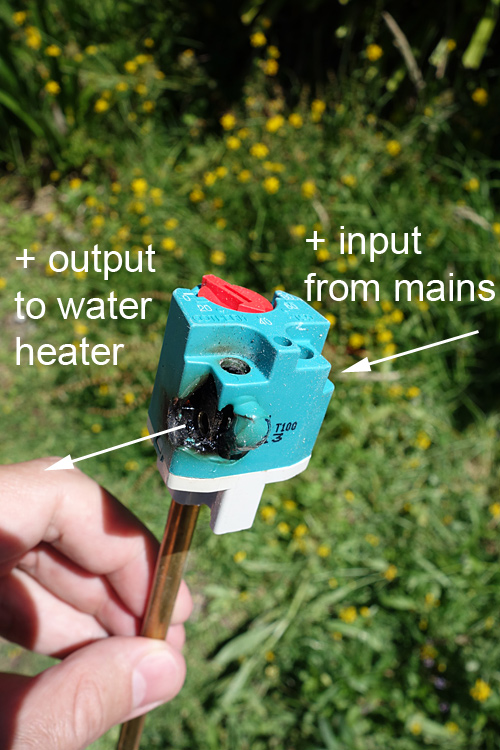
3. So, with all electrical supply places closed and messages left on multiple electricians’ 24-hour response lines being ignored, I decided to conduct an experiment. Rather than trying to wash dishes and my filthy creature sons with cold water, I wired up the hot water cylinder without any thermostat inline and flipped the breaker to ON. (Don’t try this at home, you might poke your eye out.) Then I sat by and watched… as the hot water cylinder uneventfully heated the water without any problems at all. The water had been lukewarm so I just let it run. After about 15 minutes, I felt the wires—Ambient temperature. After a half hour—Ambient temperature. After an hour—Ambient temperature. All the time, the water was getting hotter and hotter. Finally, after about an hour and a half, with the water at 52C, I shut it down. The input wiring still felt right around ambient temperature.
So, people out there in Cryptogon-land:
Why are the thermostats frying between the output terminal on the thermostats and the input terminal on the hot water cylinder?
Why does the system work fine with no thermostat in the circuit?
One-Third of Americans Reject the Idea of Evolution
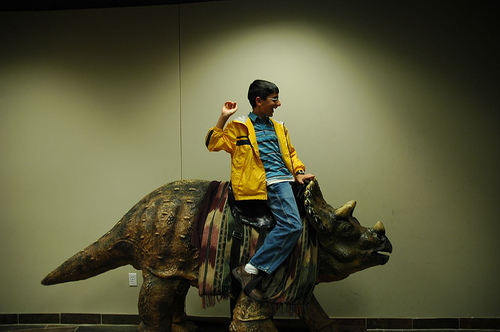
December 30th, 2013I tell people in New Zealand about the Creation Museum and they don’t believe that the place exists. They think I’m making it up.
Via: Reuters:
One-third of Americans reject the idea of evolution and Republicans have grown more skeptical about it, according to a poll released on Monday.
Sixty percent of Americans say that “humans and other living things have evolved over time,” the telephone survey by the Pew Research Center’s Religion and Public Life Project showed.
But 33 percent reject the idea of evolution, saying that “humans and other living things have existed in their present form since the beginning of time,” Pew said in a statement.
Although this percentage remained steady since 2009, the last time Pew asked the question, there was a growing partisan gap on whether humans evolved.
“The gap is coming from the Republicans, where fewer are now saying that humans have evolved over time,” said Cary Funk, a Pew senior researcher who conducted the analysis.
The poll showed 43 percent of Republicans and 67 percent of Democrats say humans have evolved over time, compared with 54 percent and 64 percent respectively four years ago.
Japan’s Homeless Recruited for Murky Fukushima Clean-Up
December 30th, 2013Via: Reuters:
Seiji Sasa hits the train station in this northern Japanese city before dawn most mornings to prowl for homeless men.
He isn’t a social worker. He’s a recruiter. The men in Sendai Station are potential laborers that Sasa can dispatch to contractors in Japan’s nuclear disaster zone for a bounty of $100 a head.
“This is how labor recruiters like me come in every day,” Sasa says, as he strides past men sleeping on cardboard and clutching at their coats against the early winter cold.
It’s also how Japan finds people willing to accept minimum wage for one of the most undesirable jobs in the industrialized world: working on the $35 billion, taxpayer-funded effort to clean up radioactive fallout across an area of northern Japan larger than Hong Kong.
…
In January, October and November, Japanese gangsters were arrested on charges of infiltrating construction giant Obayashi Corp’s network of decontamination subcontractors and illegally sending workers to the government-funded project.
In the October case, homeless men were rounded up at Sendai’s train station by Sasa, then put to work clearing radioactive soil and debris in Fukushima City for less than minimum wage, according to police and accounts of those involved. The men reported up through a chain of three other companies to Obayashi, Japan’s second-largest construction company.
Obayashi, which is one of more than 20 major contractors involved in government-funded radiation removal projects, has not been accused of any wrongdoing. But the spate of arrests has shown that members of Japan’s three largest criminal syndicates – Yamaguchi-gumi, Sumiyoshi-kai and Inagawa-kai – had set up black-market recruiting agencies under Obayashi.
Research Credit: almaverdad2