Power Out
December 3rd, 2013A storm took out our electricity about 13 hours ago. It’s still down. Apologies for the lack of updates.
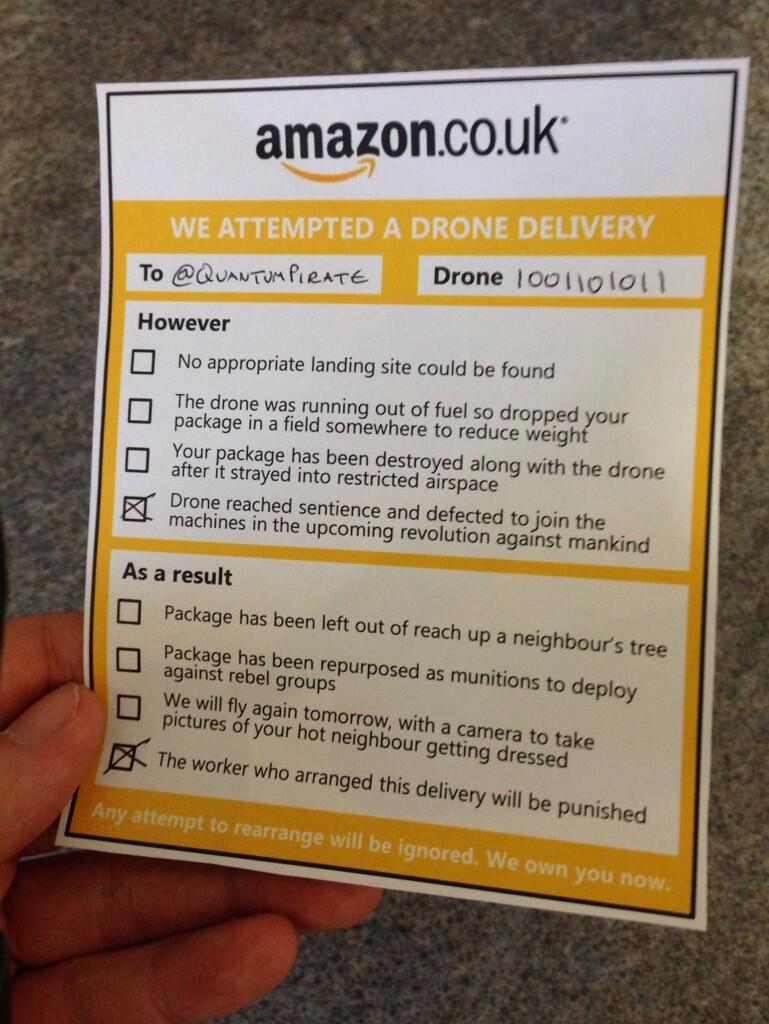
Amazon Drone Attempted Delivery Tag *Chortle*
December 2nd, 2013I don’t have a Humor category, but if I did…
For Nearly Two Decades the Nuclear Launch Code at All Minuteman Silos in the U.S. Was 00000000
December 2nd, 2013Via: Today I Found Out:
Today I found out that during the height of the Cold War, the US military put such an emphasis on a rapid response to an attack on American soil, that to minimize any foreseeable delay in launching a nuclear missile, for nearly two decades they intentionally set the launch codes at every silo in the US to 8 zeroes.
…
Oh, and in case you actually did forget the code, it was handily written down on a checklist handed out to the soldiers. As Dr. Bruce G. Blair, who was once a Minuteman launch officer, stated:
Our launch checklist in fact instructed us, the firing crew, to double-check the locking panel in our underground launch bunker to ensure that no digits other than zero had been inadvertently dialed into the panel.
Britain: Woman Forcibly Sedated, Child Taken from Her Womb by Caesarean Section
December 2nd, 2013Via: Telegraph:
A pregnant woman has had her baby forcibly removed by caesarean section by social workers.
Essex social services obtained a High Court order against the woman that allowed her to be forcibly sedated and her child to be taken from her womb.
The council said it was acting in the best interests of the woman, an Italian who was in Britain on a work trip, because she had suffered a mental breakdown.
The baby girl, now 15 months old, is still in the care of social services, who are refusing to give her back to the mother, even though she claims to have made a full recovery.
The case has developed into an international legal row, with lawyers for the woman describing it as “unprecedented”.
They claim that even if the council had been acting in the woman’s best interests, officials should have consulted her family beforehand and also involved Italian social services, who would be better-placed to look after the child.
Brendan Fleming, the woman’s British lawyer, told The Sunday Telegraph: “I have never heard of anything like this in all my 40 years in the job.
“I can understand if someone is very ill that they may not be able to consent to a medical procedure, but a forced caesarean is unprecedented.
“If there were concerns about the care of this child by an Italian mother, then the better plan would have been for the authorities here to have notified social services in Italy and for the child to have been taken back there.”
DHS Agent Cites Private Medical History to Deny Canadian Entry Into U.S.
December 2nd, 2013Via: Network World:
A U.S. Customs and Border Protection agent cited private medical history, a ‘mental illness episode,’ as the reason to deny a wheelchair-bound Canadian woman entry into the U.S.
Amazon Testing Delivery by Drone Aircraft
December 1st, 2013😯
Via: USA Today:
Amazon PrimeAir Octocopter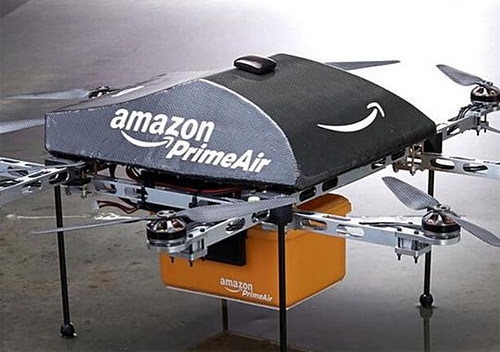
Amazon.com is testing delivering packages using drones, CEO Jeff Bezos said on the CBS TV news show 60 Minutes Sunday.
The idea would be to deliver packages as quickly as possible using the small, unmanned aircraft, through a service the company is calling Prime Air, the CEO said.
Bezos played a demo video on 60 Minutes that showed how the aircraft, also known as octocopters, will pick up packages in small yellow buckets at Amazon’s fulfillment centers and fly through the air to deliver items to customers after they hit the buy button online at Amazon.com.
The goal of the new delivery system is to get packages into customers’ hands in 30 minutes or less, the world’s largest Internet retailer said. Putting Prime Air into commercial use will take “some number of years” as Amazon develops the technology further and waits for the Federal Aviation Administration to come up with rules and regulations, the company added.
Bezos told 60 Minutes that the service could be up and running in as few as four years — although he noted that he is an optimist when it comes to such things.
“One day, Prime Air vehicles will be as normal as seeing mail trucks on the road today,” the company said.
…
However, the FAA currently limits the use of drones in the U.S. to public entities such as police forces and hobbyists, meaning the devices cannot be used in return for payment. The regulator said recently that it plans to have regulations governing commercial use in place by 2015.
“The FAA would not let Amazon do this now,” said Ryan Calo, an expert on robotics, privacy and the law at the University of Washington. “But this is precisely the type of application that Congress had in mind when it told the FAA in 2012 to come up with rules for commercial unmanned aircraft.”
…
If drone delivery takes off, it could be a threat to FedEx and UPS, which Amazon uses for a lot of its deliveries now. Indeed, FedEx founder Fred Smith told Wired magazine in 2009 that the company wanted to switch their fleet to drones as soon as possible but that it had to wait for the FAA to regulate such activity.
“We’ll be ready to enter commercial operations as soon as the necessary regulations are in place,” Amazon said Sunday. “Safety will be our top priority, and our vehicles will be built with multiple redundancies and designed to commercial aviation standards.”
Coming Soon, a Night Watchman with Wheels?
November 30th, 2013I liked being a security guard in the early 1990s. haha. I wore a polyester uniform that made me look like like ten pounds of shit in a five pound sack. I think it paid $7 per hour. I had near zero contact with any other human beings the whole night. Now, why was this a good job? I was mostly able to read the whole time.
A couple of decades later, subtract 75 cents per hour and the pesky human and what do you get?
Via: New York Times:
The night watchman of the future is 5 feet tall, weighs 300 pounds and looks a lot like R2-D2 – without the whimsy. And will work for $6.25 an hour.
A company in California has developed a mobile robot, known as the K5 Autonomous Data Machine, as a safety and security tool for corporations, as well as for schools and neighborhoods.
If You’re Fed Up with the Total Disaster That Is Facebook, Syme Deserves Consideration, Just Don’t Trust It Too Much
November 29th, 2013Syme looks like it could be useful for small, private groups looking for social networking functionality. Do not, I repeat, DO NOT believe any claims that they can’t access your material. Maybe that’s true, and even if it is, I wouldn’t assume that others can’t read it. I tend to believe that these guys are sincere. At a minimum, they are being up-front with users about the limitations.
While Syme might only introduce a few additional speed bumps to state surveillance, it looks great compared to Facebook, where the only good thing about Facebook is that a lot of people are on it. Every other aspect of Facebook is rat poison.
Via: ComputerWorld:
With the look of Google Plus and Facebook-like elements, a new social network named “Syme” feels as cozy as a well-worn shoe.
But beneath the familiar veneer, it’s quite different. Syme encrypts all content, such as status updates, photos and files, so that only people invited to a group can view it. Syme, which hosts the content on its Canada-based servers, says it can’t read it.
“The overarching goal of Syme is to make encryption accessible and easy to use for people who aren’t geeks or aren’t hackers or who aren’t cryptography experts,” said co-founder Jonathan Hershon.
Typhoons Spread Fukushima Fallout
November 29th, 2013Via: AFP:
Typhoons that hit Japan each year are helping spread radioactive material from the Fukushima nuclear disaster into the country’s waterways, researchers say.
Contaminated soil gets washed away by the high winds and rain and deposited in streams and rivers, a joint study by France’s Climate and Environmental Science laboratory (LSCE) and Tsukuba University in Japan showed.
Billionaire Bunkers: Beyond the Panic Room, Home Security Goes Sci-Fi
November 29th, 2013Via: Forbes:
Al Corbi’s residence in the Hollywood Hills has the requisite white walls covered in artwork and picture windows offering breathtaking views of downtown Los Angeles, but it has more in common with NSA headquarters than with the other contemporary homes on the block. The Corbi family doesn’t need keys (thanks to biometric recognition software), doesn’t fear earthquakes (thanks to steel-reinforced concrete caissons that burrow 30 feet into the private hilltop) and sleeps easily inside a 2,500-square-foot home within a home: a ballistics-proof panic suite that Corbi refers to as a “safe core.”
Paranoid? Perhaps. But also increasingly commonplace. Futuristic security technologies–many developed for the military but sounding as though they came straight from James Bond’s Q–have made their way into the home, available to deep-pocketed owners whose peace of mind comes from knowing that their sensors can detect and adjust for, say, a person lurking in the bushes a half-mile away.
“If you saw this stuff in a movie you would think it is all made up,” says Corbi, whose fortress-like abode doubles as the demonstration house for his firm, Strategically Armored & Fortified Environments (SAFE).
…
Biometric technologies are becoming more prevalent, too. Moving beyond a fingerprint scan, some programs don’t require a homeowner to touch anything at all. Former Israeli major general Aharon Ze’evi-Farkash, onetime head of the Israeli Military Intelligence Directorate, has spent the past three years with his company, FST21, creating a software product that merges facial, voice and behavioral recognition technology into a keyless entry system. “It transforms you into the key for your building in under two seconds,” he says.




